


Branded t-shirts are so much more than just company uniforms. Think of them as a strategic marketing asset that turns your team and your biggest fans into walking, talking brand ambassadors. A great-looking shirt builds brand recognition, pulls a team together, and creates a real-world connection with your audience, making it one of the smartest promotional tools you can invest in.
Why Branded T-Shirts Are a Powerful Marketing Tool
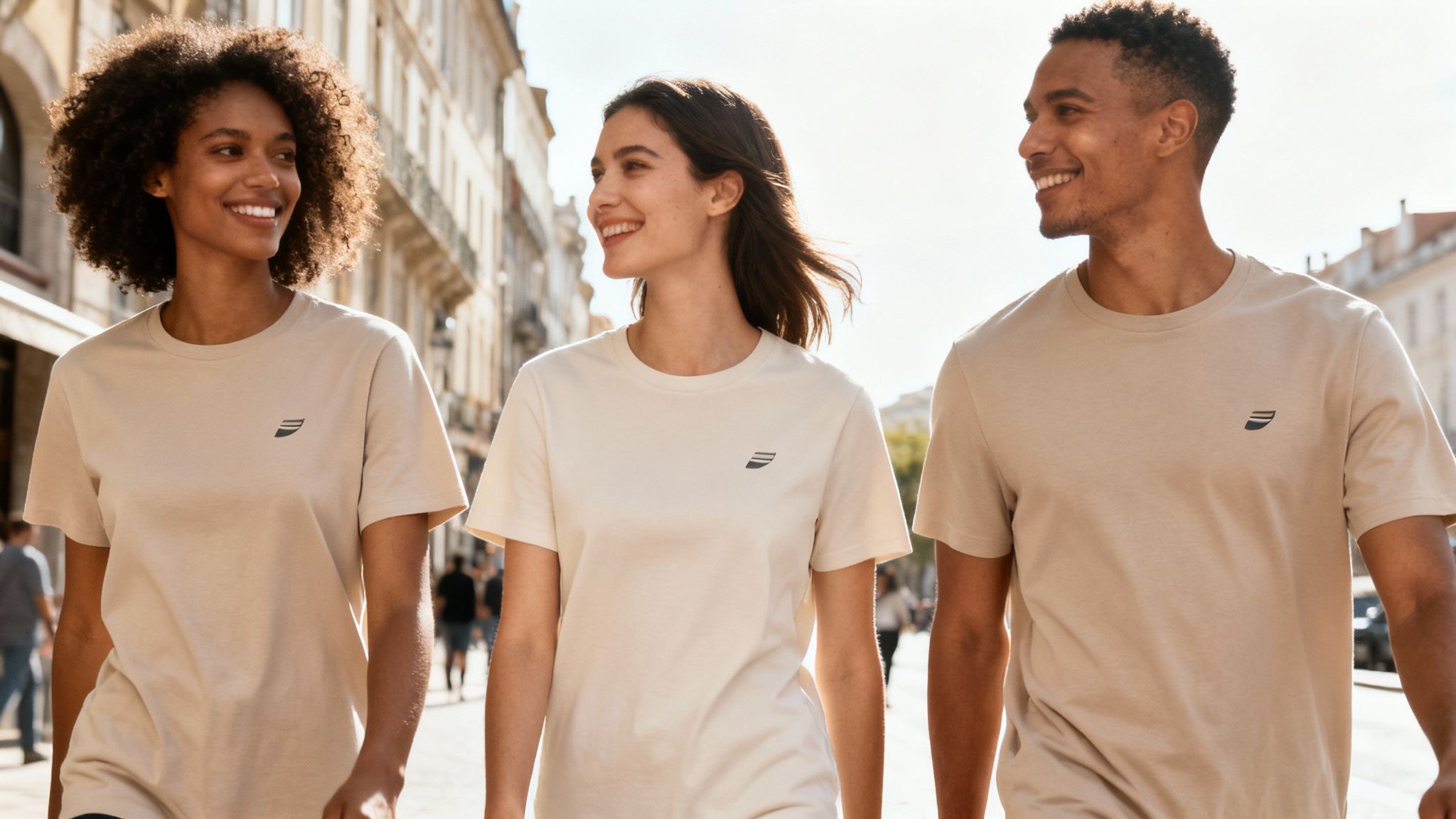
It's helpful to see a branded t-shirt not just as clothing, but as a mobile advertisement with a personal touch. Every time someone pulls on your shirt, they’re putting your business on display for their entire network. This creates an organic reach that most traditional advertising just can't match. A simple piece of fabric becomes a genuine conversation starter and a constant visual reminder of who you are.
The proof is in the numbers. Australia’s custom t-shirt printing market is experiencing a massive boom, with import growth hitting 11.93% in just one year. This isn't a fluke; it's part of a steady trend showing more and more Aussie businesses are getting fantastic results by using personalised apparel to get their name out there.
Building Brand Identity and Team Spirit
A unified team appearance speaks volumes. It instantly projects professionalism and cohesion. When your staff are all in matching branded tees at a trade show, in your retail space, or at a company event, it creates a polished, memorable brand presence that customers notice and remember. That consistency builds trust and makes your team easy to spot in a crowd.
But it’s not just about what customers see. Branded apparel has a powerful effect internally, fostering a real sense of belonging and team pride. It helps turn a group of individuals into a connected unit, which is a fantastic way to boost morale and build a stronger company culture.
Lasting Promotional Impact
Unlike a digital ad that disappears after a few seconds or a flyer that’s tossed in the bin, a well-made t-shirt sticks around. People will wear a comfy, stylish shirt for months, sometimes even years, giving your brand exposure again and again at no extra cost.
Think about all the ways you can use them:
- Event Giveaways: A cool shirt is a hot commodity at trade shows, making sure your brand is top of mind long after the event wraps up.
- Customer Loyalty Rewards: Gifting a branded tee to your best customers makes them feel genuinely appreciated and turns them into enthusiastic advocates.
- Onboarding Kits: Popping a comfortable company shirt in a welcome pack is a brilliant way to make new hires feel part of the team from day one.
This staying power makes branded t-shirts a high-return investment compared to many other promotional products available. Of course, to make them a truly effective marketing tool, you need to show them off well. Nailing your apparel product photography is key to making your merchandise look irresistible online.
1. Choosing the Perfect Fabric and Fit for Your Brand
A great branded t-shirt isn’t just about the logo you put on it; it’s about how it feels to wear. Let's be honest, a scratchy, ill-fitting shirt is destined for the back of the wardrobe, and your brand visibility goes with it. To create something people genuinely want to wear again and again, you first need to nail two things: the fabric and the fit.
Think of the fabric as the t-shirt's personality. It determines everything from comfort and durability to how well your design prints. Getting this right means your tees will be perfectly suited for their job, whether that's for a relaxed corporate event or for a team working outdoors.
Decoding T-Shirt Fabrics
You’ll generally come across three main players in the t-shirt world: cotton, polyester, and blends. Each has its own distinct feel and advantages, making them better for different situations. Understanding what makes each one tick is the first step to making a smart choice for your brand.
- 100% Cotton: This is the timeless classic for a reason. Cotton is loved for its natural softness and breathability, making it incredibly comfortable. It’s also a fantastic canvas for screen printing, as the natural fibres soak up the ink to produce rich, vibrant colours. This makes it an excellent choice for promotional giveaways and general company tees where comfort is the top priority.
- Polyester and Poly-Blends: If cotton is all about comfort, polyester is built for performance. This synthetic fabric is a workhorse—it's durable, resists wrinkles, and wicks moisture away from the skin like a champ. It's the go-to for sports teams, gym uniforms, or any staff working in physically demanding jobs where staying cool and dry is a must. A 50/50 cotton-poly blend gives you the best of both worlds: the softness of cotton with the strength and durability of polyester.
- Tri-Blends: For that modern, premium feel, you can't go past a tri-blend. Usually a mix of cotton, polyester, and rayon, these t-shirts are exceptionally soft, lightweight, and have a stylish, slightly drapey look. They feel more high-end, which makes them perfect for premium client gifts or creating a fashionable staff uniform that elevates your brand’s image.
100% Cotton: This is the timeless classic for a reason. Cotton is loved for its natural softness and breathability, making it incredibly comfortable. It’s also a fantastic canvas for screen printing, as the natural fibres soak up the ink to produce rich, vibrant colours. This makes it an excellent choice for promotional giveaways and general company tees where comfort is the top priority.
Polyester and Poly-Blends: If cotton is all about comfort, polyester is built for performance. This synthetic fabric is a workhorse—it's durable, resists wrinkles, and wicks moisture away from the skin like a champ. It's the go-to for sports teams, gym uniforms, or any staff working in physically demanding jobs where staying cool and dry is a must. A 50/50 cotton-poly blend gives you the best of both worlds: the softness of cotton with the strength and durability of polyester.
Tri-Blends: For that modern, premium feel, you can't go past a tri-blend. Usually a mix of cotton, polyester, and rayon, these t-shirts are exceptionally soft, lightweight, and have a stylish, slightly drapey look. They feel more high-end, which makes them perfect for premium client gifts or creating a fashionable staff uniform that elevates your brand’s image.
The bottom line: Let the t-shirt’s purpose guide your fabric choice. A breathable cotton tee is perfect for an office or event, while a moisture-wicking poly-blend is the clear winner for anything active.
To make it even easier, here's a quick breakdown of how these fabrics stack up against each other.
T-Shirt Fabric Comparison Guide
Choosing the right fabric is a huge step, but it’s only half the battle. Now, let’s talk about fit.
Finding the Right Fit for Your Audience
A t-shirt’s material might be amazing, but if it doesn't fit well, it won't get worn. An awkward fit can look unprofessional and feel plain uncomfortable, completely undermining the quality perception of your brand. The fit you choose should reflect your brand’s vibe and, just as importantly, the people who’ll be wearing the shirts.
Before you order, think about your audience. Is this for a specific team with similar builds, or is it a giveaway for a diverse crowd at a trade show?
Here are the most common fits you’ll come across:
- Classic Fit: This is your traditional, go-to t-shirt cut. It’s relaxed and roomy through the body and sleeves, offering plenty of comfort for a wide range of body types. It's a safe and reliable choice for large-scale giveaways where you need to cater to as many people as possible.
- Slim Fit: A more modern, tailored option. The slim fit sits closer to the body, creating a sharper silhouette. It's often preferred by fashion-forward brands or for stylish uniforms in retail or hospitality settings.
- Unisex Fit: Designed to work for both men and women, a unisex fit is a versatile and budget-friendly choice. These styles typically run closer to standard men's sizing, so it’s always a good idea to let your team know so they can choose the right size.
Classic Fit: This is your traditional, go-to t-shirt cut. It’s relaxed and roomy through the body and sleeves, offering plenty of comfort for a wide range of body types. It's a safe and reliable choice for large-scale giveaways where you need to cater to as many people as possible.
Slim Fit: A more modern, tailored option. The slim fit sits closer to the body, creating a sharper silhouette. It's often preferred by fashion-forward brands or for stylish uniforms in retail or hospitality settings.
Unisex Fit: Designed to work for both men and women, a unisex fit is a versatile and budget-friendly choice. These styles typically run closer to standard men's sizing, so it’s always a good idea to let your team know so they can choose the right size.
Ultimately, the smartest move is to offer a good range of sizes to cover all bases. You can check out our wide variety of clothing categories to see the full spectrum of styles and find the perfect match for your project. That way, everyone on your team or in your audience gets a t-shirt they can wear with pride.
2. Choosing the Right Decoration Method for Your Logo
You’ve nailed the fabric and the fit, but the next step is where your brand really comes to life: choosing how to get your logo onto the T-shirt. This single decision shapes the final look, feel, durability, and cost of your shirts, turning a great garment into a genuine piece of marketing.
Think of it like this: if the T-shirt is the canvas, the decoration method is your paintbrush. Each technique creates a completely different effect, and the right one comes down to your design, your budget, and what you want people to feel when they see your brand. Let's walk through the most popular options so you can find the perfect match.
This diagram shows how the core elements—fabric, fit, and feel—are all connected, with your fabric choice often pointing you towards the most suitable branding technique.
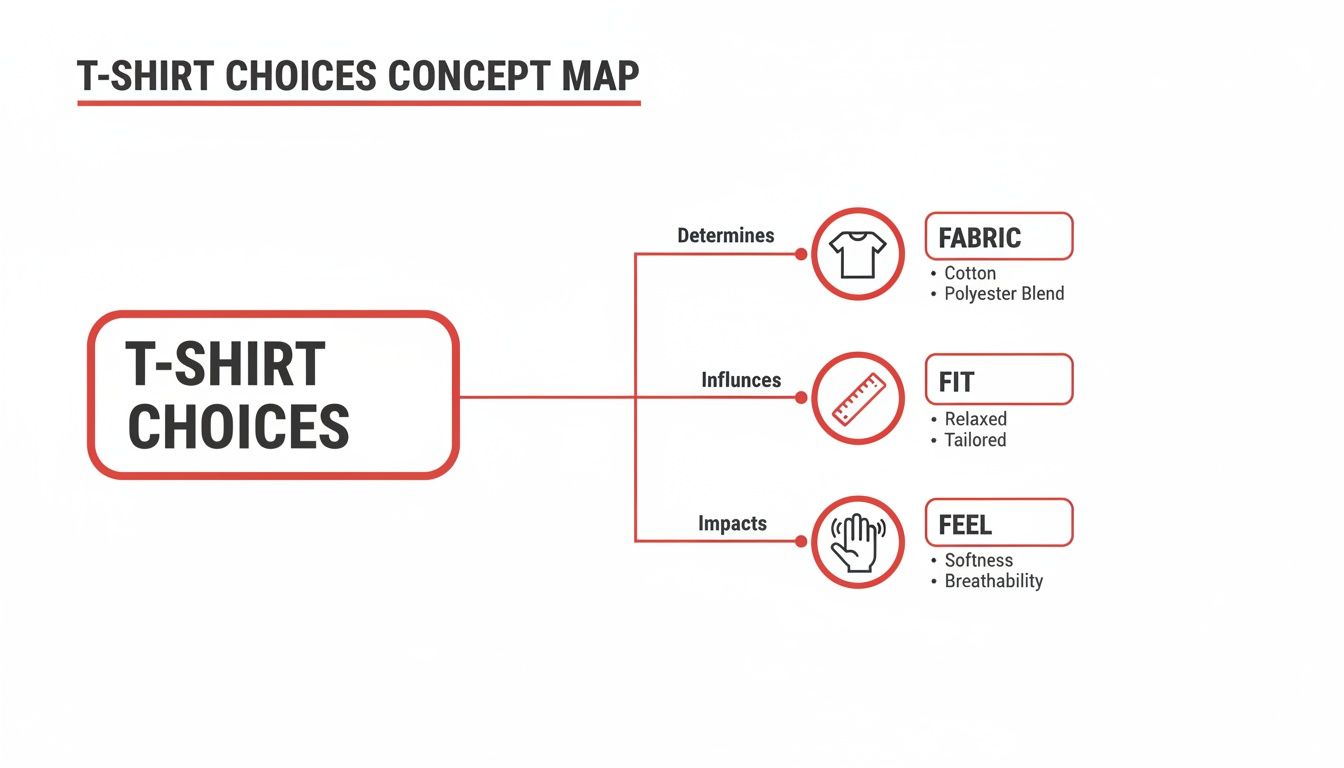
As you can see, these decisions flow into one another. The material you pick will often determine which branding method will look best and last the longest.
Screen Printing: The Bold and Versatile Classic
Screen printing is the absolute workhorse of the T-shirt world, and for good reason. It’s a time-tested process where ink is pushed through a custom stencil (or "screen") directly onto the fabric. We create a separate screen for each colour in your design, then layer them meticulously to build the final image.
The process is incredibly efficient for larger quantities, which is why it's the go-to for event giveaways, team uniforms, and big promotional campaigns. The ink sits slightly raised on the fabric, creating a bold, vibrant finish that’s famously durable and holds up wash after wash.
- Best For: Simple, punchy designs with a limited colour palette (usually 1-4 colours).
- Ideal Quantity: Larger orders, typically 50+ units, where the initial setup cost is absorbed across more shirts.
- Key Advantage: Fantastic value on bulk orders and colours that really pop.
The only catch? All that screen setup makes it less cost-effective for small runs or designs loaded with gradients and a kaleidoscope of colours.
Digital Printing (DTG): For Flawless, Full-Colour Detail
If screen printing uses a stencil, think of Direct-to-Garment (DTG) printing as a specialised inkjet printer built just for clothing. This tech sprays eco-friendly, water-based inks directly into the T-shirt's cotton fibres. The result is stunningly detailed, photorealistic images with a virtually unlimited spectrum of colours.
DTG is your answer for complex artwork—photographs, intricate illustrations, or logos with subtle colour transitions. There are no screen setup costs, making it a brilliant and affordable choice for small batches or even one-of-a-kind custom prints.
The real magic of DTG is its ability to reproduce detail with incredible accuracy. It's the go-to method when your artwork is the star of the show and you can't compromise on colour or complexity.
This technique truly shines on 100% cotton garments. The natural fibres drink up the ink, leaving a soft, smooth finish that you can’t even feel on the shirt.
Embroidery: The Premium, Professional Touch
Embroidery isn't printing at all—it's the art of stitching your design directly into the fabric. A highly specialised machine essentially "paints with thread," creating a textured, three-dimensional logo that instantly conveys a sense of class and professionalism.
This method is all about quality and permanence. An embroidered logo on a polo or a cap immediately elevates your brand, making it the premier choice for corporate uniforms, high-end client gifts, or any apparel where a premium look is non-negotiable. While it has a much higher perceived value, it’s not built for massive logos or super-fine text, as thread can only capture so much detail.
If you want to dig deeper into these techniques, you can explore a full breakdown of our custom printing options to see what fits your project best.
Dye Sublimation: For All-Over, Unbeatable Vibrancy
Sublimation is a seriously cool process that works its magic exclusively on polyester or poly-blend fabrics. Forget just putting ink on the shirt; this is more like a chemical reaction. Your design is printed onto special paper, then heat and pressure turn the solid ink into a gas that permanently infuses into the very fibres of the material.
What you get is a design that is literally part of the T-shirt. This means the colours are unbelievably vibrant, the print will never crack, peel, or fade, and it adds zero texture to the garment. Because the ink becomes one with the fabric, sublimation is perfect for creating those incredible, all-over patterns and edge-to-edge designs you see on sportswear and performance gear.
Mastering Your Artwork and Sizing for a Perfect Run
You've picked the perfect fabric, settled on a fit, and chosen a decoration method. Now for the final, crucial step: getting the artwork and sizing spot-on. This isn't just a small detail; it's the difference between T-shirts that look exactly as you imagined and a batch that comes with costly surprises or frustrating delays.
Think of it like giving a baker a recipe. If you hand them a blurry photo of a cake, they’re left guessing the ingredients and measurements. But if you provide a precise, detailed recipe, they can recreate it perfectly every single time. That’s exactly what providing the right artwork file does for us.
Why We Always Ask for Vector Files
In the world of professional printing, vector files are the gold standard. You'll usually see them with file extensions like .AI, .EPS, or .SVG. Unlike standard image files like JPEGs or PNGs, which are made of pixels and go blurry when you stretch them, vectors are built from mathematical equations.
This means we can scale your logo from the size of a postage stamp to a giant billboard, and it will stay perfectly crisp and sharp. For your branded T-shirts, a vector file guarantees every line, curve, and letter of your design prints cleanly. If you're looking for new ways to create graphics, you could even explore using an AI shirt generator for custom designs to produce print-ready artwork.
The Single Most Important Tip: Always, always supply your logo in a vector format. It's the best thing you can do to ensure a high-quality, professional finish on your T-shirts.
If all this file talk sounds like another language, don't worry. Our team is here to help get your artwork sorted. For a bit more detail, have a look at our guide on artwork submission tips for beginners.
Artwork File Type Cheat Sheet
Choosing the right file type can feel confusing, but it’s essential for getting the sharpest, most accurate branding. Here’s a quick guide to help you understand which format works best for different printing methods.
In short, vectors are your go-to for most standard branding, while high-resolution raster images are perfect for photo-realistic digital prints.
Locking in Your Brand Colours
Ever noticed how a colour on your screen looks completely different when it's printed? That’s a common headache we help you avoid by using the Pantone Matching System (PMS). Think of PMS as a universal dictionary for colour. It ensures your specific shade of brand blue, red, or green is reproduced with pinpoint accuracy every single time.
When you give us a PMS code for your brand colours, our print team can mix the inks to that exact standard. This takes all the guesswork out of the process and guarantees your branded T-shirts match your other marketing materials perfectly, creating that cohesive, professional look you’re after.
A Smarter Way to Handle Sizing
Ordering T-shirts for a whole team can feel like a bit of a gamble. Order too many of one size and you’re left with dead stock; order too few and someone misses out. Instead of trying to survey every single person (which is often a nightmare), it’s much more effective to use a standard distribution ratio.
Based on years of experience with Australian businesses, this is the sizing breakdown we’ve found works best:
- Small: 10%
- Medium: 25%
- Large: 35%
- X-Large: 20%
- 2X-Large: 10%
This 1:2.5:3.5:2:1 ratio is a safe bet for most adult groups. It gives you a balanced inventory that covers most people comfortably, dramatically cutting down on waste and making sure everyone gets a T-shirt that fits well. For an order of 100 T-shirts, that would mean 10 S, 25 M, 35 L, 20 XL, and 10 2XL. It’s a simple, efficient, and far more cost-effective way to manage your order.
Getting to Grips with Pricing, Timelines, and Sustainable T-Shirts
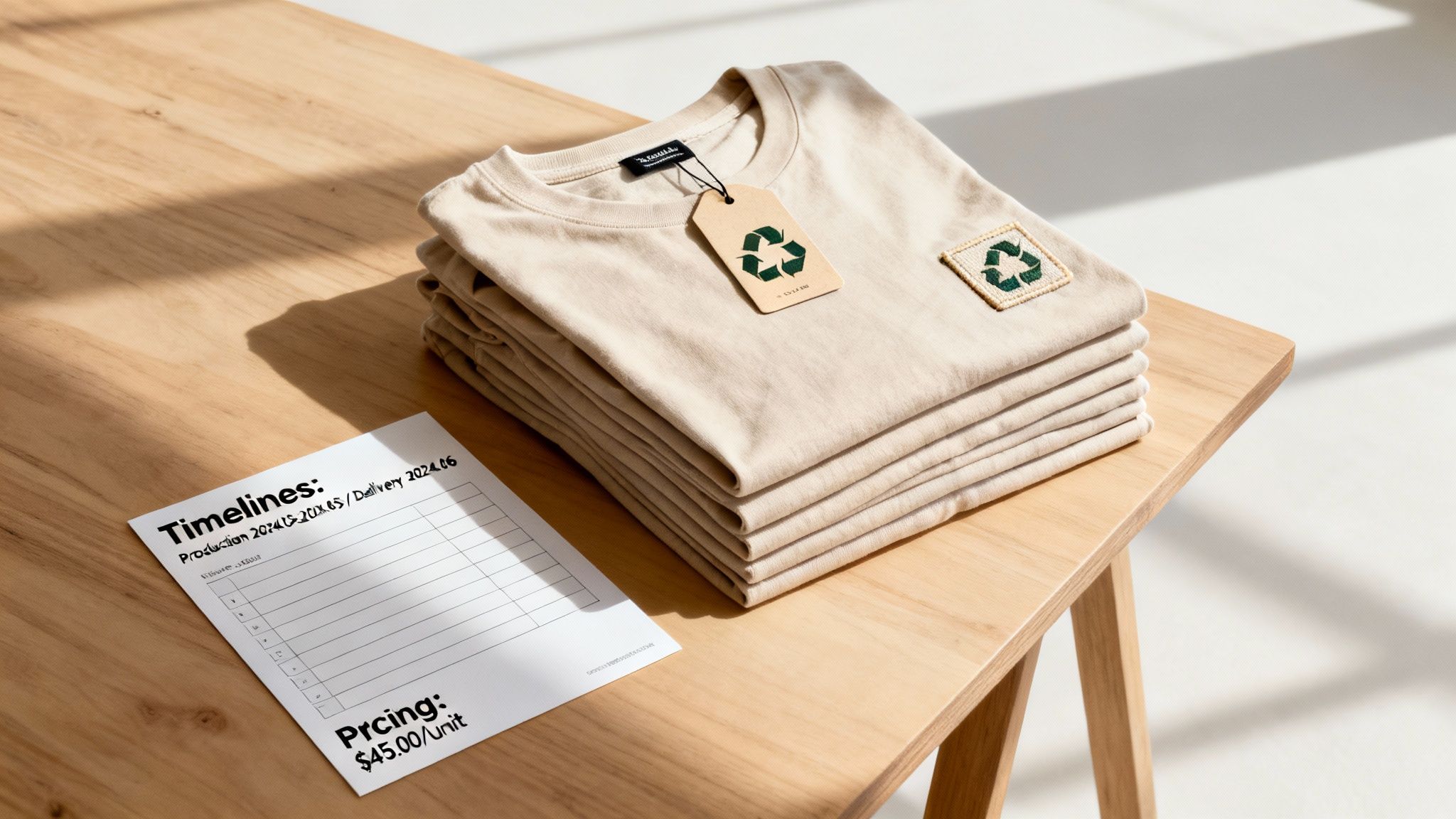
Let's talk about the practical side of things: money, deadlines, and making a positive impact. Understanding how these elements work together will help you plan your budget confidently and get the most out of your investment. The final price on your quote isn't just a number pulled from thin air; it’s a direct result of your decisions on quality, quantity, and design complexity.
It's a big market out there. The Australian apparel industry is valued at a massive AUD 32.89 billion, and custom printing is a huge piece of that pie. In fact, the t-shirt import market saw a staggering 11.93% growth in a single year, which shows just how many businesses are using branded tees as powerful promotional tools. If you're curious about the numbers, you can explore the full Australian t-shirt market analysis from IndexBox.io.
Breaking Down Your Final Price
So, what actually determines the cost of your t-shirts? Think of it like ordering a custom-built piece of furniture—every choice, from the type of wood to the finish, affects the final price. The same logic applies here.
Three main factors will shape your quote:
- The T-Shirt Itself: A basic, lightweight cotton tee will naturally cost less than a premium, heavyweight option made from a specialised blend. The garment is usually the biggest part of the overall cost.
- How Many You Order: This is your biggest lever for controlling the price. The more t-shirts you order, the lower your cost per unit gets. Why? Because the setup costs for printing are spread across more items, making bulk orders much more budget-friendly.
- The Complexity of Your Print: A simple, one-colour logo on the chest is cheaper to produce than a large, multi-colour design printed on both the front and back. Every extra colour and print location adds to the setup and material costs.
Here’s a pro tip: planning ahead to place one big order for the year, instead of several smaller ones, is the single best way to bring down costs and maximise your return.
Understanding Production Timelines
One of the first questions we always get is, "How long will my order take?" While every project is unique, a typical order follows a pretty standard path. Building in enough time is the secret to a stress-free process and a perfect result; rushing things is where mistakes can happen.
Here’s a rough guide to the journey of your order:
- Quote & Artwork Approval (1-2 days): You send us your request, we send back a detailed quote. Once you’re happy with it and provide your artwork, we’ll create a digital mockup for you to approve.
- Production (7-14 days): After you give the final thumbs-up on the mockup, your t-shirts head into production. This is the magic stage where your design is physically printed or embroidered onto the garments.
- Shipping & Delivery (2-5 days): Once everything passes a final quality check, your order is carefully packed and sent on its way to you, anywhere in Australia.
Plan Ahead: As a rule of thumb, it’s smart to allow around three to four weeks from your initial enquiry to having the t-shirts in your hands. If you’re on a tight deadline, just let us know—we have express options available.
Making a Sustainable Choice
These days, what your brand stands for is just as important as the logo on its chest. Choosing sustainable options for your t-shirts is a powerful way to show that your business cares about its environmental footprint. It’s a move that resonates deeply with modern Aussie consumers, who are increasingly backing businesses that share their values.
Going green doesn't mean you have to sacrifice quality or style, either. In fact, many of today’s sustainable materials offer a fantastic, premium feel.
Here are a few popular eco-friendly options:
- Organic Cotton: Grown without nasty pesticides or synthetic fertilisers. It’s kinder to the planet and often feels much softer against the skin.
- Recycled Polyester (rPET): This clever fabric is made from recycled plastic bottles, saving waste from landfill and using far less energy to produce than new polyester.
- Water-Based Inks: A much gentler alternative to traditional plastisol inks, these are free from PVC and other harsh chemicals.
By choosing greener materials and printing methods, you create merchandise that not only looks great but also says great things about your brand. To see what’s possible, feel free to browse our curated range of eco-friendly promotional products.
Ready to Go? Here’s How to Order Your Branded T-Shirts
So, you’ve got a good handle on the fabrics, fits, and printing methods. Feeling ready to turn that idea into a real, tangible T-shirt? The next part is actually pretty simple.
Let’s walk you through exactly how it works. We’ve refined our process over the years to be as straightforward as possible, so you know exactly what to expect from the moment you get in touch to the day your order arrives.
From Your Idea to Your Doorstep
Bringing your custom T-shirts to life follows a well-worn path. Here’s a breakdown of what the journey looks like when you partner with us.
- Get in Touch: It all starts with a simple enquiry. You might have a specific T-shirt from our online catalogue in mind, or maybe you just have a general concept. Either way, just send us a message with your idea, how many you’re thinking of, and any deadlines you have.
- Get a Detailed Quote: We’ll come back to you quickly with a full quote that breaks everything down. We're serious about our lowest price guarantee, so you can be confident you’re getting top value. No hidden fees, no nasty surprises—just clear, honest pricing.
- Approve Your Free Artwork Mockup: Once you're ready to move forward, our designers jump in. They’ll create a digital mockup showing exactly how your logo or design will look on the shirt. The best part? You get unlimited revisions until you're 100% satisfied.
- Confirm and We’ll Handle the Rest: After you give the final thumbs-up, your order heads straight into production. Our production crew takes over, applying your chosen decoration method with skill and an eye for detail.
Get in Touch: It all starts with a simple enquiry. You might have a specific T-shirt from our online catalogue in mind, or maybe you just have a general concept. Either way, just send us a message with your idea, how many you’re thinking of, and any deadlines you have.
Get a Detailed Quote: We’ll come back to you quickly with a full quote that breaks everything down. We're serious about our lowest price guarantee, so you can be confident you’re getting top value. No hidden fees, no nasty surprises—just clear, honest pricing.
Approve Your Free Artwork Mockup: Once you're ready to move forward, our designers jump in. They’ll create a digital mockup showing exactly how your logo or design will look on the shirt. The best part? You get unlimited revisions until you're 100% satisfied.
Confirm and We’ll Handle the Rest: After you give the final thumbs-up, your order heads straight into production. Our production crew takes over, applying your chosen decoration method with skill and an eye for detail.
The Simply Merchandise Advantage
Choosing the right supplier can make or break your project. We get that, which is why we've built our service around making your life easier and ensuring you get a premium result without the usual headaches.
Our whole philosophy is about making this process simple. That’s why we offer free setup on most items, free artwork layouts, and free delivery right across Australia. We sort out the details, so you don't have to.
This approach cuts out the typical friction points, like annoying artwork fees or confusing shipping costs. We manage the entire process for you. All you need to do is wait for that box of awesome new T-shirts to arrive and start showing them off.
Ready to get started? You can explore our huge online T-shirt range, request a quick quote with your project details, or just give our friendly team a call for some one-on-one advice. Let's create something brilliant together.
Got Questions About Branded T-Shirts? We've Got Answers.
Jumping into the world of custom t-shirts for your business can feel like there are a lot of moving parts. We get it. That's why we've put together answers to the most common questions we hear from Australian businesses just like yours.
We believe the process should be simple and clear, from the moment you have an idea to the day your order lands on your doorstep.
How Many T-Shirts Do I Have to Order?
This is usually the first thing people want to know, and the answer comes down to how we’re decorating your t-shirt. The minimum order quantity, or MOQ, is really tied to the branding method you choose.
- Screen Printing: This method involves a bit of a setup process, so it makes the most sense for bigger batches. You’re typically looking at a minimum of 25 t-shirts per design.
- Digital Printing (DTG): Perfect for smaller runs or really detailed, colourful designs. Because there are no setup costs, we can often do these with no minimums at all.
- Embroidery: Like screen printing, this needs a special setup file created (a process called digitisation). MOQs for embroidery usually start at around 15-20 units.
The bottom line? Whether you're a small startup or a large corporation, there's a branding option that works for you. We'll always guide you to the most cost-effective choice for the number of t-shirts you need.
Can I See a Sample Before I Commit to the Full Order?
Absolutely. In fact, we encourage it. You should feel 100% confident in your order before it goes into full production. There's nothing quite like seeing and feeling the real thing to put your mind at ease.
We have a couple of ways to do this, so you can be sure your branded t-shirts will turn out perfectly:
- Blank Sample: We can send you an unbranded t-shirt first. This is a great way to check out the fabric quality, see the colour in person, and nail the sizing for your team.
- Pre-Production Sample: For larger orders, we can create a single, fully finished t-shirt with your logo printed or embroidered on it for you to sign off on.
This simple step means no nasty surprises—what you see is exactly what you’ll get.
How Long Until My Order Arrives?
Planning is everything, so knowing when your t-shirts will arrive is crucial. Once you've given the final thumbs-up on your artwork proof, you can generally expect your order to be produced and delivered within 10-15 business days.
This timeline gives our production team enough time to do a fantastic job and run everything through our quality checks. If you're working to a tight deadline for an event, just let us know. We have express service options available to help you out of a jam.
Do You Deliver All Over Australia?
We sure do. From Sydney's CBD to the West Australian outback, we ship our branded t-shirts to every corner of the country. We work with trusted national couriers to make sure your order gets to you safely and on schedule, no matter where your office is.
Ready to create branded t-shirts that people will actually want to wear? The expert team at Simply Merchandise is here to make it happen, guiding you through every step for a brilliant result.

