



You're comparing three quotes for a national campaign, and the cheapest tote looks fine on screen. But one has thin handles, another has a print method that won't suit your artwork, and the third costs more because it's built to be carried repeatedly. The decision isn't which bag has the lowest unit price. It's whether the bag will do a useful job after the event, and whether its cost, construction and message make sense for the people receiving it.
That distinction matters in Australia, where lightweight plastic shopping bags have been phased out and reusable bags are part of everyday life. The strongest branded tote bags Australia buyers can order aren't automatically the most expensive or the most “eco” sounding. They're the ones designed for a real use, made well enough to last, and distributed to people likely to keep using them.
What a Branded Tote Does for Your Brand
Plenty of promotional merchandise ends up in a drawer. A tote is different: people carry it in public, where strangers see the branding. That makes it either a repeated endorsement of your brand or a one-use item headed for a bin, and the difference comes down to whether the recipient finds it worth carrying again.
A tote does three jobs at once. It carries something useful, it replaces a disposable bag in many situations, and it puts your brand in front of people who never attended your event, on trains, at supermarkets, outside school gates. That reach only counts if the bag survives the second use.
Australia's regulation timeline explains why reusable totes became a familiar carry option. South Australia began its statewide lightweight plastic-bag ban in 2009, and other jurisdictions followed. By 1 June 2022, all Australian states and territories had banned lightweight plastic shopping bags with handles measuring 35 microns or less, according to the timeline of Australian plastic-bag bans. That policy gives reusable bags a clear role, but it doesn't mean every promotional tote qualifies as a checkout bag. Intended use and local rules still decide that.
The cheapest quote turns expensive fast if the tote sags under a modest load, the handles pull away, or the print fades after a few outings. A premium bag wastes budget too when the audience only needs a single-day event carrier. Decide first whether you're buying a giveaway bag, a checkout bag, or a long-life campaign asset, then spend to match.
Buyer's rule: Choose the job first. Then choose the bag that can do it.
For a business weighing merchandise options, branded merchandise for business shows how a tote can sit alongside the rest of a campaign rather than being bought in isolation.
Tote Bag Types, Materials and Sizes Explained
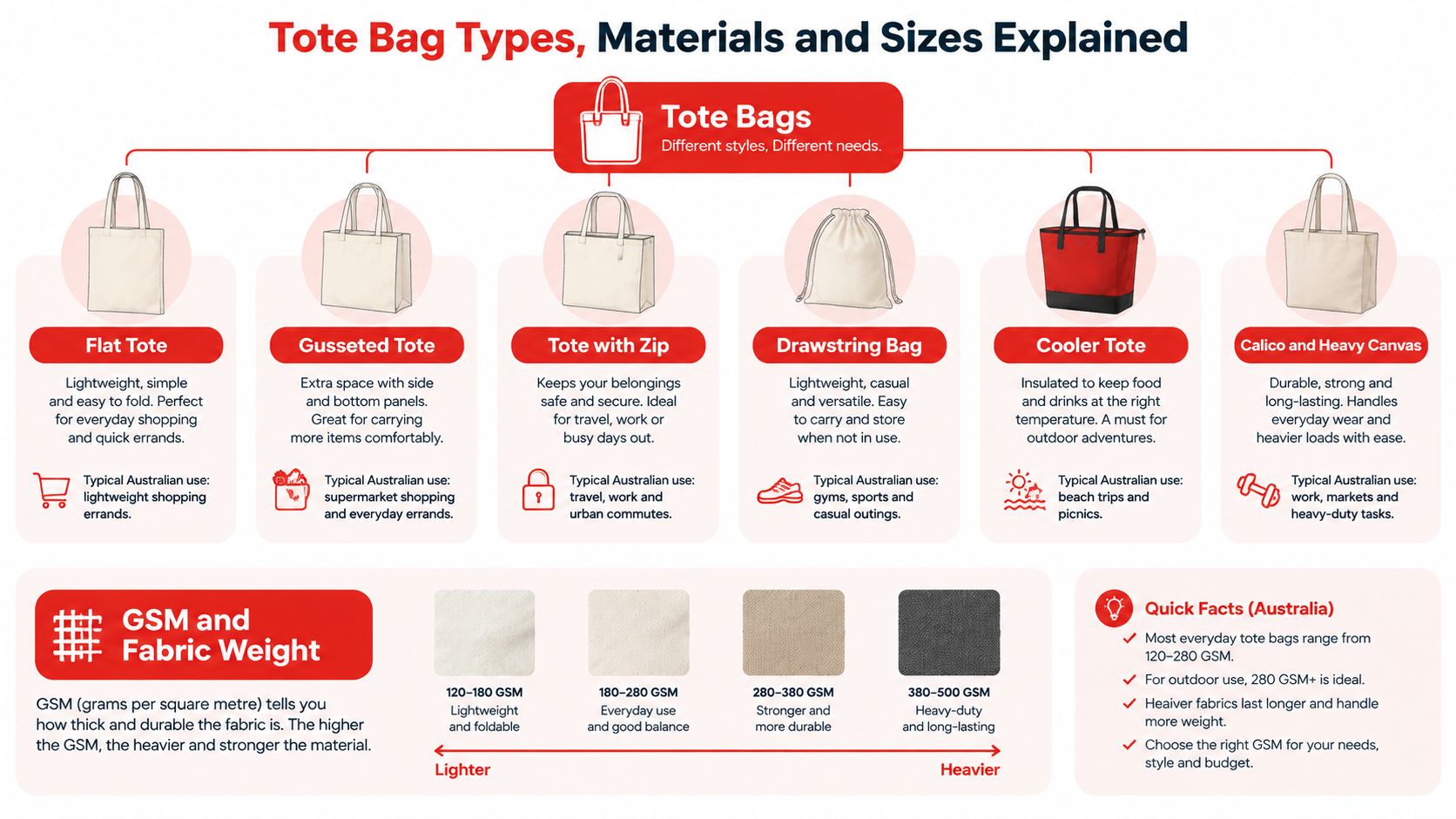
A useful specification starts with shape, then moves to fabric and construction. A flat tote is light and easy to distribute, while a gusset gives the base more room for groceries, books or event materials. A zip closure helps keep contents contained; a drawstring bag suits light personal items, but it isn't a substitute for a structured shopping tote. Cooler totes need an insulated lining, which adds bulk but makes them more suitable for food or beach use.
Read fabric specifications in plain English
GSM means grams per square metre. It describes fabric weight, not a guaranteed level of quality. A heavier fabric can feel more substantial, but stitching, handle attachment and the intended load determine whether the finished bag stands up to use.
Calico is a straightforward cotton option for simple prints and everyday carrying. Heavy canvas offers more structure and a more substantial feel, which can suit retail or staff gifts, though additional material means more weight and bulk. Recycled PET can work well for lightweight bags, but ask what the supplier means by “recycled” and how the finished item is meant to be used. Jute has a distinctive textured look, while non-woven polypropylene is often selected for a practical, budget-conscious giveaway. Organic cotton, like any material, still needs to be judged on construction and useful life, not its label alone.
Australia generated about 840,000 tonnes of textile, leather and rubber waste in 2024–25, with approximately 95% sent to landfill and a recovery rate of about 12%, according to the National Waste and Resource Recovery Report. That's a good reason to avoid choosing a material solely because it sounds environmentally appealing.
Match the bag to its load
A lunch carrier needs less structure than a bag expected to hold library books or retail purchases. For heavier loads, look for reinforced handles, strong seams and a bottom panel that helps the bag keep its shape. Ask whether the print area can accommodate your design without placing artwork across a seam or gusset.
If your tote will accompany a sports event, a guide for tournament organizers offers useful context on planning branded materials for an organised event. Give your supplier the actual use case, expected contents and preferred bag dimensions, rather than asking for a generic “standard tote”.
Choosing the Right Print and Branding Method
The print method should follow the fabric, artwork and order requirements. A one-colour logo on calico is a different production problem from a detailed photographic design on polyester. Ask your supplier to explain why a method suits the bag, rather than accepting “that's what we normally use” as the answer.
| Method | Best on | Min qty | Artwork fit |
|---|---|---|---|
| Screen printing | Cotton, calico and canvas | Ask supplier | Bold shapes and limited colours |
| Digital printing | Suitable printable fabrics | Ask supplier | Detailed or full-colour artwork |
| Heat transfer | Compatible fabric surfaces | Ask supplier | Smaller runs and complex designs |
| Sublimation | Polyester | Ask supplier | Full-colour designs integrated with the surface |
| Embroidery | Heavier fabric with a stable surface | Ask supplier | Compact logos and simple details |
The “Min qty” column is deliberately a supplier question, not a made-up universal threshold. Minimums depend on the bag, print setup and production process. Request a quote based on your actual quantity and ask whether setup costs change the value of a small run.
Screen printing can give a clean, direct logo on suitable fabric, but complex artwork may need adaptation. Digital printing can preserve more detail, although it may carry a different unit cost or be limited by the available bag surface. Sublimation is for polyester, not cotton canvas. Embroidery adds texture, but a heavy stitched design can distort a light tote, so it needs a more stable fabric.
Heat transfer can suit artwork that's difficult to reproduce with a simpler print, but ask how the finish will behave with the bag's texture and expected handling. Debossing is generally associated with materials that can take an impression; it isn't a default choice for ordinary fabric totes.
For a broader look at custom drinkware production choices, Nothing's compostable cup ordering tips provide a useful comparison point for thinking through product and branding specifications together. The same discipline applies to totes: agree on the bag, artwork and method as one package.
Use the custom printing options page as a starting point for discussing the available processes, then request a proof on the actual bag colour and material.
Cost, Quantities and How to Read a Quote
A cheap unit price can hide an expensive order. If one supplier quotes the bag only and another includes setup, screens, artwork preparation, freight and GST, the lower number may deliver less. Ask every supplier for the full delivered cost, in writing, for the same specification.
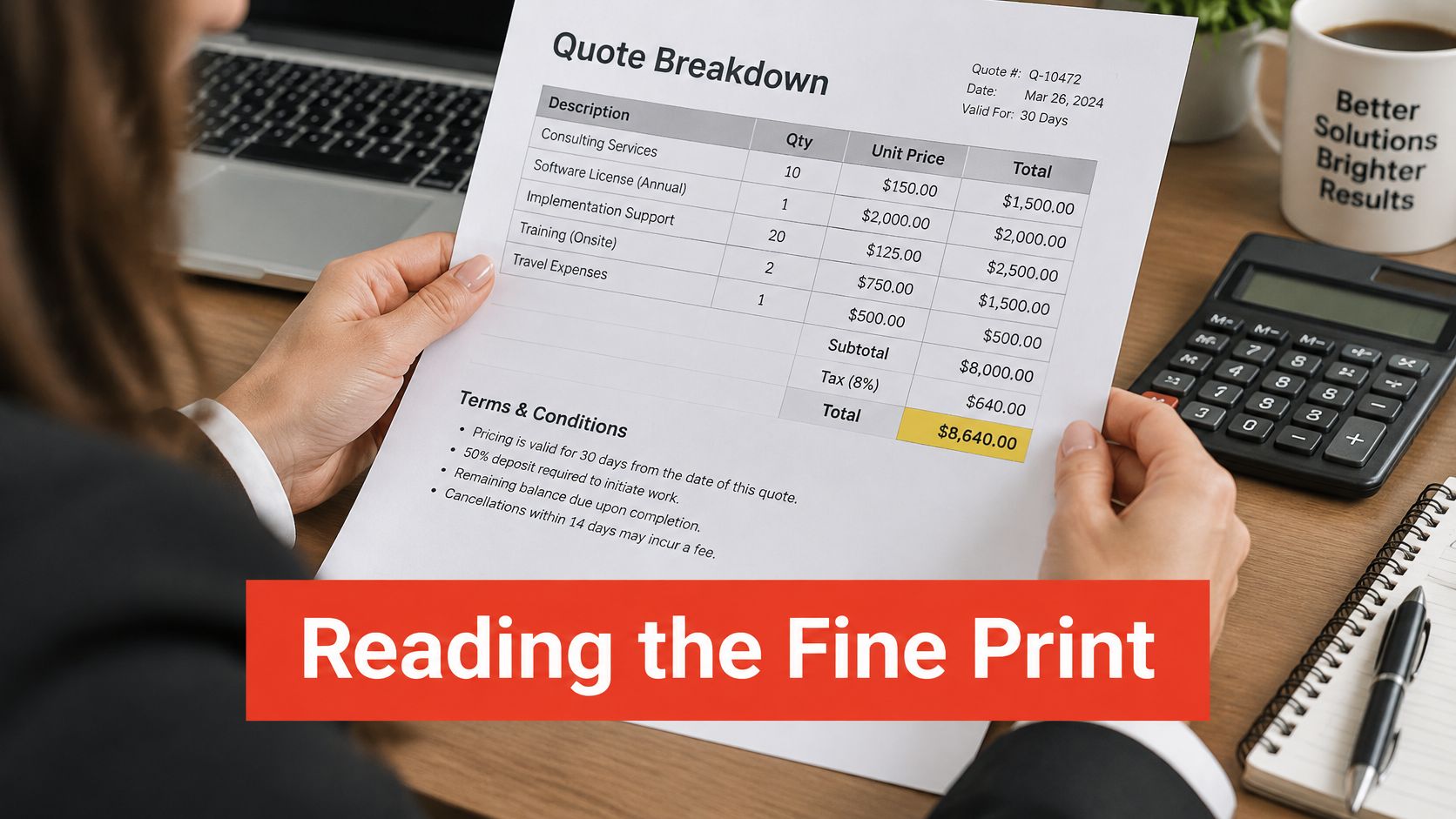
Before you approve anything, check the line items the way a buyer would:
- Bag specification: material, colour, dimensions, handle length, gusset, lining, closure and intended load.
- Print and setup: screens or plates, artwork preparation, number of print colours, print positions and any repeat-order setup fees.
- Quantity and breaks: price the quantity you can distribute, then ask what changes at the next tier rather than ordering into stock you cannot move.
- Freight and GST: delivery destinations, cartons, timing, tax treatment and who owns the risk if a deadline slips.
- Proofing and changes: whether artwork revisions are included, what a proof approval locks in and how reorders are priced.
The reusable carry-bag shift may shape whether you need a giveaway tote, a checkout bag or a long-life campaign asset, but it still leaves the price question open. Get like-for-like comparisons on construction, branding and delivery. A tote that costs more and survives weekly use can be better value than a flimsy bag that fails before the logo does.
Quantity breaks can help, but over-ordering is waste in a warehouse. Match the spend to the audience, event format and distribution plan.
Send suppliers your preferred bag style, use case, artwork, delivery locations and realistic quantity through the request a quote page. A specific brief makes it easier to see where two offers differ.
Sustainability Without the Spin
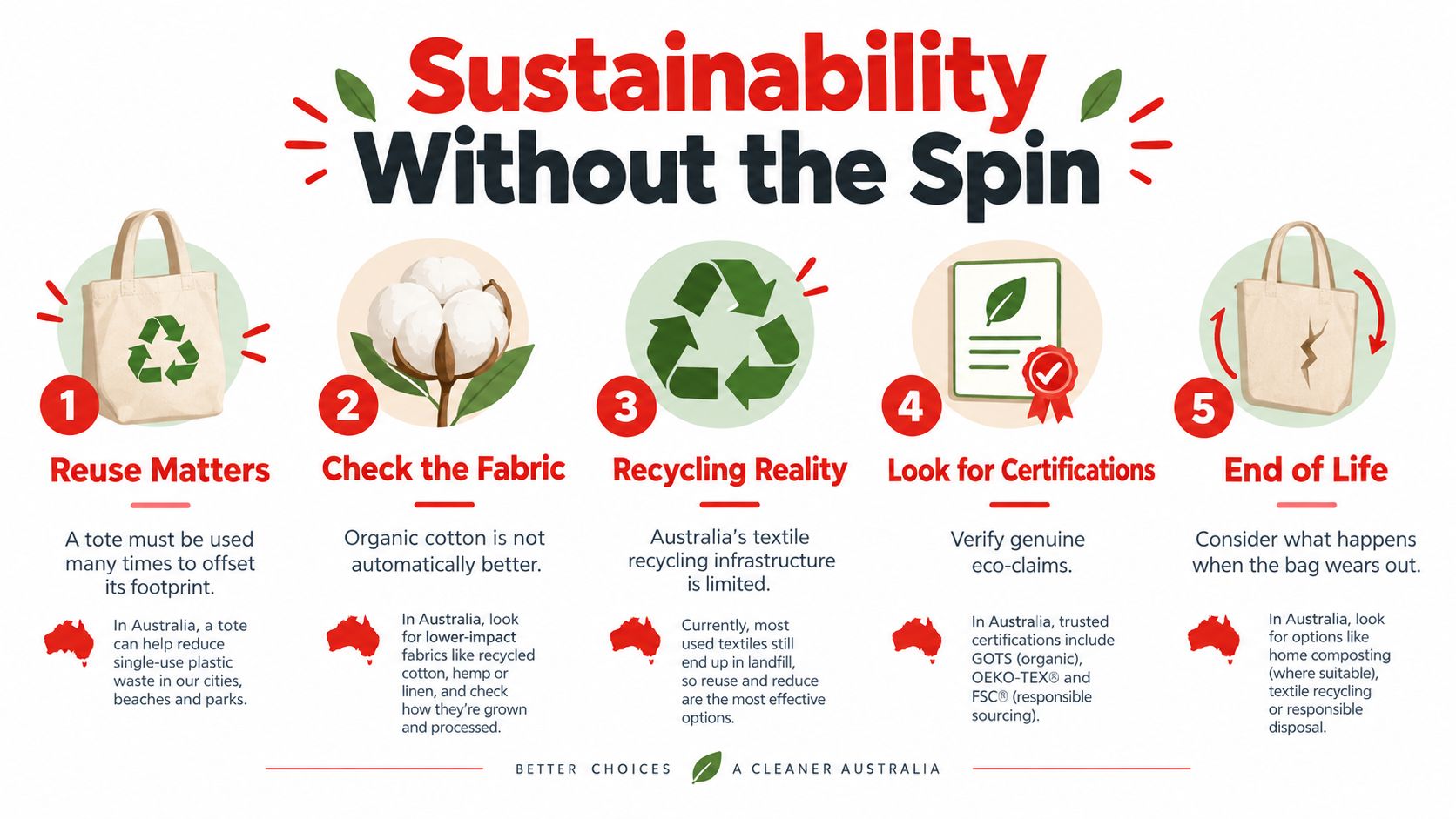
A cotton label doesn't prove a tote is sustainable. Nor does “recycled” tell you whether the bag will be reused, survive its intended job or have a practical route at end of life. Repeated use, durability and fit for purpose matter more than a flattering product description.
An NSW Parliament review reported that ACT shoppers carrying reusable bags increased from 44% to 84% after the ban. It also recorded a 41% reduction in bag units and a 31% reduction in plastic material sent to landfill. In South Australia, plastic bags' share of the litter stream fell 45% between 2008–09 and 2011–12, according to the NSW Parliament review of single-use plastic product bans. The practical lesson is not “give everyone a tote”. It's to make reusable bags convenient and useful enough that recipients carry them.
Specify what you can stand behind
Recycled PET may suit a lightweight bag for modest loads. Cotton canvas can make sense where structure, repeated heavy use or a more premium presentation is central to the brief. Jute, hemp and organic cotton each have distinct material qualities, but no fibre label replaces a proper assessment of construction and expected use. Compostable materials only make practical sense where suitable end-of-life facilities are available and the product is appropriate for the job.
A useful purchase specification records the fabric, handle attachment, load expectations, print area and care instructions. Include a direct reuse message on the bag or in the campaign materials. If the bag is too thin for its intended contents, hard to clean or awkward to carry, a sustainability claim won't rescue the decision.
A tote that's handed out without a clear use can become excess inventory, even when its fabric sounds responsible.
Keep the order matched to demand, consider pre-registration or a return-and-refill approach, and avoid vague claims such as “100% eco”. For a practical starting point on product choices, review the eco products range, then ask suppliers for material and end-of-life details you can substantiate.
Lead Times, Delivery and Proofing Across Australia
The production schedule depends on whether you're choosing an available blank, adding branding to stocked bags or commissioning a made-to-order product. Don't approve an event plan based on a verbal promise. Ask the supplier to confirm production timing, proof approval dates and delivery arrangements in writing.
Build the schedule around approval
Start with the event date, then work backwards. Allow time for artwork preparation, proof review, any sample approval, production and freight. If the tote is needed at multiple venues, tell the supplier before ordering and confirm whether bags will be sent to one central warehouse or delivered to separate locations.
Check the proof at actual size where possible. Confirm logo placement, colours, spelling, print dimensions and how the design sits relative to seams or gussets. A digital mockup helps you review layout, but it doesn't necessarily show how a textured fabric or bag colour will affect the finished result. If colour matching is important, provide the relevant references and ask how closely they can be matched on the selected material.
For time-sensitive work, find out whether an express option applies to the bag, the branding or both. A fast dispatch of an unbranded blank doesn't solve the problem if printing still needs to happen. Confirm what changes are possible once production starts, and name one person on your team who can approve proofs promptly.
Plastic bags still represented 8.7% of counted litter nationally in Clean Up Australia's FY25 report, as cited in the Australian parliamentary committee's waste and recycling chapter. That figure is a reminder that rules alone don't guarantee better habits. Make the tote easy to use and include a clear reason to keep it in circulation.
Before paying, check delivery addresses, site access, contact names and any venue receiving requirements. Compare the freight terms with the full schedule using the supplier's free freight information, and confirm exactly what the offer covers.
Matching Totes to Events, Retail, Schools and Corporate Programs
The same tote can be a sensible choice for one audience and a poor fit for another. Begin with the moment the recipient receives it, then picture what they'll carry and where they'll use it next.
At a trade show, a light flat tote may be enough for brochures and small samples. But don't order for every person who might pass the stand if your team can't distribute the stock thoughtfully. A simple logo with readable contrast is often more useful than artwork that competes with the event material inside.
A retailer has different needs. The bag may be part of the customer's checkout experience, so handle comfort, base construction and the store's visual identity matter more. Confirm the applicable local rules and the tote's intended role before treating a promotional bag as a default retail carrier.
For a school, durability and ease of carrying take priority over a complex print treatment. A library bag or uniform-related tote may be used repeatedly, so check handle length, bag size and whether the design can be recognised at a glance. If it needs to carry books, specify that load rather than asking for a generic giveaway bag.
Corporate onboarding kits sit at the other end of the spectrum. A more structured tote can make sense when it needs to carry documents, a drink bottle or other welcome items, and the company wants the bag to remain useful afterwards. Spending more on construction may be justified here, but only if the audience will keep using it.
Order for the distribution plan, not the optimistic headcount. Estimate who will receive a tote, where it will be handed out and what happens to leftovers. If the bag is meant to carry an event kit, test that kit inside the sample before approving production. If it's a retail carrier, assess the bag with the products customers typically buy. Specific use cases make supplier recommendations sharper and reduce the chance of paying for features that don't matter.
Smart Ordering Habits and Your Next Steps
Three decisions separate a useful tote order from a forgettable one. First, specify construction for the expected use, not just the logo. Second, choose the branding method to suit the artwork and material. Third, treat distribution as part of the product decision: a well-made bag still needs a clear reason for people to take it and keep using it.
Before approval, check the artwork file, colour references, print position, sample or mockup, delivery destinations and reuse message. Confirm that the quote reflects the exact bag and branding you've approved. If the tote supports a larger event presence, coordinate the merchandise brief with the stand plan; UCON Exhibitions' information on Stand Builders Australia can help teams consider how branded items fit into the broader exhibition experience.
Ask for a sample when handle feel, fabric weight or colour matters. Review the bag with its intended contents, not empty on a screen. Then place an order that reflects the people you can reach.
A useful tote keeps a brand visible because it earns a place in someone's routine. Make the brief specific, approve the construction as carefully as the artwork, and choose a bag people will want to carry.
Merchandise offers custom branded tote bags with artwork support, printing options and Australia-wide delivery. Share your intended use, artwork and delivery requirements, then visit Simply Merchandise to request a quote or discuss a suitable tote for your campaign.

