
Let's get one thing straight: promotional products are more than just freebies. They are tangible, branded items that get your company logo into the hands, homes, and offices of your customers.
Think of it like a business card that actually does something useful. It transforms a simple giveaway into a genuine, lasting connection with your brand.
Why Do Promotional Products Actually Work?
In a world where we're bombarded by digital ads, a physical item can really cut through the noise. It’s something people can hold, use, and appreciate, creating a real-world link between your brand and your audience. A social media ad is gone in a flash, but a great promotional item can become part of someone's daily life, putting your brand in front of them for months, or even years.
And this isn't just a gut feeling; the numbers prove it. The promotional products industry in Australia is a powerhouse, worth over $2 billion a year. Research shows that an incredible 76% of people can remember the brand on a promotional item they've received. Even better, these products build real goodwill—52% of people say getting a branded gift gives them a more positive view of a company.
Building Brand Recall That Lasts
Every time someone sips coffee from your branded mug, jots down notes with your company pen, or throws on your custom cap, they're reconnecting with your business. This repeated, casual exposure builds a sense of familiarity and trust. It keeps your brand right at the top of their mind for when they need your products or services.
The real magic of promotional products is how long they stick around. A digital ad is here one second and gone the next. A quality promotional item, on the other hand, can deliver a cost-per-impression as low as $0.001 because it stays in use for so long. In fact, 55% of recipients keep their promotional items for more than a year.
Creating a Real-World Connection
Promotional marketing bridges the gap between the digital and the physical. When you hand someone a high-quality, useful item at a trade show or send it as a corporate gift, you create a memorable, positive experience. This physical touchpoint builds a sense of appreciation and loyalty that’s tough to achieve online. It’s a clear signal that you value their business enough to give them something of real worth.
If you're curious about what items get the best results, you might want to check out our guide on the top 10 promotional products.
The benefits are pretty clear:
- Boosted Brand Recognition: Your logo becomes a familiar sight in daily life.
- Stronger Customer Loyalty: A thoughtful gift makes customers feel seen and valued.
- Cost-Effective Marketing: They often have a lower cost-per-impression than traditional advertising.
- Powerful Lead Generation: A great item can draw people to your event booth and get a conversation started.
At the end of the day, promotional products aren't just 'stuff'. They're powerful marketing tools. When you choose them with care, they act as brand ambassadors, building relationships and driving growth long after you've handed them out. This guide will walk you through everything you need to know to get it right.
How to Choose the Right Promotional Products
Picking the right promotional products is about so much more than just finding a trendy gadget and slapping your logo on it. The campaigns that truly deliver results are built on a solid strategy that connects the item, the audience, and your business goals. It's about finding something that doesn’t just carry your brand, but actually communicates your value and clicks with the people you’re trying to reach.
Think of it like this: handing a high-end power bank to an attendee at a tech conference is a perfect fit. The product is genuinely useful, it’s relevant, and it solves a real problem for that specific audience. But giving them a generic pen? It completely misses the mark and ends up in the bottom of a bag, forgotten.
Start With Your Audience and Goals
Before you even think about flicking through a catalogue, your first step should always be to get crystal clear on who you're talking to and what you want to achieve. Without that clarity, you're just taking a stab in the dark. A vague goal like "brand awareness" isn't specific enough to make a real impact.
Are you trying to generate high-quality leads at a trade show? If so, your product needs to be compelling enough that people are happy to swap their contact details for it. Or maybe you want to show your top clients how much you appreciate them. In that case, a premium, high-value gift sends a much stronger message than a cheap, mass-produced item ever could.
The core idea is simple: a promotional product is a marketing tool. Choosing the right tool for the job is what separates a successful campaign from a wasted budget.
To nail this, start by sketching out some simple audience personas. Think about their daily routines, their professional challenges, and even their personal interests. What's something that would genuinely make their day a little easier or more enjoyable? Answering that question is the secret to finding a product that gets used, remembered, and valued.
The right promotional product serves two key functions: it builds a lasting, tangible connection and keeps your brand top of mind.
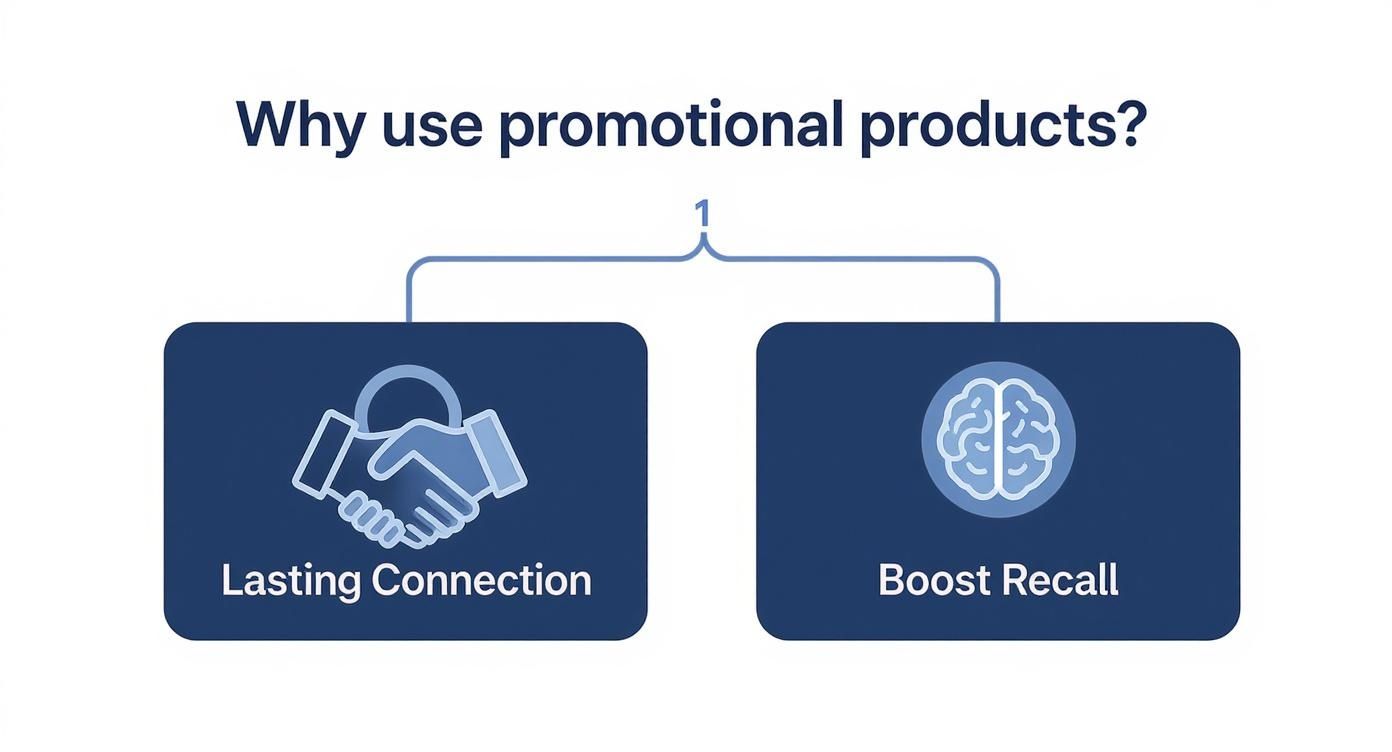
As this shows, a well-chosen item creates a meaningful touchpoint with your audience, ensuring you're the first one they think of when they need your services.
Match Products With Campaign Goals
To make this even clearer, let's look at how specific products align with different marketing objectives. The table below breaks down which types of items work best for common campaign goals.
Matching Promotional Products to Campaign Goals
| Campaign Goal | Recommended Product Types | Why It Works |
|---|---|---|
| Lead Generation | High-perceived value tech gadgets (power banks, Bluetooth speakers), premium notebooks, quality drinkware | These items feel like a fair exchange for contact information. They're desirable enough to motivate action at a trade show or event. |
| Client Appreciation | High-end gift sets (wine accessories, gourmet food baskets), premium apparel (embroidered jackets), engraved desk accessories | Luxury items convey a sense of value and exclusivity. They show you've invested in the relationship and genuinely appreciate their business. |
| Brand Awareness | Low-cost, high-volume items (pens, keyrings, tote bags, stickers) | These products are perfect for mass distribution. They get your name and logo in front of as many people as possible in a cost-effective way. |
| Employee Engagement | Branded apparel (hoodies, t-shirts), high-quality water bottles, custom backpacks, desk organisers | Useful, high-quality gear fosters a sense of team unity and pride. It makes employees feel valued and turns them into brand advocates. |
By thinking through your primary goal first, you can immediately narrow down your options to the products most likely to get you the results you're after.
Your Practical Decision-Making Checklist
Feeling a bit overwhelmed by the choices? Don't be. A structured approach makes the whole process much easier. Before you sign off on an order, run through this quick checklist to make sure your choice is a strategic one. For a more detailed guide, check out our 15 tips to choose the best promotional products.
Here’s a simple checklist to guide you:
- Is it genuinely useful to my target audience? The most effective promo items are practical things people will reach for again and again, giving your brand constant exposure.
- Does it directly support my campaign goals? Make sure the item is a perfect match for your objective, whether that’s generating leads, thanking clients, or just getting your name out there.
- Does it reflect my brand’s quality and values? People will directly associate the product's quality with your company. Choose items that uphold your standards. While you're thinking about this, it can be helpful to look at broader strategies for finding winning products to get a feel for what the market values.
- Is there enough space for clear branding? Your logo and message need to be easy to see and read. Steer clear of items where your branding will be too small, distorted, or hard to notice.
- Does it fit within my budget? Remember to factor in the total cost, including setup fees and shipping, to ensure the campaign makes financial sense.
Understanding Your Branding and Customisation Options
Picking the perfect promotional product is only half the battle. The other, arguably more important, half is getting your brand onto that item in a way that looks fantastic and lasts. The customisation method you choose is a huge deal—it directly affects the final look, feel, and durability of your merchandise.
It’s the difference between a logo that pops with professional polish and one that just… sits there.
Think of it like framing a piece of art. The frame doesn't just hold the picture; it enhances it, complementing the style and making sure it looks its best. In the same way, the right branding technique makes your logo stand out and sends a clear message about the quality of your brand.
To make a smart choice, you need to know the main methods on the table. Each one has its own strengths and is better suited to different materials and goals. Let's break down the most popular options so you can perfectly match the technique to the product.
Screen Printing For Bold Designs
Screen printing is one of the most common and versatile ways to brand promotional gear, especially for things like t-shirts and tote bags. If you’ve ever made a stencil, you get the basic idea. A fine mesh screen is used to push ink onto the product's surface, creating a crisp, vibrant design one colour at a time.
This technique is a winner for:
- Large, simple logos with solid, distinct colours.
- T-shirts, hoodies, and fabric bags that need a bold, opaque design.
- Cost-effective large orders, as the price per item drops the more you print.
It’s not the best fit for highly detailed photos or designs with colour gradients. Since each colour needs its own screen, complex images can get expensive quickly.
Embroidery For a Premium Finish
When you want a classic, high-end look, nothing beats embroidery. This technique stitches your design directly into the fabric with thread. It's essentially "painting" with thread, and the result is a textured, three-dimensional logo that feels premium and is incredibly durable.
Embroidery is the perfect choice for:
- Corporate uniforms, like polo shirts and business jackets.
- Headwear, such as caps and beanies, where it adds a clean, professional look.
- Any item where you want to communicate quality and permanence. An embroidered logo will often outlast the garment itself.
Key Takeaway: Embroidery instantly elevates an item, turning standard apparel into premium corporate wear. It signals an investment in quality, which people will naturally associate with your brand.
Laser Engraving and Sublimation
What about things that aren't fabric? Two other brilliant techniques deliver incredible results on different materials, ensuring your promo products look exceptional no matter what they're made of.
Laser Engraving Laser engraving uses a super-precise beam of light to etch a design onto a hard surface. It doesn't add colour; instead, it carefully removes the top layer of the material to reveal what’s underneath. This creates a subtle, permanent, and very sophisticated mark. It’s the go-to method for premium metal, wood, or glass items.
Consider laser engraving for:
- Metal pens and drink bottles
- Wooden cheese boards or coasters
- Glassware and awards
Dye Sublimation For jaw-dropping, full-colour images that cover an entire surface, dye sublimation is king. This process uses heat to infuse dye directly into the material’s fibres. The ink literally becomes part of the product instead of just sitting on top. The result is a smooth, seamless finish that will never crack, peel, or fade. It's perfect for creating photo-quality designs on polyester fabrics or specially coated items.
To get a closer look at all these methods, you can explore our full guide to custom printing options and find the perfect match for your next project.
Of course, custom merchandise is just one piece of a bigger branding puzzle. To see how great content can work alongside your physical products to build your identity, check out the advantages of content marketing to boost your brand.
The Shift Towards Sustainable and Premium Merchandise
Let's be honest, the days of the cheap, disposable giveaway are over. We’ve all been to a trade show and come home with a bag full of flimsy plastic pens and keyrings that end up in the bin by the end of the week. Today’s customers are far more savvy, and they want the brands they engage with to mirror their own values.
This has triggered a huge shift in the world of promotional products. The smart money is moving away from low-cost, single-use junk and towards merchandise that is either genuinely sustainable or feels truly premium. A cheap tote bag that tears after one use doesn't just end up in landfill; it sends a message that your brand cuts corners.
In contrast, a well-made, eco-friendly water bottle or a high-end tech gadget communicates thoughtfulness and a commitment to quality. It’s about giving people something they actually want to use, something that becomes a valued part of their daily routine instead of just another piece of clutter.
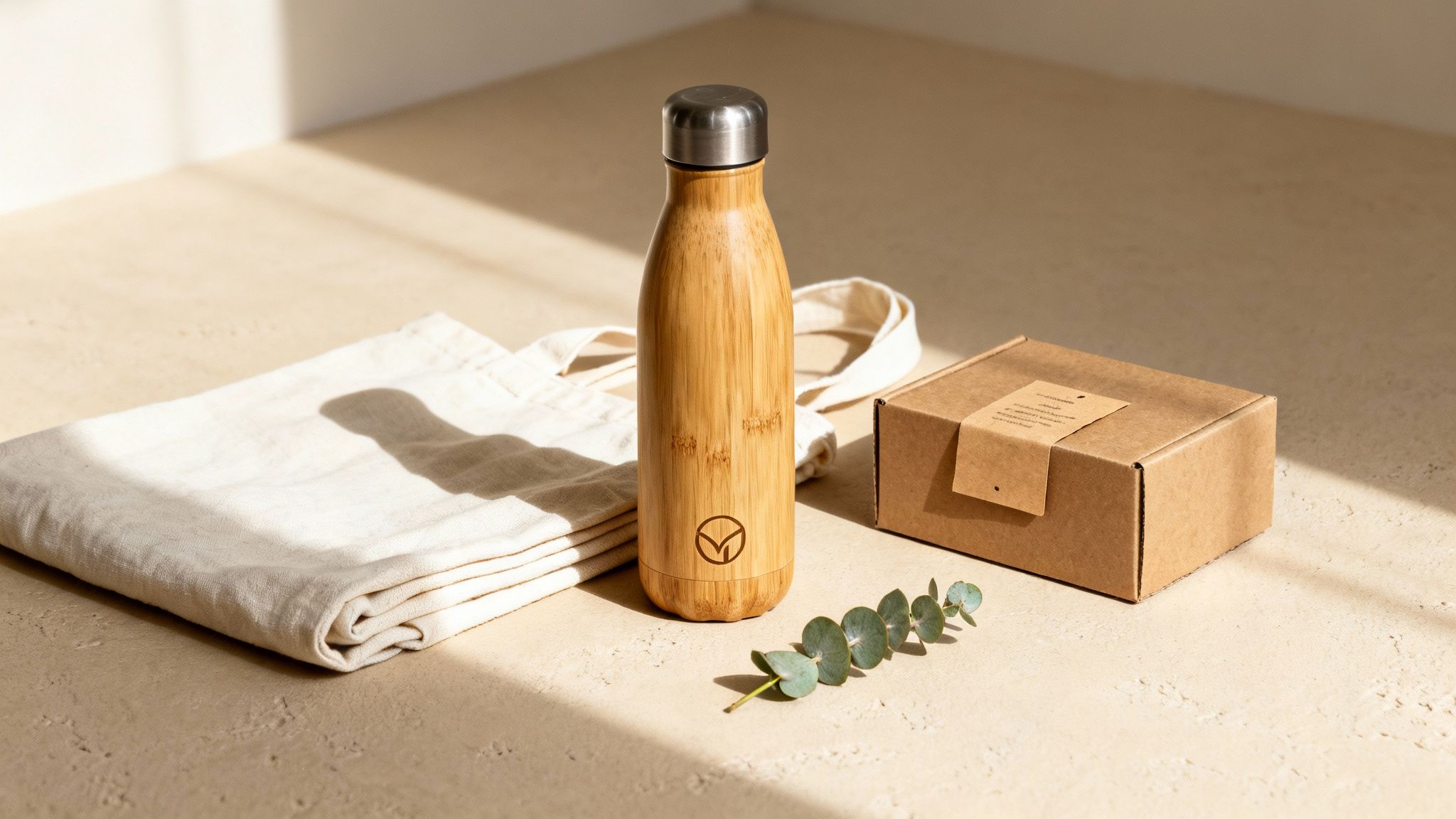
The Rise of Eco-Friendly Promotional Products
Sustainability isn't just a buzzword anymore; it’s a baseline expectation. People actively support brands that demonstrate they care about the planet, and your choice of merchandise is a very tangible way to show you’re on the same page. Choosing eco-friendly promo items proves your brand is forward-thinking and invested in more than just the bottom line.
These products are made from a fantastic range of sustainable materials, each with its own story:
- Recycled Plastics (rPET): This clever material gives single-use plastics a second life, turning old bottles into stylish bags, lanyards, and even clothing. It’s a brilliant way to show your commitment to a circular economy.
- Bamboo: As one of the fastest-growing plants on Earth, bamboo is an incredibly renewable resource. It’s used to make everything from sleek coffee cups and pens to modern-looking cutting boards.
- Organic Cotton: Grown without nasty pesticides, organic cotton is perfect for premium-feeling t-shirts and tote bags. It’s not just better for the environment; it’s softer and feels much higher quality.
When you opt for these materials, you’re doing more than just handing out a product—you're sharing your brand's values. To see what’s possible, take a look through our full range of eco-friendly promotional products.
Why Premium Merchandise Delivers Greater Impact
At the other end of the spectrum, there's a growing appreciation for sheer quality. A premium promotional item—think a high-end portable speaker or a vacuum-insulated thermos—acts as a powerful and long-lasting brand ambassador. Yes, the initial cost is higher, but the return on that investment is worlds apart.
These items feel less like an ad and more like a genuine gift. This creates a much stronger sense of loyalty and appreciation, whether you're giving it to a key client, a top prospect, or a star employee. A premium product won’t get tossed aside; it will be used, valued, and shown to others, giving your brand positive exposure for years.
When you give someone a premium item, you are making a direct statement about how you value them and, by extension, how you value quality in your own business. It shifts the perception of your brand from transactional to relational.
This dual trend towards sustainability and quality isn't just a gut feeling; the data backs it up. Recent reports show a 30% increase in sales of eco-conscious branded merchandise and a parallel 25% rise in demand for premium promotional goods. This confirms that businesses are seeing real results from investing in products that last.
Getting Your Budget Right and Measuring What Matters
Let's talk money. Turning a box of branded pens into a real, measurable marketing win all starts with a smart budget. This isn't just about avoiding a shock on your credit card statement; it's about thinking strategically. A solid budget forces you to choose items that truly resonate and represent your brand well, without breaking the bank.
Think of your budget as the game plan for your campaign. You wouldn't build a house without a blueprint, right? Same goes for ordering merch. Nailing down the numbers first helps you make clever decisions and put your money where it will work hardest for you.
Looking at the Real Costs Involved
The price tag on a single item is just the beginning. To get the full picture of what you're spending, you need to factor in all the little costs that can add up. It’s these details that often get overlooked.
Here’s a breakdown of what you really need to budget for:
- The Unit Price: This is your starting point—the cost for one item. The good news is this almost always drops as your order quantity goes up. Buying in bulk has its perks.
- Setup Fees: Think of this as the cost to get the machines ready for your specific job. It's a one-off fee to create a screen for printing or to program an embroidery machine with your logo.
- Artwork Charges: Got a fuzzy, low-resolution logo? You might need a designer to convert it into a print-ready vector file. This ensures your branding looks sharp, not pixelated.
- Freight and Delivery: This is simply the cost of getting the finished goods from our warehouse to your doorstep or event venue.
- Extra Customisation: Want your logo printed on the back as well as the front? Need special gift boxing? These kinds of extras will add to the final cost.
Knowing these costs upfront means you can compare quotes properly and avoid any nasty surprises later on.
How to Figure Out Your Campaign ROI
Once your merch is out in the wild, the big question is: was it worth it? That’s where Return on Investment (ROI) comes in. It’s the simple metric that tells you how much bang you got for your buck.
The formula itself is pretty straightforward:
ROI = ( (Financial Gain from Investment - Cost of Investment) / Cost of Investment ) x 100
Let’s make that real. Imagine a local accounting firm spends $2,000 on some really nice branded notebooks for a small business expo.
- They give out all the notebooks and get 50 solid leads.
- Out of those leads, 5 sign on as new clients. Each client is worth about $1,500 in their first year.
- That’s a total of $7,500 in new business (5 clients x $1,500).
Now, let's pop those numbers into the formula:
( ( $7,500 - $2,000 ) / $2,000 ) x 100 = 275%
An ROI of 275% is fantastic. It proves the notebooks weren't just an expense; they were a seriously profitable investment.
What to Track to Prove Success
Sometimes, the goal isn't direct sales—it's about getting your name out there. So, how do you measure brand awareness? You can still track key metrics that show your promotional products are doing their job.
Here’s what to keep an eye on:
- Cost Per Impression (CPI): This is where promotional products really shine. To work it out, just divide the total cost of your campaign by the number of times you estimate the item will be seen. That $5 branded coffee mug that gets used every single day for a year? It’s delivering thousands of impressions for a ridiculously low CPI.
- Lead Generation: At trade shows or events, this one's easy. Count how many genuine leads you get in exchange for a giveaway. You can get clever here by adding a unique QR code to the product that directs people to a specific landing page, letting you track engagement digitally.
- Conversion Rate: This one ties directly to sales. Of all the leads you got from your giveaway, what percentage actually became paying customers?
- Brand Recall and Social Media Buzz: Keep an eye on your social media channels. Are people posting photos with your merch? Tagging your business? A spontaneous shout-out is a powerful sign that your products are making a genuine connection.
Tracking these numbers gives you hard data to prove your marketing efforts are paying off. Budgeting isn't about finding the absolute cheapest item. It’s about finding the best value. By exploring different promotional products by price, you can find quality items that fit your budget and deliver a brilliant return.
Your Step-By-Step Guide to Ordering Promotional Products
Ready to get your promotional campaign off the ground? Let's walk through the entire ordering process, step-by-step. Think of this as your roadmap, guiding you from that first spark of an idea all the way to a box of fantastic promo gear landing on your doorstep.
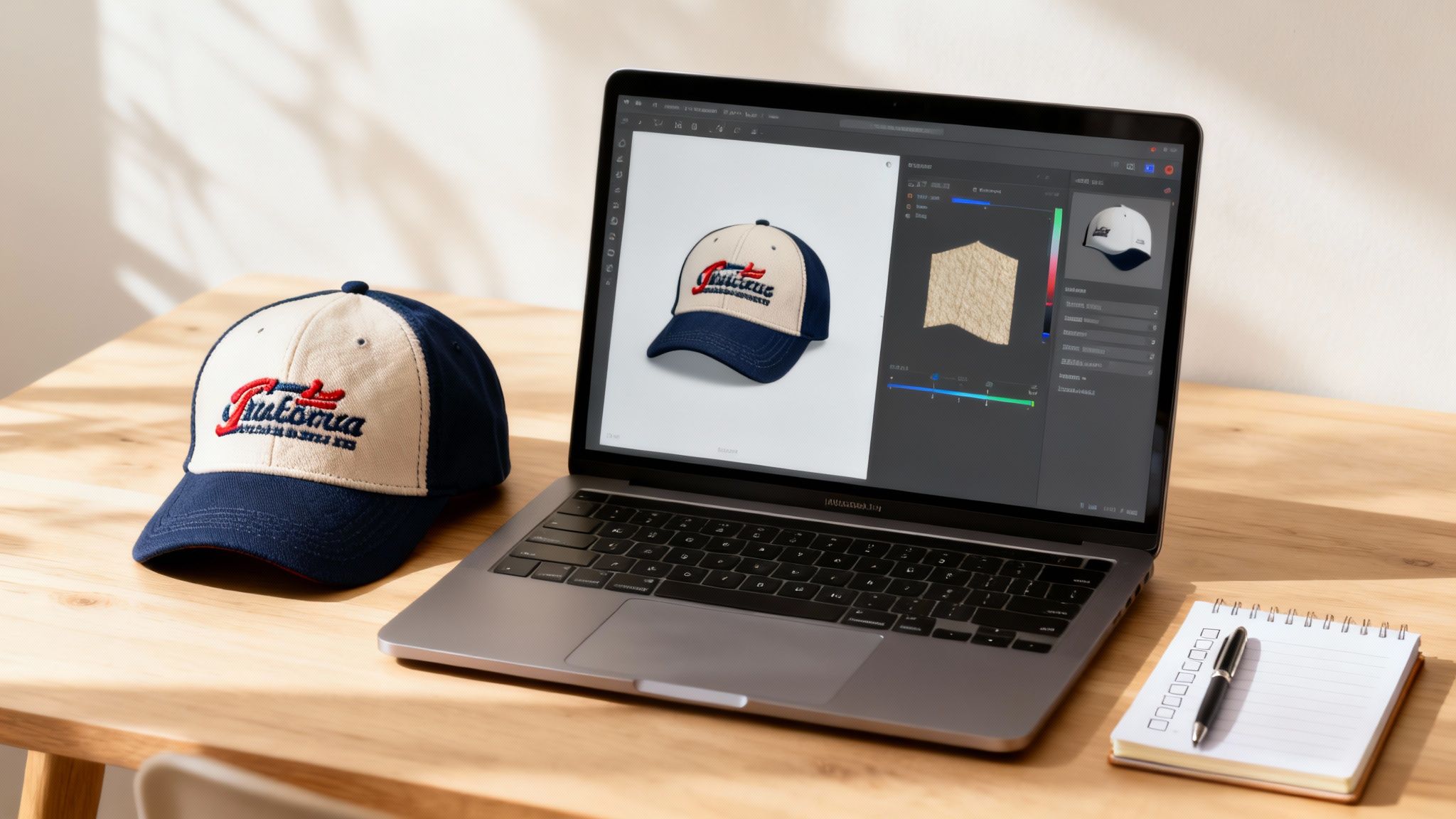
We've refined this process to take the guesswork out of it. Each stage builds on the last, so you can feel confident you’re making the right choices for your brand and your campaign.
Stage 1: Inspiration and Quoting
Every great campaign starts with an idea. This is the fun part where you get to explore products and figure out what aligns best with your goals. Think about who you're trying to reach, what your budget looks like, and the message you want your brand to convey.
Once you’ve narrowed down a few contenders, it’s time to talk numbers.
- Request a Quote: Get in touch with our team and let us know which items you're interested in, how many you need, and your branding ideas. We'll put together a detailed quote with a full cost breakdown—no hidden fees, no surprises.
- Get a Virtual Sample: Before you commit to anything, we’ll create a free digital mock-up. This shows you exactly how your logo will appear on the product, helping you see the finished item before it even exists.
This first stage is all about working together to make sure the product is the perfect match for your brand.
A virtual sample is your best friend in the ordering process. It’s a risk-free way to approve colour, sizing, and placement, guaranteeing the finished promotional products match your vision perfectly.
Stage 2: Artwork and Approval
Okay, so you've picked your product and you're happy with the direction. Now it's time to lock in the design. This is where we make sure your brand identity looks sharp and professional on the final item.
You’ll need to send us your logo or design in a high-resolution vector format. These files usually end in .AI, .EPS, or .SVG. Why is this so important? Vector files can be scaled to any size without becoming blurry or pixelated, which means your logo will look crisp and clean, whether it's on a tiny pen or a massive banner.
Once we have your artwork, our team will prepare a final proof for you to review. This is your last chance to triple-check everything—spelling, colours, logo placement, you name it. After you give us the official thumbs-up, your order heads straight to the production queue.
Stage 3: Production and Delivery
This is where the magic happens. We take your approved design and turn it into real, tangible merchandise. Production times can vary depending on what you've ordered and the branding method we're using, but we'll give you a clear delivery estimate right from the start.
We handle all the behind-the-scenes logistics and will keep you in the loop as your order moves along.
Before you know it, your custom-branded promotional products will arrive at your door, ready to make a brilliant impression at your next event, campaign, or client meeting.
Your Promotional Product Questions, Answered
Even with a solid plan, a few practical questions always pop up when it's time to order. We get it. Let's tackle some of the most common queries we hear from clients, giving you clear, straightforward answers to help you order with total confidence.
How Long Will My Order Take?
This is a big one, and the honest answer is: it depends. The lead time for your order hinges on what you're ordering, how it's being branded, and how many you need.
As a rule of thumb, you can expect standard items with straightforward branding to land on your doorstep in about 2-3 weeks after you’ve given the final artwork your thumbs-up.
But if you're looking at something more complex, like a completely custom-designed item or a massive order coming from overseas, you'll need to think further ahead. These can take anywhere from 8-12 weeks, sometimes longer. The best advice we can give? Plan ahead. Chat with your supplier about timelines right at the start to make sure there are no stressful, last-minute surprises.
How Can I Make Sure My Logo Looks Perfect?
The key to getting a crisp, professional finish on your merch is all in the artwork you provide. For the best results, you'll want to supply your logo in a vector format. Look for file types like .AI, .EPS, or .SVG.
Think of it like this: a normal image file (like a JPEG) is made of tiny dots (pixels). When you stretch it, it gets blurry and jagged. A vector file, however, is built on mathematical lines and curves. This means you can scale it up to fit on the side of a bus or shrink it to fit on a pen, and it will stay perfectly sharp every single time.
Before anything goes to print, you’ll always get a digital proof. This is your chance to double-check everything—the colours, the size, the placement—and make sure it’s exactly what you had in mind.
Is it Better to Order More Cheap Items or Fewer Premium Ones?
The classic quantity vs. quality debate! The truth is, there's no single right answer. It all comes down to what you're trying to achieve and who you're trying to reach. One isn't better than the other; they just do different jobs.
Here’s how to think about it:
- Going for Mass Awareness? If you're at a huge trade show or a community event, your goal is to get your brand in as many hands as possible. This is where cost-effective items like pens, keyrings, or tote bags really shine. It’s a smart and effective way to maximise your reach.
- Making a High-Value Impact? When you want to thank a loyal client, recognise a star employee, or make a lasting impression on a major prospect, a premium gift speaks volumes. A high-quality, thoughtful item shows you value the relationship and reflects the quality of your own brand.
Ready to find the perfect promotional products for your next campaign? The expert team at Simply Merchandise is here to help you every step of the way, from initial ideas to final delivery. Explore our extensive range and get a free quote today!