



Ever wondered how some brands get those incredibly vibrant, all-over designs on their polo shirts? The kind that look like the pattern is part of the fabric itself, not just printed on top?
That’s the magic of a sublimated polo shirt. It’s a clever printing process where special solid inks are heated until they turn into a gas. This gas then permanently infuses the full-colour design directly into the polyester fibres of the shirt.
What Is a Sublimated Polo Shirt Anyway
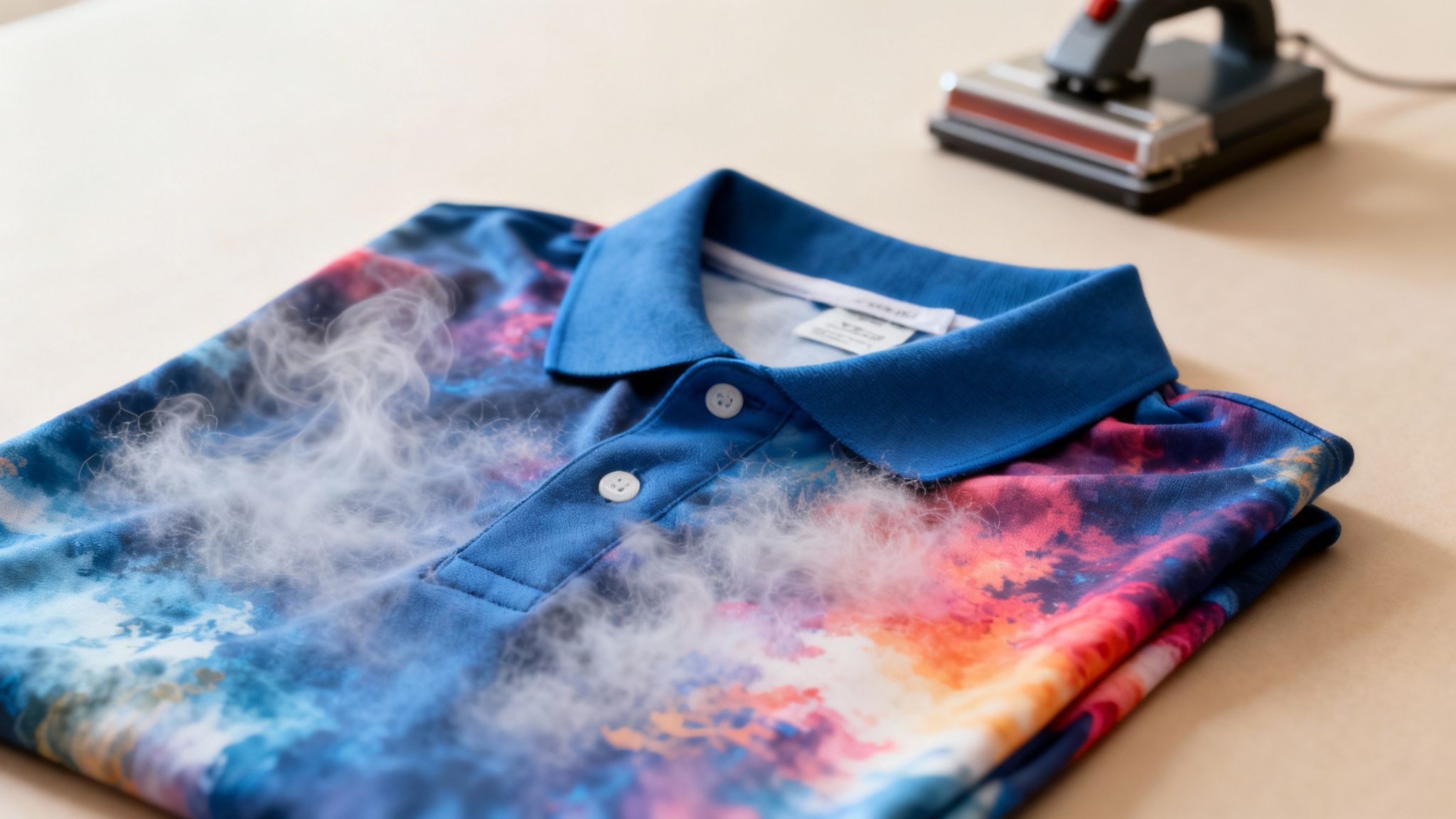
Unlike screen printing, which puts a layer of ink on top of the fabric, sublimation creates a chemical bond. The best way to think about it is like a tattoo for fabric. The ink doesn't just sit on the surface; it merges with the individual fibres when heat and pressure are applied, becoming one with the material.
Because the ink is in the material, the final design is completely seamless. You can run your hand over it and feel nothing but the smooth fabric. For businesses, this is huge. It means no more cracking, peeling, or fading logos, even after dozens of washes and long days out in the Aussie sun.
The Science Behind the Style
The whole process hinges on a special dye that goes straight from a solid to a gas when heated, skipping the liquid phase entirely. It’s a scientific process called—you guessed it—sublimation.
When this gaseous ink hits the polyester fabric under a heat press, the pores of the fabric open up and the ink bonds with the fibres on a molecular level. As it cools, the pores close, locking the colour in for good.
This is exactly why sublimation works best on synthetic fabrics, with 100% polyester giving you the most stunning, crisp results. The ink simply doesn't bond with natural fibres like cotton. This deep infusion process ensures the design is incredibly durable while keeping the fabric's original feel and performance intact.
Key Takeaway: With a sublimated polo shirt, the design isn't an addition to the garment; it is the garment. This guarantees unmatched durability, a premium feel, and zero impact on the fabric’s breathability or moisture-wicking properties.
Why This Matters for Your Brand
The benefits here go way beyond just being long-lasting. This technology opens up a world of creative freedom that other methods just can't match, making it a brilliant choice for businesses that want truly unique and high-impact branded clothing.
Here’s what makes a sublimated polo shirt such a game-changer:
- Complete Design Freedom: Your entire polo becomes a blank canvas. Think photorealistic images, intricate gradients, and patterns that run seamlessly from edge to edge.
- Incredible Durability: The design will last as long as the polo itself. It will never fade, crack, or peel away.
- Superior Comfort and Performance: The fabric stays lightweight, breathable, and soft, which is perfect for active teams or staff on the go.
For any Australian business looking for uniforms or promotional gear that really stands out, getting to know the process behind a sublimated polo shirt is the first step toward a smarter investment in your brand.
Why Sublimated Polos Are a Game-Changer for Team Uniforms
When you’re kitting out your team, you want uniforms that look sharp, feel great, and actually last. This is where sublimated polo shirts really shine, offering a whole host of benefits that older, more traditional methods just can't compete with. It’s not just a different way of getting a logo on a shirt; it’s a fundamentally better way to create a garment that truly represents your brand.
The advantages are massive, touching on everything from your long-term budget to how comfortable your team feels on a scorching summer day. Let’s break down exactly why these modern polos are leaving the old-school options in the dust.
Total Creative Freedom
Think of a standard polo shirt as a blank canvas, but with dye sublimation, there are absolutely no rules. With traditional screen printing or embroidery, you're usually boxed in by a limited number of solid colours and stuck with simple logo placements. A sublimated polo shirt throws that rulebook out the window.
Because the design is digitally printed and becomes one with the fabric, you can get incredibly creative. We’re talking:
- Photorealistic Images: Want a high-resolution photo of your flagship product or a stunning local landmark on the shirt? No problem.
- Complex Gradients: You can create silky smooth colour transitions, from a subtle fade to a vibrant rainbow effect.
- Edge-to-Edge Patterns: Cover the entire garment—sleeves, collar, the works—in a custom pattern or an intricate, repeating design.
This means your uniform transforms from a simple piece of clothing with a logo slapped on it into a powerful branding statement. You can nail your brand’s exact Pantone colours, design a shirt that tells your company’s story, or create something so visually stunning it gets people talking.
Built to Last
Let's be honest, one of the biggest letdowns with traditional uniforms is how quickly they start to look tired. Screen-printed logos crack and peel away, and embroidered designs can unravel and fray after just a few cycles in the wash. And the harsh Australian sun? It can bleach the colour out of a standard shirt in no time.
Sublimation sidesteps all of this. By infusing the ink directly into the polyester fibres, the design becomes a permanent part of the fabric. It will not crack, peel, or fade, no matter how many times it’s washed or how many long days it spends in the sun. This incredible durability means you get a much better return on your investment, with your team looking sharp and professional for years, not just a few months.
This resilience is a key reason custom polo shirts with dye sublimation have seen a massive uptake among Australian businesses. In fact, some suppliers reported a 40% year-on-year increase in orders for sublimated performance polos since 2022, as brands seek durable, high-performance options for their teams. Read more about the rise of these high-performance fabrics.
Peak Comfort and Performance
A uniform is practically useless if it’s uncomfortable, especially for active staff at trade shows, outdoor events, or on a busy shop floor. Traditional printing methods often leave a thick, plastic-like patch on the fabric that feels stiff and traps heat. It’s the last thing you want on a hot day.
A sublimated polo, however, feels exactly like the original fabric. Since the ink is a gas that dyes the fibres, it adds zero weight and doesn't clog the material's weave. The shirt remains:
- Lightweight and Soft: The feel of the fabric is completely natural and unchanged.
- Fully Breathable: Air flows right through, just as the material was designed to do.
- Moisture-Wicking: The performance polyester does its job perfectly, pulling sweat away from the skin to keep the wearer cool and dry.
This focus on performance makes sublimated polos the go-to choice wherever comfort is a priority. When your team feels good, they perform better and give your customers a much more positive impression. For a deeper look at professional apparel solutions, explore our guide to corporate wear.
Setting Your Project Up for Success
To get that brilliant, edge-to-edge finish that makes sublimated polos stand out, you need to get two things right from the very beginning: the fabric and the artwork. It’s a classic partnership. Get these fundamentals sorted, and you're well on your way to a professional, high-quality garment that looks incredible.
Think of it like painting a masterpiece. You wouldn't use cheap paper and watery paints, would you? You’d choose a quality canvas and vibrant pigments. It’s the exact same principle with sublimation.
Choosing the Right Fabric Canvas
The magic of sublimation is all in the science. The process uses heat to turn ink into a gas, which then needs to permanently bond with the fabric's fibres. This chemical reaction only works with polymers, which is why 100% polyester is the undisputed champion for sublimation.
When heated, the pores of the synthetic polyester fibres open up, allowing the gaseous ink to sink deep inside. As the fabric cools, the pores close, permanently trapping the colour within the fibres themselves. The design literally becomes part of the shirt.
This is a crucial point. Natural materials like cotton or wool just don't have the right chemical makeup for the ink to bond to. If you tried to sublimate a 100% cotton shirt, the design would look faded and washed out from the get-go, and it would practically disappear after the first wash. The ink simply has nothing to hold onto. So, for those sharp, vibrant colours that last, you absolutely need a quality polyester base.
Preparing Your Artwork for a Flawless Print
The fabric might be your canvas, but your digital artwork is the paint. A low-resolution image that looks decent on your screen will quickly become a blurry, pixelated mess when it’s blown up to the full size of a polo shirt.
To avoid any nasty surprises, here’s a quick checklist to get your design files print-ready:
- Vector is Best: Whenever possible, supply your artwork as a vector file. We’re talking formats like .AI (Adobe Illustrator), .EPS, or .PDF. Unlike JPEGs or PNGs, which are made of pixels, vectors are built from mathematical equations. This means they can be scaled to any size—from a small chest logo to a full-shirt design—without ever losing sharpness.
- Think in CMYK: Your computer monitor uses an RGB (Red, Green, Blue) colour profile, but professional printers run on CMYK (Cyan, Magenta, Yellow, Black). Designing in CMYK mode from the start gives you a much more accurate preview of how the final colours will look on the fabric.
- Size Matters: Your design file should be created at the actual size you want it printed. Sending a tiny logo and asking us to stretch it across the back of a shirt is a recipe for a poor-quality, fuzzy result.
Nailing these details isn't just about making things look good—it ensures the entire production process runs smoothly and that the final polo accurately represents your brand. For a more detailed walkthrough, check out our simple guide on artwork submission tips to help you prepare your files like a pro.
By pairing the right polyester fabric with sharp, high-resolution vector artwork, you're setting the stage for a flawless sublimated polo that not only looks professional but is built to last.
How Sublimation Compares to Other Branding Methods
Picking the right branding method for your team’s polos can feel like a big decision. You’ve got a few classic options on the table—sublimation, screen printing, and embroidery—but each one shines in a different scenario. Knowing their unique strengths and weaknesses is the key to getting the perfect result for your budget, design, and overall brand image.
Think of it like choosing the right tool for a job. You wouldn't use a hammer to drive a screw, right? In the same way, the method that’s brilliant for a simple, one-colour logo might be completely wrong for a vibrant, full-coverage design. Let's break down how these three popular techniques stack up against each other.
Branding Method Comparison: Sublimation vs Screen Printing vs Embroidery
When you're deciding how to bring your apparel designs to life, you'll likely run into these three heavyweights. Each has its place, but they deliver very different looks, feels, and performance characteristics. The table below gives you a quick side-by-side look to help you match the method to your mission.
Ultimately, the best choice boils down to your specific needs. If you want a breathable, permanent, and visually stunning design that covers your whole polo, sublimation is the clear winner. For bulk orders of simple promo shirts, screen printing is your workhorse. And for a classic, professional touch, you can't beat embroidery.
Sublimation: The All-Over Design Champion
As we've covered, a sublimated polo shirt is the undisputed champion of creative freedom. Because the ink literally becomes one with the fabric, the only limit is your imagination.
- Best for: Photorealistic images, complex colour gradients, repeating patterns, and edge-to-edge artwork.
- Feel: It’s completely smooth. You can't feel the design at all, so the fabric’s original soft, breathable feel is perfectly preserved.
- Durability: The design is permanent. It will never crack, peel, or fade, easily lasting as long as the garment itself.
This is why sublimation is the go-to for performance wear, sports teams, and any brand that wants to make a bold, colourful statement that covers the entire polo.
This hierarchy chart shows the essential components for a successful sublimated polo shirt project.
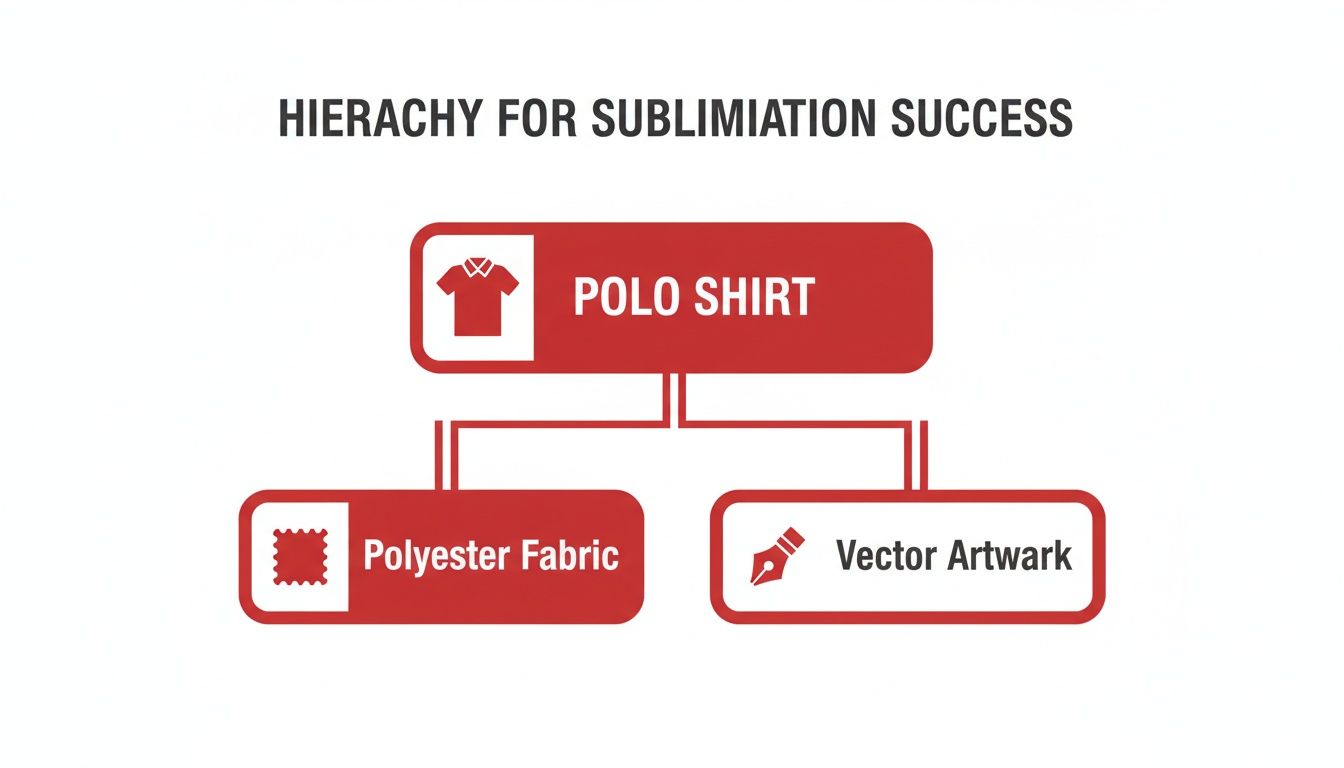
As the chart shows, it all starts with the right foundation: a quality polo shirt made from polyester, designed with clean vector artwork to ensure a fantastic result.
Screen Printing: The Bulk Order Workhorse
Screen printing is a traditional and highly reliable method where ink is pushed through a mesh screen onto the fabric. Each colour gets its own screen, so it's a process that creates the design one layer at a time. It’s a fantastic option for simpler graphics, especially in large quantities.
- Best for: Simple logos, text-based designs, and graphics with one to four solid colours.
- Feel: You can feel a thin layer of ink sitting on top of the fabric. It's generally soft but can feel thicker as more colours are added.
- Durability: A high-quality screen print is quite durable, but it can be prone to cracking or fading over many years of washing and sun exposure.
It remains an incredibly cost-effective choice for large-volume orders, like promotional giveaways or event staff shirts that feature a straightforward logo.
Embroidery: The Classic and Professional Touch
For a premium, textured finish, nothing beats embroidery. This technique stitches your design directly into the fabric with thread, adding a touch of class and a three-dimensional quality that no print method can replicate.
- Best for: Small, refined logos (think chest or sleeve placement), monograms, and text.
- Feel: The stitched design is raised and has a distinct, professional texture that people notice.
- Durability: It’s extremely durable. High-quality thread holds its colour incredibly well and resists wear and tear, often outlasting the polo itself.
Embroidery is perfect for corporate uniforms, executive apparel, and any brand wanting to convey an instant message of quality and tradition. For a detailed overview of all the different ways you can brand your gear, you can explore our full range of custom printing options.
In Australia and New Zealand, the demand for dye-sublimated apparel is surging, projected to grow at an impressive 8.1% CAGR between 2025 and 2035. This boom is fuelled by our love for personalised gear, with over 70% of Australian SMEs now choosing sublimation for its vibrant results and cost-effectiveness on smaller, more customised runs.
Bringing Your Custom Polo Design to Life
Turning a great idea into a real, high-quality sublimated polo is a fun creative process. It can feel like a big job at first, but if you break it down into a few clear steps, it’s actually a pretty straightforward path from concept to the finished product.
Following a structured approach just means every detail gets the attention it deserves. Let’s walk through the five essential stages to make sure the process is smooth, especially if this is your first time ordering custom apparel.
Step 1: Defining Your Vision
Before you even think about colours or logos, you need to know why you're making these polos. What’s their main job? Are they for a corporate trade show, a local sports team uniform, or everyday staff wear? The answer to that question will shape every other decision you make.
Think about who will be wearing them and the impression you want to make. A polo for a tech conference might be clean and modern, while a uniform for a local footy club needs to be bold and full of energy. Get this foundation right, and everything else falls into place much more easily.
Step 2: Creating the Artwork
Once you have a clear vision, it’s time to bring it to life visually. If you have an in-house designer, great. If not, working with a professional is a smart move to make sure your artwork is print-ready and looks sharp.
When you brief your designer, give them everything they need: your brand guidelines, specific Pantone colours, and any high-resolution logos. It also helps to show them a few examples of designs you like to give them a feel for your style.
Pro-Tip: For a really polished look, think about how the design will run across the seams of the shirt. A good designer can create patterns that wrap seamlessly from the front, around the sides, and onto the sleeves without any awkward cuts. It's a small detail that makes a huge difference.
If you want to play around with ideas and see how they might look, an AI outfit generator can be a useful tool for visualising how a design might look on a person before you commit.
Step 3: Choosing Your Canvas
The polo shirt itself is your canvas. The style you pick—from the collar type to the buttons—sets the overall vibe. But what's really crucial for sublimation is the fabric. As we've covered, a 100% polyester garment is what you need for the most vibrant, sharp, and permanent print.
Think about where the polos will be worn. Is your team going to be outdoors in the Aussie sun? A lightweight, moisture-wicking polyester is a must. For a corporate office, a slightly heavier polyester with a pique knit can give a more structured, premium feel. Choosing the right fabric makes the shirt look better and feel more comfortable.
Step 4: Getting the Fit Right
A brilliant design on a shirt that doesn't fit well is a wasted opportunity. Uniforms need to look professional and make your team feel good. The last thing you want to do is guess everyone's sizes.
The best way to handle this is to get a detailed sizing chart from us and ask your team to measure themselves. It’s the only way to get an accurate fit. If you have the time, ordering a few sample sizes is even better, as it removes all the guesswork before the main production run. This simple step saves you the headache of returns and ensures everyone gets a polo they’ll actually want to wear.
Step 5: The Final Sign-Off
Before your order heads to the printer, you’ll get a digital proof, or a "mock-up." This is your final chance to spot any issues. It's so important to look over every single detail with a fresh set of eyes.
- Check Spelling and Numbers: Are all names, phone numbers, and websites correct? It's amazing what a second look can catch.
- Verify Colours and Logos: Do the colours look right for your brand? Is your logo sharp and positioned correctly?
- Review Placement: Is every single design element exactly where you envisioned it?
This final check is absolutely critical. Once you approve that proof, any error on it will be printed on every single shirt. Taking an extra five minutes here can save you a world of pain later and guarantees your custom sublimated polo shirt comes out perfect.
While sublimation is a unique beast, some of these design principles apply to other methods too. For a different perspective on branding apparel, you can learn more about our custom embroidery logo services.
Where Sublimated Polos Shine in the Real World
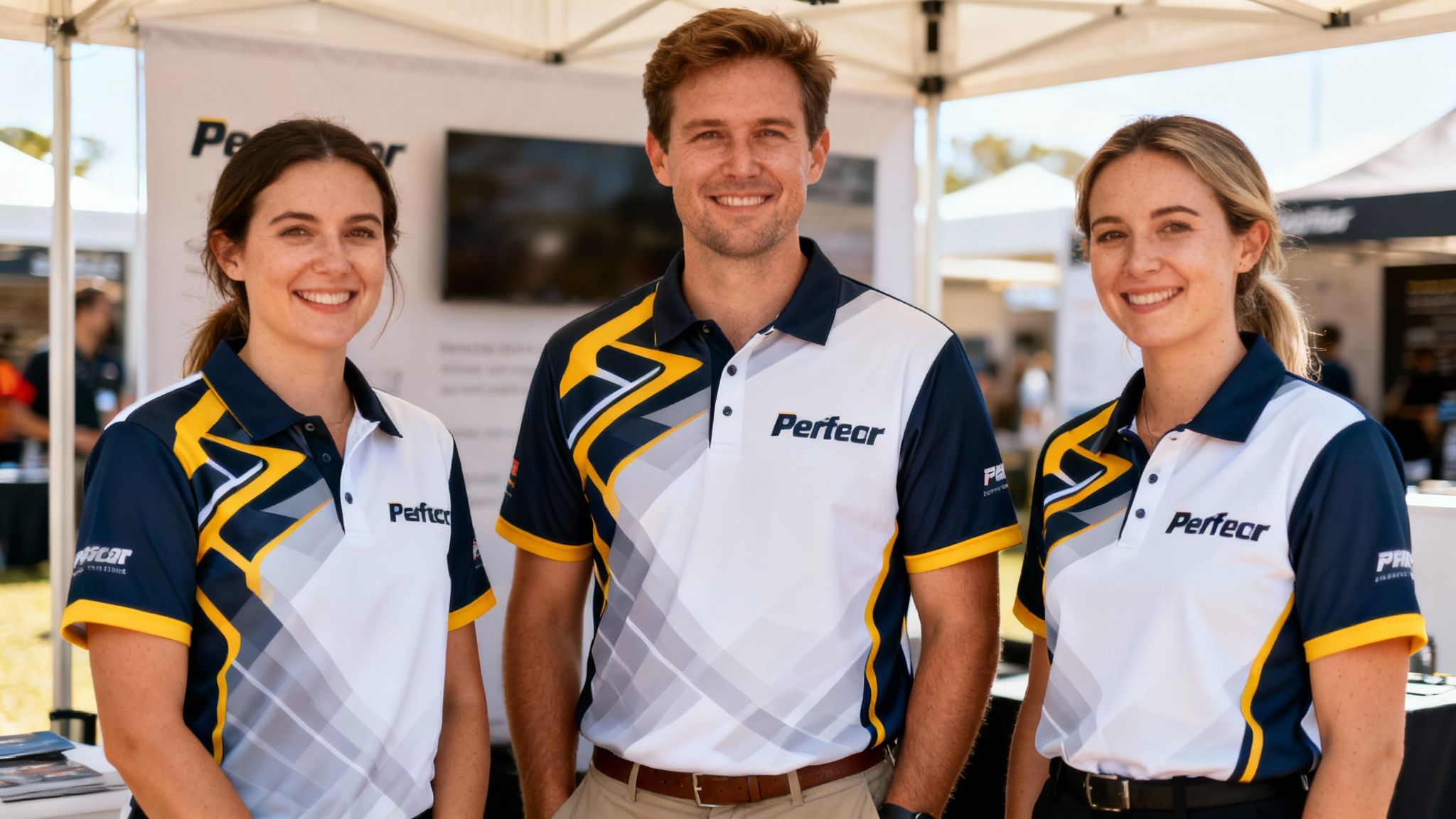
The real magic of a sublimated polo shirt isn't just in the printing process—it's how they perform out in the wild. Across Australia, you'll find them everywhere from bustling trade shows to local sports fields, and for good reason. They’re the perfect blend of hard-wearing comfort and complete design freedom.
Let's look at a few classic scenarios where these shirts really prove their worth.
Corporate and Event Branding
Picture your team at a major Sydney trade show. It's a sea of competitors, and you need to stand out. A sublimated polo gives your crew a sharp, cohesive look with branding that flows from seam to seam, all in your exact company colours. No compromises.
More than just looks, the breathable fabric keeps everyone comfortable under hot exhibition hall lights. When your team feels good, they perform better, making a brilliant first impression and ensuring they're instantly recognisable in the crowd.
Sports Clubs and Team Uniforms
Now, think about a local footy club in Perth gearing up for the season. They need uniforms that can take a beating, week in and week out, while showing off team colours and sponsor logos with pride. This is where sublimation is the undisputed champion.
Because the ink is fused into the fabric, the designs will never crack, peel, or wash out. The lightweight, moisture-wicking material is also a massive advantage, keeping players dry and comfortable when the pressure is on. It’s the ultimate combination of performance and durability.
The demand for this kind of apparel is exploding. In fact, Australia's custom apparel market—where sublimated polos are a huge player—is expected to grow by over USD 200 million between 2024 and 2029. Businesses are catching on that they need branded gear that doesn't just look good, but also performs. You can dig into more insights on this custom apparel market trend on technavio.com.
Education and Retail Environments
You'll also see sublimated polos everywhere from university O-weeks to the floor of a busy Melbourne shopping centre. For unis, the ability to print huge, vibrant designs creates fun, engaging shirts that help build a real sense of community for new students.
In a retail setting, staff need uniforms that are tough and easy to look after. A sublimated polo shirt looks just as crisp at the end of a long shift as it did at the start. Its fade-resistant nature means the whole team looks consistent and professional for years, not just a few months.
Of course. Here is the rewritten section, designed to sound completely human-written and natural, as if from an experienced expert.
Common Questions About Sublimated Polos
When you're looking to invest in new custom gear, it's smart to ask questions. To make sure you feel completely confident about choosing sublimation, we've gathered the most common queries we get from businesses just like yours.
These are the practical, real-world answers you need, covering everything from fabric colours to keeping your polos looking sharp for years to come.
Can You Sublimate on Any Colour Polo Shirt?
This is a fantastic question, and it really gets to the core of how sublimation works. The process is more like dyeing the fabric’s individual fibres than printing on top of them. Because of this, you need a white or very light-coloured 100% polyester base for the colours to come out looking true and vibrant.
Here’s a simple analogy: think about using watercolours on paper. If you paint on a crisp white sheet, the colours look exactly as you intended. But if you try to paint that same picture on blue paper, the background blue will bleed through and throw off all your other colours. Sublimation is no different. A white canvas is the industry standard for a reason—it guarantees the most brilliant and accurate results.
What Is the Minimum Order for Sublimated Polos?
One of the best things about sublimation is how flexible it is with order sizes. Traditional methods like screen printing often demand huge minimums to make a print run worthwhile. Sublimation, on the other hand, is efficient even for small batches.
This makes it a brilliant choice for:
- Small businesses or startups wanting to look professional from day one.
- Specialised teams inside a larger organisation.
- One-off events or trade shows where you only need a limited run.
- Quickly topping up staff uniforms without having to place a massive order.
While the exact numbers can vary, the minimums are generally far lower, giving you a lot more freedom.
How Should I Care for My Sublimated Polo?
It's surprisingly easy! Because the ink is fused right into the fabric, you never have to worry about the design cracking, peeling, or fading away over time.
For best results, just pop it in a cold machine wash with similar colours and then hang it up to dry. It's a good idea to steer clear of bleach and fabric softeners. If it needs a press, use a low heat setting on your iron, and it will keep looking brand new for years.
How Long Does a Custom Sublimated Polo Order Take?
The production time for a custom sublimated polo shirt really comes down to two things: how complex your design is and how many you're ordering. As soon as your final artwork gets the green light, we can give you a clear and reliable timeline for delivery.
If you’re working towards a tight deadline for a product launch or an upcoming event, we can often arrange express services to speed things up. The trick to a smooth process is having your artwork sorted and ready to go.
Ready to create a custom polo that makes your brand unforgettable? The expert team at Simply Merchandise is here to help you through every step, from design to delivery.

