


Good work wear isn't just about putting your team in matching shirts. It's a genuine investment in your brand identity, your staff's safety, and the overall morale of your workplace. A well-thought-out uniform does more than just look professional; it ensures you meet safety standards and can make your team feel valued and comfortable, which often translates to better performance.
Building Your Work Wear Strategy From the Ground Up
Before you even think about looking at catalogues or fabrics, the most important thing you can do is lay a solid strategic foundation. I've seen it happen time and time again: businesses jump straight into picking garments and end up with uniforms that miss the mark completely. They're uncomfortable, don't align with the brand, or just aren't practical for the job.
Taking the time to build a proper strategy transforms work wear from a simple expense into a powerful business tool. This first phase is all about asking the right questions. Don't just focus on how the clothes will look; think about what they actually need to do for your team.
Analyse Your Team's Daily Realities
First things first, you need to conduct a thorough needs analysis. This means going deeper than just job titles and really understanding what your employees do day in, day out. A one-size-fits-all approach almost never works because every role has unique demands.
Get practical and ask these kinds of operational questions:
- Physical Demands: Is your team sitting at a desk all day, operating heavy machinery, or constantly on the move? Someone in a physically demanding role needs fabric that breathes and stretches. A desk job, on the other hand, might call for a more structured, corporate look.
- Work Environment: Where do they actually work? Is it an air-conditioned office, or are they outdoors battling the Aussie sun? Maybe they're in a specialised space like a commercial kitchen or a cold storage facility. The environment dictates everything from fabric weight and UPF ratings to whether you need thermal gear.
- Client Interaction: How often are your people face-to-face with customers? For those in client-facing roles, a polished and professional appearance is non-negotiable. For your back-of-house crew, durability and pure function might be the bigger priorities.
This simple workflow shows how you move from understanding the need to putting a plan into action.
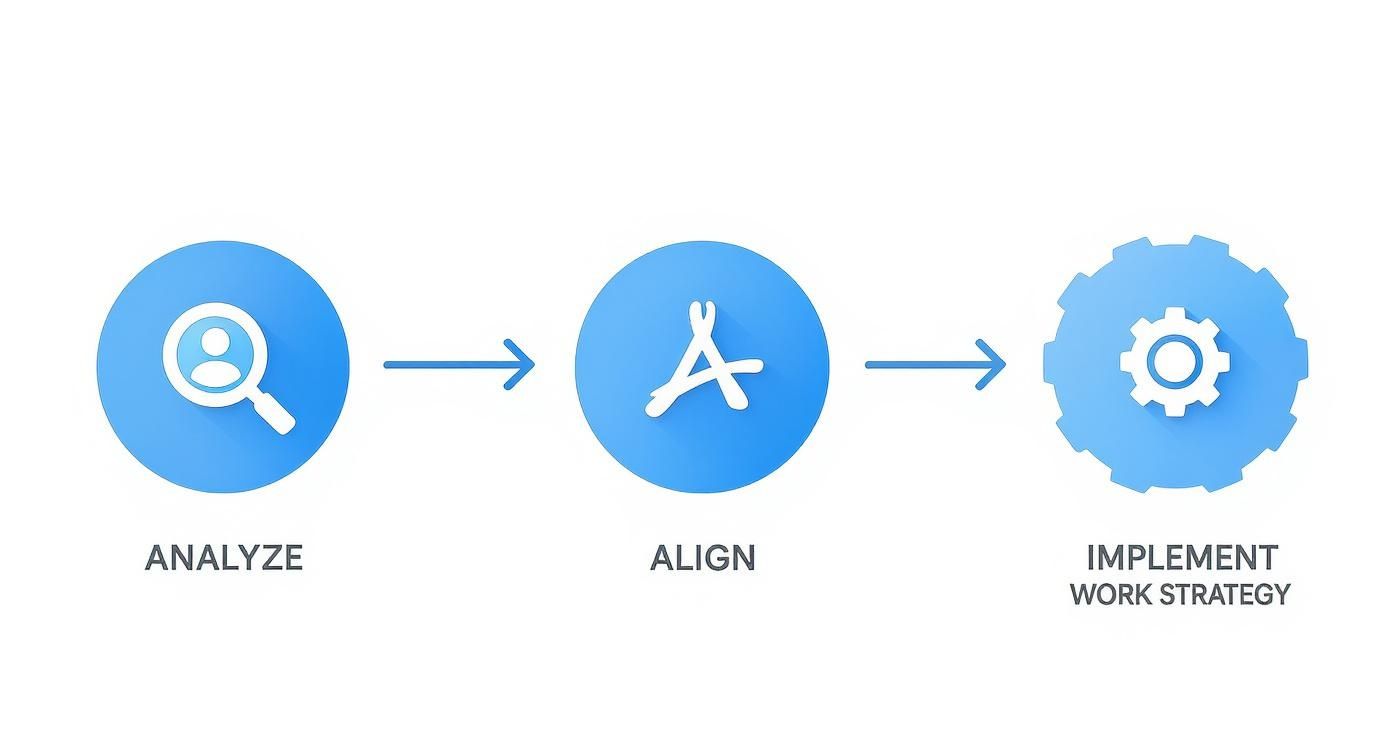
Following this process ensures every decision you make is deliberate, aligning the final uniform with both your operational needs and your brand's goals.
Aligning Uniforms with Brand and Culture
Think of your work wear as a mobile billboard for your brand. It should instantly signal what your company is all about. A creative agency, for example, might go for something more casual and on-trend, while a financial advisory firm will naturally lean towards a more traditional, formal style.
The real goal here is to create a uniform that your employees are genuinely proud to wear. When people feel good in what they're wearing at work, it shines through in their performance and how they interact with customers. That sense of pride is fantastic for company culture and helps build a truly unified team.
This way of thinking—choosing items that perfectly represent your brand—applies to more than just clothing. If you're looking for more insight on this, check out our guide on the steps to choose the right promotional products. The process ensures that every branded item, whether it's a pen or a polo shirt, sends a consistent message and gives you a great return on your investment.
Getting Safety Compliance and Industry Standards Right
Let's be honest, navigating Workplace Health and Safety (WHS) regulations can feel like a minefield. But when it comes to workwear, it’s a non-negotiable part of your business. The right gear isn't just about looking professional; it's your team's first line of defence against serious hazards, protecting them and shielding you from liability.
This isn't a small corner of the market, either. Australian workwear is a big deal, valued at USD 464.60 million in 2025 and set to grow by around 6.5% each year after that, especially in sectors like construction and manufacturing. This tells us one thing loud and clear: businesses are paying more attention than ever to safety, comfort, and productivity.
Key Australian Standards You Need to Know
You don’t need to memorise every clause of every regulation, but getting a handle on the key Australian Standards relevant to your industry is essential. These aren't just suggestions; they're rules designed to keep people safe on the job.
Here are the big ones you'll likely come across:
- AS/NZS 4602.1 High-Visibility Safety Garments: This is the absolute standard for anyone working near traffic, cranes, or in low-light conditions. It dictates the amount of fluorescent material and reflective tape needed for day, night, or day/night compliance.
- UPF Sun Protection (AS/NZS 4399): In Australia, sun safety is a massive WHS issue. Look for gear with a certified UPF rating—ideally UPF 50+, which blocks over 98% of harmful UV rays. It's a must for any outdoor team.
- Fire-Retardant (FR) and Arc-Rated (AR) Gear: If your team includes electricians, welders, or anyone in the energy sector, this is mandatory. These specialised fabrics are designed to resist ignition and self-extinguish, providing critical protection against flash fires and electrical arcs.
For a more detailed look at the gear your team might need, it's worth checking out guides on Australian Personal Protective Equipment (PPE) requirements.
The table below breaks down some of the essential safety features required across different industries, giving you a quick reference for what to look for.
Work Wear Safety Feature Checklist by Industry
| Industry | Primary Hazard | Required Safety Feature | Relevant AU Standard |
|---|---|---|---|
| Construction | Struck-by incidents, low visibility | Hi-vis apparel (Day/Night), steel-cap boots | AS/NZS 4602.1 |
| Electrical | Electric arc flash, fire | Arc-rated (AR), fire-retardant (FR) fabric | ASTM F1959, NFPA 70E |
| Warehousing | Slips, trips, vehicle collisions | Non-slip footwear, hi-vis vests | AS 2210.3 (Footwear) |
| Roadwork | Moving traffic, low light, sun exposure | Class D/N hi-vis, UPF 50+ rated fabric | AS/NZS 4602.1, AS/NZS 4399 |
| Mining | Fire, chemicals, impact | FR clothing, chemical resistance, reinforced gear | Varies by site |
This list isn't exhaustive, of course, but it highlights how the specific work environment dictates the type of protection needed.
Putting It Into Practice: Job-Specific Needs
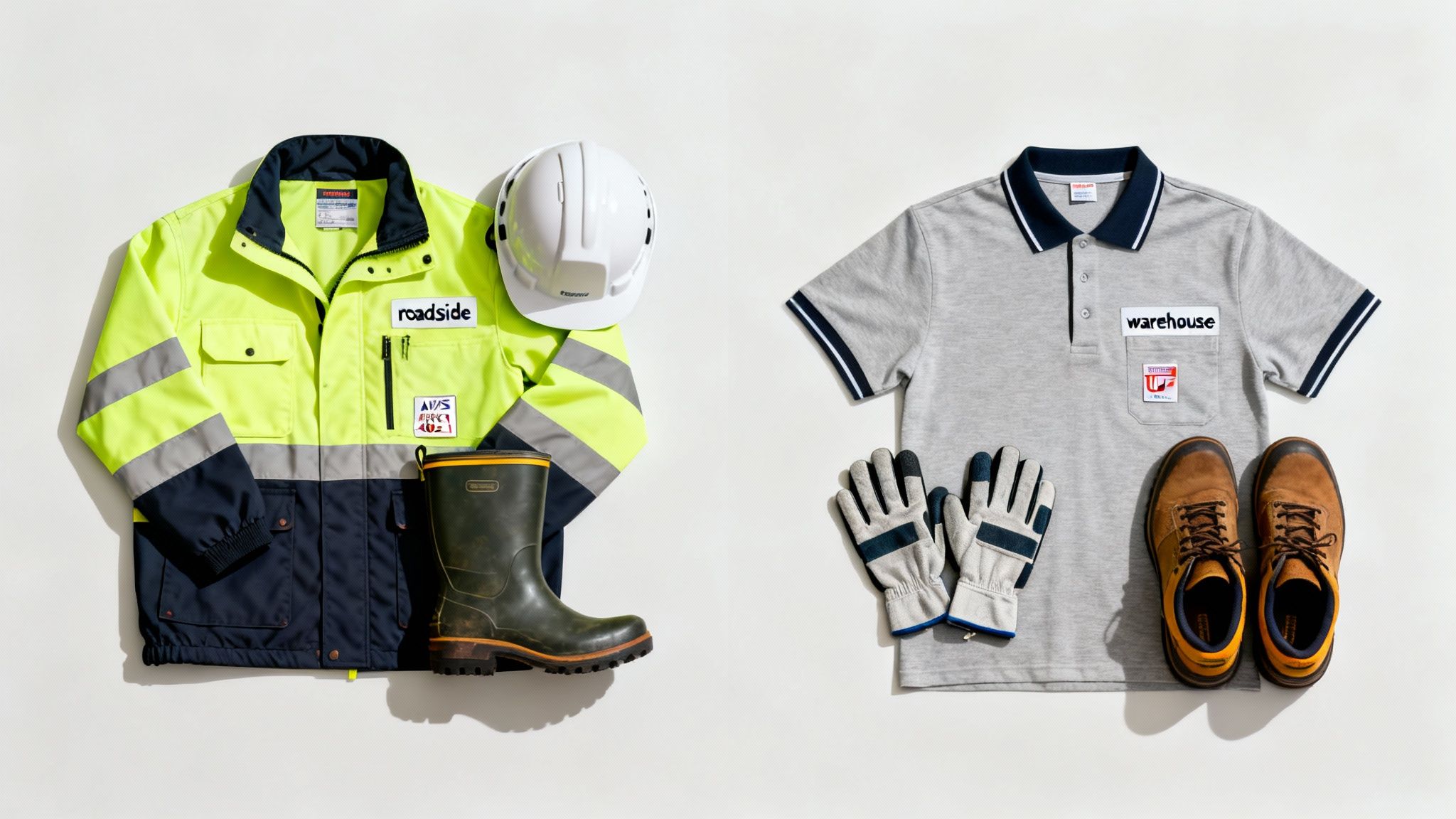
Theory is one thing, but how does this look on the ground? The uniform for a roadside construction crew is worlds away from what a warehouse team needs, even though both jobs are physically demanding.
Take a road worker. They're surrounded by constant, high-speed danger. Their kit must include Class D/N (Day/Night) high-visibility shirts and trousers with reflective tape, steel-capped boots, and a hard hat. Sun protection is just as critical, so long-sleeved, UPF-rated shirts are a no-brainer. You can see examples of this type of gear in our full work wear and hi-vis collection.
Now, picture a forklift operator in a warehouse. The risk profile shifts. High-visibility gear is still important for being seen by colleagues, but the intense day/night compliance might be overkill. Here, the focus shifts to functionality: flexible fabrics for climbing in and out of the cab, reinforced knees to prevent wear and tear, and grippy, non-slip safety boots.
A key takeaway: Compliance is the starting line, not the finish. The best workwear programs look past the bare minimum to address the unique, everyday risks each person on your team actually faces.
Don’t Overlook Ergonomics—The Hidden Safety Factor
True safety isn't just about shielding workers from obvious, external threats. It's also about preventing the gradual wear and tear on their bodies. This is where ergonomics comes in, and it's often overlooked.
A poorly fitting uniform that restricts movement can contribute to musculoskeletal strain over time, leading to chronic pain, lost productivity, and even serious health issues.
Great workwear is designed to move with the body. Look for smart features like articulated knees that bend easily, gusseted underarms that prevent sleeves from riding up, and strategically placed stretch panels. It’s about choosing clothing that helps your team do their job comfortably and safely, not fighting against them. At the end of the day, top-tier workplace safety is where comfort and compliance meet.
Choosing the Right Fabrics and Styles for Performance and Comfort
The material and style of your work wear are so much more than just a matter of looks. They’re the foundation of your team's comfort, safety, and productivity, day in and day out.
Think about it: the right fabric can keep an outdoor worker cool and protected from the sun, while the wrong one can be a distracting, sweat-soaked nightmare. The style of the uniform has to match the physical demands of the job, making sure it helps, not hinders, your team’s performance.
This is a decision that has a real impact on morale. An uncomfortable or impractical uniform is a daily frustration. On the other hand, a well-chosen one shows you’ve genuinely thought about your team's needs. It’s about looking past the catalogue and matching the material to the actual work being done.
The Fabric Fundamentals
Every fabric has its own unique mix of pros and cons. Getting your head around these is the first step to building a work wear program that actually works. There's no single "best" fabric—just the best one for a specific job and environment.
- Cotton: Famous for its incredible breathability and softness, cotton is a classic comfort choice. It’s perfect for client-facing roles or indoor work where heavy sweating isn't a major issue. The downside? Cotton absorbs moisture and gets heavy and slow to dry, making it a poor choice for physically demanding jobs.
- Polyester: This synthetic workhorse is the undisputed champion of durability. It stands up to wrinkles, shrinking, and fading, which makes it fantastically low-maintenance. Polyester is also brilliant at wicking moisture, pulling sweat away from the skin to keep the wearer dry—a huge plus for active roles.
- Poly-Cotton Blends: Often giving you the best of both worlds, these blends combine the soft, breathable feel of cotton with the tough, moisture-wicking power of polyester. They’re incredibly versatile, hard-wearing, and comfortable, making them a go-to, reliable choice for a huge range of work wear.
Here’s a piece of advice I always give my clients: the fabric you choose directly impacts both performance and how long the garment will last. Investing in a durable, job-specific fabric like a poly-cotton blend might cost a little more upfront, but it almost always delivers a better return by lasting longer and keeping your team happier and more comfortable.
Beyond the Basics: Advanced and Technical Textiles
The world of work wear is always moving forward, with new materials being engineered to solve specific challenges. These technical fabrics offer features that go far beyond basic comfort.
For instance, you’ll now find garments with built-in stretch panels that give tradies incredible freedom of movement when they’re constantly bending and reaching. Others might have antimicrobial properties woven in to stop odours—a game-changer in warm climates or for high-exertion jobs.
This kind of innovation is a key reason the market is growing so quickly. In fact, Australia's work wear market size is forecast to hit around USD 751.42 million by 2033, a boom driven by interest in these kinds of advanced textiles. Modern work wear can even integrate smart features like body temperature monitoring and hazard detection, taking worker safety to a whole new level. You can read more about this growing market on OpenPR.com.
Matching the Style to the Job
Once you’ve got a handle on your fabric options, the next step is picking a style that fits the daily tasks of the role and, of course, your company's brand. The options are almost endless, but they usually fall into a few main categories. A great starting point is to explore different clothing categories to get a feel for what’s possible for your team.
Here are a few real-world examples to get you thinking:
- Corporate and Office Wear: For your office-based staff or sales teams, a professional image is everything. This usually means button-down shirts, tailored blouses, smart trousers or skirts, and maybe a branded blazer. The goal here is a sharp, cohesive look that screams credibility.
- Trades and Industrial Gear: Here, durability and function are king. We’re talking rugged work pants with reinforced knees, long-sleeved drill shirts for sun and scrape protection, and hi-vis polos for safety. Pockets, tool loops, and flexible fabrics aren’t just nice-to-haves; they’re essential.
- Hospitality and Service Uniforms: In this industry, uniforms have to be both presentable and incredibly practical. Think stain-resistant aprons, comfy non-slip shoes, and breathable polo shirts that can handle a fast-paced shift while still looking clean and professional for customers.
When you carefully consider both the material and the cut, you end up with a uniform that doesn't just look the part—it acts as a valuable piece of equipment, supporting your team from clock-in to clock-out.
Getting Your Branding and Sizing Right From Day One
You can pick the most durable, comfortable work wear on the market, but if the branding looks cheap or the fit is all wrong, the whole effort falls flat. These two details are make-or-break. A crisp logo and a professional fit instantly elevate your brand image, while sloppy execution can honestly do more harm than good.
Getting these elements right from the start saves a world of headaches, protects your budget, and defends your brand's reputation. It’s all about translating your company’s identity onto fabric and making sure every single team member looks and feels their best.
Choosing the Right Branding Method
The two most common ways to get your logo onto work wear are embroidery and screen printing. They're not interchangeable—each has its own strengths, making them a better fit for different fabrics, logo designs, and budgets.
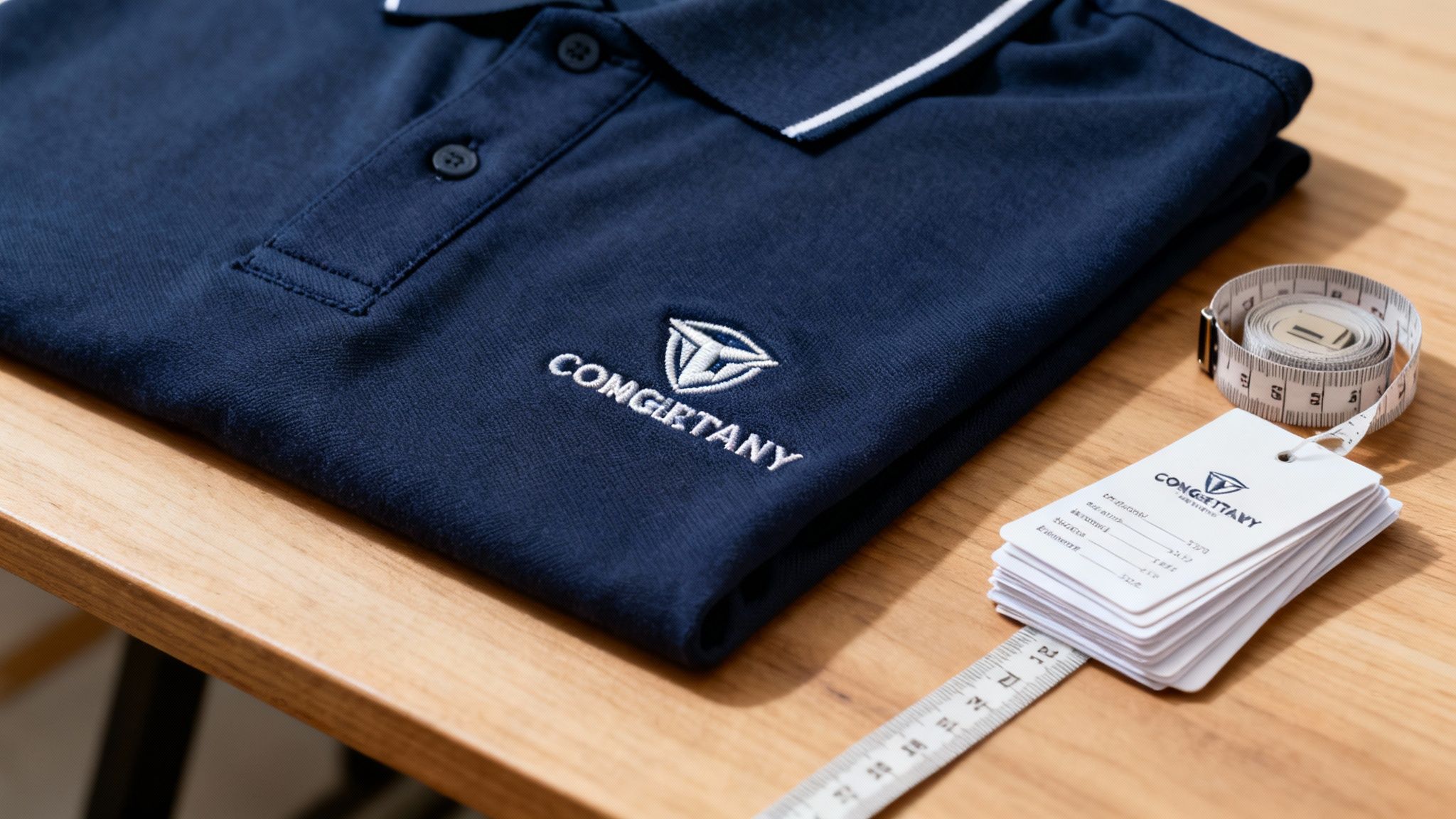
Embroidery is the classic choice, stitching your design directly onto the garment. This creates a premium, textured finish that just feels high-quality. It's incredibly durable and often outlasts the garment itself, which is why it’s my go-to recommendation for professional gear like polos, jackets, and corporate wear that needs to look sharp for the long haul.
On the flip side, screen printing applies ink directly to the fabric through a stencil. It’s brilliant for large, bold graphics and vibrant colours, making it a fantastic, cost-effective choice for t-shirts, hoodies, and high-vis safety vests. If you’ve got a simple, one-colour logo and a big order of shirts, screen printing is almost always the most economical way to go. To see a full breakdown of these techniques and others, it’s worth exploring different custom printing options to see what will work for you.
A simple rule of thumb I always share with clients: if the garment is thicker and more "corporate" (think a polo or a jacket), embroidery adds a real touch of class. If it's a lighter fabric for a promo event or a high-volume order (like a t-shirt), screen printing delivers a great result without breaking the bank.
No matter which method you choose, it’s vital to apply your brand’s visual identity consistently across every single item. Taking some time to understand the principles behind ensuring strong brand consistency will pay dividends in creating a professional, unified look for your whole team.
Nailing the Sizing and Fit
You can have the best fabric and the sharpest logo in the world, but if the uniforms don't fit properly, your investment is essentially wasted. A poor fit isn't just a cosmetic issue; it looks unprofessional, can restrict movement, and can even become a safety hazard if it’s too baggy or too tight.
Sizing a diverse team can feel like a real headache, but a straightforward process makes it manageable.
- Host a Sizing Session: The most reliable way to get this right is with physical samples. Ask your supplier for a "sizing set"—one of each size in a key garment, like a polo. Let your team try them on to find their perfect fit. This simple step eliminates guesswork and saves a fortune in returns.
- Don't Trust Generic Labels: A "Large" from one brand can be completely different from another. Always, always refer to the supplier's specific sizing chart, which gives you the actual garment measurements in centimetres. Have your employees compare these to a piece of clothing they already own and love the fit of.
- Offer Men's and Women's Cuts: Unisex sizing rarely fits anyone well. Providing both men's and women's styles is a small detail that makes a massive difference in comfort and a professional appearance. Women’s cuts are shaped differently through the shoulders, chest, and waist, resulting in a much cleaner, more flattering fit.
While the wider apparel industry sees its ups and downs, the demand for quality work wear remains solid. The Men's and Boys' Wear Manufacturing industry in Australia, which covers parts of the work wear sector, was estimated at AUD 258.1 million in 2025. Despite a recent decline, forecasts from sources like IBISWorld.com suggest a recovery is on the horizon, driven by evolving professional standards. This just underscores the ongoing importance of investing in well-fitted, professional attire.
Keeping Your Work Wear Program on Track
Getting your new uniforms out to the team feels like crossing the finish line, but really, it’s just the beginning. A truly great work wear program isn't a one-time transaction; it’s a living part of your business that needs a bit of forward-thinking to keep it running smoothly and on budget for the long haul.
The trick is to shift your mindset from reactive to proactive. Instead of scrambling when a new person starts or a shirt wears out, you need a plan. This means getting a handle on the entire lifecycle of your apparel, from supplier timelines right through to how your team cares for their gear.
Getting a Grip on Supplier Logistics
Once you’ve locked in a supplier, it's time to understand how they operate. Two things you absolutely need to get clear on are lead times and minimum order quantities (MOQs).
Lead times are simply how long it takes to get your gear after you place an order. This can be anything from a few weeks for items stocked locally to a few months for fully custom garments made offshore. Knowing this is crucial for planning. For example, you can't order new winter jackets when the first cold snap hits; you need to be placing that order back in autumn.
Minimum Order Quantities (MOQs) are the smallest number of items a supplier will produce or decorate for you in one go. Hitting these MOQs usually gets you a better price per item, but it can be a real headache for smaller businesses or when you just need to top up a few specific sizes. It's always worth asking if your supplier has options for smaller reorders, even if it means paying a little more per piece.
Why You Should Never Skip the Sampling Stage
I can't stress this enough: never, ever place a bulk order without seeing and approving a physical sample first. This is your single most important quality check, and it ensures the final product is exactly what you envisioned. A digital mock-up just doesn't cut it.
A real-life sample lets you inspect the things that matter:
- Branding Quality: Is the embroidery neat and tight? For screen prints, are the colours vibrant and the ink properly set?
- Fabric and Colour: How does the fabric actually feel? Does the colour look the same in person as it did on screen?
- Sizing and Fit: Check that the sizing lines up with the charts they gave you and that the garment fits the way it's supposed to.
Think of the pre-production sample as your ultimate safety net. It’s your last chance to spot any errors before you’re committed to hundreds of garments, saving you from a very expensive and frustrating mistake.
Making Your Investment Go Further
Your work wear is a valuable company asset. Like any asset, you need to manage it properly to get the most out of it. A little planning here can save you a surprising amount of money over time.
One of the easiest ways to do this is by giving your team clear garment care instructions. Don’t just assume they know how to wash a printed t-shirt versus an embroidered polo. A simple guide on washing temperatures, drying methods, and when not to iron can make a huge difference to how long the apparel lasts.
You also need a plan for staff turnover. Keeping a small "buffer stock" of your most common sizes is a game-changer. It means you can get new starters kitted out on day one, making them feel like part of the team straight away. This avoids those awkward waits and saves you from placing small, expensive rush orders.
Finally, set up a simple reordering process. This could be a basic spreadsheet or a dedicated online portal from your supplier. Whatever you choose, having a system to track what you have and what you need makes everything more efficient. Planning ahead for your merchandise is much easier when you have a solid system. For more tips on getting organised, you can learn about how to effectively order promotional products for any business need.
When you treat your work wear program as an ongoing system, not just a purchase, you ensure it keeps working hard for your brand, your budget, and your team for years to come.
Common Questions We Hear About Choosing Work Wear
Even with the best plan in place, picking the right work wear often throws up a few curly questions. If you’re navigating this for the first time, it’s the little details you haven’t thought of that can trip you up.
Getting straight answers to these common queries will help you build a uniform program that’s practical, gets a thumbs-up from your staff, and runs smoothly from day one.
How Often Should We Replace Employee Uniforms?
This is easily one of the most common questions we get, and the honest answer is: there's no single timeline. The lifespan of a uniform comes down to two things: the demands of the job and the quality of the garment.
Locking yourself into a rigid replacement schedule, like swapping everything out every 12 months, is rarely the most efficient or cost-effective way to do things.
A much smarter approach is to replace garments based on their actual condition. For a tradie on a construction site or a landscaper out in the elements, a uniform might only look its best for six to twelve months. On the other hand, for an indoor, client-facing role, a high-quality shirt or polo could easily last two years or more.
The key is to train your managers to spot the tell-tale signs of wear:
- Fading and Fraying: When the colour starts to look dull or the seams and cuffs get fuzzy, the uniform loses its professional edge.
- Worn-Out Safety Features: This is a big one for hi-vis gear. If the reflective tape is cracked, peeling, or has lost its brightness, it’s a critical safety failure and needs replacing immediately.
- Stains, Rips, and Holes: Permanent marks or damage not only look bad but also send the wrong message about your brand’s attention to detail.
A policy based on condition, not the calendar, will always be more practical and kinder to your budget.
Should We Let Employees Have a Say in What They Wear?
Absolutely. In fact, it’s one of the smartest things you can do. When your team has a voice in the selection process, you’ll see much higher adoption rates and a genuine sense of pride in wearing the uniform.
Ignoring their input is a fast track to endless complaints about scratchy fabrics or impractical fits.
This doesn't mean you need to open the floodgates with a company-wide vote. A really effective way to handle it is by forming a small "uniform committee" with staff from different departments. Give this group a few pre-approved options that already meet your brand guidelines and budget.
Let your committee test-drive the sample garments in their actual day-to-day roles. Their feedback on comfort, fit, and function is gold. You'll quickly find out which fabrics breathe best, which pockets are actually useful, and which styles offer the freedom of movement they need to do their jobs properly.
Of course, management makes the final call. But bringing that real-world feedback into the decision ensures the work wear you choose is not just branded, but genuinely well-liked and practical. It’s a massive win for team morale.
What’s the Best Way to Handle Uniforms for New Hires?
Nothing says "we weren't ready for you" like telling a new team member their uniform is weeks away. Poor inventory planning creates a terrible first impression and can make your onboarding process feel clunky and disorganised.
The key is to find a balance. You don’t need a massive storeroom filled with every possible size, but you do need a system. Keep a small stock of your most common sizes on hand for immediate allocation. For most businesses, this means holding a few units in sizes Small through to X-Large.
For less common sizes, the trick is to partner with a work wear supplier who offers quick turnarounds and, ideally, low or no minimums for reorders. That flexibility is crucial. Even a simple shared spreadsheet can help you track your core stock levels and flag when it's time to reorder, ensuring you never get caught short.
Are There Tax Benefits for Providing Work Wear in Australia?
Yes, there are definite tax advantages for Australian businesses that provide staff with uniforms. The cost of buying, replacing, and maintaining work wear can generally be claimed as a tax deduction.
For your employees, uniforms are typically tax-deductible expenses if they meet certain criteria:
- The clothing is protective and designed to prevent injury or illness (like steel-capped boots or hi-vis gear).
- It's an occupation-specific uniform that isn't suitable for everyday private wear, like a chef's uniform or a nurse's scrubs.
- It's a compulsory uniform that clearly identifies your business, especially if it’s registered with AusIndustry.
On top of that, providing certain types of uniforms may be exempt from Fringe Benefits Tax (FBT) for the business. The rules can be a bit tricky, so it’s always a good idea to chat with your accountant to make sure you're getting the full tax benefit for your specific situation.
Ready to create a professional and practical work wear program for your team? Simply Merchandise offers a massive range of high-quality apparel with expert branding options to suit any industry. Explore our collection and get a free quote today!

