


When you're searching for the right promotional products, it's easy to get caught up on the unit price. But here's a little secret from years in the game: the smartest marketers look past the initial cost. They're chasing high utility and long-lasting brand exposure.
Think about it. A quality reusable coffee cup or a durable tote bag isn't just a giveaway; it becomes a part of someone's daily life. That's real value.
Why Smart Marketers Focus on Value Over Price
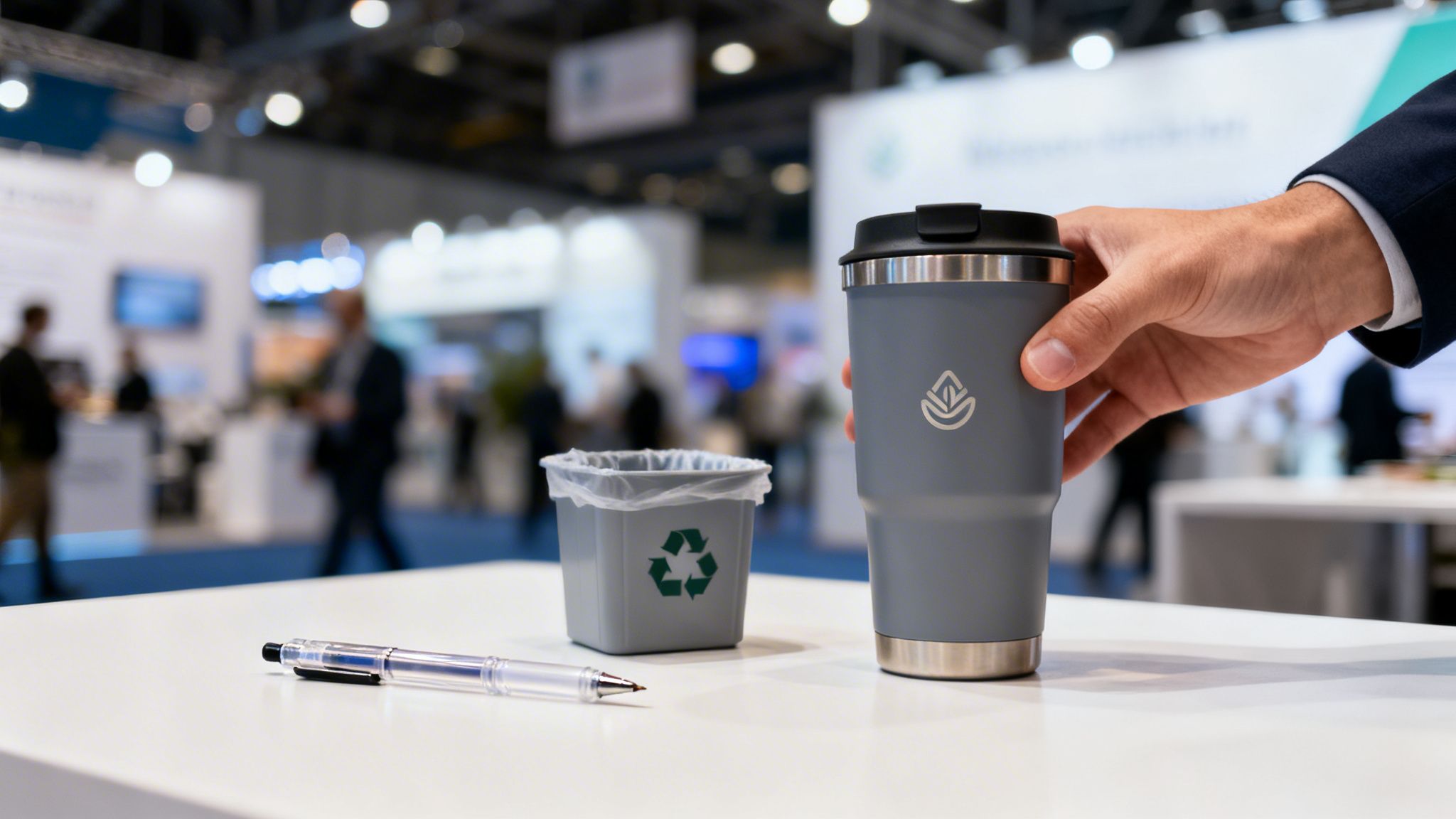
We've all seen it happen. You choose the cheapest item to save a few dollars upfront, only for it to end up in the bin by the end of the day. That’s not just a wasted product; it's your brand and your budget going right along with it. Shifting your focus from short-term savings to long-term brand building is an absolute game-changer.
Picture a bustling Brisbane trade show. You could hand out 500 cheap plastic pens that are forgotten or tossed within hours. Or, you could give 100 high-quality, branded travel mugs to genuinely interested prospects. Which one do you think makes a lasting impression?
Those mugs get used every single day on the commute, in the office, and at home. Your brand becomes a welcome part of their routine, seen by countless others along the way.
The Power of Cost-Per-Impression
This is where we need to talk about Cost-Per-Impression (CPI). It's the metric that truly reveals the value of your investment. A durable, genuinely useful item will generate hundreds, if not thousands, of impressions over its lifespan. This dramatically lowers your CPI and makes that initial higher cost look like a brilliant move.
A cheap product might give you one fleeting moment. A valuable one transforms a simple giveaway into a powerful, long-term marketing asset.
This longevity is exactly why promotional products work so well. Research consistently shows that 76% of people remember the advertiser on branded merchandise they've received, and an incredible 55% keep items for over a year. When you get it right, your CPI can be astonishingly low, making it one of Australia’s most cost-effective advertising channels.
To help you get started, we've put together a quick guide to product categories that consistently deliver fantastic long-term value.
Quick Guide to High-Value Promotional Product Categories
These categories are a great starting point because they're built around items people genuinely want to keep and use, ensuring your marketing dollars work harder for you.
Calculating Your Return
To truly get behind the "value over price" mindset, you have to know what your return looks like. Getting comfortable with how to measure marketing ROI is a crucial skill for any campaign, and promotional products are no exception.
By connecting an item’s cost to its lifespan and usefulness, you can make smarter decisions that boost brand recall and deliver a real return on your investment.
Ready to find items that deliver this kind of lasting impact? Take a look through our extensive range of promotional products designed to make your brand unforgettable.
Matching Your Merch to Your Mission
Before you even think about flicking through a catalogue, let's talk strategy. It’s easy to get distracted by the latest shiny new thing, but the best promotional products aren't just cool items—they're carefully chosen tools designed to hit a specific business goal.
What are you actually trying to achieve here? Without a clear answer, you're just buying stuff. With a clear answer, you're making a strategic investment that pays dividends.
What’s the Big Idea? Pinpointing Your Goal
Think about it. Are you trying to get your name out there to thousands of people at a big community festival in Melbourne? Or are you focused on building stronger ties with a handful of your most valuable clients in Sydney? The product that’s a huge hit in one scenario will almost certainly fall flat in the other.
Your campaign goal shapes every single decision that comes next—the product you choose, how much you spend per item, and even how you brand it. Most campaigns boil down to one of these core objectives.
- Brand Awareness: The main game here is maximum visibility. You want your brand to be seen by as many eyeballs as possible. This is the classic goal for trade show giveaways, event sponsorships, or launching a new local business.
- Lead Generation: Your product becomes a direct incentive. You’re offering something desirable in exchange for something valuable, like an email address, a meeting booking, or a demo sign-up.
- Customer Loyalty: This is all about thanking the people who already support you. The product is a 'surprise and delight' gift that shows your existing customers you genuinely appreciate their business.
- Employee Engagement: The goal is internal. You're looking to build team spirit, welcome new starters, or recognise a job well done. The right merch can foster a real sense of belonging and company pride.
A university at an open day trying to reach thousands of potential students could do wonders with branded, sustainable stationery. But a financial services firm nurturing its top 10 clients would get a far better return from ten premium, engraved tech gadgets. The goal always defines the value.
Connecting Your Goal to the Perfect Product
Once you’ve got your mission locked in, you can start brainstorming products that actually make sense for it. This isn't just about picking something you like; it’s about choosing an item that will resonate with the right people and actively help you reach your objective.
Always think about the context. Where and how will someone receive this product?
A low-cost, high-volume item like a branded fridge magnet is an absolute workhorse for a letterbox drop campaign aimed at building local awareness. If you're looking for inspiration, we've got a whole bunch of ideas on how to use custom fridge magnets to get noticed.
On the other hand, if you're running a lead generation campaign targeting professionals, a more considered item like a quality notebook and pen set is a much smarter play. The perceived value is higher, making the exchange for their contact details feel fair and worthwhile. This is how you turn a simple giveaway into a powerful marketing tool, ensuring every dollar you invest works harder for you.
Matching Products to Your Marketing Budget
Let's talk money. Getting the best value promotional products isn't just about finding the cheapest item; it's about making your budget work as hard as you do. Every dollar you spend should directly support your goal, whether you’re chasing widespread brand awareness or forging deeper client relationships.
The trick I’ve learned over the years is to think of your budget in tiers. This isn't about penny-pinching. It's about strategically allocating your funds where they'll make the biggest splash, ensuring you get a brilliant return on every investment.
This decision tree helps visualise how your campaign goals point you towards the right products. Are you trying to build awareness or nurture relationships? Your answer changes everything.
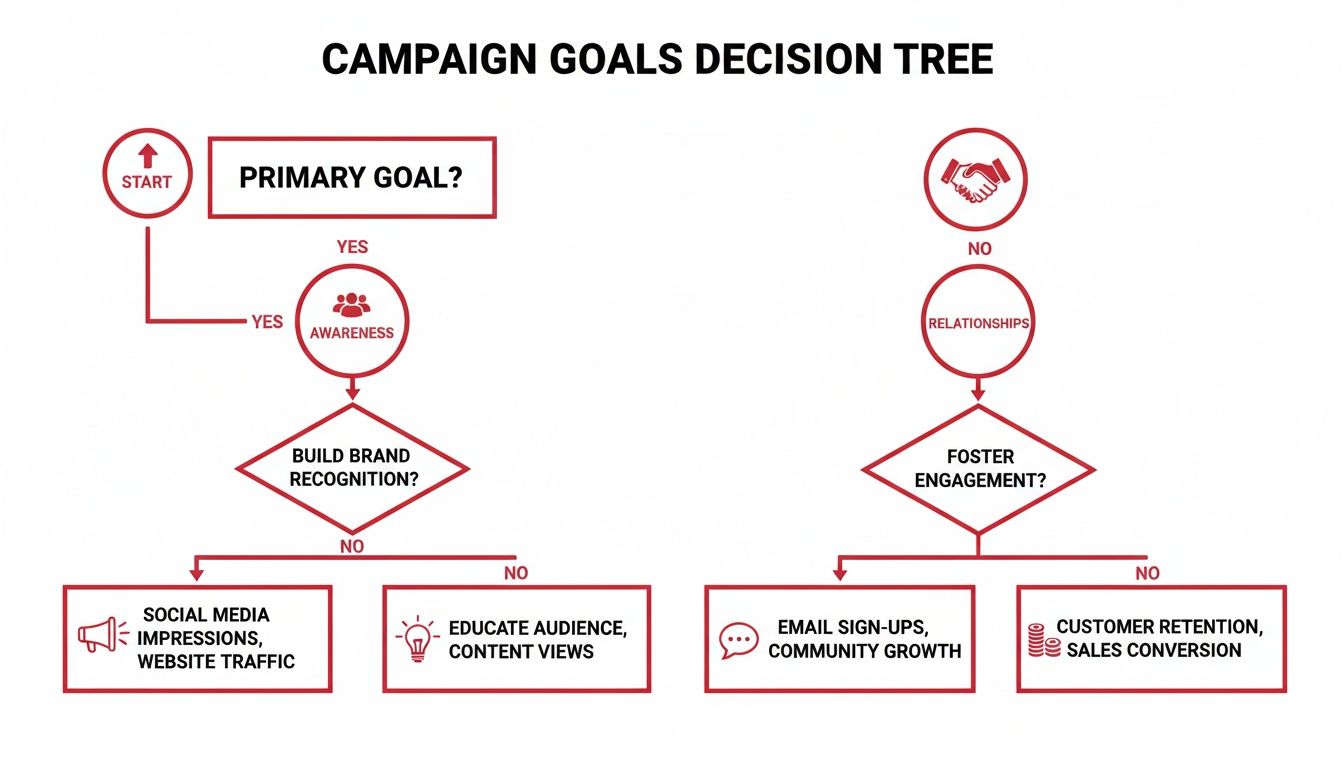
As you can see, your core objective is the launching pad for all your product and budget decisions. It’s what guides you toward either high-volume giveaways or high-impact gifts.
High-Volume Giveaways Under $5
This is your 'get the name out there' arsenal. We’re talking about maximum reach and visibility for a low cost per item. These are your go-to products for big events like trade shows, community festivals, or any campaign where the main goal is to get your brand into as many hands as possible.
Think of the classics that everyone finds useful.
- Branded Pens: They're a favourite for a reason. A quality pen is used daily and seen constantly.
- Tote Bags: An event essential. They immediately turn attendees into walking billboards for your brand.
- Keyrings and Magnets: These little troopers find a permanent home on fridges and keychains, offering daily brand exposure.
The strategy here is pure numbers. You’re aiming for a flood of impressions that builds brand recognition and keeps you top-of-mind over time.
Mid-Range Engagement Builders: $5 to $20
In this bracket, the game changes. You’re moving beyond simple visibility and starting to build genuine connection. These products have a higher perceived value, making them perfect for more targeted campaigns, encouraging valuable actions, or simply showing a bit of customer love.
The goal isn’t just to be seen; it’s to give something genuinely useful that makes the recipient feel noticed and appreciated.
Think of an insulated travel mug for their morning commute, a beautifully bound notebook, or a quality cap. These are brilliant for rewarding new email subscribers, thanking a client for a referral, or making a solid impression at a smaller industry gathering. They say, “We value you,” with much more impact than a low-cost freebie.
If you’re looking for ideas, you can browse our curated products by price to find something that perfectly suits your campaign.
Premium Relationship Gifts: $20 and Up
This is where you invest in your MVPs—your most important clients, your key business partners, and your superstar team members. These gifts aren’t about shouting your brand from the rooftops; they’re about cementing a vital connection and showing genuine gratitude.
We’re talking about items like a debossed leather compendium, a desirable tech gadget, or a premium embroidered jacket. The focus shifts entirely to exceptional quality and sophisticated, subtle branding. It’s a powerful gesture that demonstrates respect, builds unshakable loyalty, and fosters true long-term partnership.
Finding great value always comes down to matching the cost to the intended outcome. It’s a principle that applies everywhere—for instance, a guide on arranging group travel will tell you that planning ahead for a budget bus hire is the key to a successful, cost-effective trip. The same logic applies right here.
Choosing a Branding Method for Lasting Impact
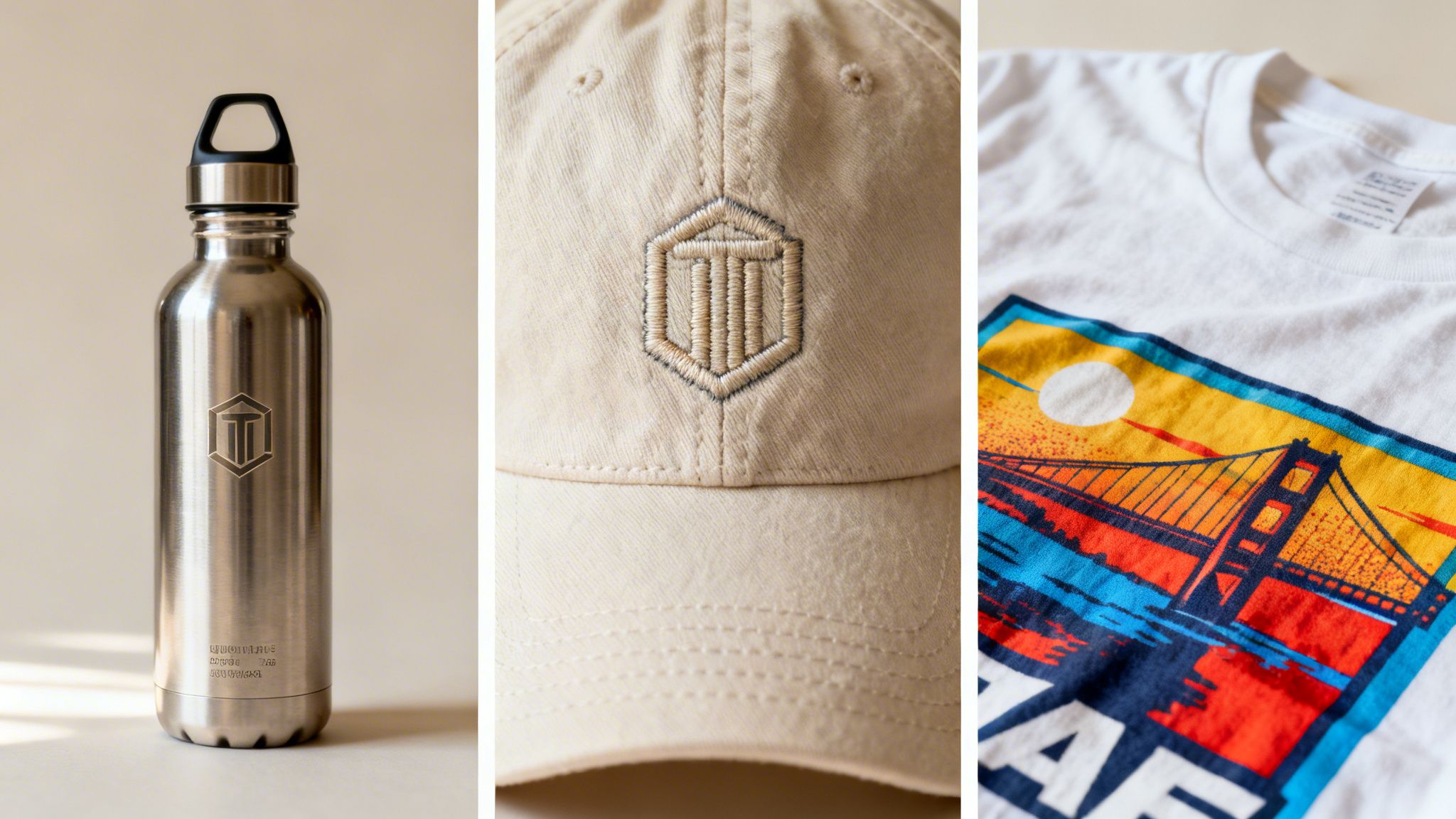
You’ve found the perfect product, but don’t stop there. A fantastic item with forgettable branding is a huge missed opportunity. How you apply your logo isn’t just a finishing touch; it’s how you tell your brand's story and transform a good item into one of the best value promotional products on the market.
Think of it this way: the decoration method you choose should feel like a natural extension of your brand’s personality. A subtle, sophisticated laser engraving on a metal water bottle speaks of precision and quality. On the other hand, a vibrant, full-colour print splashed across a t-shirt screams energy and fun—perfect for a bold, creative campaign.
Popular Decoration Methods and What They Say
Every branding technique has its own character and is suited to different materials and aesthetics. Getting this right is what ensures your logo not only looks sharp on day one, but also holds up over time, delivering impressions for years to come.
Here’s a quick rundown of the most popular choices we see.
- Screen Printing: This is the reliable workhorse for fabrics like t-shirts and tote bags. It’s incredibly cost-effective for simple, bold designs with a couple of colours and leaves a durable, vibrant finish that really pops.
- Embroidery: Nothing says "premium" quite like embroidery. For adding a textured, professional look to caps, polos, and jackets, it’s second to none. The tangible quality it adds immediately suggests a high-value, established brand.
- Laser Engraving: When you're working with metal, wood, or glass, laser engraving creates a crisp, permanent, and beautifully subtle tone-on-tone finish. It’s our go-to for a sleek, corporate look on items like executive pens, keyrings, and insulated drink bottles.
- Digital & Full-Colour Printing: Got a complex logo with gradients, photos, or a rainbow of colours? Digital printing is your answer. It brilliantly reproduces detailed graphics on everything from apparel to tech gadgets.
To get a feel for what might suit your project, it’s worth diving deeper. We've put together a full guide covering these techniques and more, which you can explore in our breakdown of custom printing options.
A hard-won lesson I've learned over the years is that the branding method directly shapes perception. We once worked with a tech startup that switched from printed to engraved logos on their client gifts. The feedback was instant—the perceived value of the gift skyrocketed, even though the product itself was identical.
Preparing Your Artwork for a Flawless Finish
The final piece of this puzzle is your artwork file. To achieve that crisp, professional result you’re picturing, your logo has to be in the right format. Honestly, this is non-negotiable for a quality outcome.
You must always supply your logo as a vector file. The most common formats you’ll encounter are:
- .AI (Adobe Illustrator)
- .EPS (Encapsulated PostScript)
- .PDF (only if it was saved correctly from a vector program)
Unlike standard JPEGs or PNGs, which are made of pixels, vector artwork uses mathematical equations. This means it can be scaled to any size—from the tip of a tiny pen to a massive event marquee—without ever losing its sharpness or becoming blurry. It’s the secret ingredient for ensuring your brand looks impeccable, no matter where it appears.
If you don't have a vector file, don't panic. Our in-house design team can help redraw your logo to make sure it’s print-perfect.
From Green Light to Grand Unveiling: Nailing Your Order Logistics
You've done the hard work of choosing the perfect product and visualising your brand on it. Fantastic! But now comes the part that truly separates a smooth, successful campaign from a last-minute, hair-pulling scramble. Getting the logistics right is everything.
This final stretch is where your vision becomes a reality, and with a bit of planning, you can ensure your merchandise arrives on time, on budget, and looking even better than you imagined.
Always, Always Get a Sample
Let me be crystal clear on this: never, ever place a bulk order without seeing a sample first. It’s a non-negotiable rule I’ve learned over many years in this business.
A product can look amazing on a screen, but you can't feel its weight, test its durability, or see the true colour until it’s in your hands. For most orders, a generic, unbranded sample is enough to give you that confidence. But if you’re making a significant investment, don't hesitate to ask for a pre-production sample with your logo on it. It’s a small extra step that can prevent a warehouse full of regret.
The All-Important Artwork Approval
Once you’re thrilled with the physical item, it's time to approve the artwork. Your supplier will send you a digital proof—a mock-up showing exactly how your design will be printed. This is your final chance to catch any mistakes.
I can’t tell you how many times I’ve seen teams give a proof a quick glance, hit 'approve', and then discover a typo or an old version of their logo on 500 finished products. Always get a second, or even third, pair of eyes on it. Check spelling, logo placement, and brand colours meticulously. Once you sign off, that’s it—the responsibility is yours.
With your final green light, the order moves into production. This is the perfect time to get firm dates from your supplier. Ask for two things: the estimated production completion date and the expected delivery date. Knowing this timeline is absolutely crucial, especially when you’re counting down to a trade show or product launch.
For a more detailed look at managing these timelines and getting your gear exactly when you need it, check out our guide on how to order promotional products without the stress.
Don't Let Shipping Derail Your Deadline
Finally, let's talk about getting those boxes to your door. Shipping across Australia, especially to regional areas, requires a bit of forward-thinking. Don't let the final leg of the journey catch you out.
Here’s a simple checklist to keep your delivery on the rails:
- Confirm Your Delivery Details: Is the address 100% correct? Double-check the street, suburb, postcode, and any specific instructions like "deliver to loading dock B". A simple typo here can cause major delays.
- Build in a Transit Buffer: Standard road freight can take anywhere from 1-7 business days across the country. Always add this transit time to your overall project timeline.
- Beware of Peak Seasons: If you need products for a December event, you should be placing your order in October, latest. The lead-up to Christmas and the end of the financial year can see production and shipping times blow out significantly.
By taking charge of these final steps, you're not just placing an order; you're orchestrating a successful outcome. You’ll sidestep the common pitfalls, avoid that all-too-familiar last-minute panic, and ensure your incredible new merchandise arrives ready to make the impact it deserves.
Your Top Promotional Product Questions, Answered
When you’re investing your hard-earned marketing dollars into promotional gear, you want to get it right. It’s only natural to have a few questions. Let’s dive into the queries we hear most often from Australian businesses just like yours, so you can order with total confidence.
What’s a Realistic Budget for a Small Business?
You can make a real impact without breaking the bank. A budget of $500 to $1,000 is a fantastic and very common starting point for a small business. This gives you enough firepower to get your hands on a good quantity of genuinely useful items—think quality branded pens, sturdy tote bags, or handy keyrings.
The real secret is choosing something your audience will actually reach for every day. These days, many suppliers even offer free setup and freight on popular items, which means more of your budget goes directly into the products themselves. My advice? Start with one solid, versatile item for a single campaign, see how it performs, and then you can confidently scale up from there.
How Far in Advance Should I Order for an Event?
Give yourself a buffer. I always recommend planning at least four to six weeks in advance, especially if you're looking at custom-made items or anything that requires more complex branding like embroidery.
Sure, a simple order with local stock and a standard screen print can sometimes be turned around in two to three weeks. But that clock only starts ticking after you’ve signed off on the final artwork proof. For big annual trade shows or conferences, I tell my clients to start the conversation eight weeks out. While a rush job is sometimes possible, planning ahead gives you the best product selection, better pricing, and saves you a world of last-minute stress.
Don't forget to account for artwork tweaks, sample approvals, production time, and shipping across the country. Building that extra time into your schedule is the secret to a smooth delivery, ensuring your merch is in your hands long before the big day.
Can I See a Sample Before I Place My Full Order?
Absolutely—and you should never hesitate to ask. Any supplier worth their salt will happily provide a sample, because it’s in everyone’s best interest that you’re 100% happy with the quality, feel, and colour before committing to a full production run.
You can typically ask for a generic, unbranded sample just to check out the item itself. For larger or more expensive orders, it’s worth asking for a pre-production sample. This is a fully branded, finished version of your exact item. It might add a small cost and a few extra days to your timeline, but it’s the ultimate peace of mind. For a new or high-value product, I consider it a non-negotiable step.
What Kind of Artwork File Gives the Best Result?
For that sharp, professional finish that makes your brand look its best, you’ll need to supply your artwork in a vector format. This is crucial. The file types you're looking for are:
- .AI (Adobe Illustrator)
- .EPS (Encapsulated PostScript)
- .PDF (but only if it was saved correctly from a vector program)
Unlike a standard image file like a JPEG or PNG, a vector file is made of mathematical paths, not pixels. This means it can be scaled up to the side of a marquee or down to the clip of a pen without ever losing its quality or looking fuzzy. It’s the difference between a logo that looks crisp and premium, and one that looks cheap and blurry.
Ready to create promotional products that people will love and actually use? The expert team at Simply Merchandise is here to help with free artwork layouts, hands-on product advice, and a lowest-price guarantee. Find your perfect match today at https://simplymerchandise.com.au.

