



It's late October. The CFO wants the festive budget locked, HR wants the team recognised properly, and operations has just realised nobody has scoped the Christmas hampers yet. That's the moment most programs go wrong, because people start shopping for “nice gifts” instead of building a compliant, inclusive, and deliverable system.
For christmas hampers for employees, the smartest approach is blunt: treat the $300 minor-benefits threshold as your budgeting anchor, then design the hamper around inclusion, not assumptions. If you get those two things right, the rest becomes manageable. If you don't, you end up with awkward tax questions, food people can't use, and a courier problem in the last week before shutdown.
Why Christmas Hampers for Employees Need Early Planning
Late October is when the scramble usually becomes obvious. Someone asks for a hamper idea, procurement starts chasing quotes, and the first supplier reply lands with delivery caveats that were already avoidable. The mistake isn't being a bit late, it's treating the hamper as a last-minute nice-to-have instead of a controlled workplace gift program.

The pressure points show up fast
You are balancing four things at once. Budget and tax exposure need to be clear before you approve anything. Dietary and cultural inclusion matters because a hamper that suits one person can exclude another. Branding consistency matters if the gift is supposed to reflect the business. Lead times matter because Australia-wide delivery gets messy once the calendar turns.
A rushed hamper program doesn't just look sloppy, it usually creates rework.
A good reference point for the office side of festive gifting is the Cartograph Coffee office guide, because it shows how even a simple workplace consumable needs thought around use, storage and routine. That same logic applies to hampers. The gift has to work in real life, not just on a purchase order.
For teams comparing gift formats, the practical discipline is similar to choosing branded merchandise. The steps to choose the right promotional products matter here too, because you still need a defined audience, a purpose, and a supplier who can deliver on time. If you skip that work, you end up buying fast instead of buying well.
What a proper reset looks like
A serious hamper program starts with a recipient list, a budget ceiling, a delivery timeline, and a clear rule for what counts as acceptable content. Then it moves into inclusion, packing, and address validation. That sounds basic, but most failed programs skip at least one of those steps.
A simple test helps. If you can't explain who the hamper is for, why that content mix was chosen, and how it will arrive, the program isn't ready. That's the difference between a tidy end-of-year gesture and a December mess.
Budgeting and FBT Rules for Employee Hampers
The Australian Taxation Office treats a hamper or present given to an employee at a Christmas function separately from the function itself. It may qualify as an exempt minor benefit when it costs less than $300 per employee and the other conditions are met, according to ATO guidance on minor benefits. There is no separate FBT category just for Christmas parties, so the party, the gift and any other benefit need to be assessed on their own.
Price the hamper first, then decide the format
Budgeting here is a tax-control exercise, not a creative one. For budget planning, the rule is simple, and the eofy merchandise planning principles in this EOFY merchandise guide help keep the per-head ceiling documented. Keep the per-employee hamper value below $300, and you stay in range for the minor-benefits exemption when the benefit is infrequent or irregular and it would be unreasonable to treat it as a fringe benefit under the same ATO guidance.
Crossing $300 does not automatically make the hamper taxable in every case, but it does remove the minor-benefits pathway on that basis alone. Procurement teams need to respect that line. Do not round up “for safety” unless finance has already modelled the tax result.
Keep the per-employee cost sheet boring and exact. Boring is what survives review.
For a 25-person team, set one hamper specification and keep every recipient under the threshold. For a 100-person team, the discipline matters even more because small overspends scale fast. For a remote workforce with mixed values, the right move is not to improvise one-off gifts, it is to create equivalent-value variants and track each one cleanly.
What to record
Keep a per-employee schedule showing:
- Recipient name and costed hamper variant.
- Declared content value.
- Whether the hamper sits alongside a party or other benefit.
- Delivery status and date.
That record-keeping matters because the ATO assesses the benefits separately, so your file needs to show each benefit clearly. If you also give a Christmas party and a hamper, a qualifying party and a qualifying hamper may each be exempt, provided they are structured properly under the same ATO guidance.
For budget planning, build the hamper to a per-employee ceiling, not a vague basket size. Once finance signs off the cost per head, the rest of the decisions become operational.
Handling Dietary Needs and Allergen Risk
A single standard hamper is the quickest way to create exclusion, and in some cases, unnecessary risk. Australian teams are mixed across diet, religion, health, remote work, and personal preference, so a “one basket fits all” approach is lazy. Use a controlled method instead.
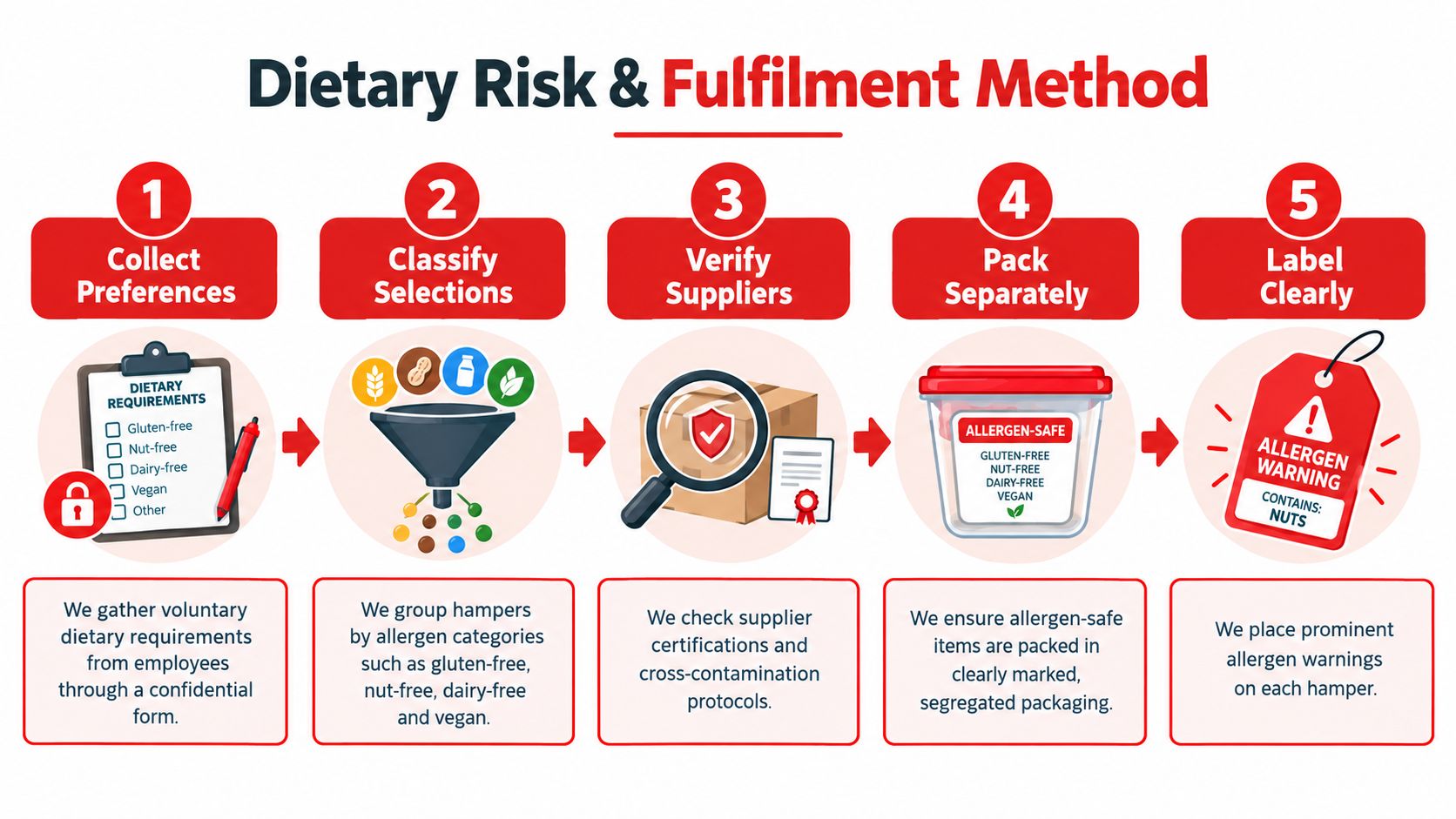
Use a five-stage fulfilment process
Start with a confidential preference form and make it voluntary. Then group responses into standard, vegetarian, vegan, halal, gluten-free and alcohol-free variants. After that, get ingredient and allergen declarations for every packaged item, separate the variants during assembly, and verify delivery addresses, regional lead times and replacement procedures before dispatch.
A smart operational target is simple: 100% preference capture for recipients who choose to respond, and 100% item-level ingredient and allergen verification before packing. Those are quality-control targets, not magic industry numbers. They just force the team to do the basics properly.
Two-person checks are essential. One person should confirm the variant selection, another should check the recipient name, address and final contents. Then sample-check cartons from each packing batch so mistakes don't get through the whole run.
Where programs usually fail
The predictable failure points are always the same.
- Hidden allergens in chocolate, biscuits or sauces.
- Alcohol included when an alcohol-free alternative should have been offered.
- Temperature-sensitive products shipped without seasonal controls.
- Substitutions made without updating the contents card.
Keep a batch manifest that links each employee to the exact hamper variant and courier tracking number. Add a clear contact channel for damaged, missing or unsuitable items, because January is a terrible time to discover nobody knows who packed what. A branded insert is fine, but don't let it hide nutrition, allergen, alcohol or storage information.
For teams that want a broader range of sweets and snack items, the Sweets and Lollies page is a useful reminder that even “fun” items still need ingredient clarity. The rule doesn't change just because the gift is festive.
Comparing Off-the-Shelf, Semi-Custom and Custom Hampers
Most buyers compare a hamper the way they compare any other procurement item, by speed, value and effort. That's the right instinct, but the wrong conclusion if you ignore branding and inclusion. The best choice depends on how much control you need over the contents, presentation and delivery process.
Hamper Build Options at a Glance
Off-the-shelf hampers win when speed matters more than detail. They're the easiest option for smaller teams and late sign-offs, but they limit your ability to manage dietary preferences and brand presentation. Semi-custom hampers sit in the middle, giving you room to shape the mix without carrying the full artwork burden.
Fully custom hampers are the right call when brand alignment and inclusion are both important. They take longer, need earlier artwork approval, and demand tighter supplier coordination. If you want to add branded drinkware, tote bags or presentation materials, that's where custom print processes become relevant, which is why the custom printing options page is worth checking before you lock the brief.
Use off-the-shelf for speed, semi-custom for balance, and fully custom when the gift has to do more than just arrive.
If your team also expects a food-and-drink element, the wine gift hampers Australia guide is a useful reminder that alcohol changes the brief materially. You need different packaging, different recipient checks, and often a different inclusion strategy.
For businesses with more complex branding needs, items such as embroidery, screen printing, digital print, laser engraving and sublimation can add value without turning the hamper into clutter. Use those methods only where the branded item will survive beyond December. If it won't get used again, it's wasted spend.
Branding Options That Add Value Without Wasting Spend
Branding should make the hamper feel considered, not noisy. The mistake many businesses make is overprinting the contents and underthinking what people will still use after December. A good branded touch works on day one and still has a job in February.
Pick branding that people keep
Small touches work better than heavy-handed ones. Sleeves, ribbons, stickers and branded boxes can lift presentation without overwhelming the gift. The stronger choices are reusable items, things like coffee cups, picnic totes, picnic sets, bluetooth earbuds, insulated drink bottles and notebooks that employees keep using after the festive season.
A clean box, a restrained insert and one useful branded item usually lands better, as outlined in this guide to building brand identity with custom merchandise. That approach keeps the hamper useful and stops the branding from becoming visual clutter.
That's also why personalisation usually beats a single premium basket. Analysts at Australian employee gifting surveys have found that many workers receive gifts they do not use or want, which points to a simple rule. Give two or three equivalent-value options, plus a non-food alternative, and you will usually get a better response than one impressive-looking hamper that gets ignored.
Avoid the common branding mistakes
Branding fails when it gets in the way of practical information. Oversized logos can hide nutrition or allergen panels. Multi-material wrapping can be hard to recycle. Inserts that look like invoices kill the appreciation effect.
Use branding as support, not the main event. Keep the box clean, keep the insert restrained, and choose one branded item that people will carry or use.
For businesses exploring branded gifting beyond the hamper itself, Simply Merchandise offers branded gift boxes with sleeve printing and reusable totes that can sit alongside staff appreciation programs. That suits teams that want a corporate feel without turning the gift into landfill.
Personalisation Versus the One-Size Premium Basket
The default Australian hamper is still the premium one-size basket. That is the wrong starting point for a mixed workforce. Choice beats uniformity, especially when you are trying to stay within FBT-safe gifting rules and still have people use the gift.
Build a simple choice system
Offer two or three equivalent-value options and include a no-food or non-alcohol alternative. Reuse the preference data already captured, then tier the pack into equivalent variants so you are not running a manual exception process for every dietary request. Keep each option priced at the same level, and use the same approval rule for all of them. That gives you control without forcing everyone into the same contents.
A premium basket that looks impressive but misses the mark creates waste, awkward follow-up and unused items in someone's kitchen. One practical example is to keep the core spend fixed, then swap in a food, drink or lifestyle variant depending on what the employee can use. That is the cleaner way to handle a mixed team.
If you want a reference point for presentation, the personalised gift box inspiration shows how a box can feel considered without overloading it with filler.
Work backwards from delivery
Start with the delivery target, then lock supplier briefing, artwork approval, sample sign-off and the packing run. After that, map regional courier cut-offs so capital city offices and regional hubs are not treated as if they move on the same timeline.
The outer presentation can still carry the premium feel. A branded box, a restrained insert and a personalised name card do the job without turning the hamper into a one-off manual build each time you have an alcohol-free or diet-specific variant. Keep the range tight, keep the contents practical, and let the personalisation sit in the selection and the finish, not in endless custom handling.
Sample Approval, Timelines and Australia-Wide Delivery
Delivery is where good hamper plans go to die. A beautiful box that lands after the office has closed is just warehouse stock with a nicer label. Treat the logistics like a production schedule, not a casual courier booking.
Lock the sample process early
Ask for photo samples first, then ingredient sheets, allergen declarations and a single sign-off point. Don't let five people keep “just reviewing” the artwork while the packing date gets pushed back. One decision-maker and a clear approval date will save more pain than any late design tweak.
Then ask the supplier five practical questions. What happens if stock is missing, how are damaged items handled, what are the peak-season surcharges, what is the customer contact channel, and how do replacements work? If the supplier can't answer clearly, they're not ready for an Australia-wide fulfilment run.
Build the timeline backwards
The safest approach is to work backwards from a mid-December arrival target. That gives you room for artwork, sign-off, packing and regional lead times without gambling on the final courier rush. Capital city addresses usually give you more flexibility than regional ones, so don't assume one dispatch date covers the whole country equally.
Batch manifests matter here too. HR needs to reconcile who got what, where it went and when it arrived. If there's a query in January, you should be able to trace the exact hamper variant and tracking number without digging through email threads.
If a supplier can't tell you how they handle substitutions and damaged stock, don't put them in charge of your employee gifts.
The clean handoff is simple. Confirm the budget ceiling, confirm the tax treatment, confirm the dietary process, confirm the branding, then confirm the delivery window. If all five are signed off before production starts, the program is under control.
If you want a hamper program that looks good, stays inside the $300 minor-benefits framework where appropriate, and still respects dietary needs, Simply Merchandise can help with branded boxes, customised presentation and promotional items that fit employee gifting programs. Visit Simply Merchandise to sort the brief, lock the artwork and get a seasonal gifting plan moving before the courier backlog starts.

