



The venue is locked in, the run sheet is almost done, and someone has just asked what goes in the delegate bag. The shortlist on your desk is a mix of clever novelties and a few things people might carry home. Three weeks is not long when decoration, freight and a spare box for the registration desk all have to land before doors open.
I would not pick by how large the logo looks on a mockup. The better test is quieter. Will a delegate still use it weeks later, and does it replace a cup, a flyer or a plastic bottle they would have taken anyway? A pen that lasts the whole programme beats a gadget that photographs well and then stays in the hotel drawer.
These conference giveaway ideas are built for that test. Australian programmes are busy, budgets are split across audiences, and the item has to earn the trip home in a carry-on. Start with who receives it, then spend only what that relationship can justify.
Giveaway Ideas by Audience and Budget
Sort the room before you sort the catalogue. A lanyard can go to every badge. A premium piece belongs with sponsors, speakers and people who have already booked a meeting. Browse products grouped by price once you know which tier each segment can carry, not before.
| Budget tier | Giveaway idea | Best audience | Why it works |
|---|---|---|---|
| Low | Branded pen with a stylus tip | Broad delegate lists and registration desks | Cheap to scale and used across the whole day |
| Low | Notepad with a QR code on the last page | Delegates taking session notes | Carries a resource link into the workplace |
| Low | Lanyard with a detachable badge clip | Multi-day events and large sessions | Worn all event, so the brand is seen repeatedly |
| Mid | Insulated coffee mug | Hosts, speakers and office users | Used daily at desks for months |
| Mid | Reusable drink bottle | Outdoor, multi-session and wellness events | Reused after the event, reducing single-use cups |
| Mid | Printed tote bag | Delegates carrying materials between sessions | Doubles as a show bag and everyday carry |
| Premium | Insulated cooler bag | Sponsors and qualified prospects | Long working life, so the logo stays in use |
| Premium | Power bank or tech accessory | Speakers and VIP delegates | High perceived value; the brand must stay tasteful |
| Premium | Branded cap or polo shirt | Team members, partners and staff | Wearable advertising, sized to each recipient |
What each tier is for
Low-tier items scale across a full registration list. A notepad with a short link on the last page gets used in every session, then sits on a desk the following Monday. You are paying for reach, so the unit has to be light, useful and easy to hand over in a queue.
Mid-tier items suit a multi-day programme where people are tired of paper cups and loose handouts. An insulated mug is the clearest example. Someone uses it at the hotel breakfast, then keeps it on an office desk for months. That is a long run of quiet brand contact from one object.
Premium items need a named reason. A power bank for a speaker, or a cap sized for a partner team, reads as thanks. The same piece handed to a cold lead often feels like pressure, and unsized apparel comes back in the returns box.
Start from the audience segment, choose the highest tier you can justify per person, then confirm the item will still be used after the event.
Creative Giveaways Delegates Keep Using
A delegate leaves a session with a low phone battery, a laptop to carry and a stack of notes. The giveaway that earns a place in their routine solves one of those problems, or replaces something disposable. Logo visibility matters less if the item is left behind after the event.
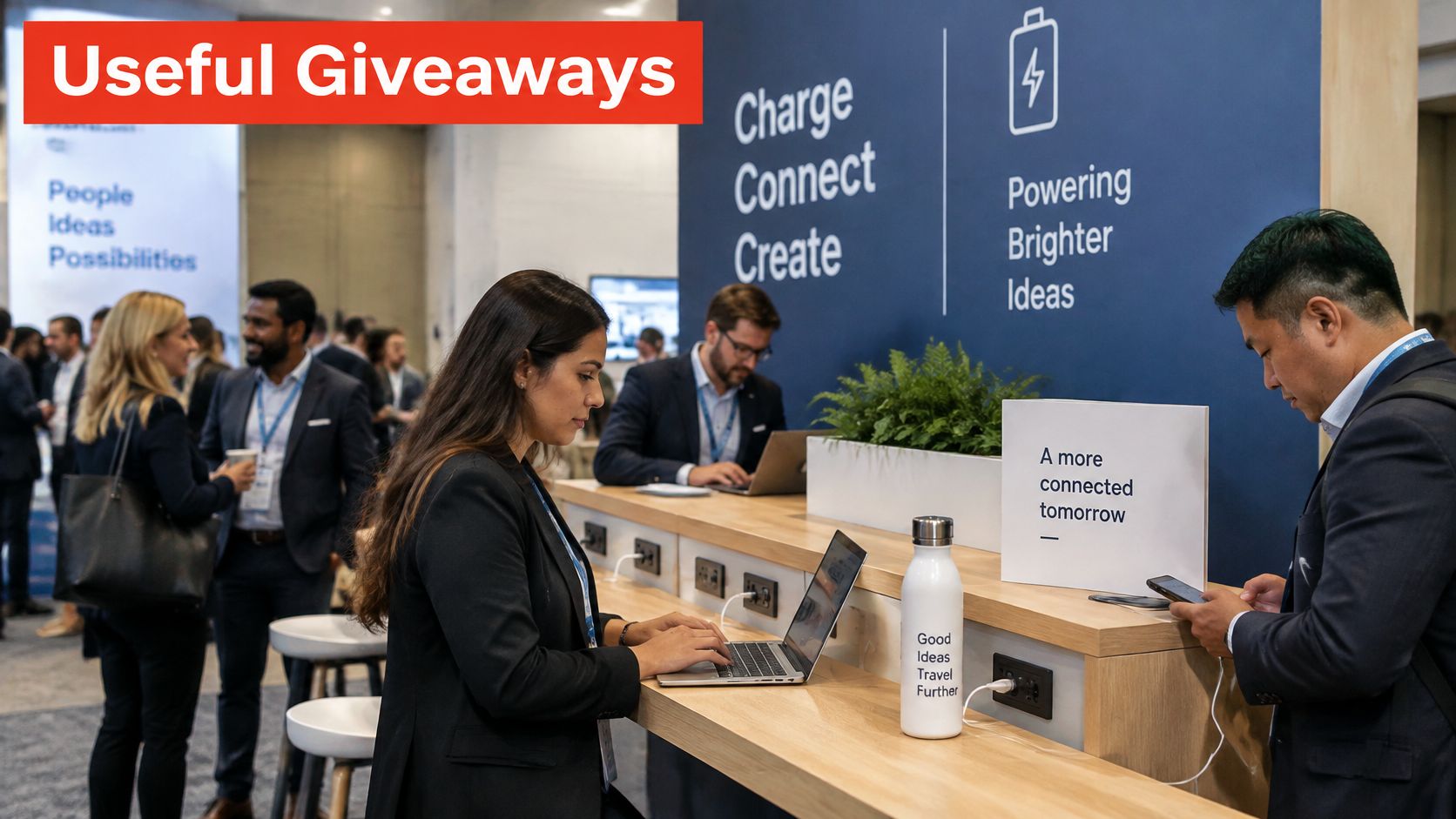
A charging station can help delegates keep devices powered during the programme, while a refill credit paired with a reusable bottle can replace single-use cups. Each works best when it fits the event: a charging point needs a practical location, and a bottle is useful only if refills are easy to access. For more ideas for portable swag that builds brand recognition, focus on products delegates can carry and use beyond the venue.
When the useful thing is still a bag
A conference satchel gives delegates a place to carry a laptop and event materials between rooms. It can remain useful as a work bag after the programme, provided its style and size suit the recipient. Check the product page for current specifications before choosing a particular model.
An insulated cooler bag suits events with outdoor breaks or packed lunches. Its value depends on whether delegates have a reason to use it after the conference; without that, it may take up storage space rather than replace a disposable item. For sessions centred on note-taking, a custom branded notebook may be the more practical choice. Pair it with a pocket session guide, or use a QR code to make slides and speaker notes available on delegates' phones.
Match the item to the programme. A compact, one-day forum may not justify a satchel, while a multi-day event with movement between rooms may. A digital bundle avoids adding another object, though it will not serve delegates who want paper notes or a physical reminder.
Choose a giveaway delegates can see themselves using weeks later. If it has no lasting use and replaces nothing disposable, reconsider the spend.
Branding Methods That Suit Each Giveaway
The material decides the decoration, not the other way around. A method that looks sharp on a proof can fade, crack or disappear once the item is washed, clipped to a badge or thrown in a tote every morning. Share your logo, team name and artwork requirements with us and we will advise on a method that suits the surface. If you are branding a cap, send the artwork so we can check which embroidery or printing options that shape will hold.
| Method | Works best on | Watch for |
|---|---|---|
| Screen printing | Mugs, drink bottles and totes in one or a few colours | Fine detail and gradients may not reproduce cleanly |
| Full-colour digital printing | Notepads, cards and items with photographs | Less durable on items washed or handled often |
| Embroidery | Caps, polo shirts, bags, blankets and towels | Dense logos lose clarity when stitched small |
| Laser engraving | Metal pens, drink bottles and wooden items | Marks can be subtle, so contrast may be low |
| Debossing | Notebooks and leather-look covers | Subtle impression with limited colour contrast |
| Sublimation | Full-coverage polyester items and mugs | Only works on polyester or suitably coated surfaces |
The failures that show up after month two
Screen printing is the workhorse for a two-colour tote or bottle. It fails when the logo is a photo or a thin gradient, so simplify the art before you approve it. Full-colour digital printing is the right call for a notepad cover with a photograph. It is the wrong call for a bottle that goes through a dishwasher.
Embroidery looks premium on a polo, a cap, a bag or a towel, and it survives washing better than ink. A dense mark stitched too small turns into a dark blob, so enlarge the logo or drop a line of type. Laser engraving on a metal pen is permanent and quiet. On a dark surface the mark can be so low-contrast that nobody reads the name across a table. Debossing on a notebook cover has the same restraint. It feels considered, and it will not shout from a stage photo.
Sublimation can wrap a polyester shirt or a coated mug in full colour. It will not take on cotton or on an uncoated metal bottle, no matter how much you like the artwork. Our custom printing options are the place to line the method up with the item before you lock quantities.
Always approve a physical sample of the chosen method on the actual item. A screen proof is not the mug, and a stitch chart is not the cap.
How to Judge a Giveaway Before You Buy
"Eco-friendly" on a product page is not a specification. It often means a bamboo lid or a recycled hang-tag, while the object itself is something nobody asked for. Judge the item by what it removes, who can use it, and where it goes when its life ends.
| Criterion | Question to ask | Good sign |
|---|---|---|
| Replaces a disposable | Would delegates otherwise use a single-use cup, bottle or flyer? | The item removes a single-use item from the event |
| Useful after the event | Will it be used at work, at home or on campus? | Delegates can name a regular use for it |
| Usable by everyone | Can every delegate open, read, carry and use it? | Easy-open packaging, plain-language instructions and a no-item or digital option |
| Recyclable at end of life | Can the materials be separated for recycling? | The supplier states how components separate |
| Minimal packaging | Is each item individually wrapped? | Bulk packing with recyclable paper documentation |
Useful is not the same as inclusive
A bottle can pass the waste test and still shut people out. Noisy crinkle packs, scent-heavy inserts, cluttered print, stiff lids and heavy kits all fail people with disability, sensory sensitivity or limited grip. The 2025 Access Conference in Melbourne focused on inclusive futures across age, gender, ability and neurodiversity. AusDN's 2025 IMPACT conference supported that shift in practice, with sensory rooms, quiet spaces, Auslan interpreters and customized support for more than 500 delegates from over 250 organisations.
Offer a choice at the point of collection. No item, a digital version, or an accessible product. Do not make anyone disclose a disability to get a fair option. Readable contrast, a tactile difference between similar pieces, easy-open packing, plain-language instructions and compatibility with assistive technology belong in the offering. An accessibility-themed novelty that does nothing for participation is tokenism. A universally usable object, or a service that helps someone stay in the session, is the gift.
Shortlist only the items that pass at least four of the five checks, and prefer one durable item used well over three disposable ones.
If you are still torn between two finalists, walk the steps to choose the right promotional products against this table before you raise a purchase order. A fail on separation for recycling, or on a no-item option, is enough to send it back.
Planning Giveaways Across the Event Timeline
Handing everything out at once creates a pile at the cloak desk and a quiet stand by lunch. Sequence the items so each one has a job in the programme. In New South Wales, approximately 145,100 business events were staged in FY2019, attracting an estimated 13.1 million attendees, according to the Value of Business Events NSW report. Nationally, more than 43.7 million people attended over 484,382 business events in 2019, on figures in a Treasury submission from the Business Events Council of Australia. In a room that busy, a logo on its own does not hold attention.
Exhibitors in that NSW research commonly put knowledge-sharing, relationships and reputation ahead of an immediate sale. Treat the item as a reason to talk, or as a reminder after the close, and attach a short use case or a follow-up offer.
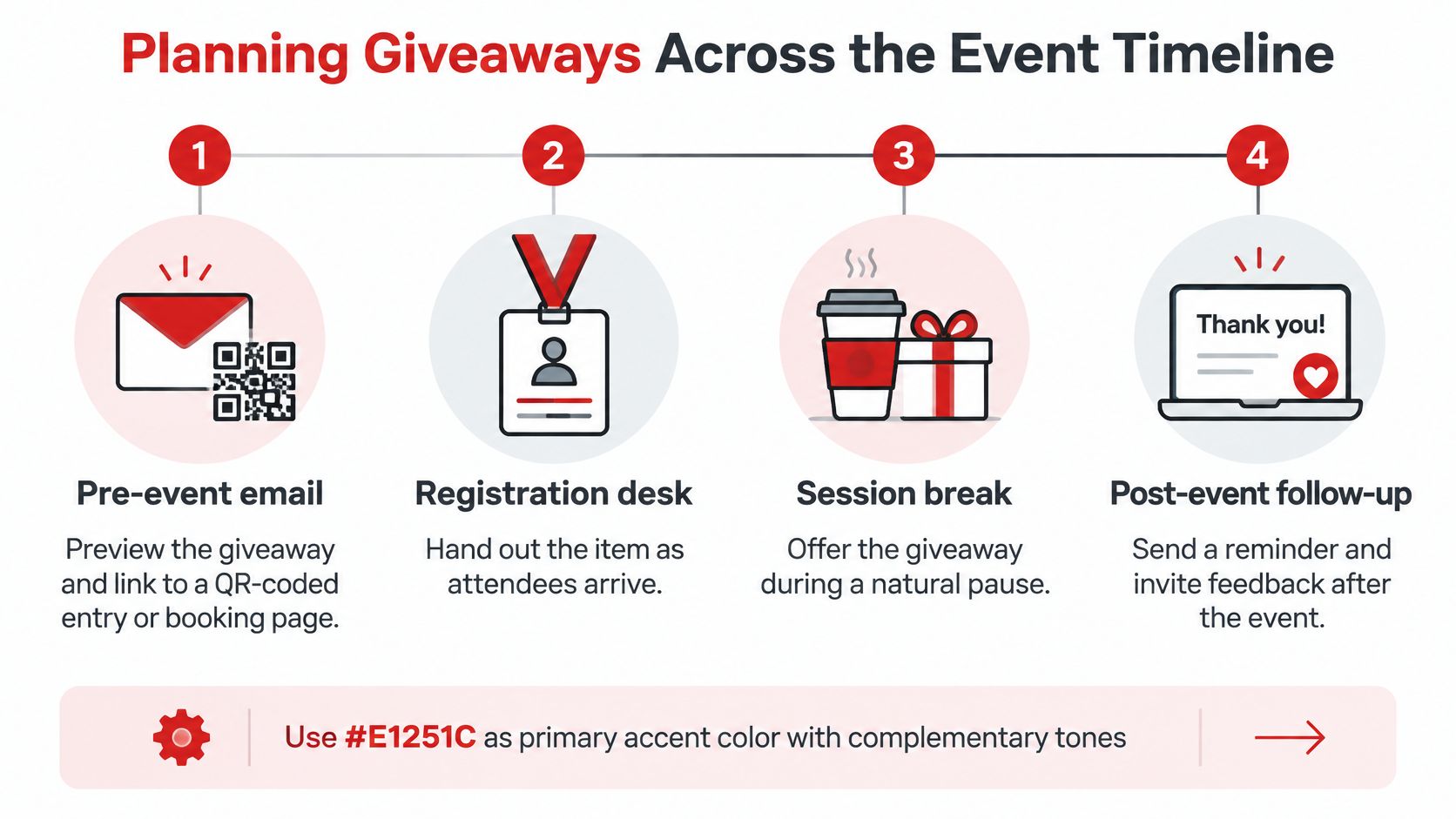
- Pre-event email. Preview what people will receive and link a QR-coded resource or booking page. Delegates arrive knowing the bottle is for refills, not a surprise at the desk.
- Registration, day one. Hand the broad, low-cost piece, such as a lanyard or notebook, to every delegate. Keep the premium allocation off the open table.
- Mid-event. Tie a second item to a session, workshop or booked meeting. A pause can be the moment itself. Some teams bring ceremonial matcha served on mint-green bikes onto the forecourt so the break is memorable, then reserve the durable item for people who joined that activity.
- Post-event. Send one follow-up with the resource or offer you promised. The email is what turns a kept mug into a continued conversation.
A 500-delegate sketch
Say you have 500 delegates. Every person gets a lanyard or notebook at the desk. You hold 20 insulated bottles for pre-booked meetings and confirmed speakers. Count scans and meetings booked per 100 items distributed, not how fast the box emptied. If the date is tight, check express promotional products early enough that a sample can still be approved before the courier cutoff.
Measuring Whether Your Giveaways Worked
The number I would watch first is scans per 100 items. It tells you whether the object prompted an action, not whether people smiled when they took it. Pair it with meetings, cost, waste avoided and a later check on whether the item is still in use.
| Metric | How to calculate | What it tells you |
|---|---|---|
| Scans per 100 items | QR scans divided by items distributed, multiplied by 100 | Whether the item prompts engagement |
| Meetings booked per 100 items | Meetings booked divided by items distributed, multiplied by 100 | Commercial pull of the giveaway |
| Cost per meaningful interaction | Total item and freight cost divided by qualified interactions | Real value for money |
| Disposable items avoided | Expected single-use replacements multiplied by estimated uses | Environmental effect of the choice |
| Items still in use | Items still used at follow-up survey divided by items distributed | Usefulness beyond the event |
| Estimated waste per attendee | Waste in kilograms divided by attendees and days, compared with 1.89 kg per day | Benchmark against the reported event average |
A waste figure you can actually beat
The average conference attendee generates about 1.89 kg of waste per day, and an Australian medical conference that adopted a no-consumables policy recorded 0.84 kg per attendee per day, 55% below that reported average, while saving more than 21,500 disposable cups from landfill, as set out by EarthCheck. That result came from removing consumables, not from labelling a tote green. Sometimes the better "giveaway" is refill access, a digital pack or a tightly rationed useful item.
Build the impact sum in four lines: disposable replacements avoided, expected uses, packaging volume, and the disposal route. Say 300 delegates each keep a bottle and use it three times a week for a year. That is 300 × 3 × 52, or 46,800 single-use drinks your item could stand in for, before you subtract people who lose the bottle in week one. Write the assumption next to the total so finance can see it is an estimate, not a certificate.
Qualified interactions, not units shipped, are what you divide into cost. A low unit price that produces no meetings is the expensive option. If you want a wider view of return, it helps to evaluate event success with EventUploader alongside these item-level counts.
Send a short survey two to four weeks later. Ask whether the item is still in use, how often, and whether it replaced something disposable. That reply is the proof a green claim usually lacks.
Brief Your Order Before You Contact a Supplier
A giveaway brief should make the audience, quantity, budget and delivery deadline clear. That gives a supplier enough detail to compare products and branding options, prepare an artwork layout and price the order.
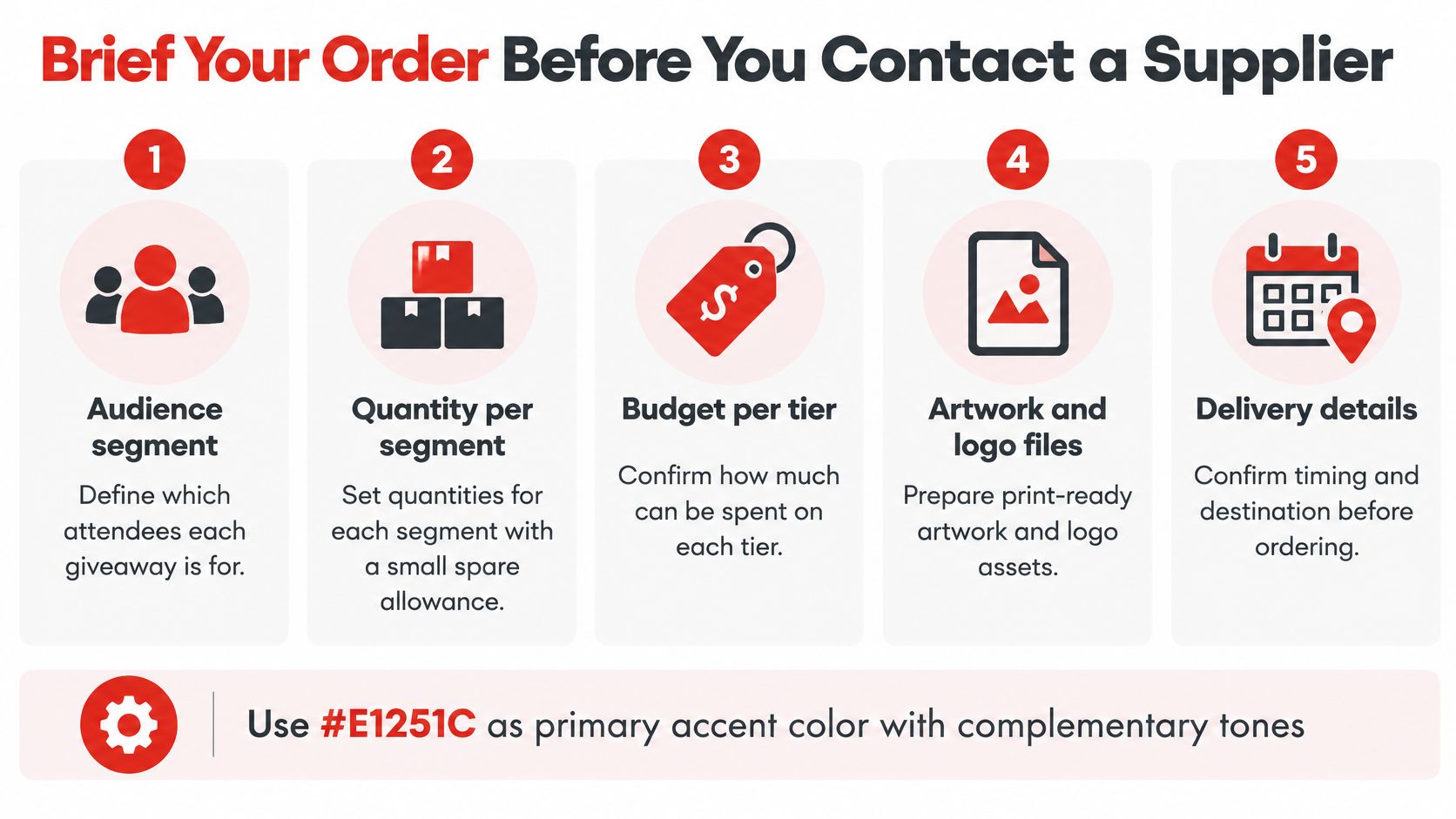
Before requesting a quote, prepare:
- Audience segment. Identify who each item is for, rather than grouping every recipient as “attendees.”
- Quantity per segment. Include a modest spare allowance for late additions or damaged units. Avoid ordering a much larger run without a clear reason.
- Budget per tier. Set a per-person ceiling so a premium item does not exceed the budget for broad distribution.
- Artwork. Share your logo, team name and artwork requirements, including any wording that must remain legible at small sizes. The team can advise on suitable decoration.
- Required date and destination. Specify the event date and delivery address, such as the venue's receiving point.
Sustainability as a buying rule
The Australian Government's sustainable procurement guidance covers considerations including emissions, waste, recycled products, packaging and end-of-life recycling. Translate the relevant points into product requirements: set a recycled-content minimum where suitable, check whether the product and packaging can be separated, and avoid unnecessary individual wrapping. Ask how packaging should be disposed of, and base environmental claims on product information rather than a generic symbol.
A reusable item only earns its place if delegates keep using it. Consider whether it replaces a disposable product, how much packaging it adds and what happens to it at the end of its useful life.
For participant packs, list every item separately and confirm packaging and freight so the complete order is ready for distribution. Describe what you have in mind to receive help with ideas, a free quote and an artwork preview. Sample items are generally unbranded or may carry another company's logo; branded samples may be available at cost. Check sampling options with the team before treating a sample as a preview of the finished branded item.
To start a project, send your audience, quantity, budget, artwork and required date to save@simplymerchandise.com.au. Simply Merchandise can help compare products and branding options and prepare an artwork layout. Request a quote and artwork preview, then confirm the chosen items, quantities and delivery details before approving the order.
We help Australian teams match conference giveaways to their audience, branding and delivery date. If you are choosing items delegates may still use weeks later, include the audience, quantity, budget, artwork and required date in your brief. Visit Simply Merchandise to request a free quote.

