



You're organising a Sydney trade show, the event team needs badges by Friday, and someone has just added a requirement: they must identify staff as well as display the brand. The quote looks reasonable, but it doesn't tell you whether attendees can read the names, whether the fastenings suit the uniforms, or whether freight reaches the venue before bump-in.
That's the buying problem with custom badges in Australia. You're not just purchasing a small printed object. You're choosing something people must wear, organisers must distribute, and someone must eventually store, reuse or dispose of. Start with those jobs, then negotiate the price.
Why Custom Badges Still Earn Their Keep in 2026
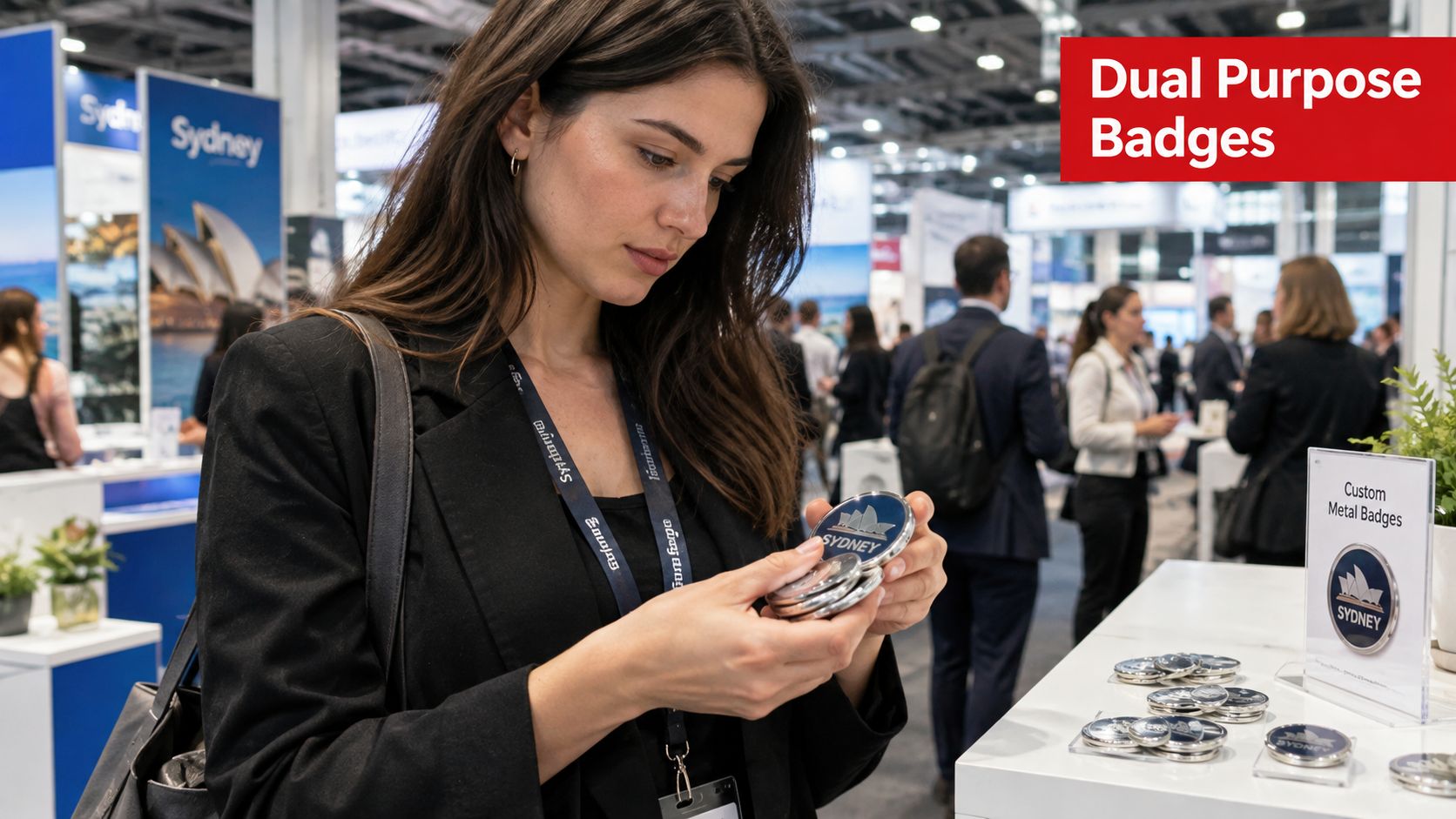
A badge earns its place when it makes an interaction easier. A visitor can find a staff member, a school can recognise a student's contribution, or a charity supporter can visibly identify with a cause. A decorative badge might still be worth buying, but decoration and identification need different briefs.
For your trade show, separate the requirements before choosing a finish. Staff identification needs readable names and roles. A keepsake needs a design people want to retain. If the badge also indicates access, agree with the event team how staff will check it rather than treating a logo as an access-control system.
Buy for a job, not a merchandise category
Australia has a long precedent for wearable identity: the Powerhouse Collection's Australian badge records document public displays of allegiance since around 1900, including charity fundraising, political campaigns, hospitals, clubs and national occasions. That history gives buyers a useful perspective. The value is in what the wearer communicates, not what the object costs.
A dated design can also become a record of participation. Museums Victoria's Australia Day badge, made in 1918, demonstrates how a compact gilt-and-enamel object preserved an occasion and its identity.
Buying principle: Write down what the badge must help a person do before writing down what it should look like.
For a council campaign, I'd prioritise a clear message and a distribution plan. For employee recognition, I'd prioritise a design recipients feel comfortable wearing. For school leadership badges, I'd ask staff about fastening suitability and how replacements will be managed.
Don't assume every badge will stay in circulation after an event. Give people a reason to keep it, or give organisers a practical way to collect it. Repeated use is a purchasing objective, not a guaranteed outcome. That distinction keeps your budget grounded and your brief useful.
The Seven Badge Types Worth Knowing
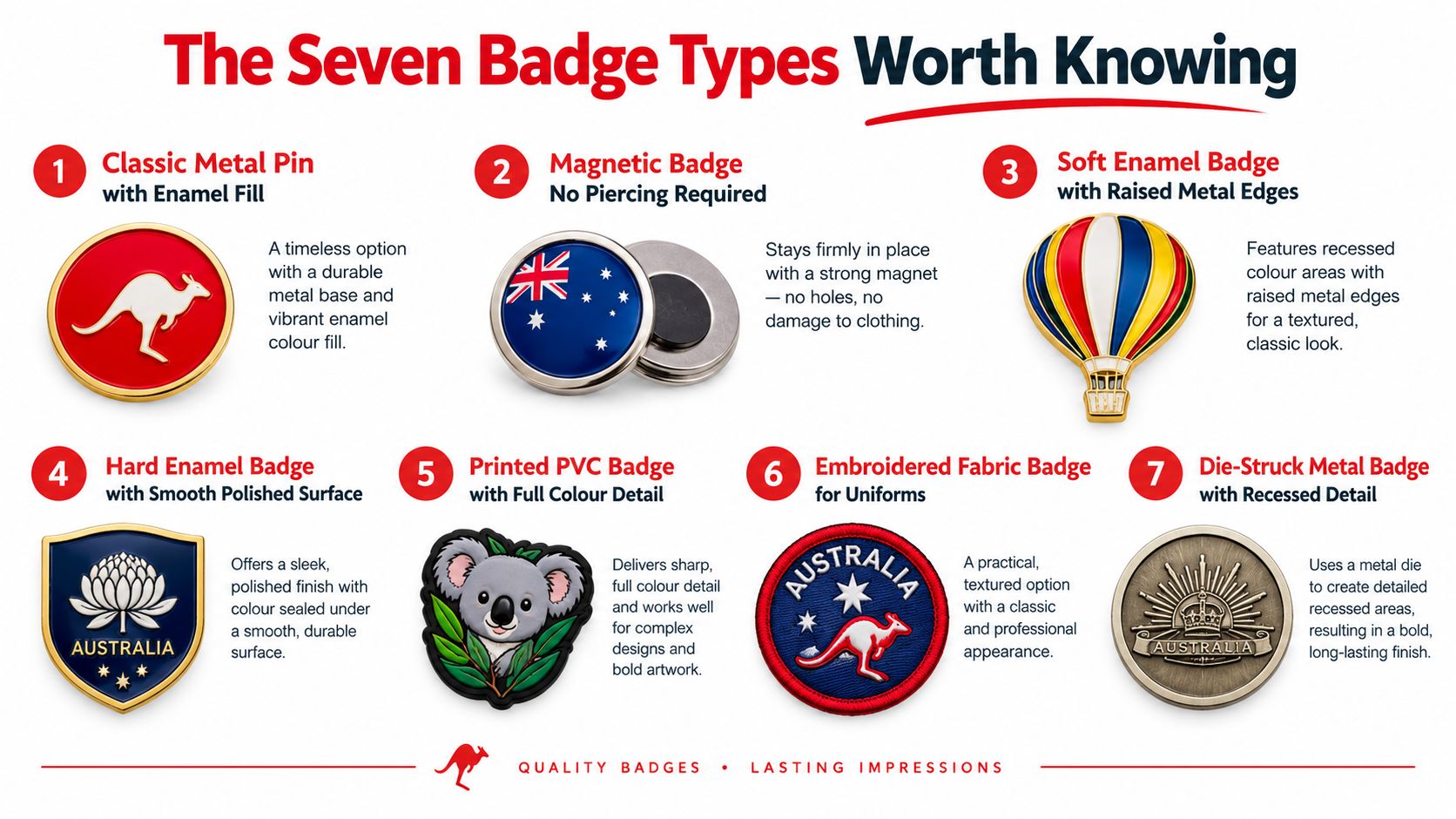
Supplier terminology can blur construction, fastening and purpose. A magnetic badge describes an attachment; a name badge describes a job. Use these categories to organise your shortlist, then ask suppliers to specify the actual construction.
Start with how people will wear it
Classic pin badges are worth considering for campaign messages, club identity and event giveaways. Ask whether you're being quoted a printed button badge or a shaped metal pin, because they're different products. Check the pin and clasp on a sample, and confirm that the venue or organisation permits that fastening.
Magnetic badges suit a brief where piercing clothing is unacceptable. Don't approve them from a photograph alone. Test the proposed backing on the actual uniform fabric and ask the supplier for safety information and any wearer restrictions.
For name and ID badges, start with the information hierarchy rather than the shell. Names, roles and organisational identity need deliberate space. Where an event requires credentials or frequently changing information, compare the badge with a custom lanyard and credential arrangement before committing to individual permanent badges.
Choose the presentation deliberately
Enamel badges deserve a sample comparison. Ask to see soft enamel with raised metal outlines alongside hard enamel with a smooth finished surface, rather than accepting “premium” as a specification. For a metal-only emblem, include a die-struck sample in that comparison.
The remaining formats answer different design briefs:
- Domed epoxy badges: Consider these when you want a printed design under a clear raised covering. Approve the artwork through the actual dome, especially where the design contains text.
- PVC badges: Shortlist a flexible format for an outdoor or sporty brief, but request documented performance rather than assuming every PVC product is waterproof or equally durable.
- Fabric badges: Consider woven or embroidered designs for uniforms and garments. Confirm whether attachment involves sewing, adhesive or another method, and ask how removal or replacement will work.
If the badge needs to become part of a uniform, Caddie Uniform's custom logo patch guide is a useful companion resource when preparing questions about patch construction and application.
My recommendation is to shortlist contrasting formats, not several cosmetic variations of the same badge. Put them on the intended clothing, handle the fastenings and read the design at its finished size. That tells you far more than a catalogue image.
Materials, Finishes and What They Cost You
Don't approve “metal badge” as a complete specification. Ask for the base material, surface finish, attachment and any protective coating. Without that detail, you can't compare quotes properly or explain what you've purchased.
For a school camp, I'd start with fastening suitability, garment compatibility and replacement needs. For a mining conference, I'd separate attendee identification from any badge expected to be worn in an operational workplace. A conference badge isn't automatically suitable for a worksite.
Material and finish decision matrix
Use this matrix to direct sample requests. The durability column identifies what to verify, not a universal performance rating.
| Material or finish | Durability | Look and feel | Best fit |
|---|---|---|---|
| Iron, brass or zinc alloy | Verify coating, corrosion and attachment performance | Ask for samples showing weight and surface detail | Recognition pins and emblems |
| Aluminium or recycled aluminium | Check bending, scratching and backing security | Compare the proposed thickness and finish | Campaigns where weight matters |
| Stainless steel | Request suitability for intended conditions | Consider an exposed-metal design | Reusable identification |
| ABS plastic or PVC | Confirm rigidity or flexibility and exposure limits | Compare printed and moulded samples | Briefs needing a non-metal format |
| Woven or embroidered fabric | Confirm care and attachment requirements | Textile appearance integrated with clothing | Uniforms and clubs |
| Printed paper insert | Check protection within its housing | Printed information in a holder or shell | Changing names or event details |
| Plating, antique, polished or matte finish | Ask about wear and cleaning | Compare shine, texture and contrast | Matching a specific brand style |
| Glitter, glow or domed resin | Request evidence for the intended use | Decorative effect or raised covering | Designs where the effect has a clear purpose |
A council campaign may justify recycled-material documentation over a decorative finish. A fashion launch may justify a particular texture, but only after the organiser has decided that the badge is a keepsake rather than an identification tool.
Ask what each upgrade changes
Have the supplier quote the same design with and without optional finishes. That exposes the cost of the effect without confusing it with a different quantity, attachment or packaging arrangement.
Don't pay for a finish you can't describe, recognise on a sample or connect to the badge's job.
Ask whether each choice introduces extra production work, approval requirements or handling. PSW Events' PSW Events printing advice can sit alongside your supplier discussion as a resource for preparing the printing brief, but the badge supplier must confirm the actual production specification.
Be equally disciplined about material substitutions. If a supplier proposes a different alloy or plastic, request written confirmation and a revised sample where practical. An approved visual mock-up doesn't give permission to change the underlying product.
Sizing, Quantities and the Real Cost Drivers
Unit price isn't the purchasing decision. It's a component of the decision. The useful figure is the total payable for the required badges, correctly branded, packed appropriately and delivered to the nominated destination.
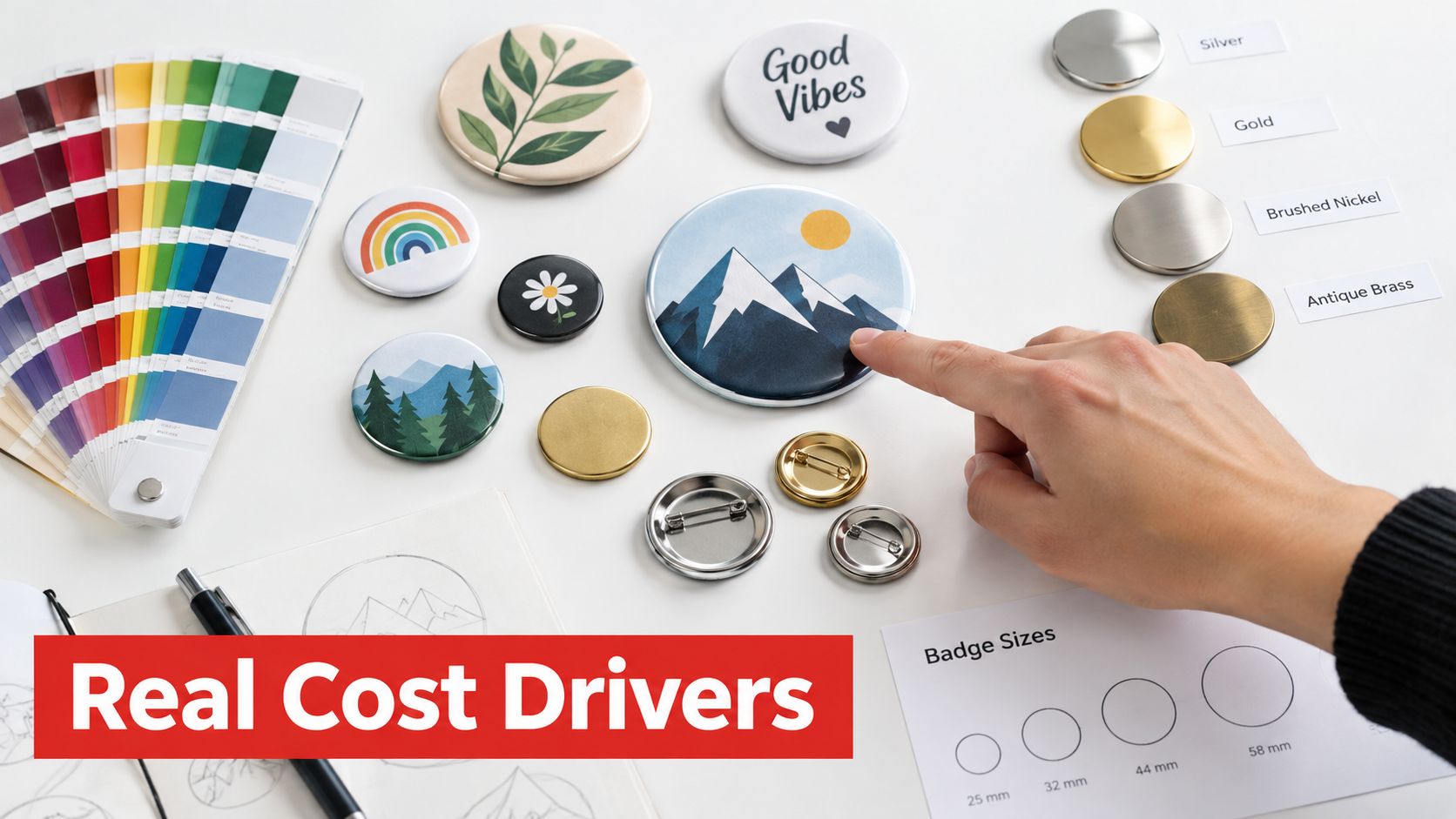
Choose size from the badge's task. A small emblem and a staff badge carrying a name and role shouldn't automatically share dimensions. Ask for an actual-size layout before requesting changes that could affect material use, tooling or packaging.
Separate the quote into comparable parts
Ask each supplier to identify:
- Product specification: Material, dimensions, shape, attachment and finish.
- Branding charges: Printing, colour treatment, tooling, artwork work and individual personalisation.
- Packing: Individual sleeves, backing cards, bulk packing and destination sorting.
- Delivery: Freight to the actual postcode, any split shipments and applicable surcharges.
- Commercial terms: GST treatment, payment conditions, quote validity and replacement arrangements.
Don't assume a charge applies to every format. Ask which costs are fixed, which vary with quantity and which recur when you reorder. For custom tooling, establish ownership, retention and whether future orders can use it.
Order for attendance and use, not the discount threshold
Minimum order quantities can reflect setup or production constraints. Ask the supplier to explain the minimum for the particular format instead of treating it as an industry-wide rule.
Build your quantity from the distribution plan: confirmed recipients, operational spares, replacement needs and any reusable stock. Ask for alternative quantities, but compare the total invoice and expected leftovers, not just the smaller unit price.
For a national campaign, include the labour involved in sorting and redistributing cartons from head office. Direct delivery might be preferable, but you need a quote to judge it. Regional destinations also deserve their own freight confirmation rather than a promise based on metropolitan delivery.
Use a promotional products by price shortlist to establish a budget range, then request a badge-specific delivered quote. A browsing category won't account for your personalisation, packing or destination.
Finish the comparison by recording exclusions. A clear quote that costs more can be easier to approve than a cheaper quote with unresolved artwork, freight and replacement terms.
Artwork, Proofing and Accessibility From Day One
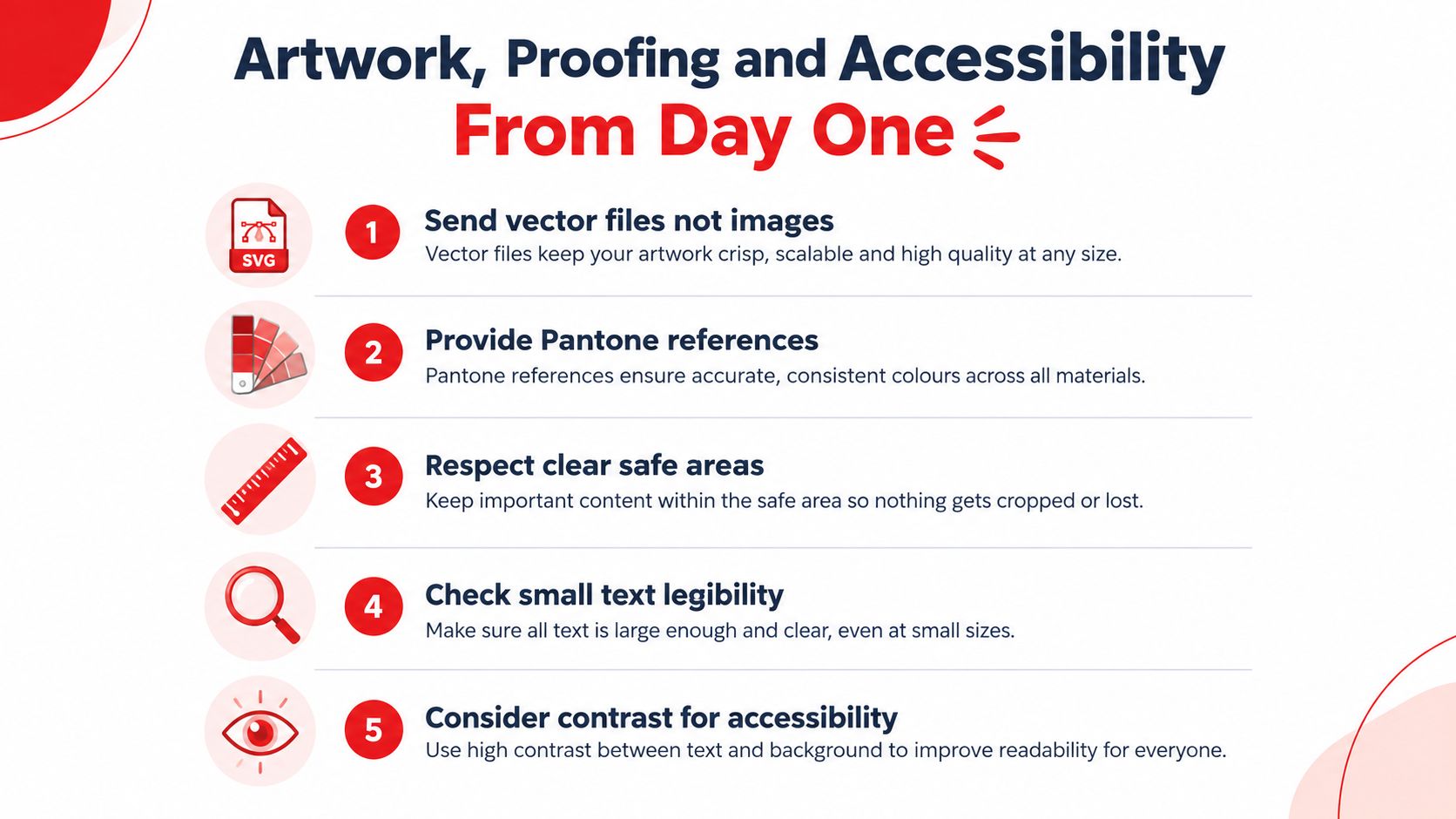
Design the badge around what people need to read first. For staff identification, that usually means the name and role should take precedence over decorative branding. For a campaign badge, the message may matter more than a detailed logo.
Supply vector artwork where available, along with brand colour references, approved wording and any required reverse-side content. Ask the supplier to confirm acceptable file formats, minimum reproducible detail and safe areas for the selected construction. Don't apply a generic text-size rule to every badge.
Make essential information easy to find
The City of Sydney's inclusive and accessible event guidance recommends good foreground/background visibility and a minimum 30% colour contrast between the background and key information text. Apply that benchmark deliberately to names, roles and important instructions rather than concentrating contrast around the logo.
Treat it as a design benchmark, not proof that every wearer can read the finished badge. Gloss, small lettering and viewing angle still need practical checking. Don't communicate an essential role through colour alone; include readable wording.
Approve the object, not just the screen image
A digital proof is useful for checking wording, placement and the proposed design. It doesn't let you judge the fastening or how the surface looks under venue lighting. Request a physical pre-production sample when the order's complexity and schedule justify one.
Your approval checks should cover:
- Content: Verify spelling, names, roles and reverse-side instructions against the approved list.
- Layout: Check the design at finished size, including edges and attachment-related restrictions.
- Colour: Confirm references and understand what the supplier will match.
- Wearability: Test orientation, fastening and visibility on the intended garment.
- Production authority: Identify who can issue final written approval and what version they're approving.
Proofing safeguard: Put the approved artwork version, product specification and attachment choice in the same sign-off record.
Use the artwork submission guide for beginners to prepare files before the supplier starts adapting them. Then keep the approval process controlled: one decision-maker, one consolidated feedback document and a clearly identified final version.
If individual names are involved, treat the data file as part of the artwork. Approving the badge template doesn't approve a misspelt name or an outdated staff list.
The Sustainability Question Most Suppliers Dodge
Ask what happens after use before accepting an environmental label. “Recycled”, “recyclable” and “reusable” describe different things. A supplier should be able to explain which claim applies to the badge, which applies to its packaging and what evidence supports each.
Australia's recovery figures make that distinction important: the Senate report on stronger packaging reform records that about 20% of approximately 1.3 million tonnes of plastic packaging placed on the market in 2021–22 was recovered, while only 6% of new packaging contained post-consumer recycled content. Those are packaging figures, not badge recovery rates. Don't use them to claim that a particular badge is, or isn't, recycled.
Separate content from recovery
Recycled aluminium offers a documented material benefit: the ACT Government's aluminium factsheet states that recycling requires approximately 5% of primary aluminium production energy, while around 95% of Australia's scrap aluminium is exported for recycling. That supports requesting recycled stock where available, but not claiming your finished badge will be recycled domestically.
Ask for a construction breakdown. A shell, pin, printed insert, adhesive and coating may need different disposal pathways. Small mixed-material items may not be accepted through kerbside recycling, so confirm the local council's rules rather than adding a recycling symbol and hoping.
Write a claim you can defend
A useful sustainability brief requests:
- Material evidence: Document the recycled-content proportion and identify which component it covers.
- Packaging detail: Specify necessary protection and ask whether individual wrapping can be avoided.
- Local disposal guidance: Check acceptance at the recipient's location, not just the supplier's address.
- Reuse arrangements: Nominate who collects, stores, checks and redistributes reusable badges.
- Take-back terms: Ask where returned items go and what the supplier does with them.
For local campaign planning, Litter Caterpillars' ward-by-ward green initiatives provide an additional sustainability resource to consider alongside council-specific disposal advice. They aren't a substitute for checking acceptance of your chosen badge.
You can browse eco-conscious promotional product options, but assess each proposed product individually. My preference for recurring events is a badge designed for reuse, with changeable information where practical. A theoretical recycling pathway isn't as useful as a collection and storage process your team will run.
Ordering and Lead Times Without the Last-Mile Panic
Work backwards from the date badges must be available for distribution, not the event opening. Organisers need time to receive cartons, check the contents and resolve problems before attendees arrive.
Ask when the production clock starts. Artwork approval, tooling, finishing, assembly and packing may all affect the schedule, depending on the format. A rush option is only useful when the supplier explains exactly what it accelerates.
Put the schedule in writing
Use this sequence before authorising the order:
- Confirm the brief: Lock the product, artwork requirements, quantity and delivery addresses.
- Set approval deadlines: Agree when proofs and any samples must be reviewed.
- Record dispatch and delivery separately: Ask what is committed and what remains an estimate.
- Confirm destination details: Include venue access, receiving hours and a contact who can accept cartons.
- Agree on contingencies: Document what happens if goods are late, damaged or incorrect.
A council event in regional Western Australia needs a destination-specific freight discussion. A Tasmanian school camp needs delivery to the right receiving location, not an unattended office. A capital-city roadshow needs cartons labelled for the correct stop.
For public procurement, the Australian Government's recycling policy guidance recognises regional and remote recycling difficulties and the inclusion of sustainability in Commonwealth value-for-money assessment. Keep that documentation with the purchasing record.
If the deadline is already tight, compare express promotional product options and simplify the brief. Don't remove approval safeguards to preserve an unnecessary finish.
The Pre-Order Checklist That Pays for Itself
- Define the job: Identify what the wearer must communicate.
- Shortlist formats: Test suitability, not just appearance.
- Lock the specification: Record materials, finish and attachment.
- Approve artwork: Check names, physical size and accessibility.
- Compare delivered totals: Include packing, freight and exclusions.
- Verify environmental claims: Keep evidence and local disposal instructions.
- Confirm the schedule: Record approvals, delivery and contingencies.
- Assign ownership: Name who receives, checks and manages leftovers.
Ask the supplier: “What have we not included that could prevent these badges being usable at the destination?” That question is more valuable than another discount request.
Merchandise offers custom-printed badges and branded merchandise for Australian businesses and event teams. Visit Simply Merchandise with your artwork, quantity, delivery postcode and required arrival date, and request a quote that makes the badge specification, packing and delivered cost clear.

