



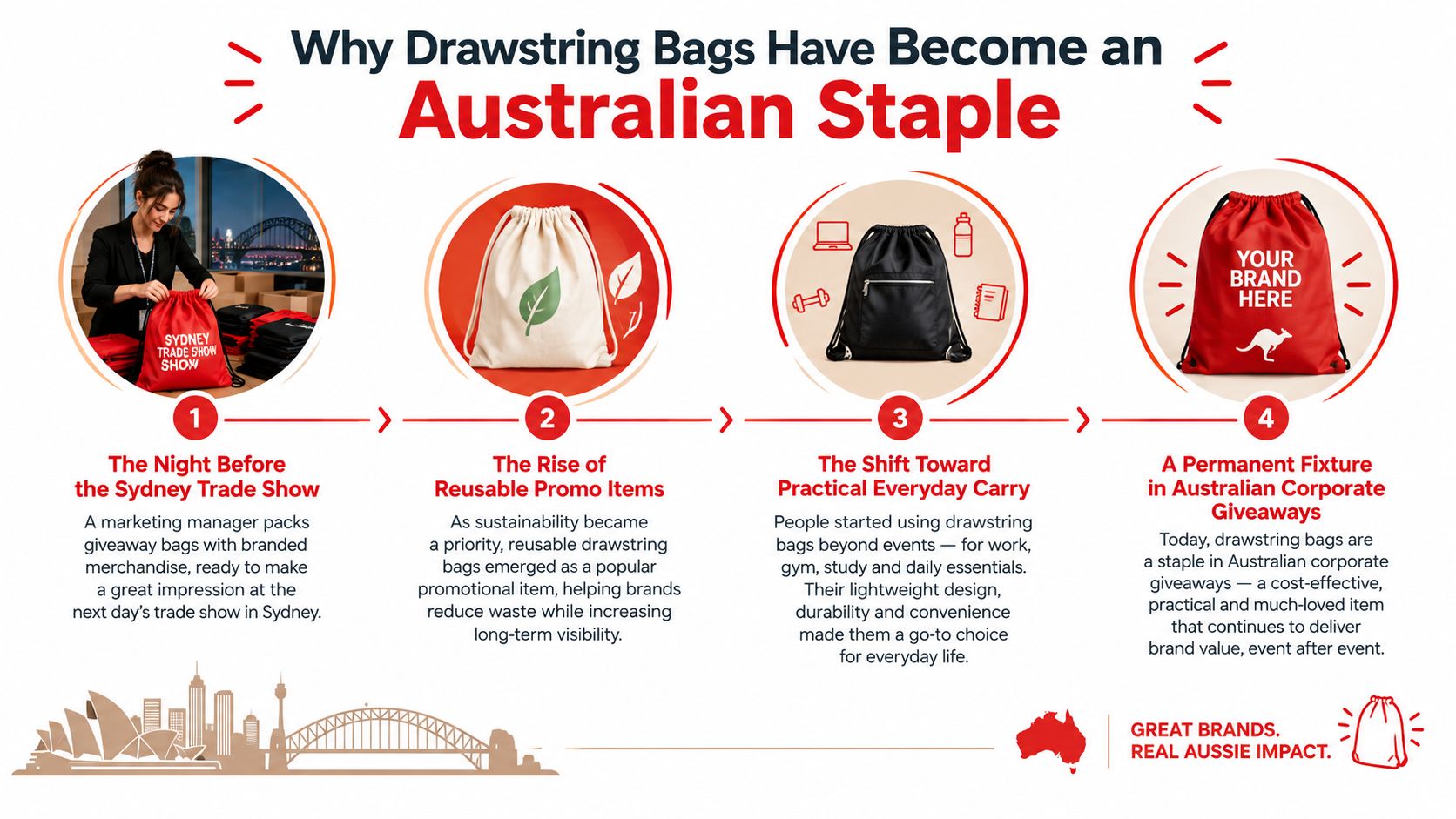
You're packing giveaways the night before a Sydney trade show. The brochures fit, the logo looks sharp, and the drawstrings close. But there's a question the purchase order didn't answer: will anyone use this bag after tomorrow?
When buying custom drawstring bags in Australia, that's the question worth paying for. Start with the recipient's next use, then work backwards through fabric, construction, branding and delivery. You'll make a better purchase than if you start with the cheapest bag or the most convincing environmental label.
Why Drawstring Bags Have Become an Australian Staple
At the packing table, a drawstring bag solves an immediate problem. Your event team needs something to hold the handouts, and visitors need somewhere to put them. The opportunity comes later, when someone reaches for the same bag before training, an excursion or a trip to the beach.
That's how I'd assess its promotional value: not whether it carries your campaign home, but whether it earns another outing. A bag designed only around the contents of an event pack has a very limited brief.
A reusable market shaped by regulation
Australia's move away from lightweight shopping bags provides useful context. South Australia introduced the first statewide ban in May 2009, the major supermarkets removed free lightweight bags in 2018, and New South Wales introduced its ban on 1 June 2022, according to the history of plastic-bag bans in Australia.
That history doesn't prove every fabric giveaway is a good purchase. It does explain why reusable bags belong in a market shaped by sustained regulatory change, rather than a passing promotional fashion. For schools, workplaces and community campaigns, the sensible question is which reusable product recipients will keep using.
Buy for the occasion after the event
Give your supplier a practical destination, not just a campaign name:
- For school sport: Ask whether the bag accommodates the actual uniform and equipment.
- For workplace use: Decide whether it's a personal carry bag or an organiser inside another bag.
- For community events: Identify a useful local activity the bag can support afterwards.
A drawstring bag shouldn't be your automatic choice because it's familiar. Choose it when the opening, carrying style and usable capacity suit the audience. If recipients need structured document storage or comfortable heavy-load carrying, ask to compare another bag format before committing.
Understanding the Core Bag Types and Materials
Don't choose cotton because it sounds wholesome, or polyester because it looks sporty. Material is a starting specification, not a verdict on quality. Ask to handle samples with your intended contents inside.
Your supplier should identify the fibre, fabric weight, finish and construction. GSM means grams per square metre, so it describes fabric weight rather than a finished bag's load capacity. Don't treat a heavier fabric as proof that the seams or cord attachments are stronger.
Drawstring Bag Materials at a Glance
| Material | Typical Feel | Best Fit |
|---|---|---|
| Non-woven polypropylene | Light, with a shopping-tote-style texture | Simple event packs and light contents |
| Cotton | Soft, with a natural fabric finish | Everyday organisers and understated branding |
| Polyester, including recycled PET | Smooth, gym-sack-style finish | Sport, travel and compact carry |
| Mesh or canvas | Open-textured mesh or substantial woven canvas | Ventilated storage or a more structured bag |
Use those descriptions to shortlist samples, not to approve a purchase remotely. Treatments, linings and construction can change how a finished bag behaves.
Match the fabric to the load
For a light promotional pack, I'd consider non-woven polypropylene, then inspect the seams and corner attachments closely. For a bag intended to become someone's regular gym sack, I'd compare polyester options and assess how comfortably the cords sit when loaded.
Cotton deserves consideration when hand-feel and a restrained visual finish matter. Canvas is worth sampling for a more substantial presentation, but don't assume recipients want the extra bulk. With mesh, check whether the contents need ventilation or protection from outside contact.
- Ask for load suitability: Give the supplier a contents list rather than accepting an undefined “strong” bag.
- Check care requirements: Choose something recipients can realistically maintain.
- Compare complete products: Assess lining, closures and attachments alongside the main fabric.
Browse the promotional bag options with that shortlist in mind. You're comparing a reusable shopping tote, a gym sack and a beach hauler in practical terms, even when the catalogue calls them all drawstring bags.
Print and Branding Methods That Actually Last
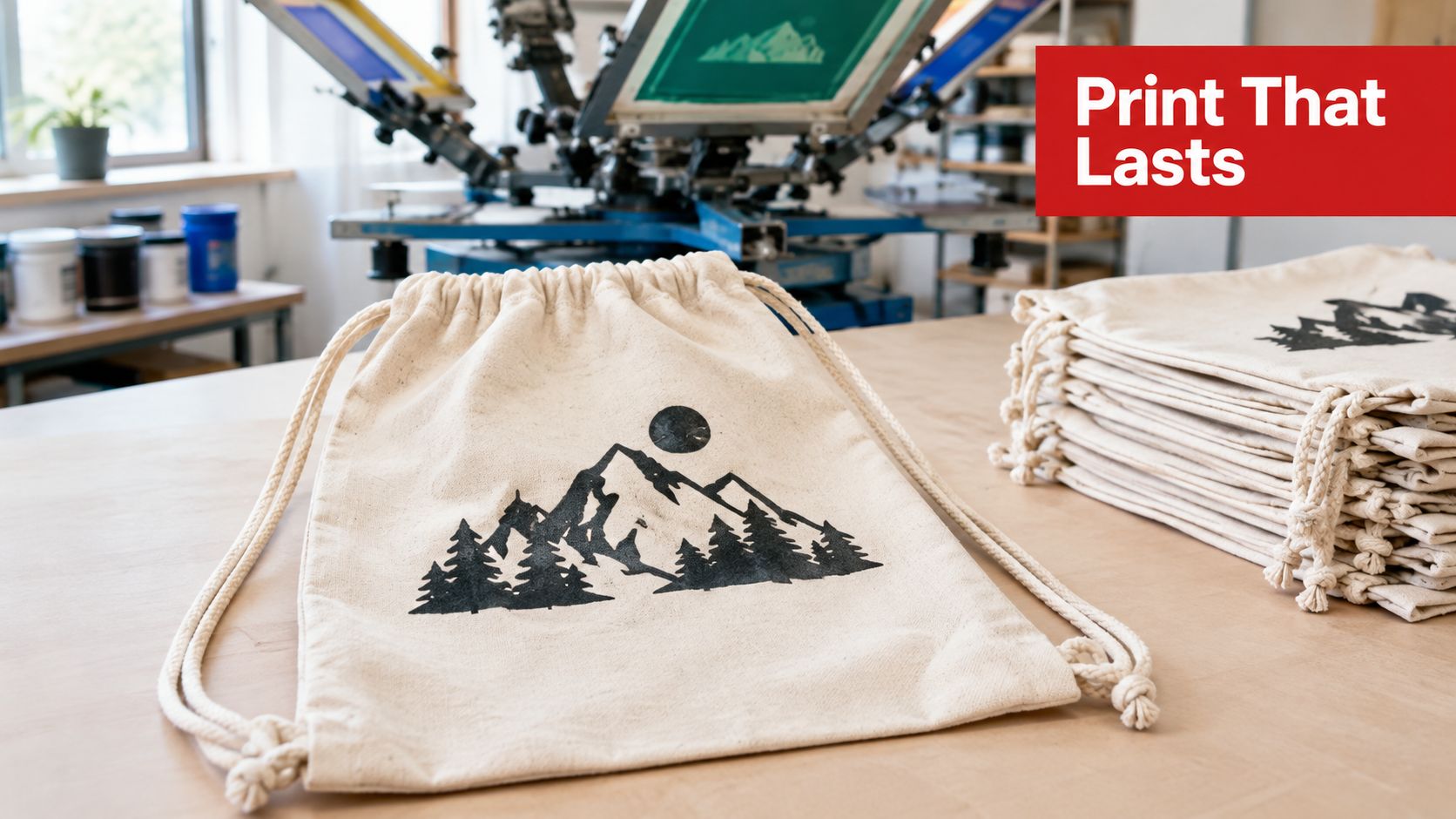
A beautiful proof doesn't establish how branding will survive use. Ask the supplier to recommend a method for the specific bag, artwork and care routine, then request a decorated sample where the campaign warrants it.
For a simple logo on cotton, I'd start by asking about screen printing. For photographic artwork or gradients, I'd request a digital-print or transfer option. Don't insist on identical production methods across different fabrics just to make the purchase order look tidy.
Choose the process around the artwork
| Method | My buying recommendation |
|---|---|
| Screen printing | Ask for it when the design uses bold shapes and a restrained colour palette. |
| Digital printing | Request a sample when fine detail or tonal artwork matters. |
| Heat transfer | Check the transfer's flexibility, edge finish and care requirements. |
| Sublimation | Have the supplier confirm fabric compatibility and achievable colour results. |
| Embroidery | Sample it on the selected panel before approving a stitched finish. |
“Digital” isn't a complete production specification. Ask whether the supplier means direct printing or a digitally produced transfer. Likewise, don't approve embroidery without checking how the fabric supports the stitching.
Practical rule: Approve the decoration on the chosen fabric, not on the strength of a logo mock-up alone.
Keep the wider event identity consistent
If you're coordinating bags with signage and exhibition structures, Premier Marquee Hire's resource on bespoke branded event marquees is a relevant planning reference. Keep the visual identity consistent, but let each supplier specify an appropriate production process.
Use the available custom printing options to frame your quote request. Ask suppliers to itemise print positions, artwork colours, maximum decoration area and setup requirements, and explain how each option affects the minimum order. I'd simplify an overcrowded design before compromising the bag itself.
Cost Drivers, Minimum Orders and Lead Times
Compare delivered specifications, not catalogue thumbnails. Bags that look alike can carry different costs because the quote includes different fabric, reinforcement, decoration or packing requirements.
Ask for an itemised quote against a fixed brief. Then request alternatives that change a clearly identified feature, such as removing a pocket or simplifying the artwork. Otherwise, you can't tell whether a cheaper offer represents better buying or less product.
Separate the product from the production costs
- Bag construction: Confirm fabric weight, dimensions, cord type, reinforcement, gussets and pockets.
- Decoration: Separate setup, print positions, colours and any special artwork preparation.
- Packing: Identify individual wrapping, kit assembly, labelling and carton requirements.
- Delivery: Confirm freight, delivery address requirements and applicable taxes.
Don't assume increasing the quantity automatically improves the purchase. Ask for quantity breaks, then compare the total commitment against your distribution plan. Leftover stock isn't a saving if you have no credible use for it.
Minimum orders also need an explanation. Ask whether the restriction comes from stocked bag availability, the decoration process or custom manufacturing. A supplier may be able to offer a different colour or branding method without changing the purpose of the bag.
A useful quote tells you what you're buying, what can change and what must happen before production starts.
Work backwards from the receiving date
There's no universal Australian turnaround you should apply to every drawstring bag order. Require a written schedule covering stock confirmation, artwork approval, production, dispatch and arrival at the actual destination.
For urgent jobs, compare an available stock bag with express decoration against a custom-made option. Ask what the express service accelerates and what it doesn't. Bulk freight and express delivery also deserve separate quotes rather than assumptions.
Give the supplier your required receiving date, not just the event date. Allow time for your team to inspect, sort and pack the bags. If delivery goes to a venue, confirm its receiving arrangements before approving freight.
Sustainability Claims That Actually Mean Something
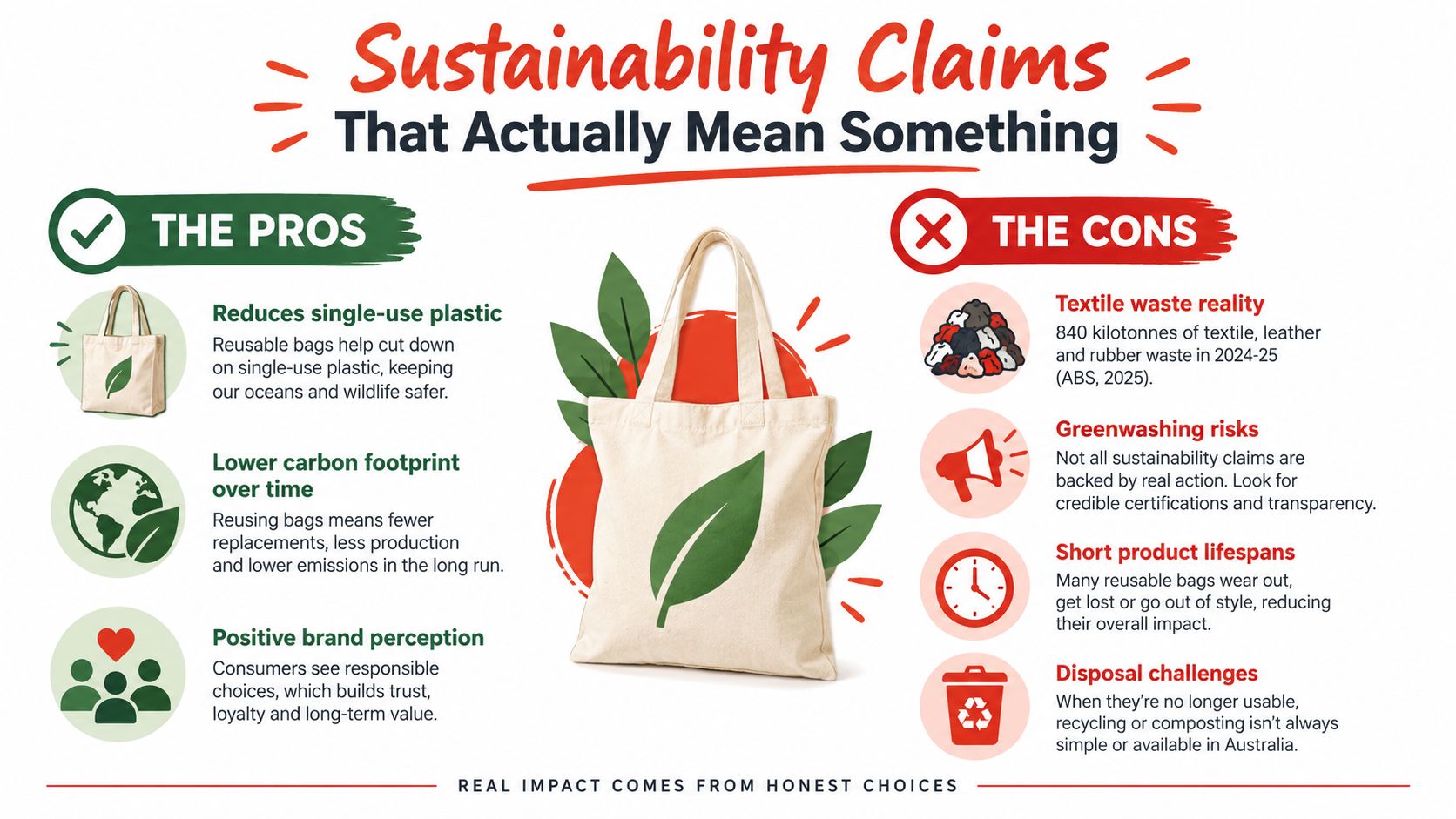
A reusable label isn't evidence of a lower-impact purchase. The bag still needs to be made, transported, used and eventually managed as waste. Buying cotton or recycled polyester doesn't remove those responsibilities.
Australia generated approximately 840 kilotonnes of textile, leather and rubber waste in 2024–25, with around 95% going to landfill, according to the National Waste and Resource Recovery Report. That's a reason to challenge disposable thinking in merchandise procurement, including products sold as reusable.
Request evidence attached to the product
The Australian Government's textile guidance describes the Global Recycled Standard as applying to products containing at least 20% recycled material, with certification required across production stages through the final business-to-business seller, while noting that it doesn't establish product quality or legal compliance in its textile standard assessment.
Write a specific evidence request:
- Composition: State the named fibre or polymer and recycled proportion by weight.
- Verification: Supply current certification and relevant chain-of-custody or transaction documentation.
- Service life: Provide care instructions and evidence supporting the intended application.
- End of life: Identify an actual acceptance pathway, including any exclusions.
Don't assign a universal break-even reuse count without a product-specific lifecycle assessment. Record the intended reuse pattern and identify what the bag is expected to replace. A promotional sack that sits unused in a cupboard hasn't displaced anything.
Treat outdoor claims separately
Dense fabric isn't sufficient proof of sun protection. If a supplier makes a UPF claim, request the material-specific test report identifying fabric and colour, consistent with ARPANSA's sun-protective clothing guidance. Don't present a rated fabric panel as evidence that carrying the bag protects the wearer.
Use an eco-product shortlist to find candidates, then apply the same scrutiny to every option. Environmental language should help you ask better questions, not replace the answers.
Sizing, Specs and Artwork Proofing Essentials
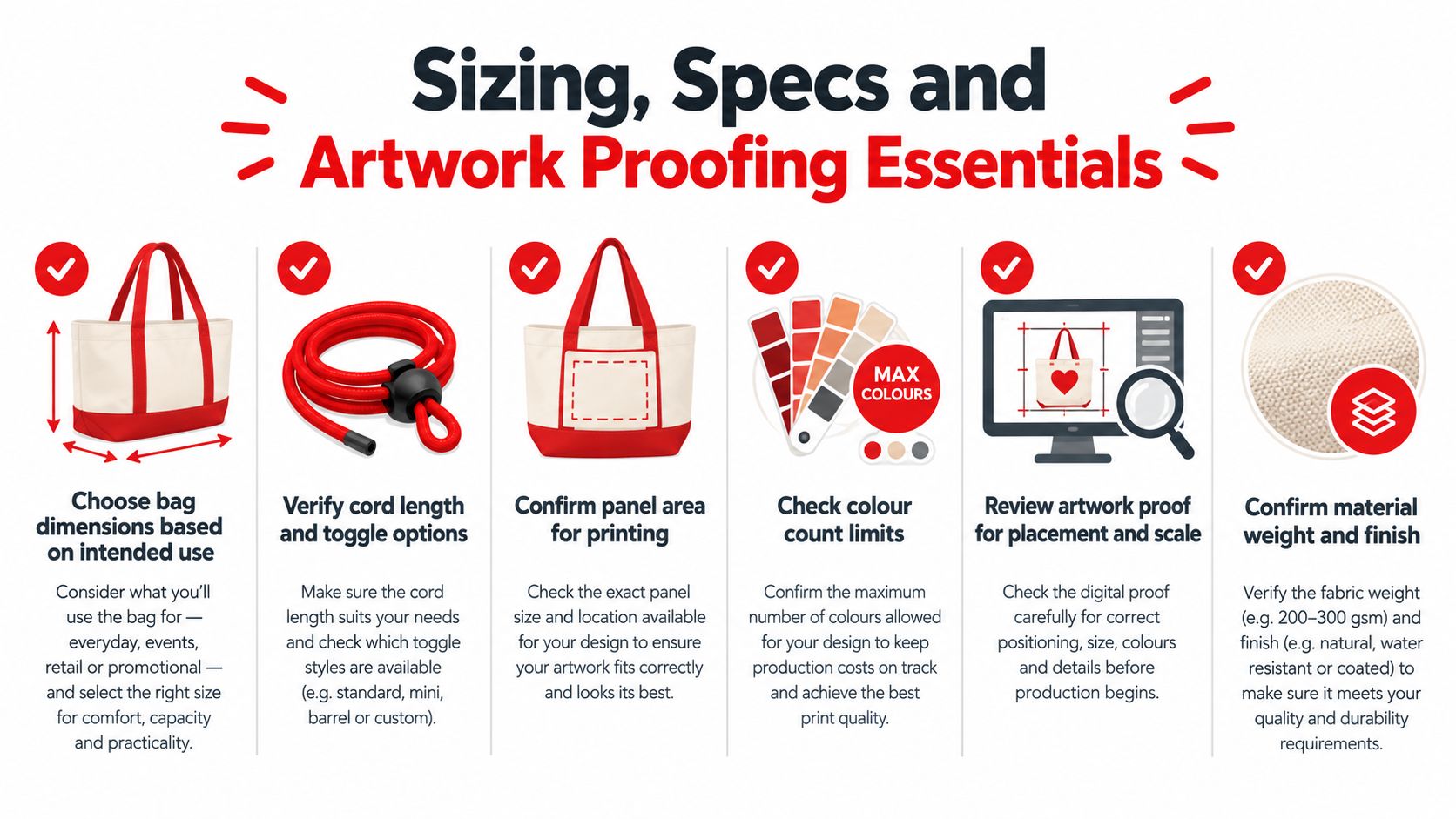
Put the intended contents on a table before choosing dimensions. A bag that holds folded clothing may still be awkward with shoes, a drink bottle or rigid conference materials. Test the packed shape and closing clearance, not just the empty bag's width.
There's no useful universal size recommendation without knowing the contents and recipient. Ask for external dimensions, usable internal capacity and the opening measurement, then check the sample yourself.
Build a specification your supplier can quote
- Fit and carrying: Record the contents, expected load, cord length and preferred closure or toggle.
- Construction: Specify the seam finish, corner reinforcement and whether a gusset is necessary.
- Decoration panel: Confirm the usable print area clear of seams, channels and attachments.
- Finish: Record fabric weight, colour, lining, labels and any pocket requirements.
Check how the cords adjust when the bag is full. For school applications, ask the organisation to confirm age suitability and its own cord-safety requirements. Don't assume a standard adult promotional bag suits every student group.
Approve a production document, not a pretty picture
Supply the original vector logo where available. For photographic or raster artwork, ask the decorator to confirm suitability at the intended reproduction size. The artwork submission guide is a useful preparation reference.
Your proof should identify the selected bag, artwork version, print dimensions, position and colour references. Ask for safe areas and bleed where relevant, and clarify whether a Pantone reference is a matching target or a guaranteed outcome.
Approval check: A screen proof can confirm layout. It can't establish the finished fabric's feel, carrying comfort or exact physical appearance.
Nominate an approver and consolidate feedback before returning revisions. Ask whether layout assistance and revisions are included rather than assuming every supplier offers them. If physical colour matching or decoration finish is critical, make sample approval part of the production agreement.
Matching Bag Styles to Australian Use Cases
Start with the activity, not the department ordering the merchandise. A school sports bag and a corporate onboarding bag might share a drawstring closure, but they shouldn't automatically share a specification.
I'd make the following shortlists, then test them against the organisation's contents, audience and budget.
Schools, clubs and community programs
For school sport and excursions, compare polyester or verified recycled-PET options with comfortable cords and reinforced attachment points. Ask for a straightforward logo treatment and a practical identification area.
Where team members carry similar kit, plan how they'll distinguish bags. InchBug's resource lets organisers browse tennis tag bundles for teams, a useful reference when considering identification alongside the bag itself.
For council and community events, consider a simple non-woven option for light contents, but move to a different construction if the intended use demands it. Match the order to the confirmed distribution plan rather than buying speculative extras because the unit quote looks attractive.
Workplaces, events and customer orders
| Application | My starting recommendation | Detail I'd prioritise |
|---|---|---|
| Corporate onboarding | Cotton, canvas or verified recycled PET with restrained branding | Fit the actual welcome kit |
| Trade shows and conferences | A lightweight bag with a clear, uncomplicated print | Comfortable carrying when packed |
| Hospitality and wellness | Cotton for dry-kit presentation or a sampled synthetic option for active use | Clear care instructions |
| Retail and ecommerce | A bag sized around the purchased product | A useful purpose after unpacking |
For conference artwork, I'd favour an enduring brand identity over a large date-specific graphic. For onboarding, I'd put budget into the recipient's daily experience rather than elaborate decoration hidden beneath the kit contents.
Use the guide to choosing promotional products when comparing the drawstring format against alternatives. Sometimes the right recommendation is a tote, backpack or organiser instead. The objective is useful merchandise, not defending the first item selected.
Your Drawstring Bag Ordering Checklist
Send a brief that a supplier can answer without guessing. A request for “a sustainable drawstring bag with our logo” leaves too many decisions unresolved and makes competing quotes difficult to compare.
Specify the outcome, identify the must-haves and invite clearly labelled alternatives. That gives you room to improve the purchase without letting the specification drift.
Settle these questions before requesting a quote
- Purpose and audience: Who receives the bag, what goes inside and where will they carry it?
- Quantity: What is the confirmed distribution requirement, and is any reserve stock justified?
- Budget: What is the total delivered allowance, including decoration and packing?
- Artwork status: Are approved files available, and who can authorise changes?
- Evidence requirements: Which material, environmental and institutional requirements must suppliers address?
- Deadline: Where must the bags arrive, and when does your team need to start packing?
For a school fete, brief the contents and handout arrangements. For a conference, include pack assembly and venue delivery requirements. For a product launch, decide whether the design must remain useful after the campaign ends.
These are different purchasing jobs. Don't let a familiar bag style conceal those differences.
Request an approval pack
Ask the supplier for a product specification, itemised quote, digital proof, written production schedule and care information. Add a sample and relevant verification documents where the application demands them.
For eligible Commonwealth purchasing, the Environmentally Sustainable Procurement Policy covers textile procurements valued at or above $1 million from 1 July 2025, requiring consideration of environmental outcomes and supplier sustainability data, as explained in the Australian Government's supplier selection guidance. Don't apply that threshold indiscriminately to every university or public-sector organisation; confirm the rules governing your buyer.
A useful closing instruction to your supplier is straightforward:
Please quote against the attached specification, identify substitutions separately, and flag any requirement you can't substantiate before we approve production.
Before signing off, check that the quote, sample and proof describe the same product. Keep the approved documents together so the receiving team can inspect against an agreed standard. That's how you turn a promotional purchase into a managed brand asset rather than a box of hopeful giveaways.
For custom drawstring bags, Simply Merchandise offers material and branding options, sampling support and artwork guidance. Send your intended contents, audience, quantity and required delivery date, and ask the team to recommend a specification built around the bag's next use, not just its first impression.

