



You've got the quote open, the artwork file half-finished, and a delivery deadline that can't slip. That's the normal pressure point with custom tote bags bulk orders in Australia, the decision looks simple until you realise the bag has to survive handling, printing, transport and reuse without embarrassing your brand.
Buyers get stung when they treat totes like a throwaway commodity. A bag that feels fine on screen can turn out flimsy in hand, print badly on the fold, or arrive in an MOQ that's too high for the actual campaign. Australia's shift away from lightweight single-use bags makes the stakes higher, too, because reusable carry bags are part of a long-term behavioural change, not a passing promo fad. Major supermarket phase-outs were linked to an estimated 80% reduction in plastic-bag use by December 2018, which works out to around 1.5 billion fewer bags entering the environment, so the market already expects carry bags to be used more than once (plastic-bag ban history in Australia).
If you want a simple reference point for why construction matters, even a beginner tote bag sewing tutorial shows how much structure, seam choice and handle attachment affect a bag's lifespan. That's the mindset to bring to procurement. Order for use, not for novelty.
Why Bulk Tote Bags Are Worth a Real Buying Plan
A buyer sitting at a desk with a quote in one tab, artwork in another and a deadline on the calendar doesn't need a pep talk. They need a plan that stops them from approving the wrong tote because it was the fastest option to tick off. The smart move is to treat custom tote bags bulk as a campaign asset, not a generic giveaway.
A tote gets carried in public, photographed, stuffed with catalogues, rolled under desks and reused in shops. That visibility only works if the bag holds up. If the fabric is too thin, the seams split. If the print sits on a fold line, it cracks early. If the MOQ is too aggressive, you're left with boxes of dead stock in a storeroom and no second use for them.
Practical rule: buy for the second and third use, not just the hand-out moment.
Australia's bag rules reinforce that approach. The country didn't move away from single-use bags for style reasons; it did it because consumer behaviour and regulation both pushed in the same direction. That means your tote should look like something worth keeping, and feel like something people want to reuse. If you're still comparing concepts, a strong internal benchmark is to ask whether the bag would still feel appropriate at a trade show, a school open day or a council event six months later.
A good order brief starts with the campaign setting, the expected handling, and the lifespan you want the bag to have. Everything else, price, fabric, print, delivery, follows from that. If you don't define those basics, the supplier will define them for you, and that's usually where the mistakes start.
Choosing Materials, Weights and Sizes That Actually Get Used
The first real decision is the substrate, because material determines feel, strength and how long the bag stays in circulation. Buyers often get distracted by eco language, but that's backwards. Start with the use case, then choose the fabric that can do the job without overengineering it.
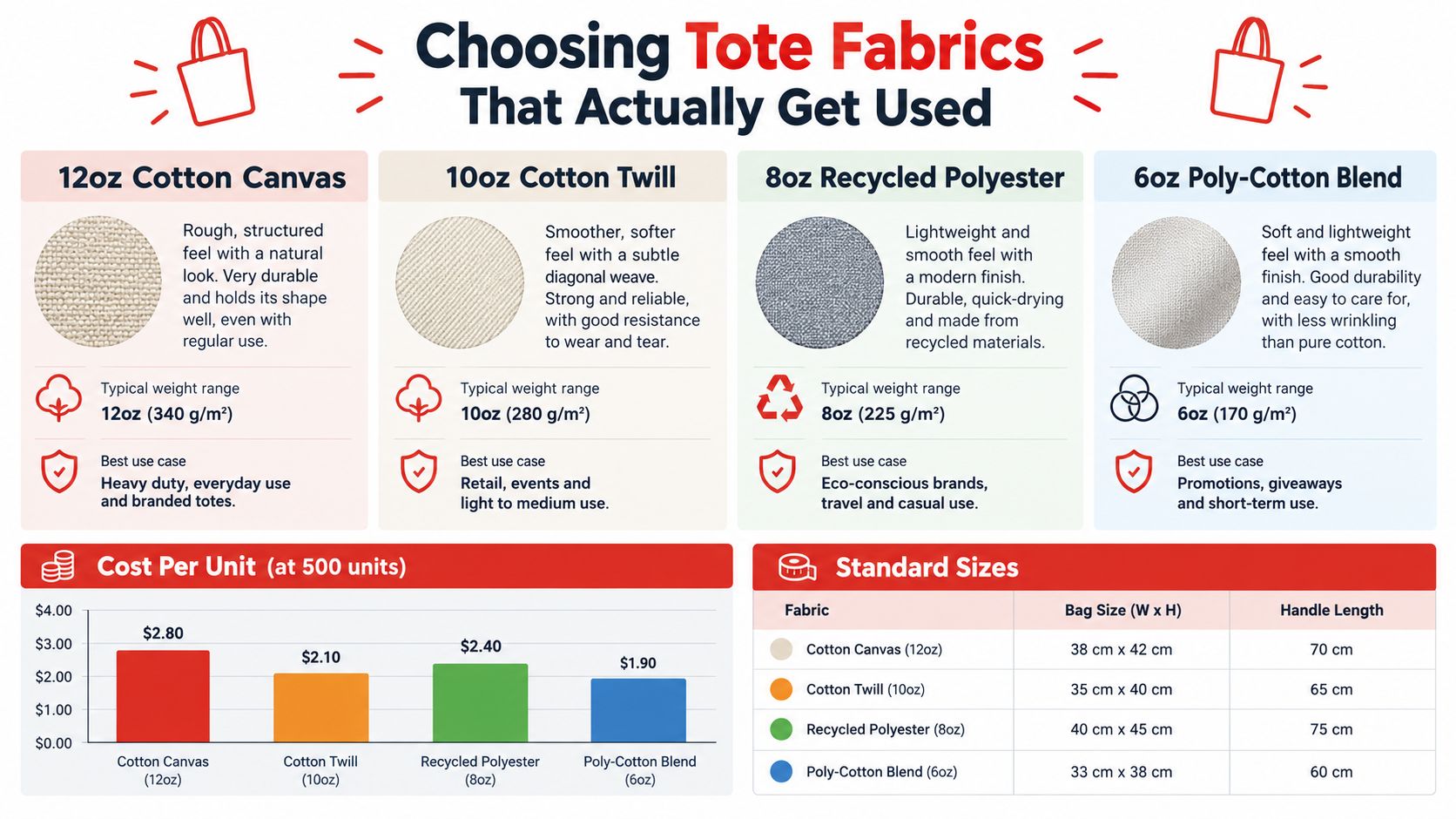
Match the fabric to the job
Cotton is the safe all-rounder for retail, school and corporate use because it feels familiar and prints cleanly. Calico is lighter and usually suited to events where you need a straightforward hand-out bag without a heavy retail finish. Polyester works when you want a smoother surface and better resistance to wear. Non-woven polypropylene is the practical pick when the order needs a lower-cost structure for short-run promotions or high-volume distribution.
The Australian reuse data is a warning sign here. In stores where single-use bags weren't charged, only 13% of transactions involved a purpose-designed reusable carry bag, but that rose to 33% where single-use bags were charged (NEPC retail bag study). In plain English, people reuse what's practical, not what's marketed as sustainable.
Specify the construction properly
Don't let a supplier quote “tote bag” as if that tells you enough. You need the dimensions in centimetres, handle drop length, seam style, whether the base is gusseted, and whether the bottom or handle points are reinforced. If the bag is for heavier handouts or retail carry, ask for a reinforced base and stitching that can handle repeated loading.
If the bag is meant to leave the venue with papers, merchandise or groceries, write the load expectation into the brief.
For design selection, it helps to think in roles. Lightweight event bags should stay simple and compact. Retail carry bags need a more durable hand feel. School packs and council campaigns usually sit in the middle, they need enough structure to survive being kept, but not so much weight that they become annoying to carry.
For a broader product range and specification comparison, use the promotional bags overview as a starting point rather than guessing from photos alone. And if your artwork is going onto cotton, the article choose screen printing for tote bags is a useful reminder that the print method has to match the surface, not just the logo.
Picking the Right Branding and Print Method
Print choice is where a decent tote turns into a polished one, or a cheap-looking one. The wrong decoration method won't just look bad on day one, it can fail fast on the fold line, around the handle points, or after a wash. The right method depends on artwork complexity, colour count, fabric and the finish you want to project.
Compare the decoration methods honestly
| Method | Best for | Watch out for |
|---|---|---|
| Screen printing | Bold logos, simple artwork, high-volume orders | Fine detail can fill in, and every extra colour adds complexity |
| Digital printing | Complex artwork, gradients, detailed graphics | Can look softer on some fabrics if the substrate is too textured |
| Transfer printing | Small runs, detailed art, flexible placement | If the film isn't matched to the fabric, durability drops |
| Embroidery | Premium cotton or canvas bags, brand marks with texture | Not ideal for tiny text or intricate line work |
| Woven labels | Brands that want a subtle, stitched-on identity | Not the right choice if you need a large front-panel graphic |
A single-colour bold mark is usually a screen-print job. Fine detail belongs in digital. Cotton and canvas can carry embroidery well when you want a more premium feel. Polyester needs more care, because the wrong method can show through weak edges or scuff early.
The other issue is print placement. Cracked ink on a fold is usually a layout problem, not a production mystery. If your logo sits too close to the centre crease or handle seam, it's going to take a beating every time the tote is packed and emptied. Dark synthetics can also create problems if the ink or transfer isn't matched to the fabric properly.
Buy for durability, not novelty. A logo that survives regular use beats a more detailed graphic that looks clever for one week.
For buyers who want a process guide before they commit, the custom printing options page is useful as a reference point. The practical rule is simple. The more complex the artwork, the more the substrate and print process have to be chosen together, not separately.
Understanding Minimums, Pricing Breaks and Artwork Prep
Bulk tote orders usually go wrong in the quote stage. Buyers chase the lowest headline price, then get hit with setup charges, artwork fixes, freight, and substitutions after they have already committed. The best order is not the cheapest quote. It is the one where the MOQ, decoration method, and artwork file all line up before approval.
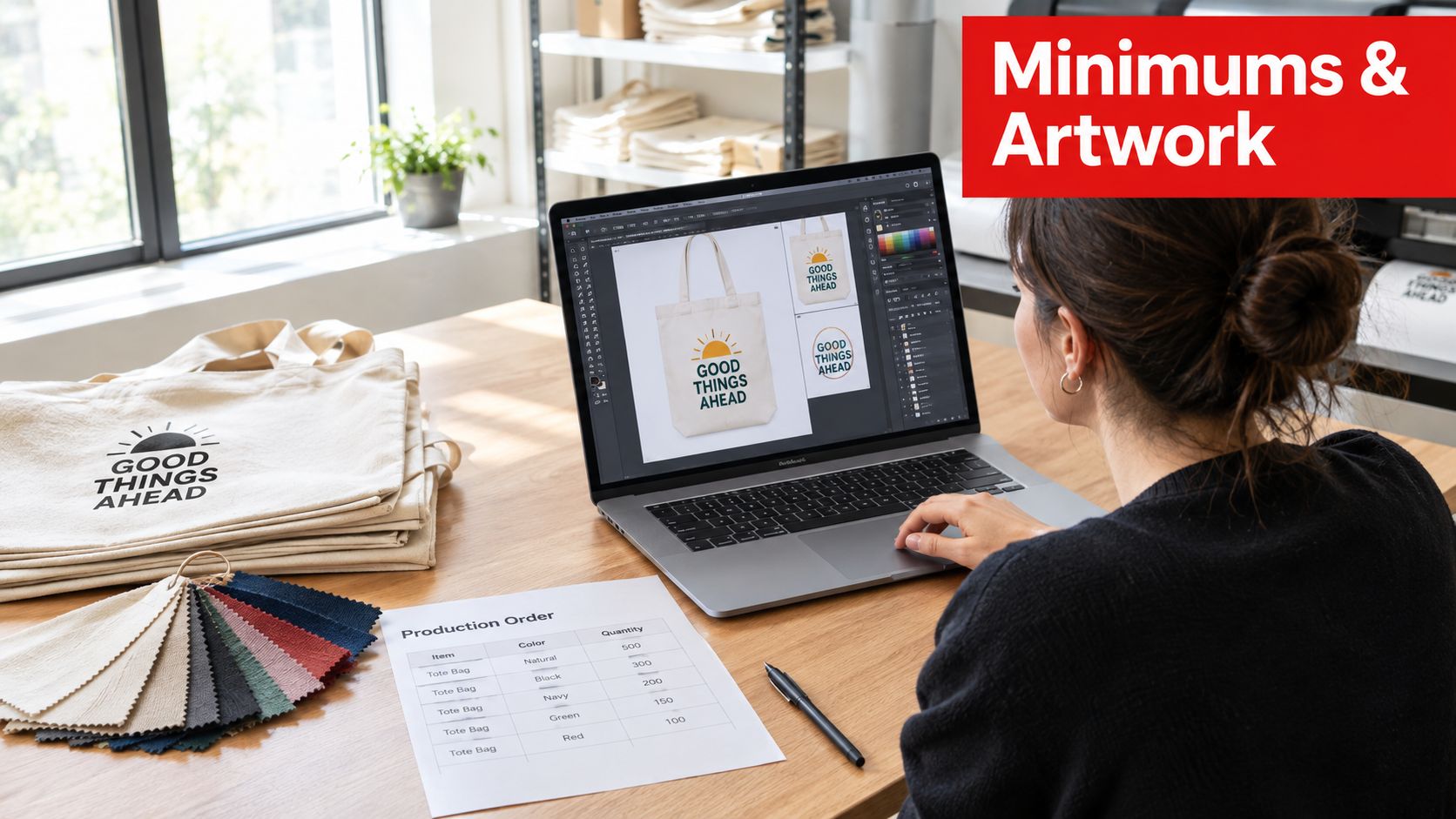
Ask for the full commercial picture
MOQs on tote bags can suit a campaign test, but the pricing usually improves once the run gets bigger. The number itself matters less than the break points around it. If a quote hides setup, freight, artwork edits, or sample costs, it is incomplete. Use the bulk order page as a reference for how a run is structured, then ask for the costs that sit around it.
A clean vector file with outlined fonts and the right colour references saves time and money. It also cuts out the back-and-forth that slows production. Suppliers move faster when artwork is ready to place, not when they have to rebuild a low-resolution file.
Follow the proofing sequence
Request, layout, digital mock-up, client approval, then a pre-production sample if the job needs one. That sequence catches layout problems before anything is printed. If you skip straight to production, you are betting that the artwork will behave perfectly across fabric, ink, and stitching.
For bulk transfer jobs, matching the film to the fabric is what protects the finish. If the film isn't matched to the fabric, durability drops, as explained in Cobra DTF's bulk transfer guide. That matters on tote bags, where folded edges, handles, and repeated use all expose weak artwork fast.
Here is the checklist I would send with a quote request:
- Quantity and use case: say whether the bags are for trade shows, retail, schools, or council campaigns.
- Artwork format: send vector files where possible, plus any Pantone or brand colour guidance.
- Decoration needs: state the number of colours and whether you want one or both sides printed.
- Budget controls: ask for setup, sample, freight, and revision costs to be shown separately.
- Approval step: confirm whether you will sign off on a digital proof or need a physical sample.
Buy for durability, not novelty. A simple logo that survives regular use is a better result than a detailed graphic that fails after a short campaign run.
Sampling, Lead Times and Delivery Across Australia
Timing is where good tote orders fail. A perfect spec still misses the mark if the freight window is wrong, the sample arrives too late, or the supplier's production queue is already full. Build the order backwards from the event date, not forwards from the day you email the quote.
Control the timeline early
For Australian bulk tote orders, the practical lead time is usually a matter of weeks, not days, once you've allowed for artwork approval, sampling and delivery. The exact turnaround depends on stock, decoration method and quantity, so I'd treat every deadline as a reverse-planning exercise. Peak periods, overseas production and multiple print locations all add friction.
The cleanest process is to approve a digital proof first, then request a physical sample only when the order is large, the fabric choice is new, or the event is high-risk. That keeps the process moving without overusing samples on simple repeat buys. If you're managing multiple delivery points, split the shipment plan early and confirm who signs for each parcel.
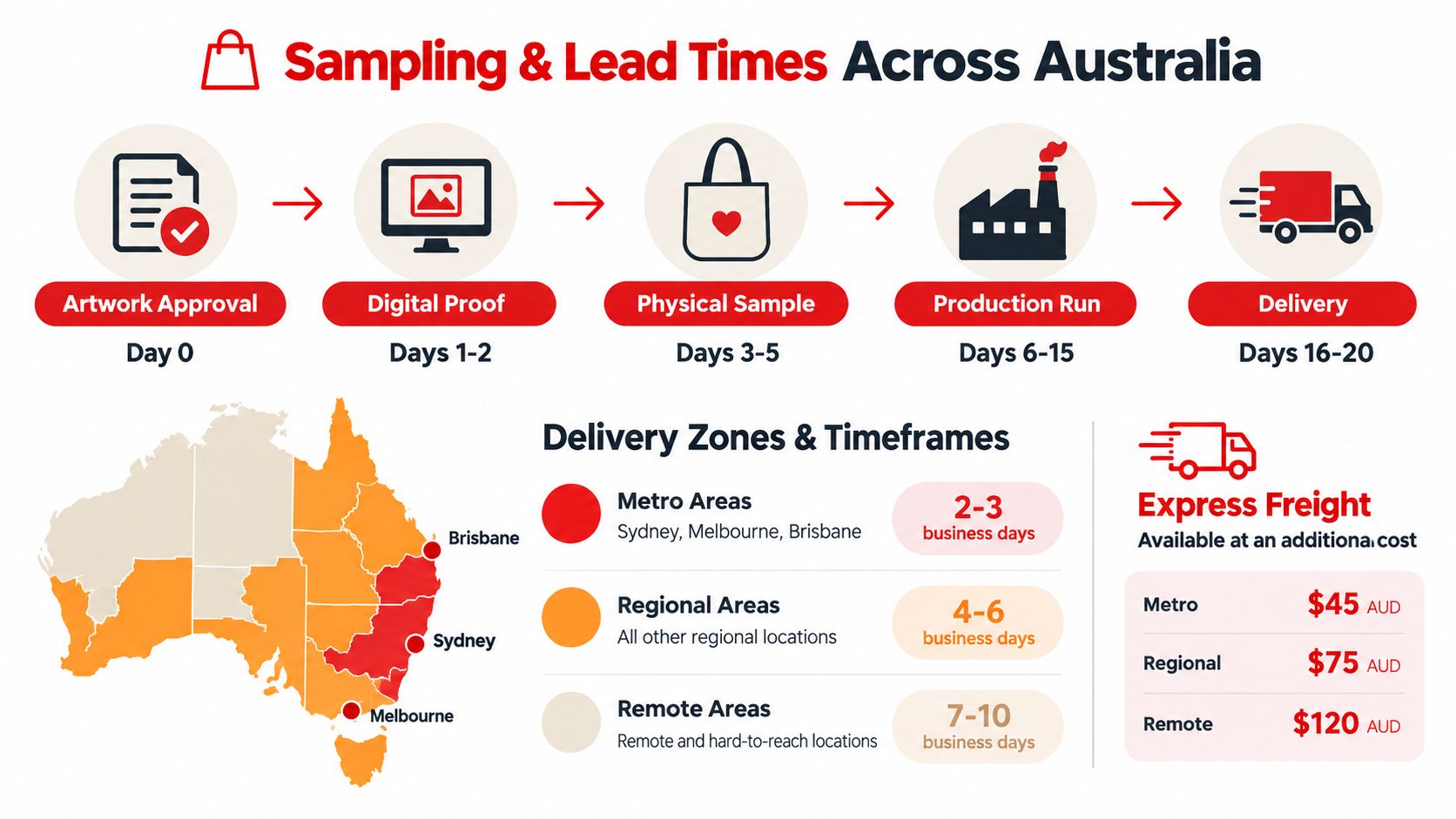
Set freight rules before you pay
Ask whether the freight is palletised, whether it's insured, and who carries the risk if the shipment is delayed or damaged in transit. That sounds boring until a pallet lands at the wrong site on the wrong day. For multi-site campaigns, one Australia-wide delivery partner is simpler than coordinating separate couriers through different branches.
Delays usually come from approvals, not production. Get the proof right quickly and the rest of the order is much easier to keep on schedule.
If you're moving bags across metro and regional sites, build in buffer time. That's especially true for event runs, where a late tote order doesn't just look messy, it weakens the whole campaign. The buyer who controls the timeline usually controls the stress as well.
Sustainability and Cost-Saving Decisions That Hold Up
The sustainability question gets oversimplified all the time. People want a green label, but labels don't carry bags through repeated use. Reuse does. The Australian lifecycle evidence is blunt on that point, reusable polypropylene had lower overall environmental impact than cotton, paper and single-use plastic in the comparison, while cotton's main trade-off was relatively high water use (life-cycle assessment of reusable bags).
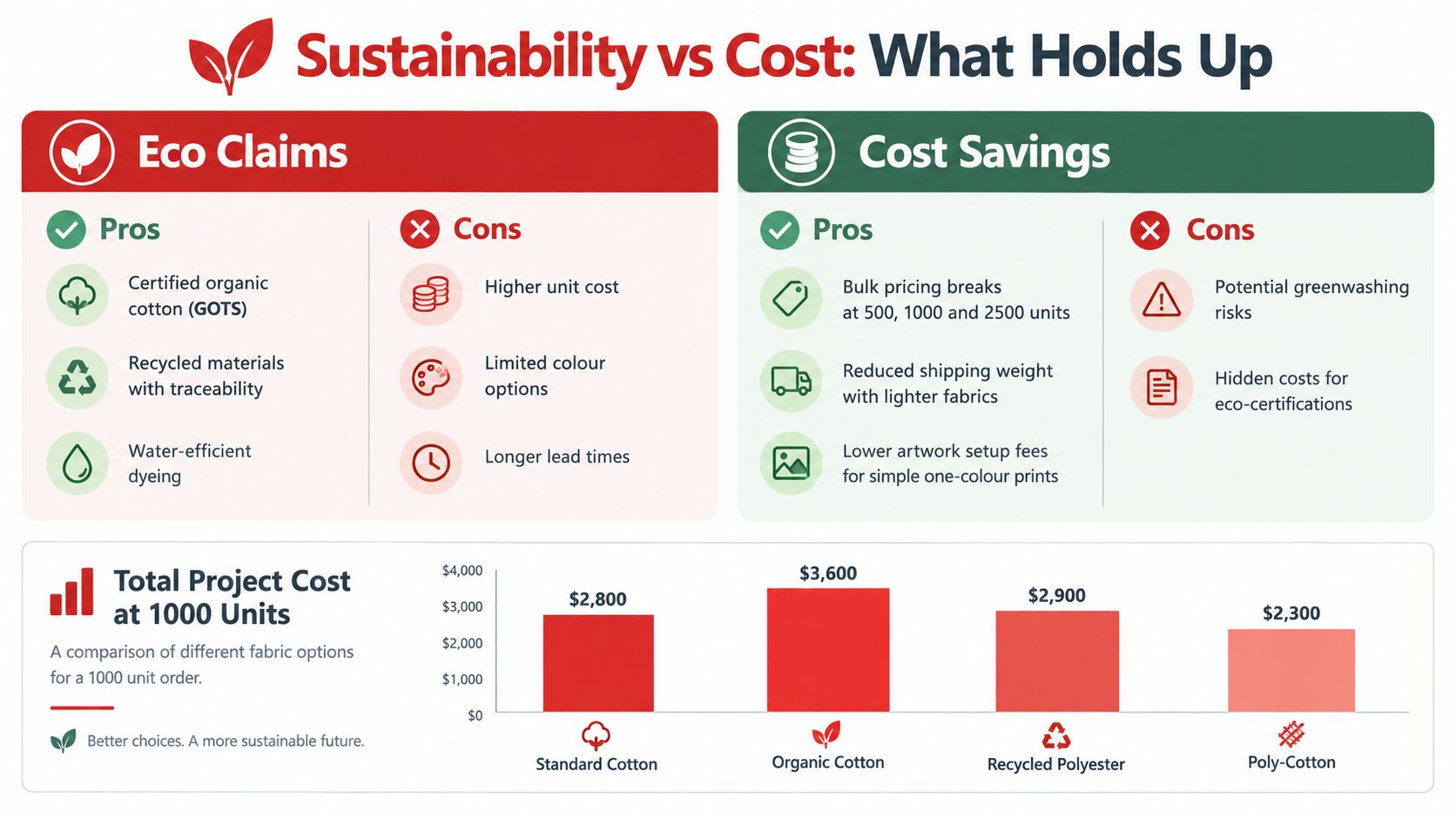
Buy the bag that will be used
The most sustainable tote is the one that stays in rotation. That means the right fabric, the right size and a print that survives real handling. If the bag is so fragile or awkward that recipients dump it in a drawer, the eco story collapses.
The other part of sustainability is proof. Request fibre composition, recycled-content evidence, print process details and a realistic reuse plan. If a supplier is vague about those things, the claim is fluff. For government, university and council programs, that documentation matters more than a recycled-looking surface finish.
Save money without weakening the order
The safest cost moves are operational, not cosmetic. Order to actual demand so you don't build dead stock. Standardise one bag style across campaigns if you can. Keep the artwork simple when the logo allows it. And if the decoration can be done locally, you reduce logistics pain without changing the tote itself.
My rule on eco claims: if the supplier can't explain the material, the print process and the end-of-life path, the claim isn't ready for procurement.
The eco products page is a useful place to compare sustainable merchandise categories, but the same buying logic applies across the range. Strong sustainability is specific, documented and tied to actual use, not just to the fabric name.
Your Ordering Checklist and How Simply Merchandise Supports It
A tote brief becomes far easier when you write it as a checklist instead of a wish list. Use case. Dimensions. Fabric and GSM. Handle drop. Print method. Colours. MOQ. Sample. Artwork. Lead time. Delivery. Sustainability evidence. If those fields are clear, the quote is clear, and the order is far less likely to go sideways.
NSW packaging-stewardship guidance treats total packaging weight, unit count by material, and recovered, reused, recycled or landfilled quantities as useful reporting data (packaging stewardship guidance). That's the mindset buyers should copy. Document what you ordered, what it weighed, what it was made from and where it went. That's how tote programs become easier to justify the next time around.
Keep the ordering brief tight
A good brief should tell the supplier exactly what the bag is for and how it will be judged. If you need one supplier to handle the order end to end, check that they can cover stock, decoration, proofing, sampling and delivery without bouncing you between contacts. For a straightforward purchase path, use the request for quote page and give the supplier the same details you'd want back in the quote.
Merchandise can support that workflow with tote stock across common materials, in-house decoration options, artwork help and Australia-wide delivery. That matters if you're trying to keep one production path across a retail run, a school campaign or a council event.
Screenshot this checklist: if the supplier can't answer every line item, the order isn't ready.
- Use case and audience: trade show, retail, school, council or internal kit.
- Bag spec: dimensions, material, GSM, handles, seams and reinforcement.
- Branding spec: print method, number of colours and artwork file type.
- Commercial spec: quantity, MOQ, sample requirements and freight terms.
- Proof of sustainability: recycled content, material details and disposal pathway.
A tidy brief saves time, keeps the budget honest and makes reorders much easier later.
If you're ready to turn a rough tote quote into a proper purchase brief, get in touch with Simply Merchandise and ask for a bulk order that matches your use case, artwork and deadline. They can help you tighten the spec, compare decoration options and keep the order moving across Australia without the usual back-and-forth.

