


Six weeks out from a trade show, the carton of blank drink bottles sits on the desk and the logo file looks sharp on a 27 inch monitor. The question that decides the job isn't whether the machine can mark the bottle. It's whether the mark still reads clearly after a hundred hands, a dozen wash cycles and a year rattling around in a kit bag. Material choice, compliance and end of life all sit behind that one question, which is why a specified engrave so rarely disappoints and an impulse order so often does.
Perth buyers have an advantage most cities don't: a deep local base of fabrication, metalwork, signage and precision-marking suppliers sits within the metropolitan area, so test swatches and replacement runs don't cross a continent. The rest is discipline, and it starts with the product on the desk rather than the logo on the screen.
Laser Engraving in Perth and When It Fits
Laser engraving earns its place when the item is hard, long lived and handled constantly. Stainless steel drinkware, anodised aluminium, zinc alloy keyrings, timber, acrylic, leather and painted steel all hold a fine mark well. It's the wrong method for fabric, for multicolour artwork and for anything that has to survive a commercial dishwasher.
Mechanically, the beam works like a very fine stylus. It cuts into the material to expose the layer underneath, so the mark takes the colour of what lies beneath rather than sitting on top like ink. That's why an engraved logo on black anodised aluminium arrives light, and why the same file on a dark timber plaque comes back darker still.
The caveat worth hearing early is that the identical logo can look crisp on anodised aluminium and muddy on timber. Grain, resin and density vary across a single board, and the burn follows those variations rather than your brand guidelines. Settle the product before you finalise the artwork, not after the proof lands in your inbox.
Laser technology has spread well past the workshop floor, and it's worth remembering how visible it has become. If you want a light reminder of how thoroughly laser applications entered mainstream consumer conversation, Seth Leitman's Kelly and Michael appearance on The Green Living Guy is an entertaining detour. The same physics that marks a corporate bottle also drives devices people use at home, which is exactly why the machine behind your logo deserves more scrutiny than its wattage.
Five checks decide whether an order runs smoothly. Whether the material suits the mark, whether engraving is the right method at all, whether the supplier's equipment and operator training meet Western Australian requirements, what happens to the item when the campaign ends, and whether the artwork was approved on a physical swatch rather than a PDF. Define the campaign before you define the logo: what the item is, who receives it, and how long the mark must last. A one day conference giveaway and a five year service award call for different products and different expectations. Our steps to choosing the right promotional products work through that order of decisions, and the sequence matters more than the product list.
Which Products and Materials Suit Laser Engraving
The Beer Growler shows why stainless steel is a dependable choice for branded drinkware. Laser engraving cuts into the material to expose the layer underneath, so the mark takes the colour of the material beneath the surface. On stainless steel, that means a precise mark in the steel finish, with no ink layer to peel or rub away. It is a strong fit for corporate gifts, bottles and growlers because the branding stays tied to the object rather than sitting on top of it. The trade-off is the finish around the mark. Handling is fine, but heat, abrasives and harsh cleaning can dull the surrounding surface while the engraved detail remains.
Start product selection with the surface, then match the artwork to it. A mark that works on coated metal may fail on bare metal. A logo that reads clearly on a dark panel may disappear on silver. A burn that looks rich on one timber board may look patchy on another. These are material decisions before they are decoration decisions, and they matter more when the order is going to Perth teams, WA events or client gifts that need to look consistent.
| Product or material | Engraving result | Best for | Watch-out |
|---|---|---|---|
| Stainless steel drinkware | Crisp mark in a stainless steel finish | Corporate gifts, growlers and bottles | Check the care instructions for the selected product |
| Anodised aluminium | Contrasting mark where the anodised layer is removed | Tech accessories, plates and awards | Test light and dark anodising before a bulk run |
| Zinc alloy keyrings with matt black panel | Light, elegant mark on a dark panel | Event giveaways and key rings | Keep logos simple, as fine lines lose contrast |
| Timber | Darker, natural burn mark | Awards, plaques and signage | Grain and resin can darken unevenly, so approve a swatch |
| Acrylic | Frosted or clear engraved text | Nameplates, awards and displays | Cast and extruded acrylic behave differently, so check edge finish |
| Leather | Dark, raised-looking mark | Notebooks and luggage tags | Fine detail blurs, so avoid large solid fills |
| Painted or coated steel | Coating removed to reveal bare metal | Equipment labels and signage | Coating thickness varies, so test adhesion and contrast |
Anodised aluminium behaves differently because the anodised layer carries the colour. Engraving removes that layer and reveals the paler metal underneath. That gives strong contrast on black, navy and deep red, and very little on silver. Light anodising needs a test before a bulk run, and so does a very dark finish where the goal is a subtle tonal mark rather than a bright one. I would treat the test piece as part of the order process, not an optional extra, because the wrong assumption here turns a clean logo into a low-contrast smudge.
Small metal items live or die by panel design. The Le Mans Shield Key Ring is a shield-shaped keyring with a strong zinc alloy body and a black matt finishing panel centred in the middle. That dark panel gives engraving a crisp surface to work against, while the surrounding metal holds the shape of the item.
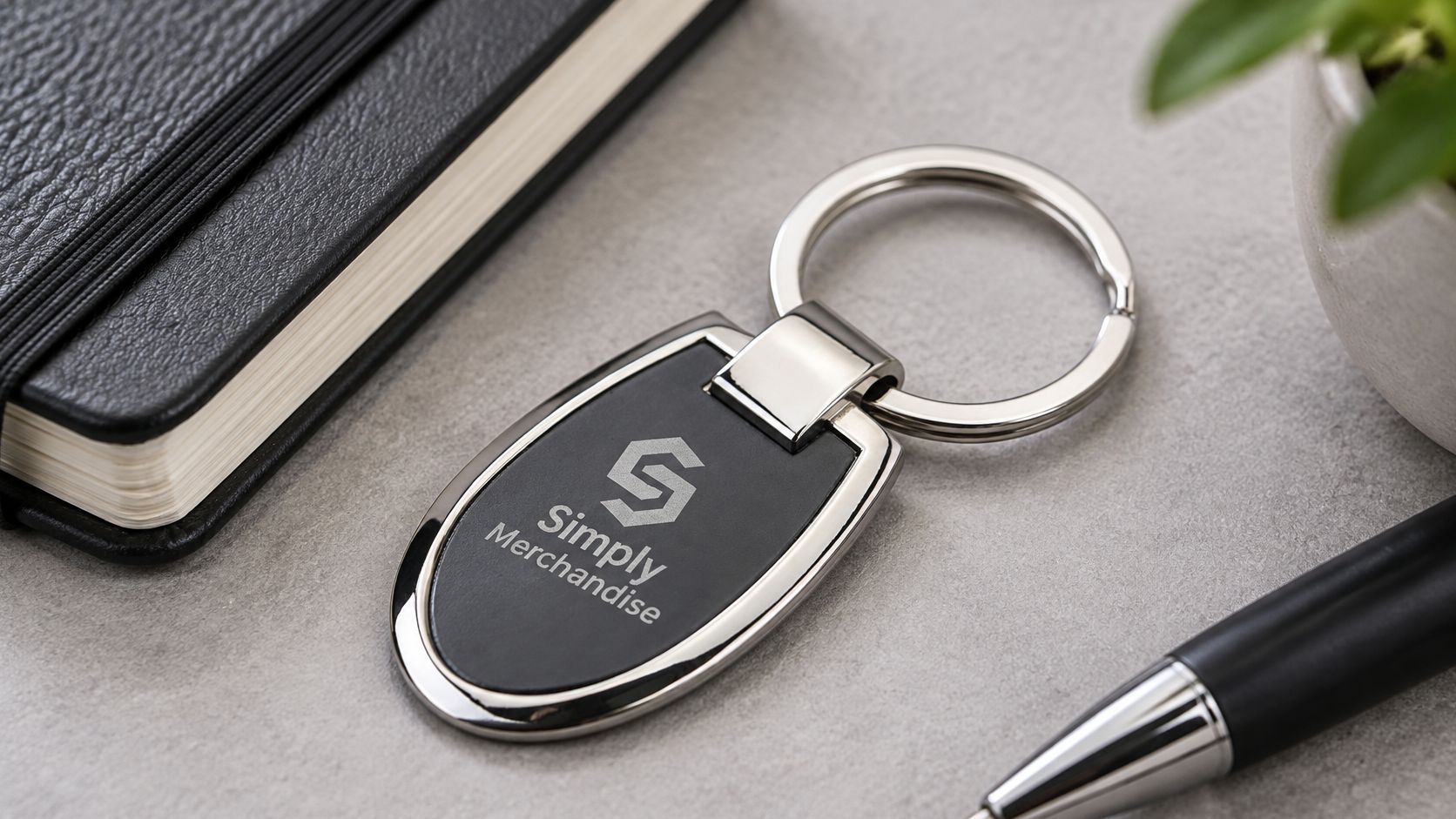
Keep artwork simple at keyring scale. A mark that reads well at a larger size can lose its counters and thin strokes when reduced, so test the smallest size you intend to use before you approve anything bigger. Reversed type, tiny taglines and tight line spacing are where small engraved pieces start to fail. If you are weighing shapes, finishes and panel options, the range of promotional keyrings shows which styles give engraving a clean surface to work on.
Timber returns a darker, natural burn, and the grain decides how even it looks. Approve a swatch on the same board stock as the production run, because a sample cut from a different plank proves very little. Resin pockets and changes in grain can darken unevenly, which is fine for rustic signage and less welcome on a formal award. Acrylic engraves to a frosted or clear effect depending on the sheet, and cast and extruded acrylic behave differently at the edge. That difference shows up quickly on nameplates, awards and displays where the border matters as much as the logo.
Leather takes a dark, raised-looking mark, but fine detail blurs, so avoid large solid fills and heavy hairlines. Painted or coated steel suits equipment labels and signage because the coating is removed to expose the bare layer underneath. Coating thickness varies between batches, so contrast needs checking each time. A practical operator earns their keep at that point: the setting that looks sharp on one batch can cut too deep on the next.
The material rule that saves the most reprints: a dark panel or a coloured coating gives contrast for free. Bare or thin-coated surfaces need a physical test before you commit.
Engraving is not the only way to mark a timber piece. Where a plaque or display needs colour a burn cannot give, teams sometimes pair engraving with a transfer element, and compare decal types for wood projects is a practical reference for how those decals behave on different wood surfaces. Build a shortlist of two or three products and run your artwork against each material before you commit to a quantity. A bulk run is an expensive way to discover that a reversed logo fills in on black, or that a fine detail disappears into timber grain.
Laser Engraving Versus Print, Embroidery and Debossing
Choose laser engraving when the mark must be permanent, fine-detailed and sit on a hard surface. Choose another method when the item is fabric, or when the artwork is bold and colourful and needs to stay that way. The four main methods split along one line, which the chart below makes quick to apply.
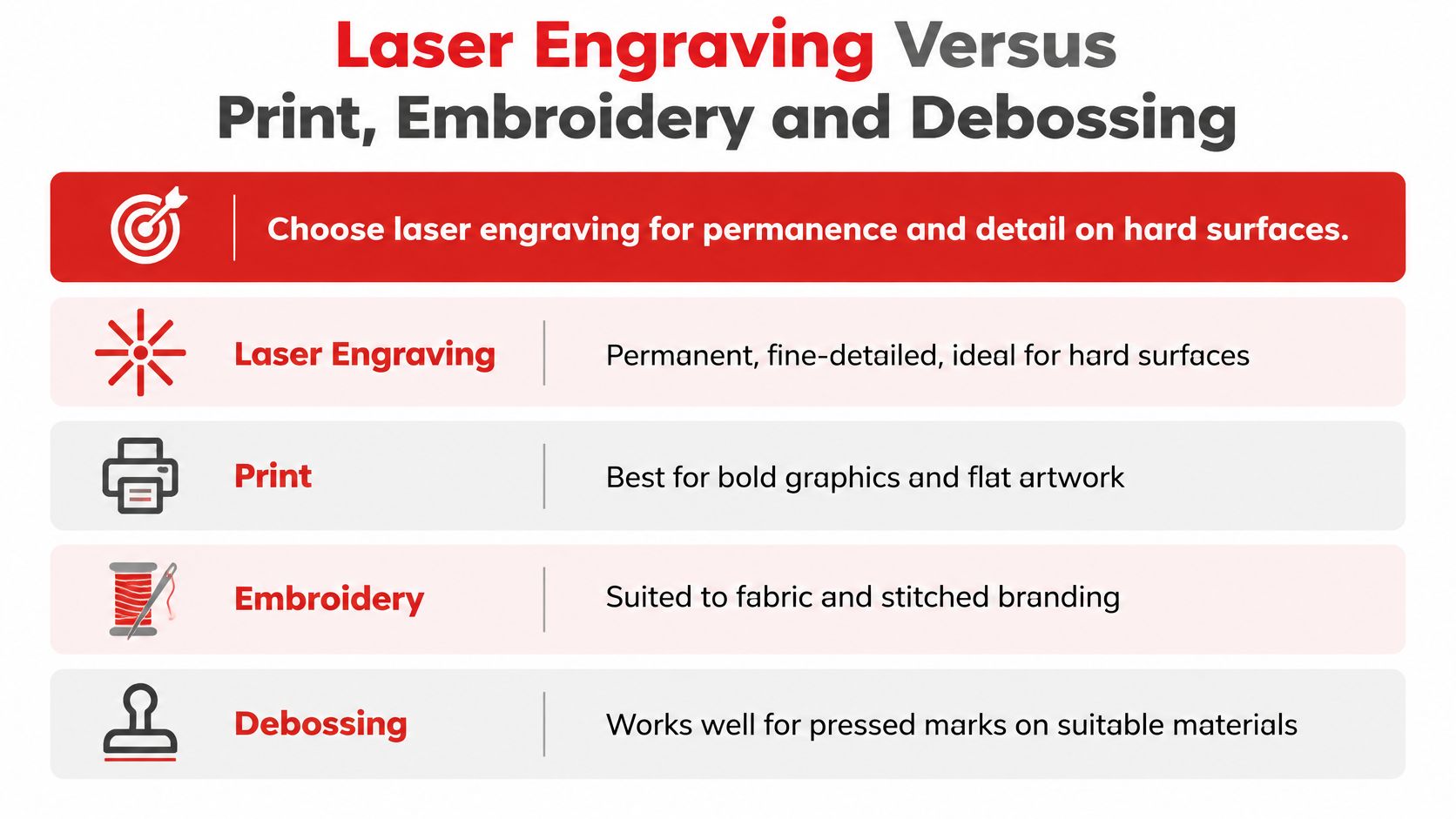
| Method | Best detail level | Colour options | Durability | Best use |
|---|---|---|---|---|
| Laser engraving | Fine lines and small text on hard surfaces | Takes the material's finish or colour | Very high, does not wear off | Metal drinkware, awards and keyrings |
| Screen printing | Bold, solid shapes | Several spot colours, each needing a screen | Good, can wear with repeated washing | Large runs of bags and apparel |
| Embroidery | Logos and lettering on fabric | Thread colours | High on apparel | Uniforms, caps and polo shirts |
| Debossing | Pressed impression with subtle detail | Colour comes from the base material | High | Leather, paper and premium packaging |
| Pad printing | Small detailed logos on curved items | Usually one colour per pass | Moderate | Pens and small curved objects |
Three scenarios settle most arguments. Say a Perth software firm orders 200 stainless steel bottles for a trade show stand: engraving wins because the mark has to survive being carried, dropped and washed for years, and no print on a curved bottle does that as cleanly. A hospitality group reissuing staff uniforms should be in embroidery, because the item is fabric and the mark has to move with the cloth. A long run of tote bags for a school fundraiser belongs in screen printing, since the design is bold, the colours are fixed and the volume makes the setup worthwhile.
The constraint that catches people is colour. Engraving is a single tone process: the tone comes from the material, not from a Pantone number, which is why a four-colour logo needs either a deliberate one-colour simplification or a different method entirely. Simplifying isn't a compromise when it's done with intent. Keep the strongest single element, drop the strapline, thicken hairlines that will otherwise disappear, and let the product's finish do the work.
Engraving is one tone, not one colour: the product choice is the colour choice.
Four questions close the decision out. What is the item made of, how long must the mark last, how many colours does the logo need, and how many units are you ordering? If the answer to the third question is full colour on a flat surface, engraving isn't the method, and our custom printing options show which processes carry it well.
Safety and Supplier Checks Before You Order
A supplier's wattage tells you what a machine can cut. Safety depends on enclosure design, extraction, eyewear, training and records. Engraving systems can expose operators to direct or reflected radiation during focusing, alignment, maintenance or an enclosure bypass, not only while production is running normally.
Western Australia sets a clear baseline. WorkSafe WA's laser hazards guidance states that lasers and laser products must be classified and labelled in accordance with AS 2211, and that Class 3B and Class 4 lasers must not be used for construction work. All lasers, regardless of class, must comply with the Australian laser safety standard, and new laser makes or models require evidence of conformity with AS/NZS IEC 60825.1.
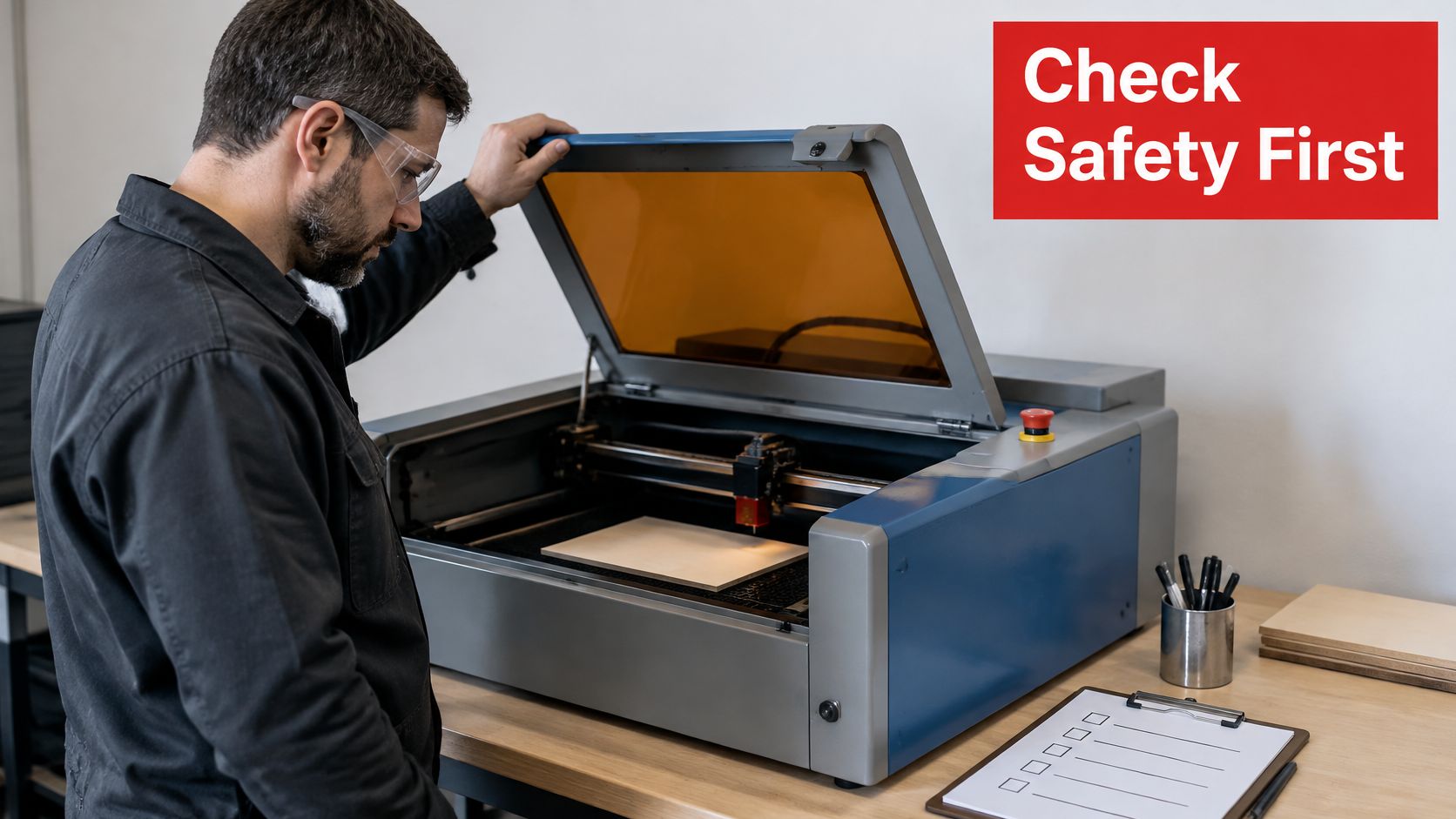
Operator competence carries as much weight as the hardware. Safe Work Australia's guidance on laser classifications records that employers must provide workers with information, training, instruction and supervision whenever lasers are used, which means a purchased machine with no training plan is an unfinished purchase.
Five questions do the due diligence for any Perth supplier, whether you're buying engraved goods or commissioning a run:
- Is the machine enclosed and interlocked? An interlocked lid stops the beam when the housing opens, removing a common exposure route.
- What laser class does it carry, and where is the label? The classification should be documented on the machine and in the paperwork, not quoted verbally.
- Is extraction installed and running? Fumes and particulates vary by substrate, and a sealed unit with no extraction moves the problem into the room.
- Are operators trained to the relevant standard? Ask who delivered the training and when it was last refreshed.
- Are classification and maintenance records kept? Records show whether the process is controlled rather than improvised.
A supplier who answers the class, enclosure and extraction questions in one email usually controls the process. One who answers with wattage usually doesn't.
Keep the answers with the job paperwork. For a batch of branded bottles, badges or timber pieces, the supplier should be able to connect the machine class, guard condition, extraction setup and operator training to the work being quoted. That gives your marketing team a practical compliance trail and a better basis for choosing between repeat orders, one-off pieces and products where another decoration method suits the material.
Signage buyers often compare engraving with cut vinyl for the same door plate or wall sign. custom vinyl lettering for storefronts is a useful reference for the vinyl side of that comparison, particularly for large colour graphics that no single-tone engrave can reproduce.
Lifecycle, Recycling and Choosing Products That Last
Durable gets confused with sustainable. An engraved mark does last the life of the product, which is a real advantage over a print that wears off within a season. That says nothing about what happens to the object when the campaign ends, when the battery swells, or when the coating and the core material can't be separated at the recycling stage.
A stainless steel bottle and an engraved power bank have very different recovery pathways. Western Australia implemented an e-waste-to-landfill ban on 1 July 2024 under the Waste Avoidance and Resource Recovery (e-waste) Regulations 2024, as set out in the WA Waste Authority's guidance on the e-waste landfill ban. The same guidance describes e-waste as one of Australia's fastest-growing waste streams and flags the risks from hazardous materials and battery-related fires, which changes the calculation for any promotional item with a battery inside it.
Four choices keep a campaign out of that problem:
- Favour mono-material products. A single-material bottle or a plain steel keyring is far easier to recover than a bonded assembly of plastic, metal and glass.
- Skip unnecessary electronics for short campaigns. A three month campaign rarely needs a power bank; a bottle that stays on a desk for five years does more brand work.
- Separate batteries and components before disposal. If electronics are part of the brief, plan who removes and routes the cells.
- Plan collection or reuse before ordering. Decide where surplus stock goes while you're still negotiating the quantity, not after 400 units arrive.
Ask before you order: where will this item be in two years, and who is collecting it?
The question procurement teams should put to any supplier is simple: can engraved promotional products still be recycled in WA? The honest answer is product specific. A permanently branded bottle may still be donated or reused, while a branded electronic item can be harder to resell and needs battery handling on top. Our eco product range is a sensible starting point when you want mono-material options that engrave cleanly and leave a cleaner end of life.
Prepare Artwork and Order Engraved Merchandise
Artwork that looks right on screen is half the job. The other half is knowing what the beam does to that specific material at that specific size, then building the approval sequence so nothing is discovered after the run. Laser engraving cuts into the material to expose the layer underneath, so the mark takes the colour of the material beneath the surface. That makes artwork preparation less about decoration and more about controlling contrast, depth and legibility before production starts.
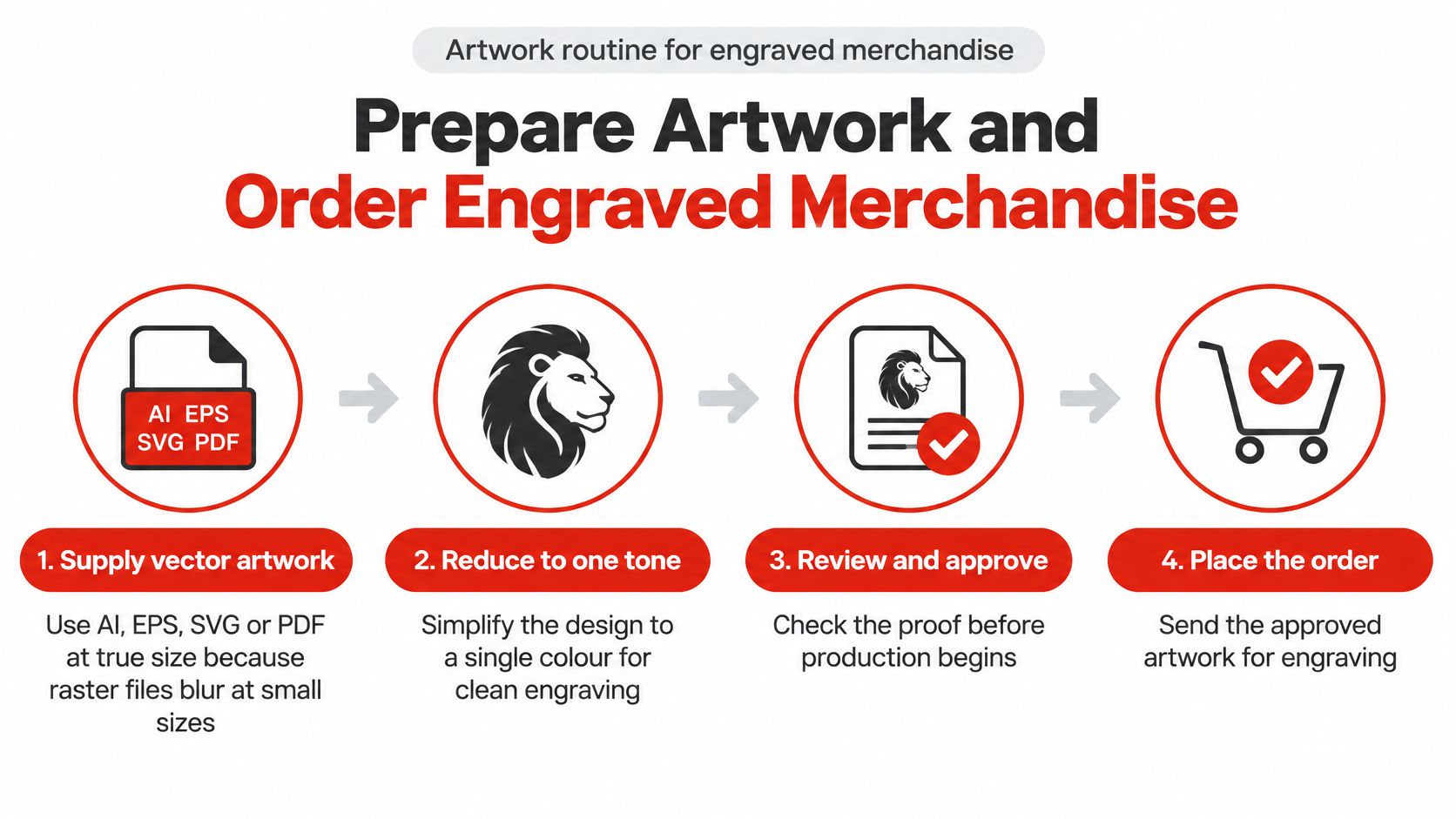
The artwork routine
- Supply vector artwork at true size. AI, EPS, SVG or PDF, drawn at the finished dimensions. A raster file that looks sharp on a monitor blurs the moment it is scaled down to a 30mm keyring panel. The artwork submission tips for beginners cover the file formats, naming and export settings that avoid a redo.
- Reduce the design to one tone. Engraving marks one contrast layer, so gradients, drop shadows and photographic fills turn to mush. Convert to solid black on white, then judge what survives.
- Confirm minimum line weight and font size with the supplier. Hairlines and small serifs disappear on textured metal and on timber, and the only reliable answer comes from the people running the machine. Ask for their minimum rather than guessing at 1pt.
- Reverse the logo for dark finishes. A white logo file placed on a black matt panel should be inverted so the mark carries the detail instead of the background. Reversals are also where counters fill in, so check the inside of every O, A and R.
- Approve a material-specific swatch before the bulk run. The swatch should show small text, a logo reversal, your tightest line width and a solid area, all on the actual production material. Judge it on contrast, legibility at arm's length, residue and dimensional distortion.
- Check the final proof for size, placement and colour. Measure the mark against the product, not against the page, and confirm which face of the item it sits on. Fine lettering, detailed artwork and large solid designs may need different treatments, and the size, placement and colours are approved on the artwork proof.
Energy density sits behind most of what goes wrong. Too much of it chars timber, melts acrylic edges, produces smoke and washes out fine detail, while too little leaves weak contrast and text that reads as a smudge. The AS/NZS IEC 60825.1 preview states that the AS/NZS IEC 60825.1 preview classification follows optical-radiation hazard across wavelengths from 180 nm to 1 mm. Safe, repeatable settings depend on the complete system rather than the nominal power rating.
A good swatch has three signatures. Crisp edges with no brown halo, small text that is still readable at 30cm, and even contrast across the full width of the mark. Run a white cloth over the engrave to check residue, and compare two items from the same batch to catch drift. Never assume a substrate is safe to mark because it engraves cleanly. Coated metals and plastics can release very different fumes from one another, so the material and finish belong in the approval conversation, not just the artwork file.
Ordering without the back-and-forth
Use the product shortlist from the earlier materials section as the starting point, then gather the supplier's requirements. Customers share their logo, team name and artwork requirements so Merchandise can advise on suitable decoration. Providing your logo also lets the team check the available decoration positions, colours and size for a product. That early conversation usually improves the product choice before any money is committed, because the mark and the substrate need to work together.
For a golf day or similar event, a good enquiry includes product names, quantities and the event date, since timing decides whether a swatch is realistic or whether you are choosing from stock that is already in hand. Add the decoration position, the colour of the item, and any deadline that cannot move. If the brief involves custom embroidered apparel as well as engraved merchandise, keep the decoration requests separate so each method is judged on its own strengths.
Ask for a quote that itemises setup, artwork, the test swatch, delivery and lead time, plus the minimum quantity and any rush fee. A quote that only lists a unit price hides two costs that often blow out: reworking artwork and air freighting a shortfall. Request a mockup, approve the proof in writing, and settle the safety and end of life answers before the invoice rather than after. Expect the mockup to show the logo at the intended size and position, the contrast direction, and any areas where fine detail may need adjustment.
Simply Merchandise lists laser engraving alongside embroidery, digital printing, screen printing, pad printing, full colour branding and other decoration services. Its in-house design team provides free mockups and branding options, including printing, laser engraving and embroidery. You can confirm product options and request a quote by phone on 1800 833 006 or by email at save@simplymerchandise.com.au. Send the logo, quantities,event date and artwork requirements in the same message so the reply can cover product fit, decoration positions, colours, size, mockups and a quote without another round of questions. Merchandise is delivered Australia wide, including Perth.

