



You're on a winery lawn on a warm afternoon, balancing a tasting plate while your white wine turns tepid. The stemmed glass looks lovely, but it's awkward to carry and there's nowhere level to put it down. If you're choosing branded drinkware for that occasion, start with the wine, not the logo.
A good insulated wine tumbler should make the drink easier to enjoy, the vessel easier to manage and the next use straightforward. Buy it as a temperature and hygiene tool first. Then make it something your guests will want to keep.
Why Wine Lovers Are Reaching for Insulated Tumblers
Say you're organising a winery client afternoon. Guests move between the tasting bench, lawn and picnic tables, carrying drinks as they chat. A double-wall vacuum tumbler suits that movement better than delicate stemware, particularly when you don't have seated table service.
The attraction is practical rather than mysterious. A compact, stemless vessel is easier to pack for a picnic, carry around a festival or include in an outdoor hospitality kit. Stainless-steel construction also reduces dependence on fragile glassware where people are moving between different surfaces.
Vacuum insulation adds another useful function, but it shouldn't be confused with refrigeration. Choose the vessel for the drinking occasion rather than assuming that every insulated cup will deliver the same result.
Buy for the occasion, not the trend
For a promotional buyer, the strongest reason to choose a wine tumbler is that recipients already understand what to do with it. You're giving them an item that belongs at a barbecue, a picnic or a relaxed evening outside, rather than asking them to find a use for another desk ornament.
That doesn't establish how many tumblers Australians buy or prove that wine drinkers prefer them to glasses. A proper tasting service may still call for conventional stemware, especially when presentation and close examination of the wine matter most.
Buying principle: Choose the vessel that improves the actual occasion, not the one that looks most impressive in a merchandise mock-up.
For an outdoor gift or event, judge the sample in your hand. Is the rim pleasant? Can you operate the lid comfortably? Would you willingly wash it and take it out again? Those answers matter more than an ambitious claim on the packaging.
What to Check Before You Buy an Insulated Wine Tumbler
Buying criteria for an insulated wine tumbler
| Feature | What to Look For | Why It Matters |
|---|---|---|
| Wall construction | Double-wall vacuum stainless steel | Slows heat gain from ambient air |
| Capacity | Room for your intended pour, with headspace | Keeps service portions separate from vessel capacity |
| Lid and seal | Silicone seal with spill-resistant sliding closure | Limits warming and spills; check the seal for wear |
| Shape | Tapered or aroma-focused bowl | Helps direct scent towards the nose |
| Base | Non-slip silicone base | Helps reduce scratches and sliding outdoors |
| Cleaning | Explicit dishwasher-safe or hand-wash-only instructions | Heat and detergent can degrade printed finishes and seals |
| Decoration area | Smooth surface compatible with the chosen process | Determines which branding methods are possible |
Start with wall construction, then handle the lid. Double-wall construction alone isn't the same specification as double-wall vacuum insulation, so make sure the product description identifies both. A single-wall steel cup may be durable, but it isn't an equivalent temperature-control choice.
Capacity needs a little discipline. The vessel's total volume isn't a serving recommendation, and filling it to the brim makes drinking and carrying less comfortable. Test your intended pour with the lid fitted.
Inspect a complete product, not isolated features
The CamelBak Horizon Wine Vacuum Tumbler - 350ml provides a concrete example: its stated capacity is 350 ml, with double-wall vacuum stainless-steel construction, an aroma-focused shape, a powder-coated finish and a non-slip silicone base. Its push-on lid has a silicone seal and spill-resistant sliding closure, while the care instructions specify hand-washing rather than dishwasher use.
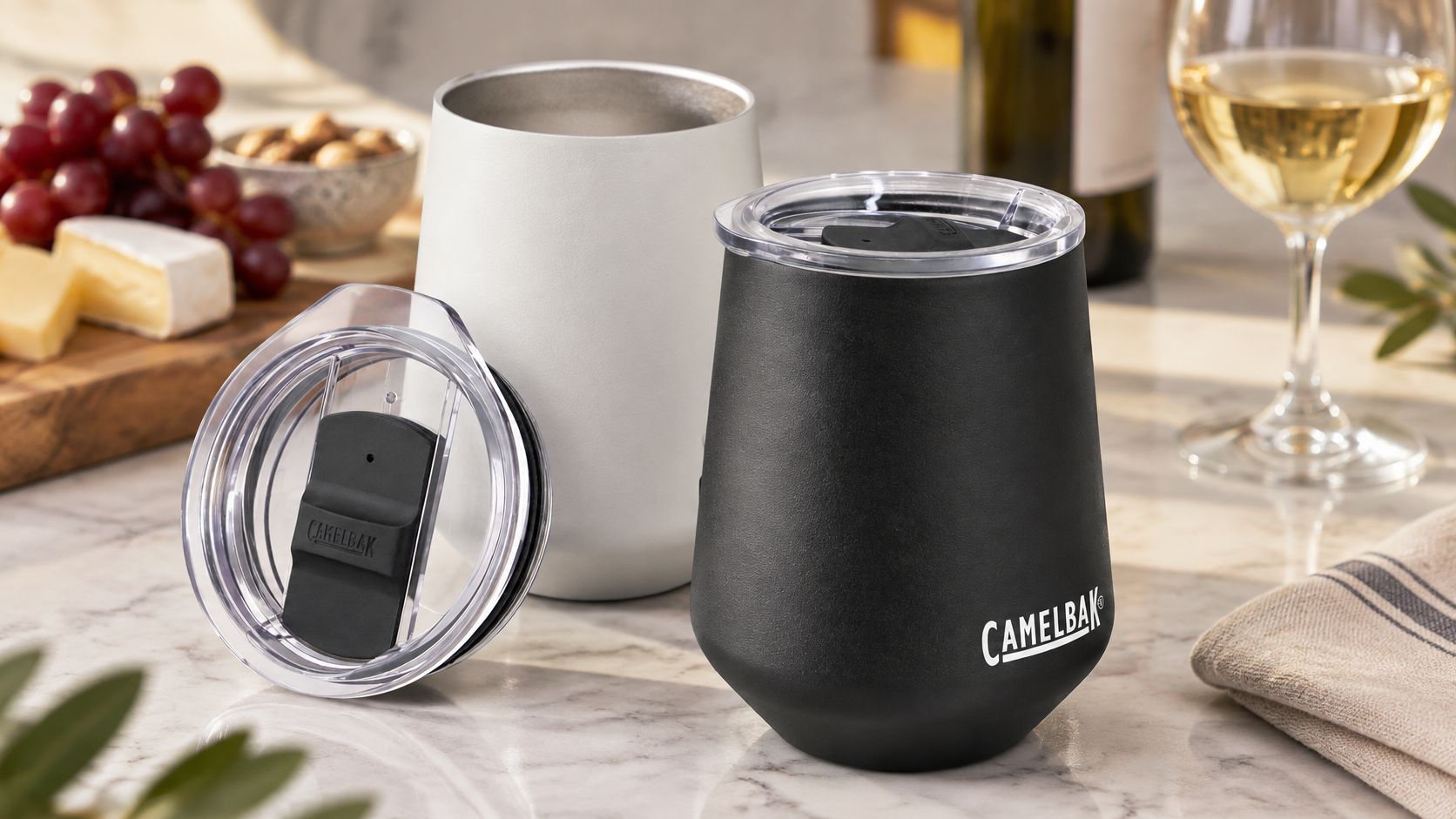
Don't translate spill-resistant into leakproof. Check how the closure behaves when you walk, set the cup down and drink through it. Inspect the base on the surfaces your guests will use, rather than expecting a grip pad to make an uneven table safe.
Compare specifications before price
For price context, Reusable Planet Australia listed a 330 ml insulated stainless-steel wine tumbler at AUD 19.95 in 2026, while YETI Australia listed a 10 oz (295 ml) insulated wine tumbler at AUD 45.00 in 2025. These are individual retail listings, not a market average or a quote for decorated merchandise.
Use those references to question what you're paying for: construction, closure, finish, presentation or brand. When comparing drinkware options, rank your essential criteria before looking at colours. For an outdoor event, I'd put insulation, cleanability and lid usability ahead of elaborate packaging.
Keeping Wine at the Right Temperature in a Tumbler
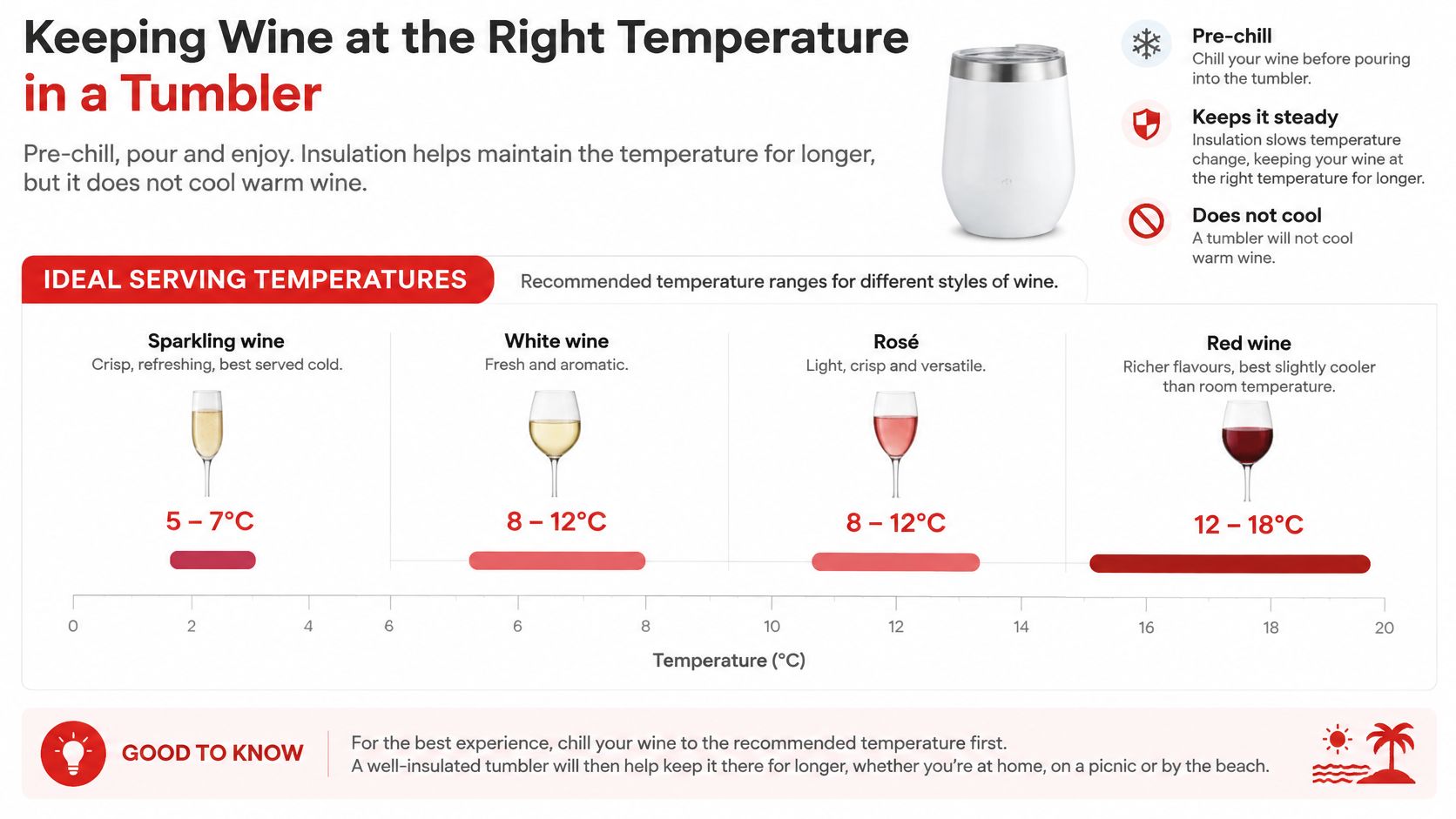
Serve wine at the right temperature before it reaches the tumbler. Insulation helps preserve that temperature, while a warm starting pour stays warm.
The Wine Companion serving guide recommends around 5–7°C for sparkling wine, 8–12°C for white wine and 12–18°C for red wine. It also explains that reds served at typical Australian indoor temperatures of approximately 24–30°C can lose freshness and seem more alcoholic.
Set up service properly
- Prepare the vessel. Pre-chill the tumbler when appropriate, following its care instructions.
- Start with the bottle. Pour wine that's already at the intended serving temperature.
- Close between sips. Use the lid when the drink isn't being enjoyed.
- Choose shade. Keep the tumbler out of direct sun and hot vehicles.
A smaller serve can warm faster than a larger one under comparable conditions. Keep the bottle properly stored and pour manageable amounts rather than overfilling the vessel.
A lid can reduce warming through the opening, but it cannot replace an ice bucket or refrigeration. At an event, assign someone to manage bottle storage. Judge success by how long the wine stays pleasant to drink.
Demand a meaningful performance claim
To compare claims about keeping drinks cold, look for the starting temperature, ambient temperature, fill volume and test duration. Without those details, the claim gives you little basis for comparison.
For a sample check, use a probe thermometer and record readings at consistent intervals. Compare vessels under the same conditions, then repeat in conditions resembling your event. Judge success by how long the wine remains pleasant to drink, rather than by whether the final sip is cooler than the surrounding air.
Branding Methods That Suit a Wine Tumbler
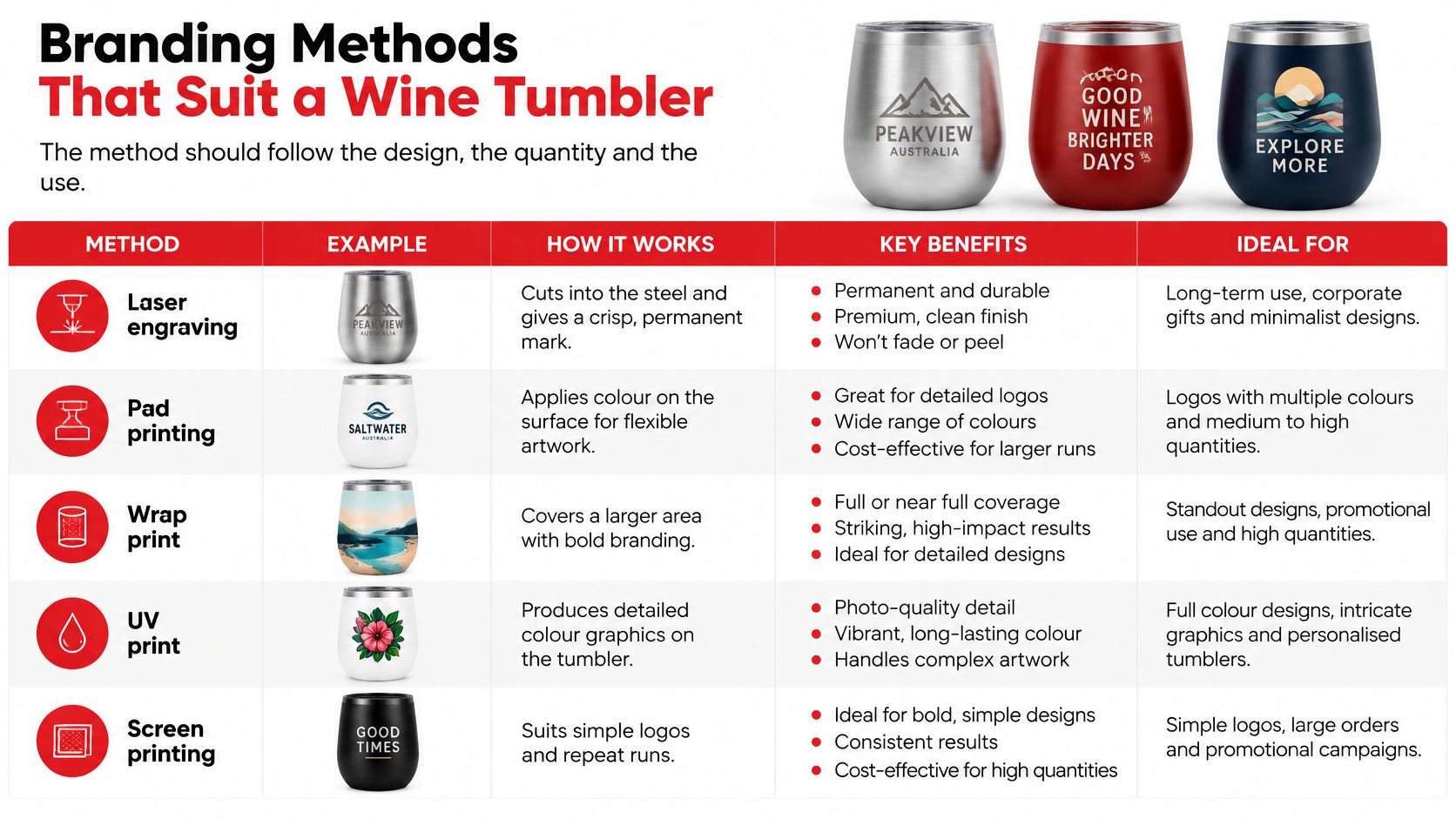
Laser engraving suits a recipient's name on a steel body; screen printing suits a bold single-colour logo. Pick the visual effect you need, then confirm the vessel's material and coating support it. The decoration has to survive real use: regular washing, stacked storage and a lid handled every time someone pours. A mark that fades quickly shortens the tumbler's working life, and a tumbler that leaves the cupboard often is where the branding value lives.
Branding methods for insulated wine tumblers
| Method | Best Suited For | What to Check |
|---|---|---|
| Laser engraving | Fine logos, names and detail on steel | Crisp, permanent mark; confirm depth and exposed finish |
| Debossing | Subtle tactile logo on a suitable lid or base | Confirm placement and whether custom tooling is available |
| Screen printing | Bold single-colour logos | Check durability after hand-washing |
| Digital or full-colour printing | Photographic or multi-colour artwork | Request a sample and check colour accuracy |
| Sublimation | Full-wrap designs on compatible coated surfaces | Confirm the process suits the product coating |
Laser engraving can expose bright steel beneath a coloured coating, producing a restrained contrast without adding printed colour. It's a strong choice for individual names and fine linework, provided the artwork remains readable at the final size.
Debossing creates a recessed, tactile impression in a suitable component. A debossed logo already moulded into a lid or base usually comes from the manufacturer's tooling, so confirm which areas are open to customisation before designing around them.
Match the artwork to the surface
Screen printing earns its place with a clear, bold mark that stays readable at arm's length. Digital and full-colour processes give designers more freedom with gradients, illustrations and photographic artwork, and the sample must still prove that detail survives on a curved surface.
Sublimation needs a compatible coating. A full-wrap design also needs careful layout around the taper, because a rectangular graphic rarely translates neatly to every vessel shape.
For applied transfers, Raccoon Transfers' guidance on how to fix bubbles on curved tumbler decals is useful when assessing application quality. A transfer should lie cleanly against the curve, without lifted edges or trapped bubbles.
Send a production-ready brief
- Supply vector artwork. Include outlined fonts and a separate file for any personalised names.
- Identify colour priorities. State whether exact brand-colour reproduction matters more than the decoration effect.
- Approve actual placement. Check the mark against the drinking side, existing manufacturer branding and usable surface.
- Test the decorated sample. Inspect fine details and edges after washing according to the product's instructions, since regular cleaning is what keeps the vessel in rotation.
We can help compare custom printing options, including screen printing, digital and full-colour printing, laser engraving, debossing and sublimation. Compatibility with the selected tumbler comes first; a process earns its place on the order only when the finish supports it.
Matching the Tumbler to Gifts and Events
Choose the occasion before the product. A client thank-you, an outdoor tasting and a staff kit ask different things of the same piece of drinkware.
For a corporate gift, I'd favour a full-size vessel with restrained engraving and a carefully checked recipient name. Keep the company logo secondary so the gift feels personal rather than like a walking advertisement. Presentation should protect the finish and make the care instructions easy to find.
For a winery tasting or festival, choose artwork that remains recognisable when someone holds the tumbler. A beautifully detailed illustration loses value if the important part sits under the drinker's hand.
Match the treatment to the recipient
| Occasion | Recommended Direction | Decision to Settle Early |
|---|---|---|
| Client thank-you | Personalisation with understated branding | Whether names are appropriate |
| Outdoor tasting | Clear, recognisable artwork | Whether guests keep the vessel |
| Staff onboarding | Consistent finish and practical design | How replacements will be handled |
| Bridal party keepsake | Names and occasion-led presentation | Whether it's a keepsake or drinking vessel |
| Trade show giveaway | Bold artwork with readable branding | How attendees will carry it |
For miniature gifts, the Mini Insulated Tumbler 2oz is a 2 oz vacuum double-wall tumbler supplied with a straw and lid, offering engraving and presentation in a kraft paper box. Treat it as a compact keepsake rather than a substitute for a conventional wine-service vessel.
For staff gifts, resist adding every department name, campaign slogan and social handle. A simple design is easier to coordinate across recipients and less tied to a campaign that will soon finish.
A gift earns its place in someone's cupboard when they like using it without needing to explain the logo.
Resolve the practical questions
Before browsing promotional bar accessories, establish the recipient count, whether ownership is individual or shared, and how far away the design needs to be readable.
Those answers shape the vessel and artwork together. A personal gift can reward close inspection, while event branding needs clear recognition. The occasion sets the size, and the available surface sets the branding.
Food-Contact Documents and Shared Tumbler Cleaning
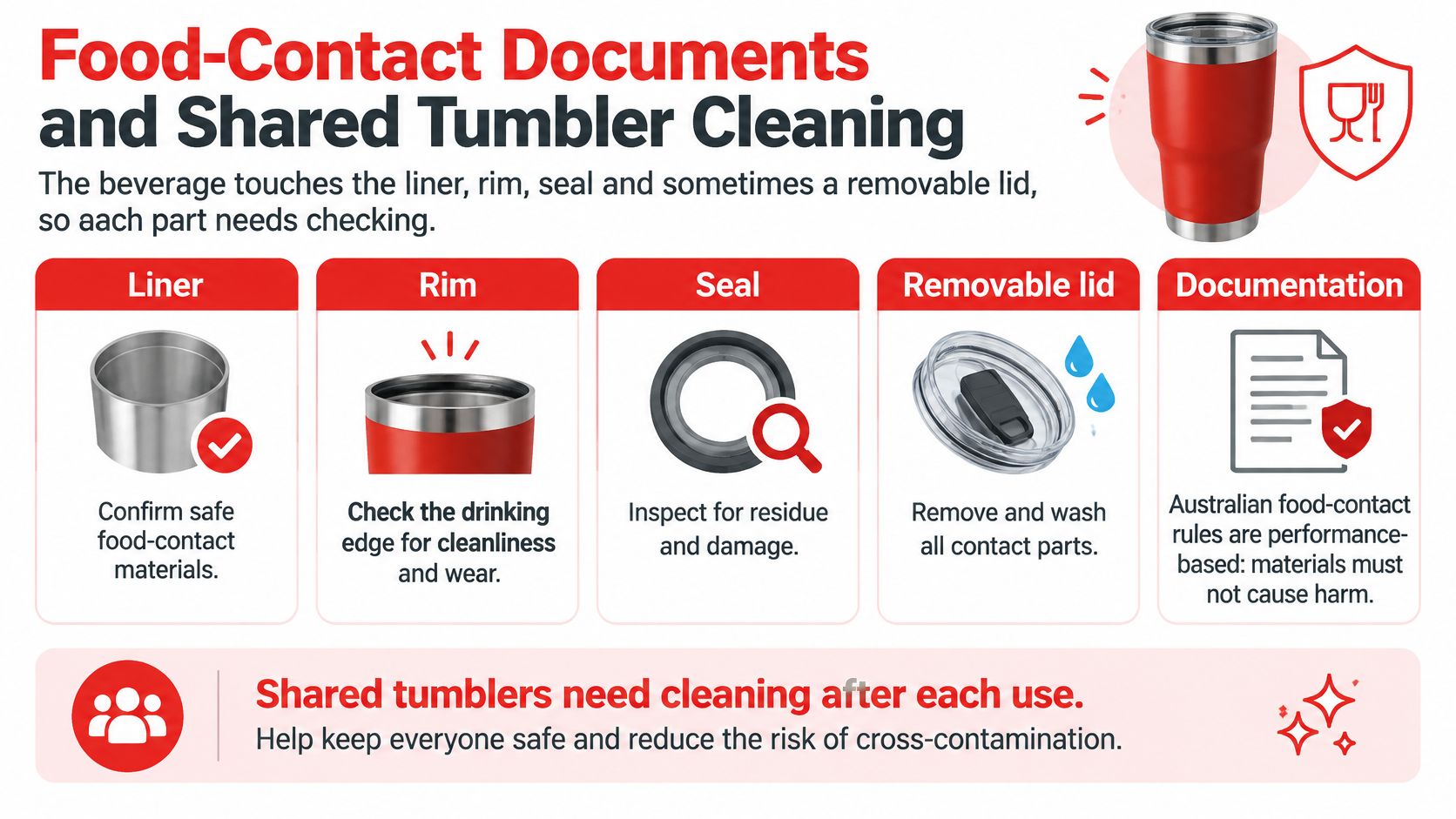
The beverage touches the liner, rim, seal and sometimes the removable lid. Check the complete assembly, not just the steel body.
Greenvyne's quality and safety guidance describes Australian food-contact requirements as performance-based: materials must not cause harm, while stainless-steel drinkware doesn't have a single dedicated migration method or universal finished-product limit. A generic food-safe label isn't a substitute for documentation relevant to the actual product.
Request a useful technical dossier
- Internal steel grade, identifying the beverage-contact liner.
- Gasket and coating materials, including components exposed to the drink.
- Intended beverage use, covering wine rather than only water.
- Migration or extractables testing, using conditions relevant to acidic alcoholic beverages and addressing metals such as chromium and nickel where relevant.
Keep the documentation connected to the supplied model. A report for a different lid, coating or liner doesn't establish the suitability of your order.
Design the cleaning operation before service
The NSW Food Authority's food-packaging guidance emphasises reusable surfaces that are smooth, easy to clean and resistant to deterioration. For shared serviceware, establish a cleaning and sanitising procedure between users, not merely a quick rinse.
Inspect sliders, gasket channels and narrow openings closely. These can be harder to clean than the open body, particularly if staff can't remove the components safely.
- Separate used and clean stock. Give staff clearly identified collection and storage locations.
- Follow the approved wash method. Don't put hand-wash-only vessels through a commercial dishwasher.
- Dry before reassembly. Store clean parts where they won't be recontaminated.
- Inspect before release. Check seals, closures, rims and coatings.
Keep decoration away from beverage-contact surfaces. Withdraw any vessel with a cracked seal, lifting coating or closure that won't clean fully, then replace the affected part only where an approved replacement is available.
When Reusable Tumblers Beat Disposable Cups
Clean Up Australia's FY25 litter report recorded packaging as 59.5% of reported litter and described an Australian reusable-cup system serving more than 46,000 drinks over 31 days, diverting 372 kg of single-use plastic and achieving an almost 85% return rate. Figures like these come from an operating system of collection points, wash logistics and staff follow-through, and a tumbler handed out without that support will not reproduce them on its own.
A reusable vessel also carries the cost of its own materials, manufacture and transport. It earns that back through repeated filling, washing and returning. An insulated wine tumbler abandoned in a cupboard is a stainless object that kept no wine at temperature and spared no cups.
Choose a reuse model you can manage
| Model | What Determines Success | What to Track |
|---|---|---|
| Personal giveaway | Recipients choose it repeatedly | Intended use, care requirements and replacement parts |
| Deposit-and-return pool | Guests return vessels and staff recover them | Returns, losses, wash workload and damaged stock |
| Controlled staff or event issue | The organiser maintains an accountable pool | Issue records, repeat service and retirement reasons |
For a personal giveaway, favour a vessel the recipient can realistically use and clean. For a return pool, make collection points conspicuous and explain the return process before handing out drinks. Controlled issue can make sense for recurring workplace functions, since it gives the organiser a clear view of what gets reused, what disappears and which parts fail.
Sustainability test: Plan the next use before you purchase the first vessel.
Assess repair and disposal too. Mixed materials can complicate recycling, so check whether lids and seals separate and whether replacements are obtainable. Print only the environmental claims your operating arrangements can support.
When comparing eco product options, prioritise credible repeated use over environmental styling. A defensible claim describes what you did, such as replacing disposable serviceware at a recurring function, while the vessel's materials, manufacture and end-of-life still belong in your own assessment whether you advertise them or not.
Brief Your Wine Tumbler Order Before the Event
The most common ordering mistake is approving the artwork before the vessel. A polished mock-up cannot rescue a lid that frustrates guests, a wall that loses the serving temperature before the toast, or a washing method the venue cannot support.
Build the budget around the finished, usable item, including decoration and presentation. Compare quotations on the same inclusions rather than the unit headline alone.
Turn the decision into an order checklist
- Define the occasion and vessel. State who'll receive it, where they'll use it and whether they'll take it home.
- Choose the decoration. Supply the artwork and describe the finish you want, rather than prescribing a process the surface can't support.
- Confirm the complete specification. Resolve the lid, seal, care instructions and food-contact documentation before approval.
- Request a physical sample. Check drinking comfort, closure operation and decoration after an appropriate hand-wash durability check.
- Set the quantity. Include a considered allowance for damage, late recipients and any stock retained for replacements.
- Agree the delivery date. Work backwards from the event, allowing time for sampling, artwork approval and distribution.
Run these decisions through the promotional product ordering process before production begins. Sampling options and artwork guidance let you judge the physical tumbler alongside the design, which is where temperature retention and lid hygiene stop being assumptions.
For urgent work, don't assume an express service covers wine tumblers. Express ranges include coffee mugs, water bottles, metal pens and badges for rush orders, and the selected line determines what's possible. Lock the timing before promising recipients a particular item.
We offer branded drinkware, decoration options, sampling support and artwork guidance to help you choose a wine tumbler that suits the occasion. Visit Simply Merchandise and send us your event details, recipient count and vector design file so we can help recommend a suitable size, branding method and sample before you commit.

