



Say your club's presentation night is a month away. The trophies are ordered, the hall is booked, and someone at the committee table finally asks the question that lands every season: what does each kid take home? A medal goes in a drawer by June. A certificate lives on the fridge for a fortnight. A miniature cricket bat gets carried around until the handle goes grey.
There's a reason the mini bat keeps turning up in Australian campaigns, from junior presentations to trade show stands. It's small, it's flat, and it holds a name. The printable zone, not the bat length, decides what your brand can say on it, and the same object can be a treasured keepsake or a genuine junior sports item depending on how it's built. Get those two things right and a piece of timber the length of a school ruler does more work than a banner twice its size.
Mini Cricket Bat Sizes and Specs to Check First
Lay one flat on a desk and the first surprise is the shape. A mini cricket bat is closer to a signed plank than a piece of playing kit, and that flat face is where every branding decision gets made. Australian product specifications put these bats at approximately 38 cm in total length: one Gray-Nicolls miniature is listed at 38 cm, a blank bat is described as roughly 15 inches (38 cm), and a separate promotional-products specification gives 49 mm wide by 383 mm long by 25 mm high, as set out in the Cricket Warehouse specifications. This is a display format, not a regulation playing bat, and it has been one for as long as players have been signing things.
The object you're working with is a short, flat-faced piece of timber with a handle, closer to a plaque than to a bat.
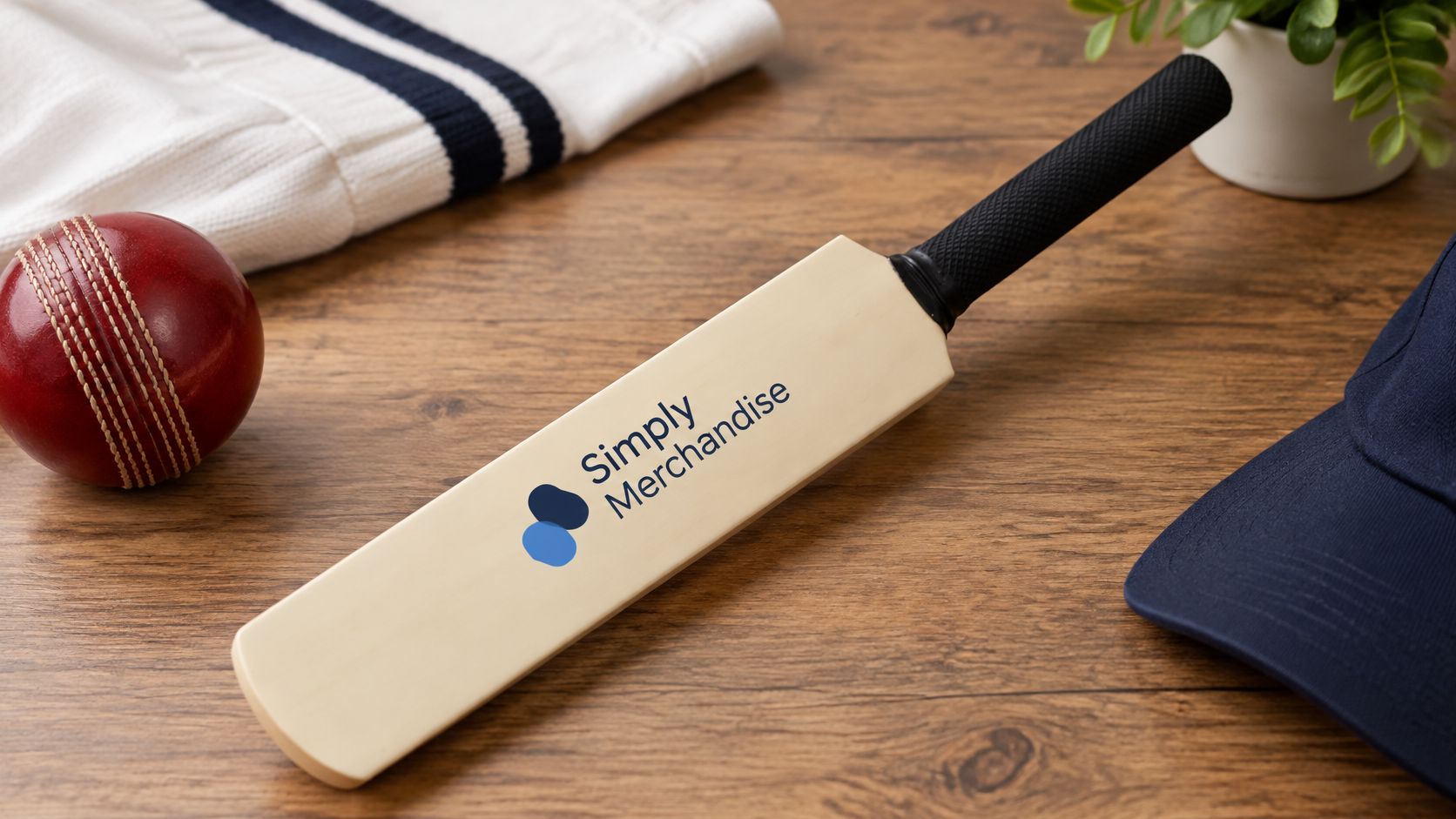
The printable zone sets the limit
A brand either fits on the face or it doesn't. A bat can be beautifully made and still be useless for your logo if the face is crowded by a spine, a splice or a deep maker's decal. That same specification lists a laser engraving zone of up to 30 mm by 150 mm, with smaller pad-print areas beside it. Thirty by 150 mm holds a full name, a signature line, a date and a small crest. It does not hold a photograph, a tagline and three sponsor logos without turning to mush.
| Specification | Reference value | What it means for your order |
|---|---|---|
| Total length | about 38 cm (15 inches) | Compact display size, not a regulation playing bat |
| Face width | about 5 cm (2 inches) | Defines the writing and engraving space on the face |
| Sample dimensions | 383 x 49 x 25 mm (length, width, height) | Use as the artwork boundary check with your supplier |
| Laser engraving zone | up to 30 x 150 mm | Largest area for names, signature lines or a crest |
| Pad-print zone | smaller than the laser zone | Suits a small logo or a short line of text |
| Mini Cricket Bat listing | from $10.16, in stock, four variants | Can be laser engraved with individual names or signatures |
That catalogue example is worth holding against your own artwork template. The engraving there is done name by name rather than as one block of print, which changes both the layout and the lead time, and it sits in the same compact family as the 38 cm reference bats.
The three-step check before you approve a proof
- Measure the artwork at final size. Print it at 100% and lay it on the bat face. Anything you have to squint at on paper will disappear on timber.
- Compare it with the face width and the engraving zone. A logo wider than a few centimetres on a 5 cm face leaves no margin, and margins are what make a mark look deliberate.
- Ask for the finished dimensions in writing before you approve. "Around 40 cm" isn't a specification. Length, width, depth and the decoration area are.
That last step is the one buyers tend to skip. A sample photo arrives, the bat looks right, and the decorated dimensions never get confirmed on paper. The steps to choose the right promotional products start with exactly this kind of check, before artwork, before budget, before anything gets signed off.
Display Bats or Junior Playing Bats
The most expensive mistake in a branded mini bat order isn't a smudged print. It's assuming a cricket-shaped object is automatically a cricket item for a child. Unless the dimensions and construction are intended for junior match play, treat it as a display or novelty product and brief it that way.
Junior bats are sized by the child's height, not their age. The CHOICE guide to junior cricket bats notes that sizing runs from Size 3 for younger children through Size 5/6 and Harrow for larger juniors. A bat that's too heavy or poorly balanced reduces controllability, while a lighter, correctly sized blade supports safer swing mechanics and better technique. That's a coaching outcome, not a branding one, and it's the reason a giveaway bat shouldn't be handed to a nine-year-old as match kit.
What to put in writing before you approve the run
- Finished length and mass. Ask for both, in millimetres and grams, for the decorated item rather than the plain blank.
- Balance point. Where the bat balances on a finger tells you how it will feel in a small pair of hands.
- Handle dimensions. Grip size decides whether a junior can hold the thing properly.
- Decoration placement. Confirm which face carries the branding before artwork is drawn.
For genuine junior-use products, branding shouldn't change how the bat performs. Keep logos on the back, on the lower blade, or on a removable presentation sleeve rather than adding thick print layers to the striking face.
The line that settles it early: if children will swing it in a game, specify it as a playing item and ask for match-play dimensions in writing. If it sits on a desk or in a case, call it a display piece and design for the shelf.
Willow choice follows the same logic, and the CHOICE guide identifies two types worth understanding. English willow is more responsive and springy, which suits players chasing feel and timing. Kashmir willow is harder, less expensive and more durable, which makes it the pragmatic pick for school programs, holiday clinics and event giveaways where impact resistance and cost matter more than elite playability. Neither is a downgrade. They answer different briefs.
Branding Methods That Suit a Mini Bat
The method you choose decides two things at once: how much design fits on the face, and how long it survives in someone's hand. Set the options side by side before anyone opens a design file.
| Branding method | Best for | Where it fits on a mini bat | Watch for |
|---|---|---|---|
| Laser engraving | Names, signatures, crests | Up to 30 x 150 mm wood zone | Permanent; needs clear, high-contrast artwork |
| Pad printing | Small logos and short text | Smaller area than laser engraving | Fine lines can blur; limited colours |
| Screen printing | Bold, solid-colour logos | Flat areas on the face or back | Ink wear and finish to confirm with the supplier |
| Full-colour digital printing | Photographs and gradients | The flat face, once a surface test passes | Finish and durability vary between blanks, so test first |
Two briefs, two answers
Say a cricket club wants twenty player names on a signing bat for a retiring captain. Twenty names on a 5 cm face is a layout problem before it's a printing problem. Laser engraving inside that 30 x 150 mm wood zone is the strongest fit: one name per line, consistent spacing, and a finish that won't rub off when the bat is passed around a function room for an hour. Ask the engraver to keep the names in a single column and leave the top third clear for a club crest.
Now a trade show team with one logo, a stand number and four days to be remembered. They don't need twenty names. They need a mark that reads from two metres away, which usually means screen print in one or two solid colours, or a small pad print on the face if the budget is tight and the run is long.
Design rules that hold across both briefs:
- Two colours, maximum. Every extra colour adds a setup cost and a chance of misregistration on a narrow face.
- Readable at arm's length. If the logo needs a caption to be understood, it's the wrong logo for this product.
- Keep a margin from every edge. Engraving that runs to the edge of the blade looks like a mistake and often is one.
- One line per name. Wrap a name onto two lines and the spacing collapses.
Full-colour digital printing earns its place when the design carries a photograph, a gradient or a club's full-colour emblem. It also needs a surface test on the actual blank, because finish and durability differ between suppliers and a proof on paper tells you nothing about how ink sits on a lacquered face.
Check contrast in the room, not on your screen. Take the proof outside, then under the downlights in the venue, and see whether the name still reads at a metre.
Confirm the method in writing before the design is locked. Where the bats are heading to a junior program, keep the striking face clear and put screen print or full-colour work on the back or a removable sleeve, so the object stays usable. The artwork submission tips for beginners cover the file formats that save a day of back and forth.
Where Mini Cricket Bats Win Attention at Events
At the table after the speeches, a mini bat moves from hand to hand and collects names. The signature queue decides the value of the object: a small flat face, one clean panel, and just enough room for the marks that matter. Length is secondary at an event. The printable zone sets the limit for what a brand can say, and the build decides whether the bat leaves as a mantelpiece keepsake or as something a junior can still knock around. Five settings repeat that moment, and each one asks something different of the design.
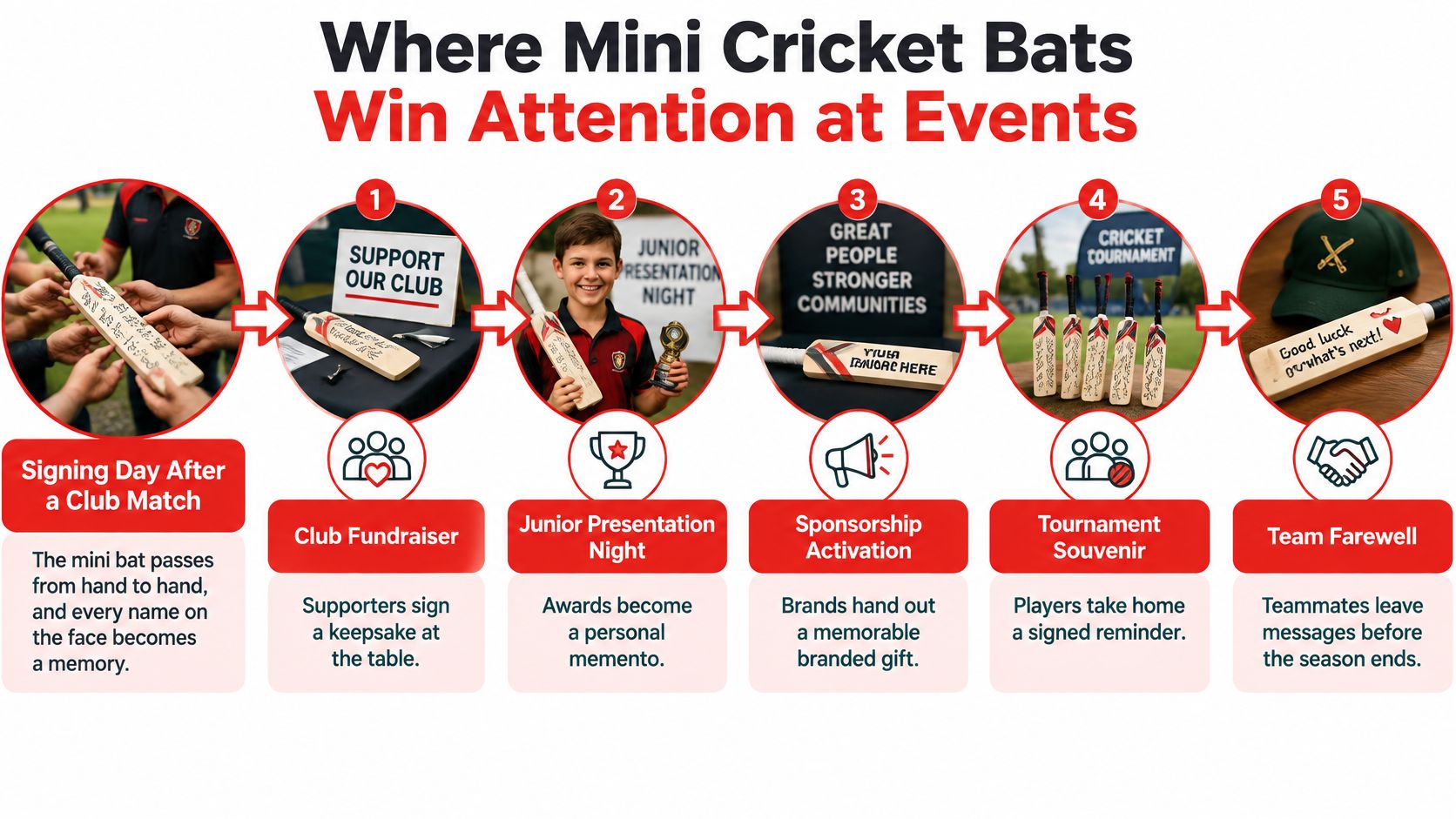
Five settings and the design each one needs
- Trade show giveaways. The goal is recall a week later, so use one logo in pad print or screen print on the back, plus a short contact line. The bat gets noticed at the booth and still has a job to do on someone's desk on Monday.
- Award night presentations. Goodwill is the point. Laser engrave the recipient's name and the date inside the engraving zone, keep the sponsor logo small and low, and let the person's name be the biggest thing on the bat.
- Team milestones and signing bats. A season farewell or a 200-game cap wants a story people retell. Engrave names on a single line each, leave a clear signature panel, and hand it round at the function instead of packing it away.
- Client gifts at corporate functions. Restraint reads as respect. A small logo on the back with a short thank-you line on the face beats a full-face brand assault every time, and it's the version people keep.
- School and community sports days. A child will show this at home, so give them a crest they recognise and keep branding off the striking face. A simple shape with the school name down the blade gets kept, not binned.
The reachable crowd is concrete. In 2025, the Australian Sports Commission reports an estimated 564,000 Australians aged 15 and over played cricket at least once, alongside 163,000 children aged 0 to 14. Those figures count participation rather than mini-bat ownership, but they show how many club sheds, family rooms and school bags a cricket keepsake can plausibly reach.
Some events need a shared activity more than a take-home object. When the brief is a corporate away day rather than a cricket crowd, conference ideas from Corporate Challenge Events give you formats where a keepsake still earns its place.
Community sports days and gala days also live outdoors, so pair a bat with outdoor promotional products that survive a full day of sun, wind and dropped water bottles.
Match the event to its purpose before anyone draws a design. A bat built for recall uses one mark and a contact line. A bat built for a signing queue protects open space. A bat built for juniors keeps the face playable. The versions that get thrown away are usually the ones that tried to carry every job at once.
Wood, Sustainability and What Happens After
Say a club committee is weighing a pale timber bat against a plastic giveaway for the season fundraiser. The timber one looks greener before anyone asks a question, and that first impression does most of the selling. Product content aimed at Australian buyers often presents timber as eco-friendly without touching sourcing, manufacturing waste, durability or material trade-offs.
The lifecycle numbers are sobering. Research on cricket bats reports that willow can take up to 15 years to mature, and that manufacturers may discard up to 30% of sourced wood during production, as Wood Central's report on bamboo and cricket bats sets out. A bat that sat in a field for fifteen years and lost a third of its timber along the way isn't automatically a low-impact object.
Why bamboo complicates the story
Laminated bamboo can offer greater stiffness, a larger effective sweet spot and stronger energy transfer than willow. It sounds like the obvious answer until you reach the botanical detail. Bamboo is a grass rather than a wood, which conflicts with the traditional playing-law requirement that a bat blade consist solely of wood. The material that performs well can't be swapped into a bat that claims to be regulation-shaped.
For a promotional mini bat, that tension plays out differently. A display piece is a small flat canvas for a crest or a line of text, so composite materials, rubber, plastic or laminated wood are all legitimate when the object was never meant to face a ball. A bat styled to resemble regulated equipment raises harder questions about authenticity and what happens to it at end of life. Each serves a different brief, and the buyer should know which one they're ordering.
Four questions to put to your supplier
- What's the recycled content? Ask for the figure, not the sentiment.
- Which coatings and finishes are used? Lacquer, stain and clear coats all affect disposal and repairability.
- How is it packaged? A compostable sleeve beside a foam insert isn't a win.
- Is it repairable, and will it be kept beyond the event? A bat with a name on it usually is.
Ask in writing, not on a call. A supplier who can answer those four questions by email has thought about the end of the product's life. One who replies that it's timber so it's eco hasn't.
The trend worth watching isn't just swapping willow for bamboo. It's a broader shift toward lower-waste materials and honest lifecycle claims, and buyers who ask the awkward questions early tend to get the better product. If the materials story should match the marketing, start with the eco products range and hold the bat to the same standard.
Budget and Ordering Steps for a Branded Run
Say a junior club wants two hundred bats for presentation night, each one carrying a player's name under the club crest. The first question the treasurer asks is what the wood costs. In 2026, Cricket Warehouse Australia listed a blank mini cricket bat at AU$8.95, described as approximately 15 inches (38 cm) long with a face width of approximately 2 inches (5 cm). That is the price of undecorated timber. Everything above it is your design, your method, your quantity and your deadline.
Retail gives a second reference point. Sports Direct Australia listed a Gray-Nicolls Mini Cricket Bat at AU$14.99 in 2026, per the Sports Direct Australia cricket bats listing, a finished retail item rather than a blank sold for decoration.
| Item | Listed price (2026) | Notes |
|---|---|---|
| Blank mini cricket bat (Cricket Warehouse Australia) | AU$8.95 | Approx. 15 inches (38 cm) long, face approx. 2 inches (5 cm) wide |
| Gray-Nicolls Mini Cricket Bat (Sports Direct Australia) | AU$14.99 | Retail listing, unbranded |
| Branded run (Simply Merchandise) | Quoted per order | Price set by run size, branding method and number of colours |
The order runs in a fixed sequence, and skipping a step is how a name gets misspelt on two hundred bats.
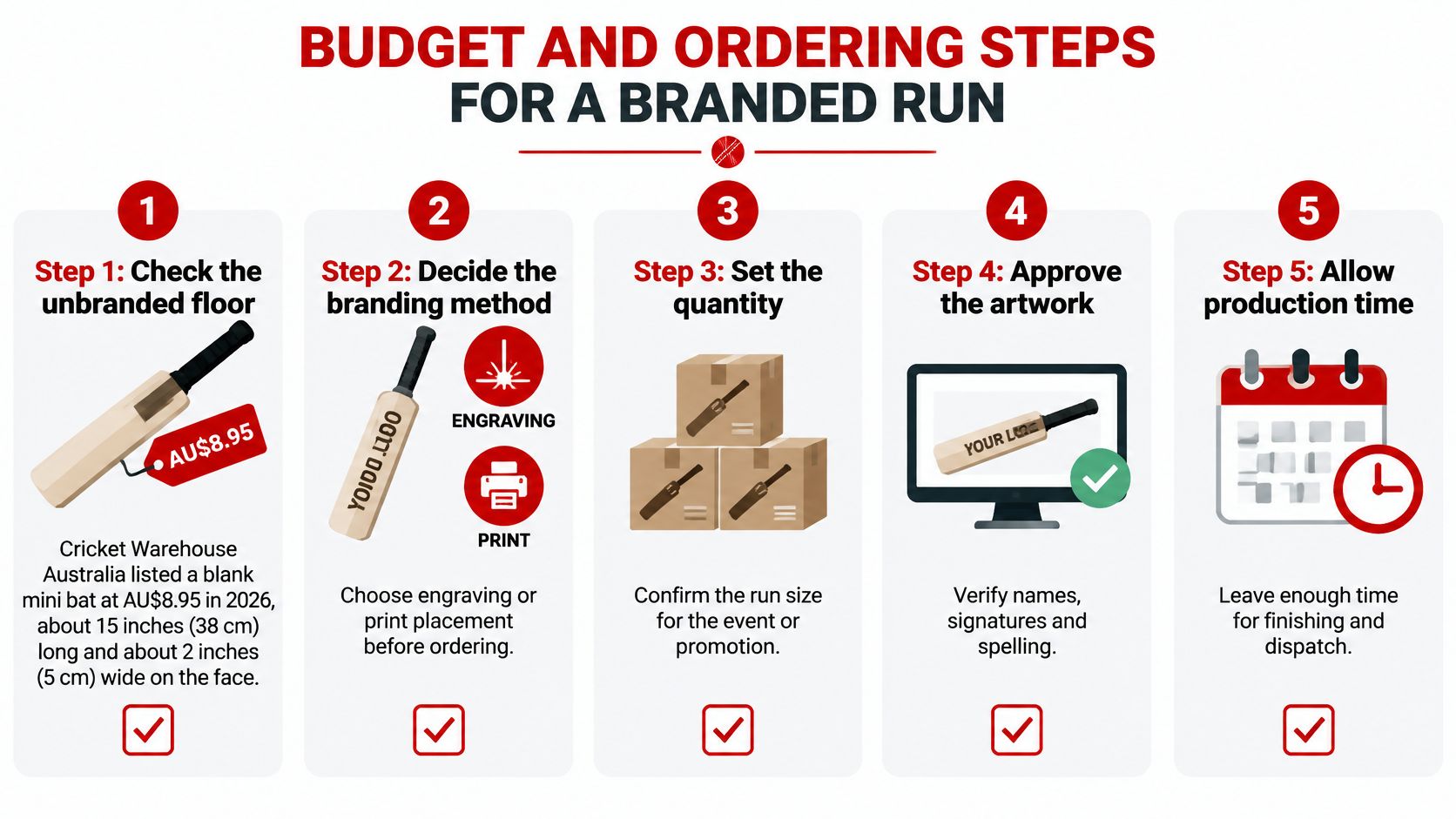
What moves the quote
Four variables do most of the work, and only one of them is the bat itself.
- Quantity and price breaks. Unit costs fall as the run grows, because setup is spread across more pieces. A 50-unit run and a 500-unit run rarely sit on the same price curve.
- Colours in the artwork. Each colour in a screen or pad print adds a setup and a pass. Cutting from three colours to two often saves more than changing the bat.
- Branding method. Engraving individual names takes more machine time per piece than a single-colour logo print. That is a fair trade when the names are the point.
- Deadline. Express services exist for events that were booked before the merchandise was. They cost more, and they need the artwork locked earlier, not later.
Sampling matters more on a mini bat than on a mug or a tote bag. The branding zone is a narrow strip of flat timber, so a name engraved slightly off-centre or a letter clipped at the edge has nowhere to hide. On a printable area that small, a single millimetre decides whether a surname sits on one line or wraps onto a second.
The six steps from brief to delivery
- Confirm the item and its use case. Display piece, junior-use product or keepsake. That single answer decides dimensions, materials and where the branding goes.
- Lock the decoration zone. Keep names and crests inside the laser engraving area, or inside the smaller pad-print area if that is your method. Draw the zone on the template before you design into it.
- Supply artwork in the required format. High-contrast logos and clean name lists, checked for spelling by someone other than the person who typed them.
- Approve the proof against the finished dimensions. Both on the same document, so there is no argument about which version was signed off.
- Agree delivery to your state. Australia-wide freight is straightforward, but a regional school in term three is not the same delivery as a Sydney CBD office in January.
- Set a date backed by the event calendar. Work back from the function date, not forward from the order date, and leave a buffer for a reprint if a name is wrong.
Before you send artwork, work through the ordering process for promotional products so the quote, the proof and the delivery date all sit in the same conversation rather than three separate email threads.
The habit that saves the most grief: order a sample first whenever names or photographs must be exact. One engraved bat in your hand settles questions a digital mock-up cannot, from how dark the engraving burns into the timber to whether a hyphenated surname still fits on one line. If the sample is right, the run will be right. If it is not, you have lost a week instead of a season's worth of goodwill.
Your logo has one narrow strip of timber to make an impression, and we can show you exactly how it will sit before you commit a single unit. We offer free artwork layouts and unlimited revisions, in-house laser engraving and printing, and Australia-wide delivery, so a run of named mini cricket bats can go from brief to presentation night without a second supplier. Send us your artwork and your event date, and we'll work back from the date to the delivery, then the proof, then the engraving.

