



Printing on tote bags is one of the smartest ways for an Aussie brand to get noticed. It takes a simple, practical item and turns it into a mobile advertisement that people actually want to use. This isn't just a fleeting glance; it's long-term exposure that builds a genuinely positive feeling around your brand, especially as reusable bags are now a part of daily life right across the country.
Why Custom Tote Bags Are Such a Powerful Marketing Tool
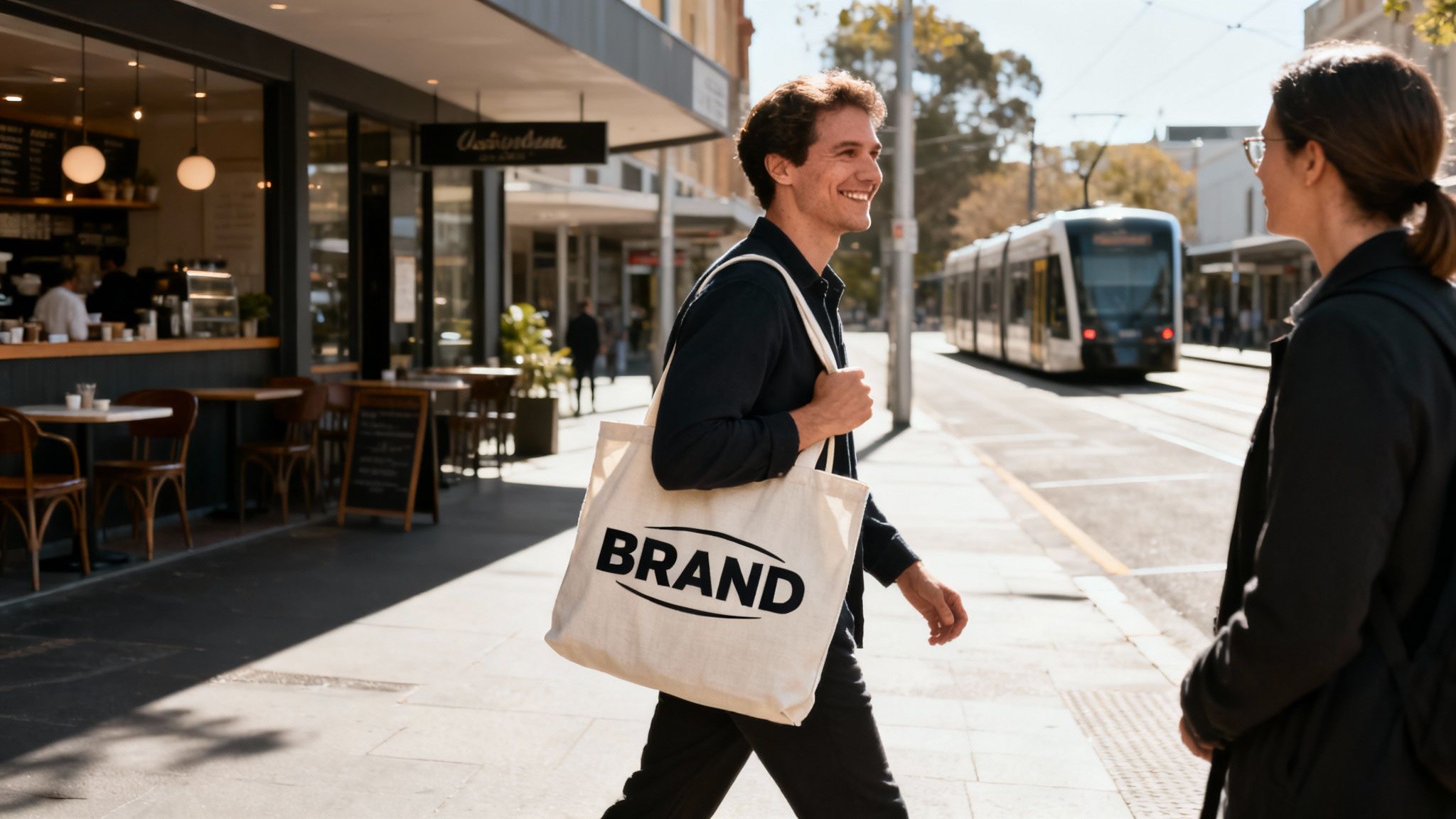
Stop thinking of a custom tote as just another giveaway item. It's a walking billboard. Every time someone takes your branded bag to do their weekly shop, head to the gym, or browse the local weekend market, your logo is getting out there in front of countless potential new customers. That kind of consistent, real-world visibility is pure marketing gold.
Here in Australia, the opportunity is massive. We've got a strong national focus on being environmentally conscious, and with plastic bag bans in place everywhere, reusable totes have gone from a niche eco-product to an absolute daily essential. This cultural shift means there's a huge audience ready and waiting for a functional, good-looking bag they can use over and over again.
Maximising Brand Exposure and Recall
The real magic of a printed tote bag is in its staying power. A digital ad is gone in a flash, and a flyer usually ends up in the bin, but a quality tote bag can stick around for years. This repeated use builds a comfortable familiarity with your brand, strengthening recall without being pushy or in-your-face.
For any business, this adds up to a seriously impressive return on investment. When you break it down, the cost per impression for a promotional tote bag is incredibly low compared to most traditional advertising channels.
A single custom tote bag can generate thousands of impressions over its lifespan. It’s a marketing asset that keeps working long after the initial investment is made, building brand recognition with every use.
A Versatile Tool for Any Campaign
The sheer versatility of custom totes is what makes them a go-to for so many different campaigns. They work just as well for corporate events and trade shows as they do for retail promotions or raising awareness for a non-profit. A branded bag is a genuinely useful gift that carries your message wherever it goes, making it a cornerstone of many successful promotional products strategies.
The numbers back this up. The Australian bags market was valued at USD 916.0 million and is on track to hit USD 1,655.9 million by 2033. A huge driver of this growth is the demand for printed totes made from sustainable materials—a trend that's only accelerated since plastic bag bans made reusable bags a non-negotiable part of our daily routine.
Choosing the Right Tote Bag Material for Your Brand
Picking the right material for your tote bag is a lot like choosing the right canvas for a painting. The fabric’s texture, weight, and colour all play a huge role in how your final print looks and feels. Get it right, and you’ve created a product that perfectly reflects your brand's quality and message.
Think of a lightweight cotton bag as your favourite comfy t-shirt. It’s affordable, easy to distribute, and perfect for mass giveaways where you want to get your name into as many hands as possible. On the other hand, a heavy-duty canvas bag is like a pair of quality work jeans—it's built to last, can handle a heavy load, and sends a clear message of reliability and premium quality.
Your choice of material speaks volumes before a single word of your branding is even read. Let’s walk through the most common options to help you find the perfect fit for your next campaign.
Classic Cotton: The Versatile Favourite
Cotton is the go-to for promotional tote bags, and for good reason. It's soft, lightweight, and folds down to almost nothing, making it super convenient for people to stash away and reuse. Its smooth, natural surface is a fantastic base for most printing methods, ensuring your designs come out looking sharp and clear.
This material is a great fit for:
- Large-scale giveaways: Its low price point makes it a no-brainer for events, conferences, and festivals where you need thousands of bags.
- Eco-conscious campaigns: Choosing organic cotton really resonates with an environmentally aware audience.
- Simple, bold logos: Screen printing on cotton delivers incredibly vibrant results, especially for one or two-colour designs.
Just keep in mind that standard, lightweight cotton isn't as tough as other options and might shrink if not washed carefully. It’s best for carrying lighter loads like brochures, a water bottle, and a few small items.
Durable Canvas: The Premium Powerhouse
When you need a bag that feels substantial and is built for the long haul, canvas is the clear winner. Made from a thicker, more densely woven cotton, canvas is incredibly strong and durable. This robust nature makes it an excellent choice for a high-value promotional item or even a retail product.
Canvas doesn’t just hold a print beautifully; it communicates a message of quality and permanence. When you give someone a canvas tote, you’re giving them something designed to last for years—keeping your brand visible long after the event is over.
Its premium feel makes it perfect for corporate gifts, hefty trade show goodie bags, or for any brand wanting to project an image of strength and dependability.
Jute and Non-Woven PP: Other Popular Picks
Beyond the two big players, a couple of other materials offer their own unique advantages. Jute, a natural plant fibre, has a rustic, earthy texture that immediately gives off an eco-friendly vibe. Its coarser surface works best with simple, bold prints rather than designs with fine, intricate details.
Non-Woven Polypropylene (PP), on the other hand, is a budget-friendly and water-resistant plastic fabric. It's a fantastic, cost-effective choice for huge orders and is available in a massive range of bright colours, making it easy to find a perfect match for your brand’s palette. While it's not a natural fibre, it is recyclable.
To help you get a better feel for your options, check out our full range of promotional bags and see these materials in action.
Making the right choice is especially important here in Australia. Mid-sized tote bags (5-20L) dominate the market with a massive 50.04% share. At the same time, the shift towards natural fabrics is undeniable. Paper and fabric bags now command 60.7% of the market, which is valued at USD 627 million and continuing to grow. You can dive deeper into these Australian retail bag market trends on mordorintelligence.com.
Tote Bag Material Comparison for Printing
Feeling a bit overwhelmed by the options? Here’s a quick-glance comparison of the most common tote bag materials to help you choose the best fit for your branding needs, budget, and design.
Ultimately, the best material depends on your specific goals. Are you aiming for widespread visibility with a tight budget, or are you looking to make a lasting impression with a premium, durable item? Answering that question is the first step to choosing the perfect tote.
Decoding the Best Printing Methods for Tote Bags
Picking the right material for your tote bag is only half the battle; choosing how to get your design onto the bag is just as crucial. The printing method you select will shape the final look, feel, durability, and, of course, the cost of your project. Getting your head around the main techniques is the key to matching your design vision with your budget.
Think of it like painting a room. For a big, solid-coloured wall, you'd grab a roller for speed and efficiency. But for a detailed mural, you’d need a set of fine brushes to get the details just right. Printing on tote bags works on the same principle – there's a different tool for every job.
This little flowchart can help you start thinking about which material might be the best fit before we get into the nitty-gritty of printing.
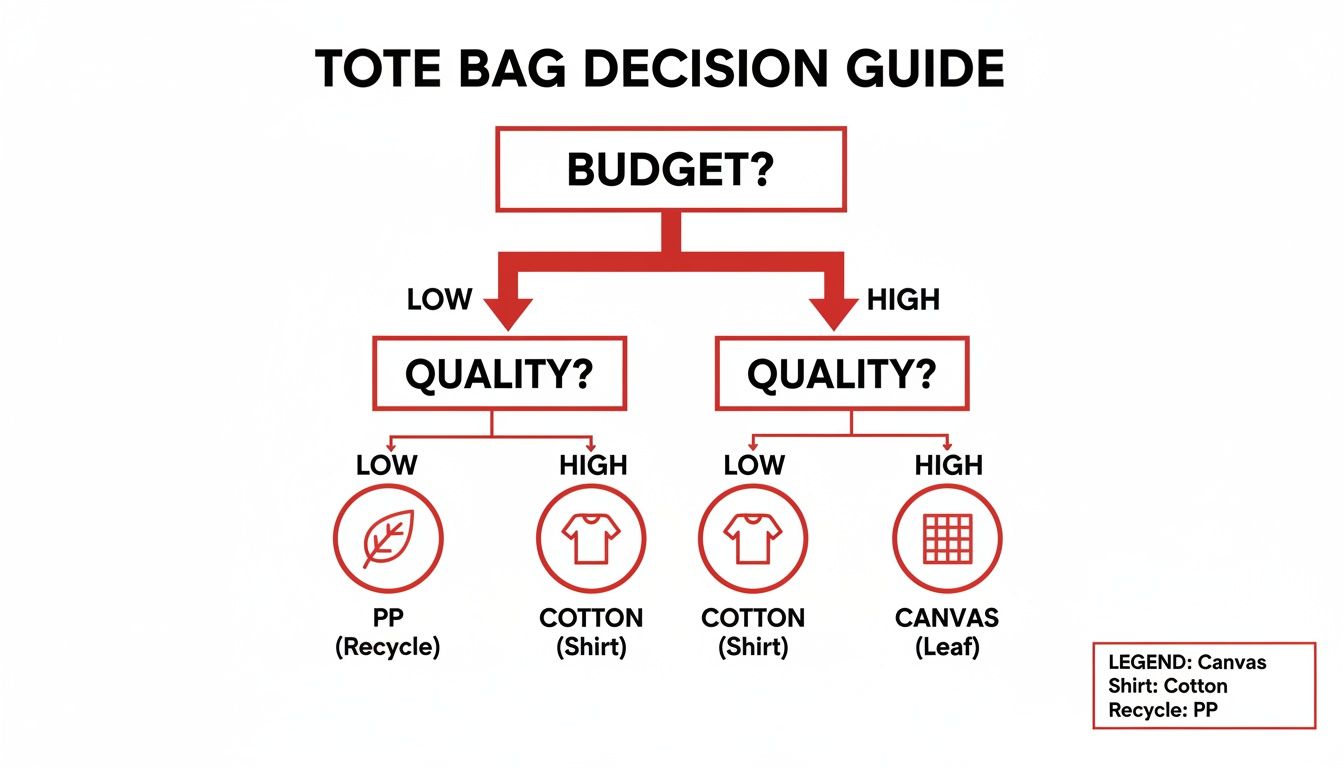
As you can see, your budget and the quality you're after are the first things to consider. These factors will guide your material choice, which in turn influences how your final print will turn out.
Screen Printing: The Bold and Vibrant Workhorse
Screen printing is a classic for a reason. This time-tested method produces incredibly bold, vibrant, and durable results that really last. It’s a bit like using a stencil – a mesh screen is created for each individual colour in your design, and then ink is pushed through the screen directly onto the fabric. Simple, effective, and built to last.
This technique is the undisputed champion for simple, graphic-heavy designs with just one or two solid colours. Because a new screen has to be made for every single colour, it really shines on larger orders where you can spread those initial setup costs across hundreds, or even thousands, of bags.
- Best For: Large quantity orders (100+ units), bold logos, simple text, and designs with just a few colours.
- Pros: The prints are super durable and long-lasting, the colours are bright and opaque, and it offers the lowest cost-per-bag on big runs.
- Cons: Not the right tool for photos or designs with colour gradients. It can also get pricey for small orders or jobs with lots of different colours.
It’s interesting to note that even with all the new tech available, simple is still king. One industry report found that over 91% of decorated promotional gear featured a single-colour design, proving just how popular and effective this bold method continues to be.
Digital Printing (DTG): For Full-Colour Detail
Digital printing, often called Direct-to-Garment (DTG), works pretty much like the inkjet printer in your office, but for fabric. It sprays specialised, water-based inks directly onto the tote bag, allowing it to reproduce incredibly detailed, full-colour images. We’re talking photographs, complex graphics, and smooth colour gradients – no problem.
This method is perfect when your artwork is the star of the show. There are hardly any setup costs, which makes it a fantastic choice for smaller orders or for any design that needs that photorealistic pop.
Digital printing unlocks complete creative freedom. It's the ideal choice when you need to perfectly replicate a multi-coloured logo or a vibrant photograph without compromising on detail or colour accuracy.
This makes it a brilliant option for brands that want to create a visually stunning, high-impact promotional item. If you want to get into the technical side of things, you can explore detailed guides on different custom printing options.
Heat Transfer: For Versatility and Small Batches
Heat transfer printing is a two-step process. First, your design is printed onto special transfer paper. Then, using a commercial heat press, that design is applied to the tote bag, essentially bonding it to the surface of the fabric.
It’s an incredibly versatile method that works well on all sorts of materials and is particularly great for small, customised runs. For instance, if you need to add individual names or numbers to each bag, heat transfer is often the quickest and easiest way to get it done.
While modern heat transfers are a world away from the old iron-on patches you might remember, they might not have the same long-term durability as a screen-printed design, especially after a lot of trips through the wash. For more tips on achieving flawless prints on various materials, especially tricky ones, other expert guides can be a great resource.
Ultimately, each method has its place. Screen printing delivers unbeatable value and durability for big orders with simple designs. Digital printing excels at bringing full-colour, detailed artwork to life on smaller runs. And heat transfer offers a flexible middle ground, perfect for intricate customisation jobs.
Getting Your Artwork Ready for a Flawless Print
Getting your artwork right is hands-down the most critical step in the whole process. It’s what ensures the design on the finished tote looks just as sharp and vibrant as it does on your screen. Nail this part, and you’ll avoid the headaches of blurry logos, off-brand colours, or last-minute redesign costs.
Think of it like building a house. You wouldn’t start construction with a rough, hand-drawn sketch; you’d use a precise architectural blueprint. Your digital art file is that blueprint. It needs to be perfect.
When you provide a print-ready file, you set the stage for a smooth production run and a final product you’ll be proud to put your name on. Let's walk through what you need to know.
Vector vs. Raster: The Only Technical Bit You Really Need to Know
The first thing to get your head around is the difference between vector and raster files. Honestly, if you understand this one concept, you've solved about 90% of common printing problems before they even begin.
Vector files are the gold standard for printing. You’ll usually see them with file extensions like .AI, .EPS, or .SVG. They're built from mathematical equations, which sounds complex, but it simply means they can be scaled to any size—from a tiny logo on a pen to a giant billboard—without ever losing a drop of quality.
Raster files are what you’re probably more familiar with. These are your .JPGs, .PNGs, and .GIFs. They’re made from a grid of tiny squares called pixels. They look great on a screen, but when you try to enlarge them, you're just stretching those same pixels, which leads to that dreaded blurry or "pixelated" look.
For the best results on any promotional product, always supply your logo as a vector file. It gives us the flexibility to resize your design to fit the tote bag's print area perfectly, guaranteeing a crisp, clean finish every single time.
Mastering Colour and Resolution
With the right file type sorted, the next step is making sure the colours and sharpness are set up for a physical print, not just a digital screen.
- Colour Mode (CMYK vs RGB): Your computer monitor uses an RGB (Red, Green, Blue) light model to create colours. Professional printers, however, use a CMYK (Cyan, Magenta, Yellow, Black) ink model. Supplying your file in CMYK mode is vital for colour accuracy, preventing nasty surprises when your vibrant brand colours look dull or different in the final print.
- Resolution (DPI): If your design must include any raster elements (like a photo), its resolution needs to be at least 300 DPI (dots per inch) at the final print size. Anything less will almost certainly look fuzzy and unprofessional.
Colour Mode (CMYK vs RGB): Your computer monitor uses an RGB (Red, Green, Blue) light model to create colours. Professional printers, however, use a CMYK (Cyan, Magenta, Yellow, Black) ink model. Supplying your file in CMYK mode is vital for colour accuracy, preventing nasty surprises when your vibrant brand colours look dull or different in the final print.
Resolution (DPI): If your design must include any raster elements (like a photo), its resolution needs to be at least 300 DPI (dots per inch) at the final print size. Anything less will almost certainly look fuzzy and unprofessional.
These details matter more than you’d think. For a deeper dive, we’ve put together some more tips in our simple guide on artwork submission tips for beginners.
Final Artwork Checks for a Perfect Print
Before you hit 'send' on that email, a quick final check can save you from common issues that cause production delays. These little steps make a massive difference.
- Outline Your Fonts: Ever opened a document on a different computer and the text looked all wrong? That’s because the new device didn’t have the right font installed. By converting all text to "outlines" or "curves," you turn the letters into fixed vector shapes. This locks them in, so they’ll look exactly as you intended, no matter who opens the file.
- Know the Printable Area: Every tote bag has a defined "printable area." This is the specific zone where your design can actually be printed. Make sure your artwork fits comfortably within these dimensions so nothing gets cut off or printed too close to the seams. We'll always provide these specs for you.
- Embed Your Images: If your design contains any raster images (like a photo inside a larger design), they need to be embedded into the file. This packages everything together, so no crucial elements go missing when our team opens it.
Outline Your Fonts: Ever opened a document on a different computer and the text looked all wrong? That’s because the new device didn’t have the right font installed. By converting all text to "outlines" or "curves," you turn the letters into fixed vector shapes. This locks them in, so they’ll look exactly as you intended, no matter who opens the file.
Know the Printable Area: Every tote bag has a defined "printable area." This is the specific zone where your design can actually be printed. Make sure your artwork fits comfortably within these dimensions so nothing gets cut off or printed too close to the seams. We'll always provide these specs for you.
Embed Your Images: If your design contains any raster images (like a photo inside a larger design), they need to be embedded into the file. This packages everything together, so no crucial elements go missing when our team opens it.
Follow these guidelines, and you’re not just sending over a file—you’re providing a clear, professional set of instructions for a fantastic-looking tote bag that will do your brand justice.
Understanding Costs, Timelines and Ordering
Alright, let's get down to the brass tacks: how much will this cost, and when will you get your bags? Figuring out the final steps of a custom tote bag order can seem a bit daunting, but it really just comes down to a few key details that shape your price and delivery schedule. Once you get a handle on these, you can plan your budget and deadlines like a pro.
Think of it like ordering a custom cake. A simple, single-flavour sheet cake for a big party has a much lower price per slice than a small, intricate, multi-tiered wedding cake. The same logic applies to printing tote bags. The complexity of your design and the number of bags you order are the biggest factors influencing your final cost.
What Drives the Cost of Your Custom Totes
A few key variables come together to determine the price per bag. The biggest one is economies of scale—put simply, the more bags you order, the cheaper each one gets. This is especially true for something like screen printing, where the initial setup costs get spread out over the entire batch.
Here are the other main things that will affect your final quote:
- Print Method: For big runs with just a few colours, screen printing is usually your most budget-friendly option. Digital printing, on the other hand, can be a better fit for smaller orders with full-colour, complex designs.
- Number of Colours: With screen printing, every single colour in your design needs its own custom screen and setup. That’s why a one-colour print will always be kinder to your wallet than a four-colour one.
- Bag Material: It goes without saying that a premium, heavy-duty canvas tote will cost more than a standard, lightweight cotton or non-woven bag.
- Print Locations: Want to print on both sides? That will cost more than a single-sided print because it’s essentially a whole separate setup and printing process.
By understanding how these elements play off each other, you can make smart choices that keep your project on budget. For example, sticking with a one-colour design on a standard cotton bag might let you order a much larger quantity for the same price as a smaller run of multi-colour canvas totes.
If you want to see exactly how these choices impact the numbers, you can get an instant print quote and play around with the options in real-time.
Mapping Out a Typical Project Timeline
Knowing what to expect from the production process is crucial for planning your marketing campaigns or events. While every job is a little different, a standard order for custom printed totes usually follows a fairly predictable timeline.
Here’s a look at a typical schedule:
- Quote and Artwork Submission (1-2 days): This is where you send us your design and we send back a detailed quote. Our team gives your artwork a once-over to make sure it's ready for printing.
- Artwork Proof Approval (1 day): We’ll send you a digital mock-up showing exactly how your design will look on the bag. You give it the final thumbs-up before we print a single thing.
- Production (7-14 business days): Once you’ve approved the proof, your bags hit the production floor. This is when your design is physically printed onto the totes.
- Shipping and Delivery (2-7 business days): After production and a final quality check, your order is packed up and sent on its way. Delivery times will vary depending on where you are in Australia.
Once your custom tote bags are shipped, knowing the ins and outs of the delivery process is key, particularly for orders heading overseas. For a great guide on keeping an eye on your shipment, it's worth learning how to track international packages. This will help you stay in the loop from dispatch to delivery, ensuring your campaign stays right on schedule.
Caring for Your Totes to Promote Sustainability
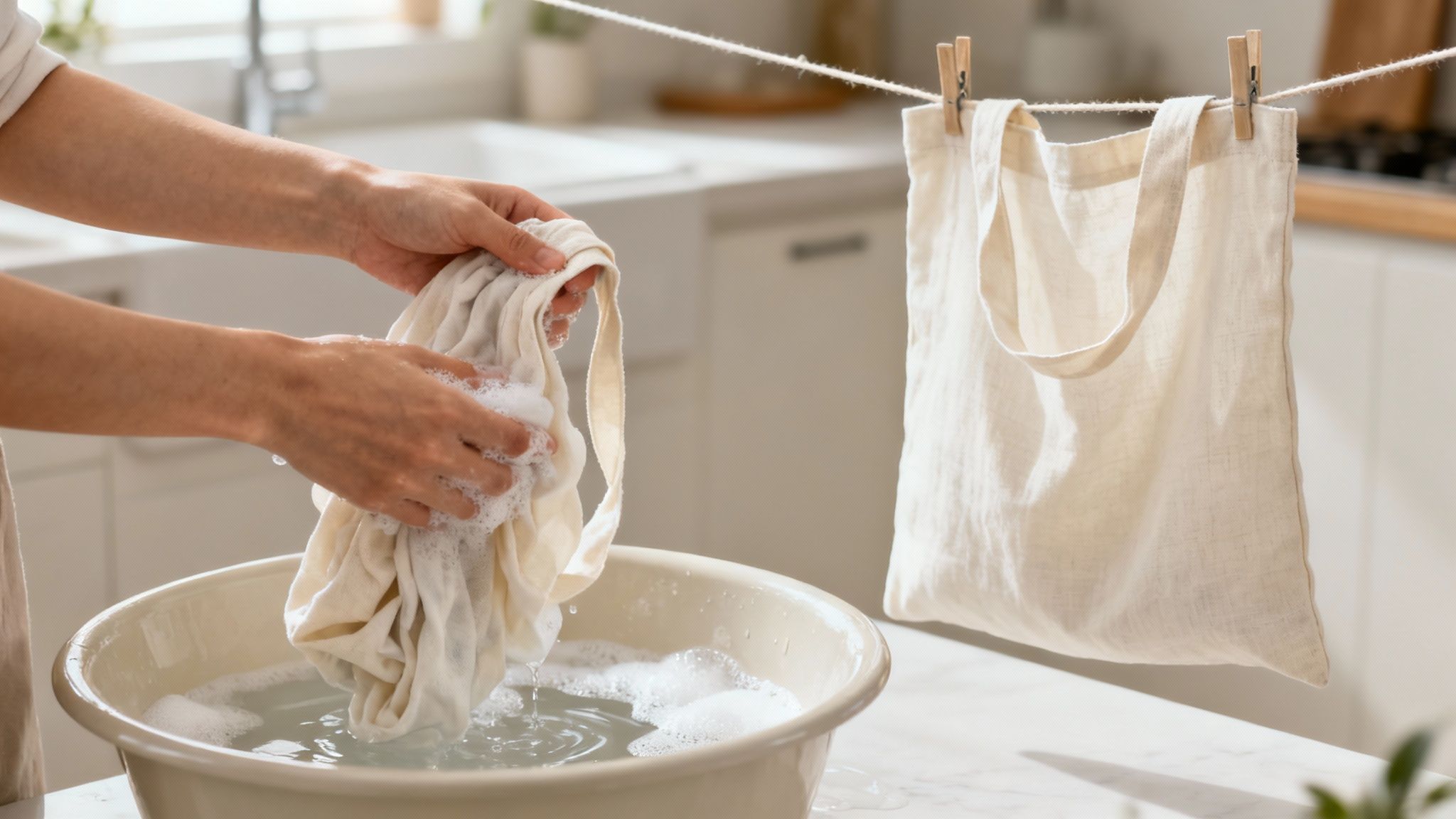
When you hand out a custom tote bag, you’re not just giving away a product. You're launching a tiny, mobile marketing campaign. A promotional item that lasts is one that keeps working for you, and the longer that bag stays in rotation, the more eyes land on your brand.
That's why proper care is such a crucial piece of the puzzle. By including simple care instructions, you help your customers keep their bags looking fresh and your branding sharp. It’s a small detail that reinforces your commitment to sustainability—a well-cared-for reusable bag is a powerful statement against throwaway culture, something that really clicks with Australian consumers.
This simple act transforms a giveaway into a lasting symbol of your brand’s thoughtful values.
Simple Care Tips for Common Tote Materials
Different fabrics need different handling to protect both the material and the printed design. Sharing a few easy tips can make a world of difference to the lifespan of your merch.
- Cotton and Canvas Bags: These are usually the easiest to look after. The golden rule? Turn the bag inside out before washing to protect the print. A gentle, cold machine wash or a quick hand wash works best to stop it from shrinking or fading. Always let it air dry flat to keep its shape.
- Jute Bags: Jute is a hardy natural fibre, but it really doesn't like being soaked. It's best to spot clean only with a damp cloth and a bit of mild soap. If you get a jute bag completely wet, it can lose its stiffness and shape for good.
- Non-Woven PP Bags: These are water-resistant and a breeze to clean. A quick wipe-down with a damp cloth is all it takes. Definitely steer clear of the washing machine, as the heat and tumbling can wreck the fabric and your print.
Cotton and Canvas Bags: These are usually the easiest to look after. The golden rule? Turn the bag inside out before washing to protect the print. A gentle, cold machine wash or a quick hand wash works best to stop it from shrinking or fading. Always let it air dry flat to keep its shape.
Jute Bags: Jute is a hardy natural fibre, but it really doesn't like being soaked. It's best to spot clean only with a damp cloth and a bit of mild soap. If you get a jute bag completely wet, it can lose its stiffness and shape for good.
Non-Woven PP Bags: These are water-resistant and a breeze to clean. A quick wipe-down with a damp cloth is all it takes. Definitely steer clear of the washing machine, as the heat and tumbling can wreck the fabric and your print.
Adding a small tag or a little card with these tips empowers people to get years of use out of their bag.
Linking Durability to Your Brand's Green Credentials
Choosing to print on tote bags is already a great step towards sustainability. But guiding your customers on how to care for them takes that commitment to the next level, showing your environmental focus is more than just talk.
When a brand helps its customers make a product last, it sends a clear message. It says, "We value quality, we care about the environment, and we want this to be useful for you for a long time." This builds a deeper, more authentic connection than any short-lived promotion ever could.
This simple approach shows a genuine investment in reducing waste. For your audience, the bag becomes more than just a freebie; it’s a reliable tool they can count on, all while carrying a positive association with your forward-thinking brand.
Got Questions About Printing on Tote Bags? We've Got Answers.
When you're ordering custom promotional products, asking questions is a great sign. It means you’re thinking carefully about your goals and want to make sure the final product is a perfect match for your brand. To help you feel confident as you print on tote bags, we’ve gathered some of the most common queries we get from clients just like you.
Think of this as your go-to cheat sheet. Each answer is short and sharp, cutting straight to the point to help you make smart decisions without getting bogged down in jargon.
What’s the Best File Format for My Artwork?
For the best possible result, you’ll want to send us your logo or design as a vector file. Look for file extensions like .AI (from Adobe Illustrator), .EPS, or .SVG.
Why vector? Simple. These files are built with mathematical formulas, not pixels, so we can scale your design up or down to any size without it getting blurry or pixelated. This guarantees a crisp, professional finish on the final bag. If all you have is a standard image file like a .JPG or .PNG, make sure it’s high-resolution—at least 300 DPI (dots per inch) at the actual size you want it printed.
What’s the Minimum Number of Totes I Can Order?
This really depends on the bag and the printing method you’ve got your eye on. For a straightforward job, like screen printing a one-colour logo onto a classic cotton tote, the minimum order quantity (MOQ) can be as low as 25 to 50 units. This makes it a fantastic option for small businesses, local events, or even boutique campaigns.
On the other hand, more complex jobs or highly customised bags often need a larger run to make the setup costs worthwhile. The best bet is always to check the product page for the specific tote you're interested in, or just ask us for a quote.
How Long Until My Order Arrives?
From the moment you sign off on the artwork to the day the boxes land on your doorstep, a typical order for custom tote bags usually takes about 2-3 weeks. That timeline covers everything: getting your artwork proofed and approved, the actual production run, and shipping anywhere in Australia.
Just a heads-up: this is a general guide. If your design is particularly intricate, you're ordering a huge quantity, or we're sourcing a unique bag for you, it might take a little longer. If you’re in a hurry, we often have express options available. A little forward planning always goes a long way!
Can I Really Print a Full-Colour Photo on a Tote?
You absolutely can! If you have a photograph or a design packed with gradients and different shades, we use a technique called digital printing (you might also hear it called Direct-to-Garment or DTG).
It works a lot like your desktop inkjet printer, but on fabric. Unlike screen printing, which is better for bold, solid colours, digital printing applies the ink directly onto the tote. This lets us capture all the tiny details and rich colours of your original image with incredible accuracy. It’s the perfect way to turn a favourite photo into a brilliant, wearable piece of marketing.
Ready to create a walking billboard for your brand? The expert team at Simply Merchandise is here to help you choose the perfect tote bag and printing method to bring your vision to life. Explore our range of custom tote bags today!

