



You're standing at a trade show booth with a hard deadline, a stack of samples, and one simple question, which cap will people wear after the event is over? That's the test for promotional caps Australia, not whether the logo looks neat on a flat lay. If you buy caps like they're cheap throwaways, you'll get cheap throwaway behaviour. If you buy them as visible, wearable, practical merchandise, they can keep your brand in play long after the handout moment.
The Australian promotional-products market is big enough to make cap buying a serious decision, not a side job. APPA estimates the market at AUD 3.5 billion in 2025, and says that's about 14% of Australia's total advertising expenditure estimated by Oxford Economics at AUD 25 billion for the same year, so headwear sits inside a large marketing channel, not a niche purchase (APPA market footprint report). The old habit of defaulting to a baseball cap because it's familiar is lazy buying. The better question is whether the cap gives you enough coverage, enough durability and enough life after the campaign to justify the spend.
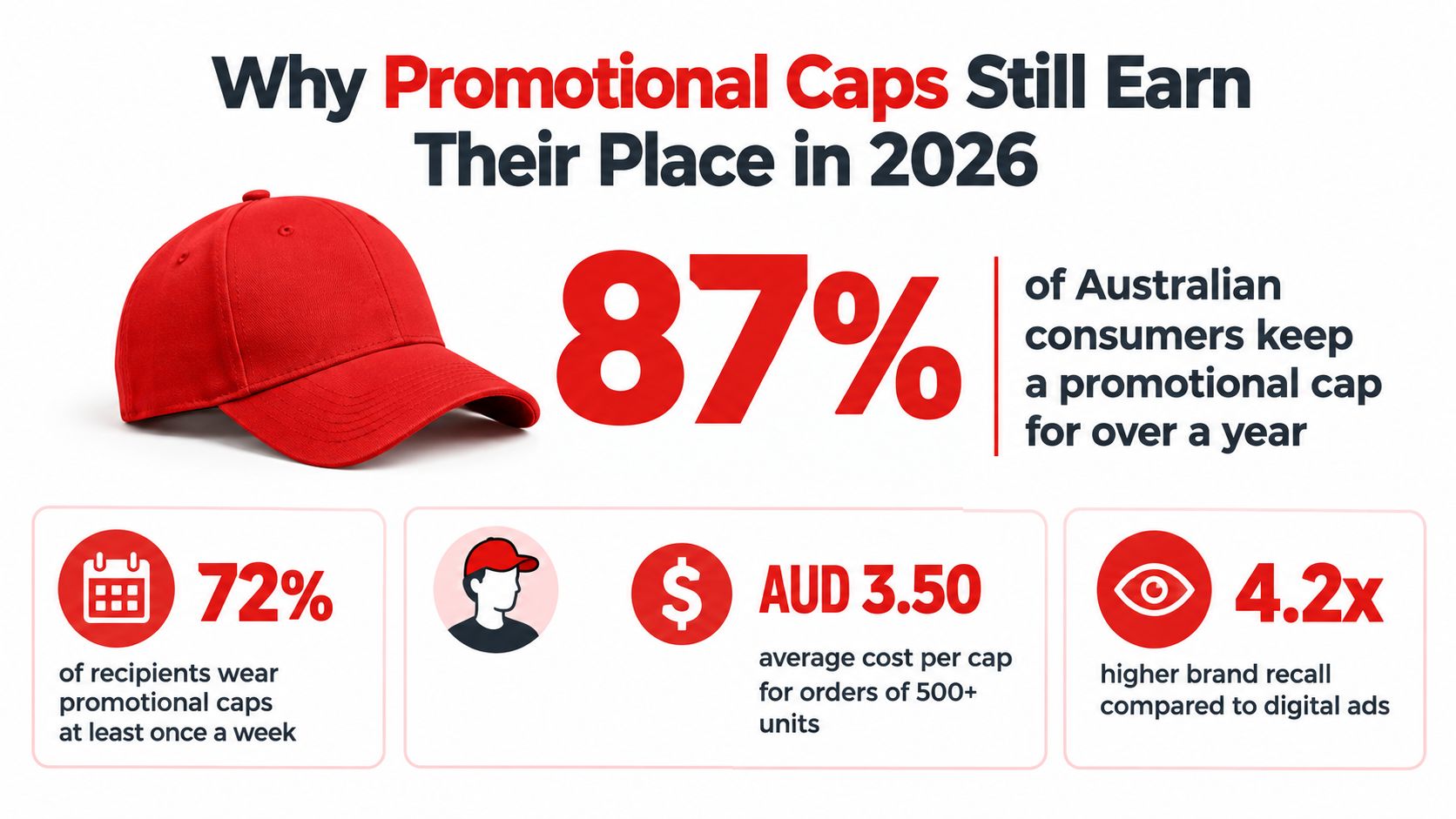
Why Promotional Caps Still Earn Their Place in 2026
A marketing manager at a Sydney trade show isn't choosing between “caps” and “no caps”, they're choosing between a forgettable handout and a piece of gear that might get worn next week at a job site, in a school pickup line or on the sidelines at a weekend game. That's why promotional headwear still works. It gives you a large, visible front panel, it travels with the wearer, and it keeps doing its job when the booth lights are off.
Promotional caps also sit in a category with real history behind them. In Australia, headwear has long carried identity, status and group belonging, which is why branded caps feel natural rather than forced. The Australian War Memorial records that the slouch hat was adopted in 1885 by Colonel Tom Price for the Victorian Mounted Rifles, then later became part of wider Commonwealth Army identity, while the British Service Cap was also worn in the First World War (Australian War Memorial headwear history). That history matters because it shows the basic principle hasn't changed, visible headwear tells people who belongs where.
The business case is scale, not novelty
You don't need to pretend a cap is a magic marketing trick. You need to recognise that it sits inside a market measured in billions, which means buyers are competing for attention in a crowded but established channel. A cap order is not a novelty purchase, it's a brand touchpoint, and it should be judged like one.
The practical takeaway is simple. If the cap is for a trade show, staff uniform, school event or community activation, it should do more than carry a logo. It should fit the wearer, suit the environment and survive more than one outing.
Practical rule: if the cap won't be worn again, it wasn't really merch, it was waste with a logo on it.
Choosing the Right Cap Style for Your Audience
Start with the wearer, not the decoration. A structured six-panel cap gives a sharper, more corporate look, while a relaxed dad cap feels softer and more casual. Trucker caps add mesh ventilation, bucket hats widen the protective footprint, Legionnaire styles cover the neck, visors leave the top of the head exposed, and beanies belong in cold-weather campaigns, not summer giveaways.
A procurement manager should treat those styles as different tools, not variants of the same thing. A structured baseball cap suits staff uniforms and polished brand presentation. A trucker cap works better when casual comfort matters, especially at hospitality, outdoor or trade-event activations. A bucket hat or Legionnaire cap makes far more sense when the brief is sun coverage. A beanie belongs in winter kits, while a visor only makes sense if you want minimal coverage and maximum airflow.
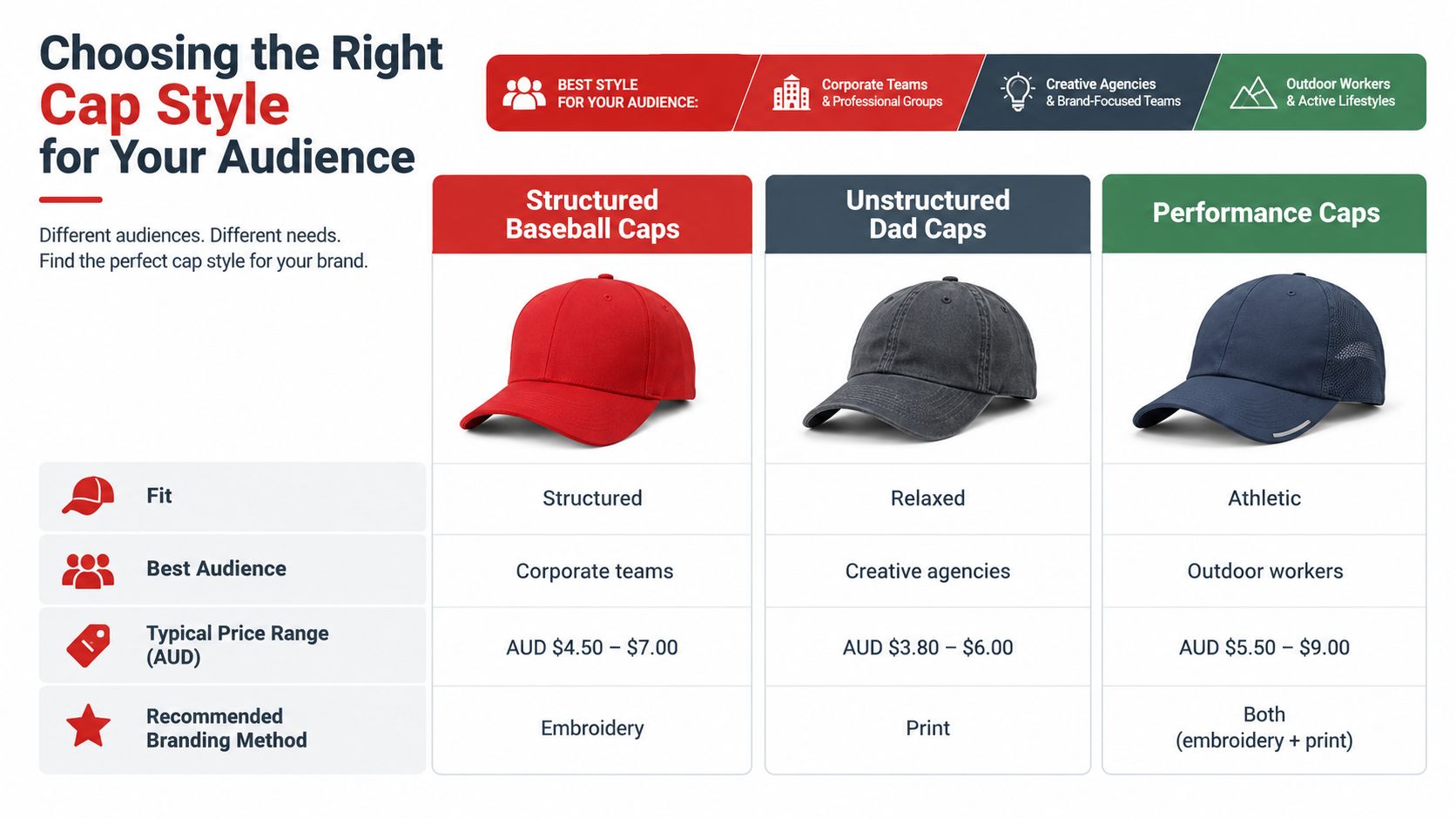
The smartest way to shortlist is to separate structure from use case. A firmer crown keeps a logo looking crisp, but a softer build feels easier to wear for long periods. Mesh-back styles breathe better, but they lean more casual. Fitted closures look clean, snapbacks adjust easily, and velcro closures are practical for mixed-size distribution. None of that matters if the style is wrong for the job.
Choose the cap the wearer will keep on, not the one that looks most “merch” on a product sheet.
If you're building a broader merchandise selection, use this cap decision as part of a wider product shortlisting process, not as a standalone guess. A useful starting point is the supplier's step-by-step promotional product selection guide, because the right headwear choice usually follows the same logic as any other branded item, audience first, then purpose, then decoration.
Materials and Construction That Hold Up in Australia
Fabric choice decides whether a cap feels like kit or clutter. Cotton twill gives a classic hand-feel and takes embroidery well. Cotton-poly blends hold shape better and tend to behave more predictably in day-to-day wear. Performance polyester is the practical pick when moisture management matters, and recycled polyester only deserves the label if you're comfortable with the full-life trade-offs, not just the recycled-content claim.
The end-of-life question is where a lot of “eco” merchandise falls apart. The Australian Government's 2026 National Waste and Resource Recovery Report records 840 kilotonnes of textile, leather and rubber waste in 2024–25, equal to 31 kg per person, with about 95% sent to landfill and a recovery rate of only about 12%. For clothing specifically, it estimates 442 kilotonnes were discarded, with 52% going straight to Australian landfills and only 2% recycled in Australia (National Waste and Resource Recovery Report 2026). That's why a durable cap worn repeatedly can be the more responsible choice than a “greener” cap that gets tossed after one event.
What each fabric is good at
- Cotton twill: Soft feel, reliable embroidery base, good for structured staff caps and everyday promo wear.
- Cotton-poly blends: Better shape retention, steadier washing performance, and a safer choice for uniforms.
- Polyester: Strong for sport and work use, especially where sweat and frequent wear matter.
- Recycled PET blends: Fine when you need a recycled-content story, but don't confuse that with automatic local recyclability.
- Acrylic and wool blends: Better suited to beanies and colder-weather ranges than summer headwear.
If you're sourcing caps for security teams, the standards for durability and neat presentation are similar to the expectations outlined in GM GROUP Services security uniform advice, where consistent appearance and practical wearability matter more than decorative extras. That's the mindset to apply here as well, because a cap that sits well, survives washing and still looks tidy is more valuable than one that only photographs well on day one.
Branding Methods and Where Each One Works Best
Decoration should follow the cap, not fight it. Embroidery is still the safest choice for most structured cotton and poly caps because it looks premium and wears well. Flat embroidery works for clean logos, while 3D embroidery suits bold marks that can handle depth. If your logo is too detailed, too shaded or too fine for stitching, don't force it, move to a print or patch solution.
The wrong branding method makes a decent cap look cheap. Screen printing can be effective on smoother, lighter fabrics when you want bigger artwork without the stitched texture. Heat transfer helps when the logo has multiple colours or fine detail. Sublimation belongs on polyester performance caps where the artwork can be carried into the fabric itself. Woven labels and debossed patches are useful when the surface shape makes embroidery awkward or when you want a cleaner side or back detail.
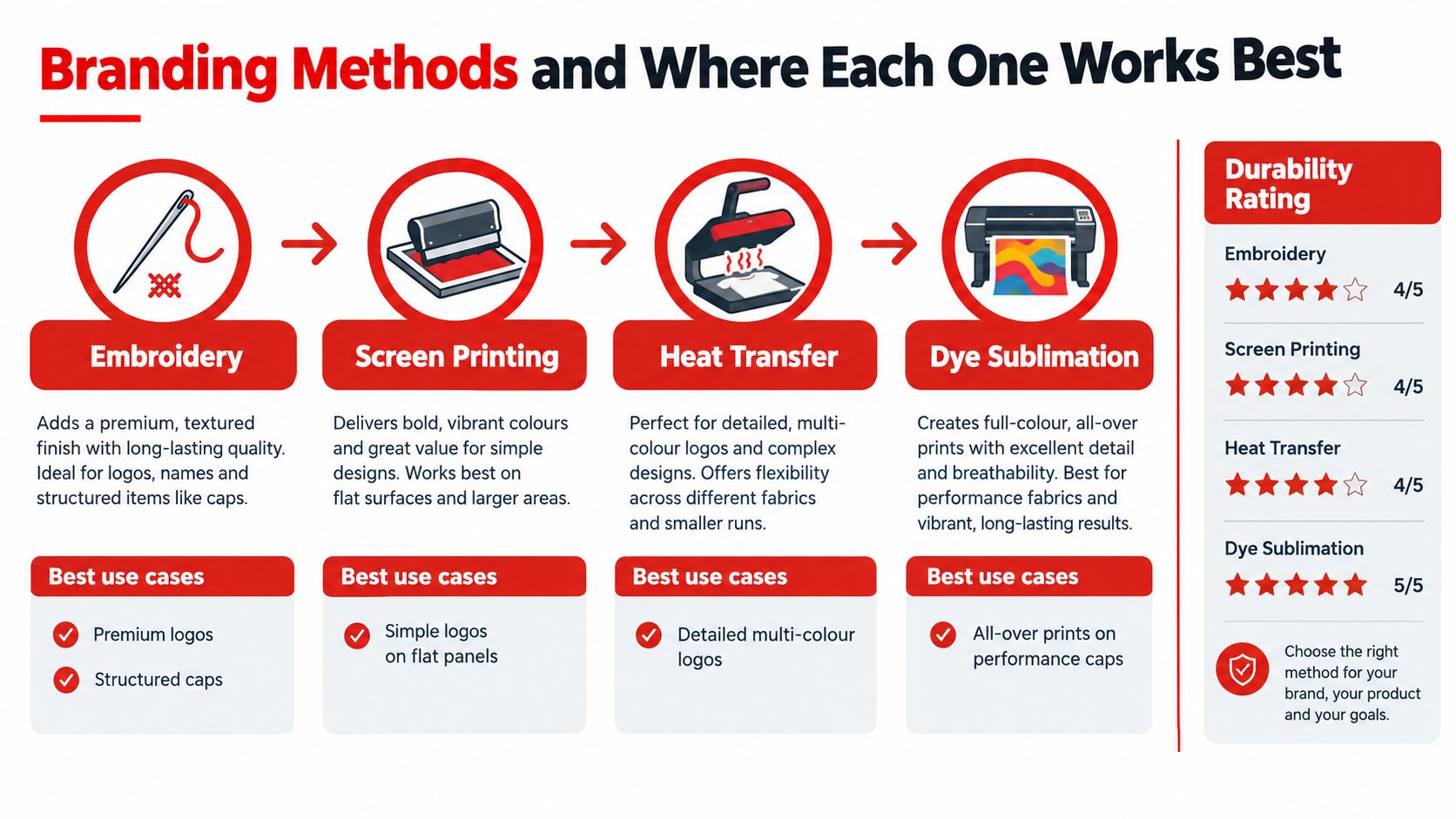
If you want an efficient way to brief a decorator, think in this order. First, identify the cap surface. Then match logo complexity to the method. Finally, decide whether the result needs to feel premium, casual or technical. That avoids the common mistake of designing a logo first and only then discovering the cap can't carry it properly.
A practical place to see how embroidery services are positioned around cap decoration is the supplier's in-house custom embroidery services page. Use that as a reference point, not a substitute for a proper spec sheet, because the embroidery choice still depends on crown shape, stitch count and the finish you want.
For sports sponsorship, club merch and supporter gear, the decision tree is the same. A sponsor logo that is too fine for a cap ends up looking weak, which is exactly why guides like the Vanta Sports sponsorship guide are useful context when you're matching merchandise to a team audience. The cap should reinforce the identity, not dilute it.
Sun Safety, Compliance and the Baseball Cap Myth
A standard baseball cap is a weak choice for Australian outdoor work. It shades the forehead and eyes, but it leaves the ears and neck exposed, which is where heat and UV exposure keep doing damage. For construction crews, schools, sports programs and event staff, coverage has to drive the buying decision, with branding treated as the secondary layer.
Cancer Council Australia says more than 1.2 million Australian workers experience solar UV exposure at levels five to 10 times those of indoor workers, with an estimated 200 melanomas and 34,000 non-melanoma skin cancers caused annually by occupational UV exposure (Cancer Council workplace UV guidance). It also says baseball caps do not provide good sun protection and recommends a brim of at least 7.5 cm, or 6 cm for bucket hats. WorkSafe Victoria identifies a 7.5 cm broad brim as protective for the face, ears, neck and eyes, and says Legionnaire-style caps and bucket hats with a minimum 6 cm brim can provide excellent protection when made from close-weave UPF 50+ fabric (Cancer Council sun-protective clothing guidance). Those are the specifications that should shape your shortlist.
What to ask for in writing
Ask for brim width, fabric construction and test evidence. Don't accept a generic “sun smart” claim without it.
Under AS/NZS 4399:2020, UPF describes ultraviolet transmission through tested material, and UPF 50 or 50+ is classified as excellent protection, permitting roughly 2% or less UV transmission through the fabric (OHS Rep sun protection overview). ARPANSA notes that caps and sun visors can be excluded from UPF clothing labelling when body coverage is inadequate, so a supplier should not call a cap UPF-rated without the right test report and design evidence. If you are ordering for outdoor teams, ask for documentation, set the coverage style in writing, and keep embroidery or a branded front panel in its proper place. It does not make the whole cap sun-safe.
For a wider shortlist of gear suited to outdoor teams, see the supplier's outdoor promotional products range.
The blunt call is simple. If sun coverage matters, a baseball cap is usually the wrong starting point. Use a bucket hat or Legionnaire style for real protection, and choose a conventional cap only when wearability and front-on branding matter more than full coverage. If you need both, define the trade-off clearly so nobody confuses promotional headwear with compliant sun-safe gear.
Quantity, Pricing, Lead Times and Delivery Across Australia
Cap buying gets easier once you stop treating pricing as one flat number. In Australia, the unit price usually falls as quantity rises, because setup costs spread out over a bigger order. The total budget also includes artwork preparation, embroidery digitising or screen setup, freight and, in some cases, express production if the deadline is tight.
| Typical Australian promotional cap order economics | |||
|---|---|---|---|
| Order Size | Typical Setup | Indicative Lead Time | Best Use |
| Small run | Higher setup impact per unit | Longer than stocked bulk orders | Internal teams, pilots, small campaigns |
| Mid-tier order | Setup spread across more units | Standard production window | Trade shows, staff uniforms, clubs |
| Larger run | Lower cost pressure per cap | Often the most efficient timing | Events, onboarding, recurring distribution |
Free freight usually helps most when the order is going to a single address, but it doesn't mean every destination is equally fast. If you're sending caps to Perth, Darwin, Hobart or regional locations, build in extra time because transport legs can stretch. For urgent campaigns, ask about express production before you commit to a date you can't move.
If you want a simple freight reference point, review the supplier's free freight information and then build your own landed-cost view from there. That means thinking about decoration fees, delivery location and whether the order needs multiple drops, not just the headline unit price. Cheap caps with slow freight are not cheap if they miss the event.
A sensible procurement rule is to order to the actual audience count, then add a small buffer only if you know the caps will be reused. Over-ordering “just in case” usually leaves you with boxes of unused stock, and that's where cost turns into clutter.
Ordering Checklist and Sample Brief for Your Supplier
Good cap orders start with a clean brief. If you skip the details, you get proof delays, colour mismatches and decoration problems that could've been avoided in one email. Give the supplier the product type, the exact colours, the quantity by size or fit, the artwork file, the deadline and the delivery address up front.
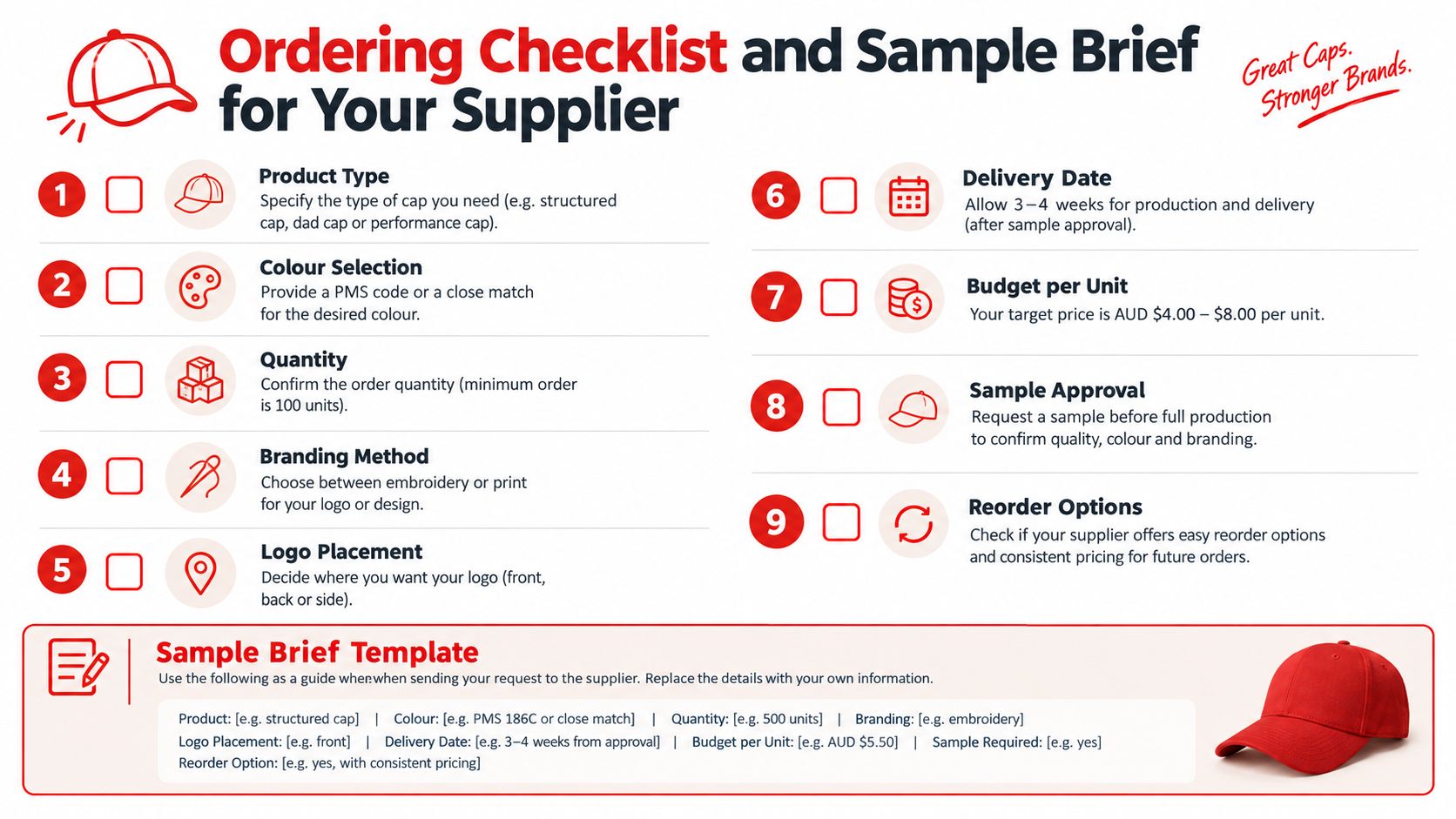
What your brief should include
- Product type: Structured cap, dad cap or performance cap.
- Colour selection: PMS code or closest fabric match.
- Quantity: Split by sizes or closure type if needed.
- Branding method: Embroidery, print, patch or transfer.
- Logo placement: Front, side, back or multiple positions.
- Deadline: Allow enough time for proofing and delivery.
- Compliance needs: UPF documentation, if sun protection matters.
- Artwork contact: One person who can approve proofs quickly.
Ask the supplier about thread colours, sample policy, artwork revisions, proof photos of the finished piece, defect replacement policy and storage instructions on arrival. That sounds basic because it is basic, and basic mistakes cost money. If the logo file is messy, send it through the supplier's artwork submission tips guide before production starts.
Sample brief: “Please quote 300 structured cotton-poly caps in navy with white embroidery on the front, logo supplied as vector artwork, delivery required to Melbourne by the agreed date, with UPF documentation if a sun-protective style is proposed. Please confirm proof timing, decoration method and replacement policy for defects before production.”
Matching Caps to Use Cases and Bringing It Together
Pick the audience and environment first, then the decoration, then the price. That order saves money and gets you a cap that people will wear. Trade show giveaways usually work best with mid-tier cotton caps and bold embroidery. Staff uniforms need structured six-panel cotton-poly caps in brand colours. Outdoor crews and school sport should move straight to Legionnaire or wide-brim bucket styles in UPF 50+ fabric. Winter campaigns belong in beanies. Sustainability-led campaigns should favour durable, repairable caps ordered to realistic quantities over one-off throwaways.
The decision framework is simple. If the cap is mainly for visibility, choose a style that looks sharp and holds a logo well. If it needs to stand up to sun, choose coverage first and branding second. If the campaign is meant to last, choose construction and repeat wear over novelty. That's how you get real value from promotional caps Australia-wide.
If you want cap recommendations that are built around coverage, wear life and proper branding, talk to Simply Merchandise about the use case before you lock in the style. They supply custom promotional caps, embroidery and print options, and can help you match the right cap to your campaign, budget and deadline. Visit Simply Merchandise and brief your next order with fewer surprises.

