
When you're running a small business, every bit of marketing counts. Promotional items are those handy, tangible products you see everywhere—pens, tote bags, drink bottles—all carrying a company's logo. Their purpose? To boost brand awareness and keep customers coming back. Unlike a digital ad that vanishes with a click, these items stick around, becoming a physical reminder of your business in a customer's daily life.
Why Physical Products Still Win
In a world filled with digital noise, a real, physical item can make a genuine connection. Don't think of it as just a freebie; a well-chosen promotional product is like a brand ambassador that works for you 24/7. It's a business card that actually gets used, living on your customer's desk, in their car, or at home.
A quality drink bottle or a sturdy tote bag can generate thousands of impressions over its lifetime. Every time it's used, it subtly reinforces who you are and builds a positive feeling about your brand. This constant, gentle presence fosters loyalty in a way a fleeting pop-up ad never could. To get a better sense of how traditional methods break through the digital clutter, it’s worth exploring the power of banners for advertisement.
The Tangible Advantage
This isn't just a gut feeling—the numbers tell the same story. The promotional products industry in Australia is a massive, AU$2 billion a year sector. That figure alone shows just how much local businesses believe in and get back from their investment.
Studies have found that a staggering 76% of people can remember the brand on a promotional item they've received. What's more, over half of them keep that item for more than a year. This simple act turns a low-cost product into a long-term marketing machine, delivering what many consider one of the most cost-effective marketing channels out there.
The real power of a promotional item is its utility. When you give someone a product they actually use, you’re not just giving them an advertisement—you’re giving them a solution to a small, everyday problem, with your brand attached.
This idea of providing real-world value is key. By focusing on high-quality, genuinely useful https://simplymerchandise.com.au/pages/branded-merchandise-for-business, you're not just advertising; you're building a relationship. The goal is to become a helpful, integrated part of your customer's routine, ensuring your brand is the first one they think of when they need what you offer.
Connecting Promotional Products to Your Business Goals
Choosing the right promotional items isn't about flicking through a catalogue and picking whatever looks good. The best, most effective campaigns always start with a simple question: "What are we actually trying to achieve here?" Answering that first is what turns a branded giveaway from a simple cost into a powerful marketing tool.
Every dollar you put into merchandise should be working towards a specific, measurable result. Without a clear goal, you're just throwing things at the wall and hoping something sticks. Your objective is your compass, guiding every decision you make, from the type of product you choose to how much you spend and who you give it to.
Define Your Objective First
Before you even think about pens or t-shirts, you need to nail down your main goal. Are you just trying to get your name out there in the local community? Or are you looking to build much deeper relationships with your top clients? Each of these goals requires a completely different approach and a different kind of product.
Most small business goals fall into one of these buckets:
- Boosting Brand Awareness: Getting more people in your area to recognise your name and know what you do.
- Generating New Leads: Capturing the details of potential customers at places like trade shows or community events.
- Increasing Customer Loyalty: Showing your repeat customers some love to keep them coming back and turn them into brand champions.
- Rewarding Employees: Acknowledging your team's hard work to boost morale and create a great company culture.
- Launching a New Product or Service: Building some excitement and educating people about your latest offering.
Once you know exactly what you’re aiming for, you can start matching the right promotional items to that mission. This strategic thinking is what separates a giveaway that gets forgotten from one that becomes a genuine brand-building asset.
Matching Promotional Products to Your Marketing Goals
To help you connect the dots, this table lays out some common business goals and the types of products that work best to achieve them. It's a quick reference to ensure your choice makes sense for your strategy.
| Business Goal | Recommended Product Category | Example Items (from Simply Merchandise) | Why It Works |
|---|---|---|---|
| Mass Brand Awareness | High-Volume, Low-Cost Items | Branded Pens, Keyrings | These are budget-friendly, easy to distribute widely, and get your logo in front of a lot of eyes quickly. |
| Lead Generation | Useful & Relevant Tools | Tote Bags for trade shows, Note Pads for seminars | People are more likely to give you their details in exchange for an item they'll actually use. |
| Customer Loyalty | Premium & Thoughtful Gifts | High-End Drink Bottles, Branded Jackets | A high-quality gift shows appreciation and makes your best customers feel truly valued. |
| Employee Recognition | High-Quality Desk or Lifestyle Items | Engraved Power Banks, Coffee Mugs | Practical, quality items for the office or home serve as a constant, positive reminder of the company's appreciation. |
At the end of the day, the goal is to make a smart choice that resonates with your audience and pushes you closer to your business objectives.
Let's break this down with a real-world example. Imagine your goal is mass brand awareness at a local footy match. You'll want to focus on high-volume, low-cost items that are easy to hand out to hundreds of people. Think practical things like branded pens, keychains, or maybe even silicone wristbands. The name of the game here is quantity and visibility—getting your logo into as many hands as possible.
Now, let's flip the script. Say your goal is to strengthen relationships with your five most important clients. Giving them a cheap pen would feel impersonal and could even do more harm than good. For this, a premium, high-quality gift is the only way to go. A beautifully engraved power bank, a high-end insulated jacket, or a deluxe notebook set all send a powerful message: "We value you and your business."
The item you choose is a physical representation of your intention. A low-cost, high-volume product says, "We're here and ready to help everyone," while a premium, targeted gift says, "We deeply value your partnership."
This simple flowchart can help you gut-check your decision and see if you're on the right track.
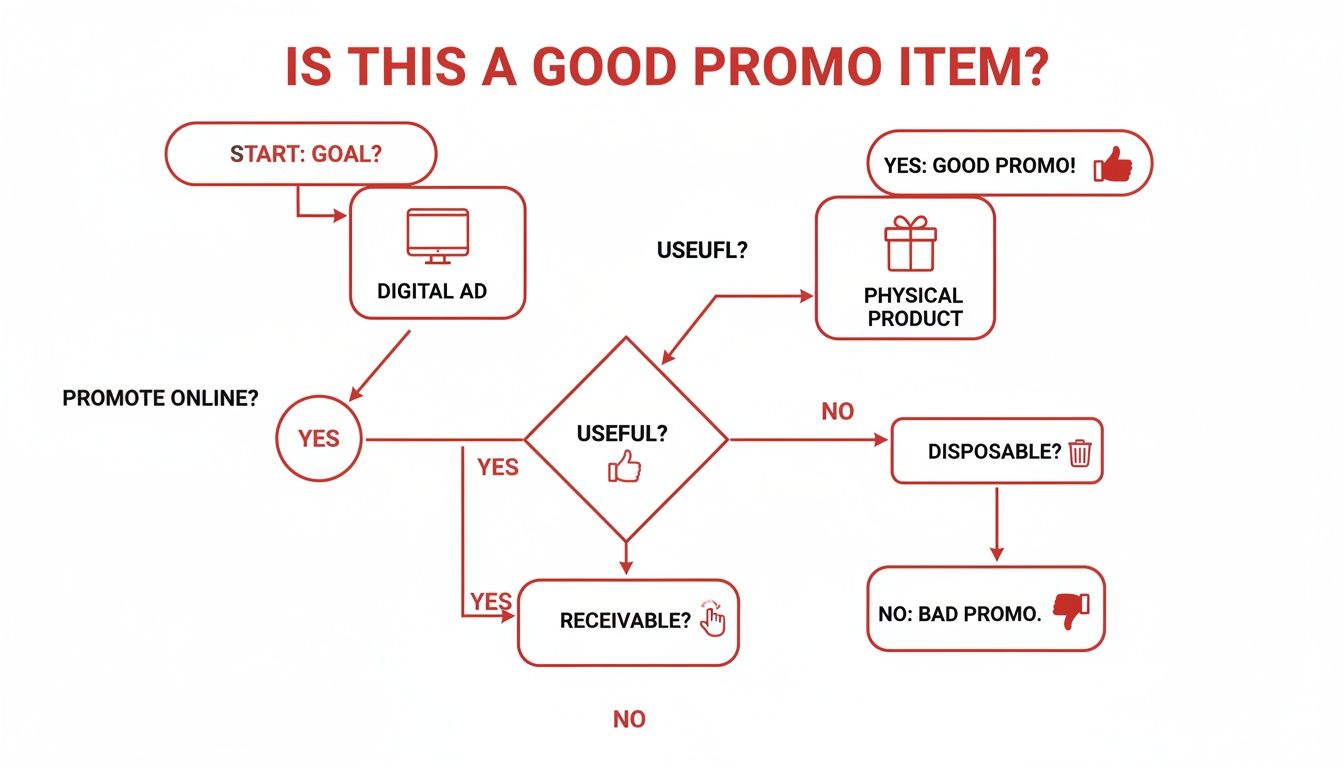
The key takeaway is pretty simple: the item’s perceived value and genuine usefulness have to line up perfectly with your business goal and the person you're giving it to.
A Framework for Strategic Selection
To make this crystal clear, let's map out a few more scenarios. A real estate agent who wants to generate leads at a home and garden show could hand out branded tape measures. It’s a genuinely useful, relevant tool that potential clients will hang onto and use, keeping the agent’s brand top-of-mind every time they start a new project.
Likewise, a tech startup launching a new app could give away branded phone grips. It’s an item that’s directly related to their industry and offers immediate, practical value to their target audience. When you start with your goal, you ensure the product you choose does the heavy lifting for you, creating a lasting impression that drives real business results.
Choosing Products Your Customers Will Actually Use
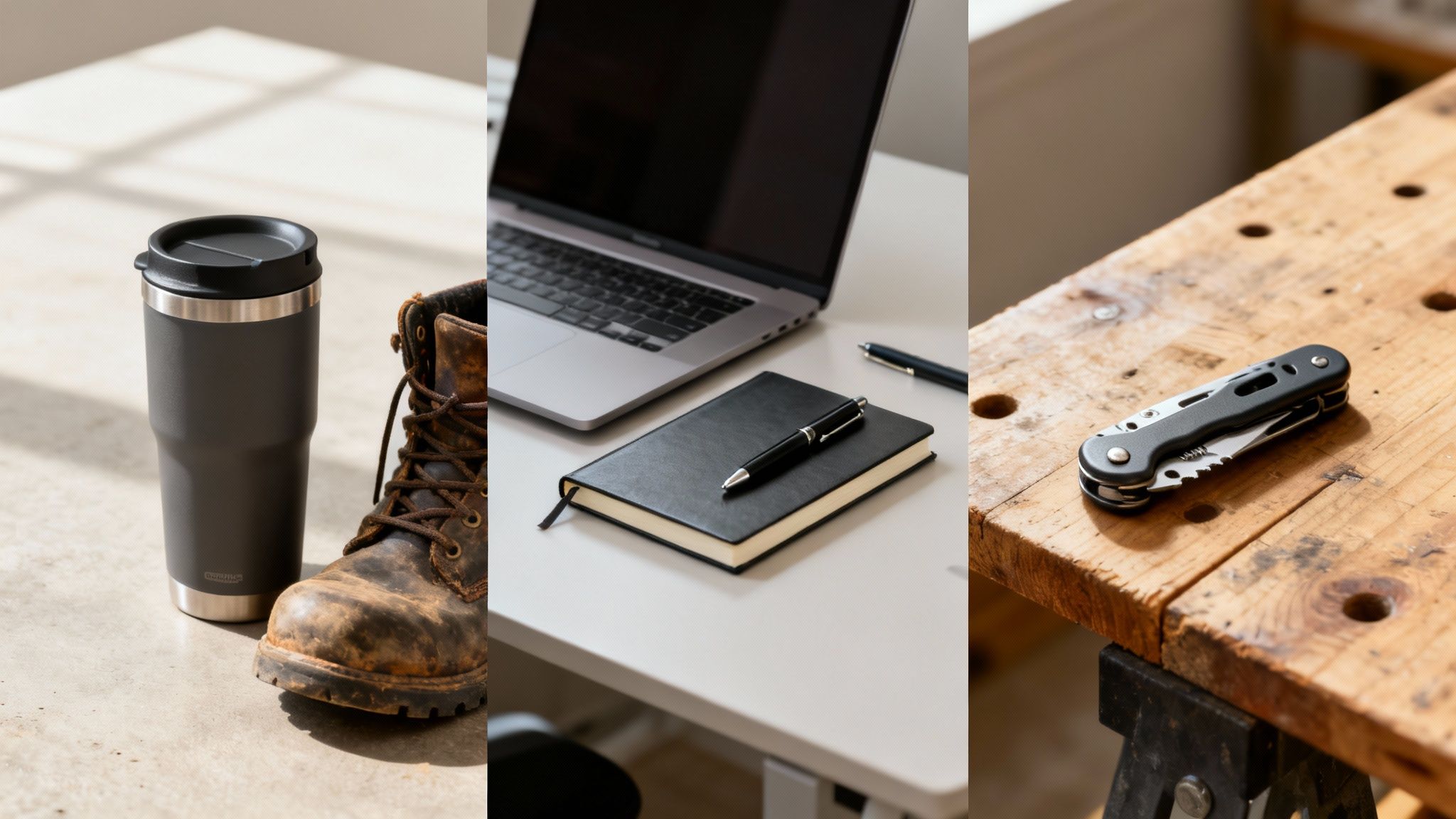
The real measure of a promotional item isn’t its price tag or how trendy it is. It's whether it actually gets used. Think about it: a genuinely useful product earns a spot in your customer's daily life, acting as a constant, subtle reminder of your brand. If it doesn't solve a problem or fit into their routine, it's destined for the bin or the back of a cluttered drawer.
To avoid that fate, you need to stop guessing and start thinking like your customer. What are the small, everyday challenges they face? A promotional product that offers a practical solution, no matter how small, creates a positive feeling about your brand every single time they use it.
This is the secret sauce. Moving from a simple giveaway to a genuinely helpful tool is what makes your brand memorable long after that first handshake.
Aligning Products with Audience Lifestyles
Knowing your customer's world is everything. A tradie out on a work site from dawn till dusk has completely different needs than a professional sitting in an office. A one-size-fits-all approach just doesn't work; you have to tailor your choices to their specific environment.
For someone in the construction industry, for example, a tough, insulated travel mug that keeps their coffee piping hot for hours is a game-changer. A multi-tool on a keyring or a high-vis beanie also offers immediate, real-world value. These items aren't just branded merch; they become part of the daily toolkit.
On the other hand, an office worker would likely get more mileage out of a sleek notebook and a quality pen. You can find everything from classic to modern when you explore the world of promotional pens to match your brand's professional vibe. A portable power bank for charging a phone between meetings is another great example of solving a modern office problem.
When you walk through these daily scenarios in your head, you'll find items that feel less like advertising and more like a thoughtful, useful gift.
Quality is a Reflection of Your Brand
The quality of your promotional item says a lot about your own business. If you hand out a cheap, flimsy product, you're subconsciously telling people that your own services might be low-quality too. It's a direct reflection of your reputation.
Think about it: a premium brand would never put its logo on something that's going to fall apart after a few uses. That just creates a bad experience and can do more harm to your brand than giving nothing at all. Investing in quality ensures your merchandise stands the test of time, just like your business aims to.
The durability of your promotional product is directly linked to the longevity of your brand message. A well-made item that lasts for years provides thousands of positive impressions, reinforcing brand trust with every use.
This doesn't mean you have to buy the most expensive thing on the market. It just means choosing a product that's well-made, reliable, and does its job properly. It's far better to give a smaller number of high-quality items to a targeted audience than to hand out thousands of cheap trinkets that are headed straight for landfill.
The Power of Everyday Utility
At the end of the day, genuine, everyday usefulness is what makes promotional products stick. The ultimate goal is to become a go-to item in your customer's routine. When your branded mug is the first one they reach for in the morning, you've won.
When you're weighing up your options, think about these three key factors:
- Problem-Solving: Does it solve a common headache? A branded umbrella on a miserable, rainy day or a handy tote bag for an unplanned grocery stop are perfect examples.
- Frequency of Use: How often will they see and use it? Things like keyrings, phone grips, and coffee mugs get daily use, which means maximum brand exposure.
- Visibility: Where will the item be used? A branded cap or jacket worn out and about generates far more impressions than a desk calendar that only one person sees.
By putting usefulness first, you make sure your promotional product becomes a welcome part of your customer's life, not just more clutter. This is how you build lasting brand recall and a loyal following, one helpful item at a time.
What’s Trending in Branded Merchandise?
To really connect with people, your promotional items need to feel current and thoughtful. Gone are the days of handing out forgettable trinkets that end up in the bin. The world of branded merch is always evolving, and understanding what's happening right now is your key to standing out.
Two massive trends are defining the industry today. First, there's a big move away from cheap, throwaway items towards high-quality products that are genuinely useful and built to last. Second, and just as important, is the booming demand for sustainable, eco-friendly options. Getting a handle on these shifts will help you make a much smarter investment.
Quality Over Quantity is the New Standard
The old strategy of flooding a trade show with thousands of cheap pens is officially over. Today’s customers are savvy; they'd much rather receive one fantastic item they’ll actually use every day than a bag full of flimsy giveaways. The goal has shifted from fleeting visibility to making a lasting, positive impression.
When you hand someone a premium item—like a well-made insulated flask or a durable tech gadget—it says something powerful about your brand. It quietly communicates that you stand for quality and that you value them as a customer. This approach isn't just about creating walking billboards; it's about turning happy recipients into genuine brand advocates.
A well-made promotional product becomes a trusted part of someone’s daily routine. It’s a constant, positive reminder of your brand’s reliability and commitment to excellence, building loyalty with every use.
The numbers back this up. Recent Australian insights show a 25% spike in demand for premium branded goods, proving people want fewer, better things. For small businesses, this is a golden opportunity to make an impact that truly sticks. For more information, you can discover the latest promotional product prospects in Australia.
The Unstoppable Rise of Eco-Friendly Choices
Right alongside the demand for quality is an equally strong push for corporate responsibility. People, especially younger generations, are incredibly loyal to brands that share their values. Choosing sustainable promotional items isn't a niche tactic anymore—it’s one of the best ways to show you’re a business that cares.
This means looking for products made from recycled, renewable, or biodegradable materials. Think about items like:
- Reusable Coffee Cups: The perfect daily companion that tackles single-use waste head-on.
- Recycled PET Tote Bags: Practical, durable bags made from old plastic bottles that carry a powerful green message.
- Bamboo Notebooks and Pens: A stylish and sustainable swap for traditional paper and plastic.
- Wheat Straw Drink Bottles: An innovative, earth-friendly material that’s surprisingly tough.
Offering an eco-friendly product tells a story about your brand without you saying a word. It shows a commitment to sustainability that attracts customers and employees who feel the same way. It's about building a brand for the future and connecting with an audience that rewards businesses for doing the right thing. This isn't just a feeling; Australian figures show a massive 30% surge in demand for eco-conscious merchandise.
By embracing these trends, you're positioning your brand as modern, thoughtful, and in sync with what people value today. You can explore a huge variety of products that tick these boxes by checking out this curated collection of eco-friendly promotional items. Making a conscious choice here helps you build a stronger, more authentic connection with your community.
A Practical Guide to Artwork and Branding Methods
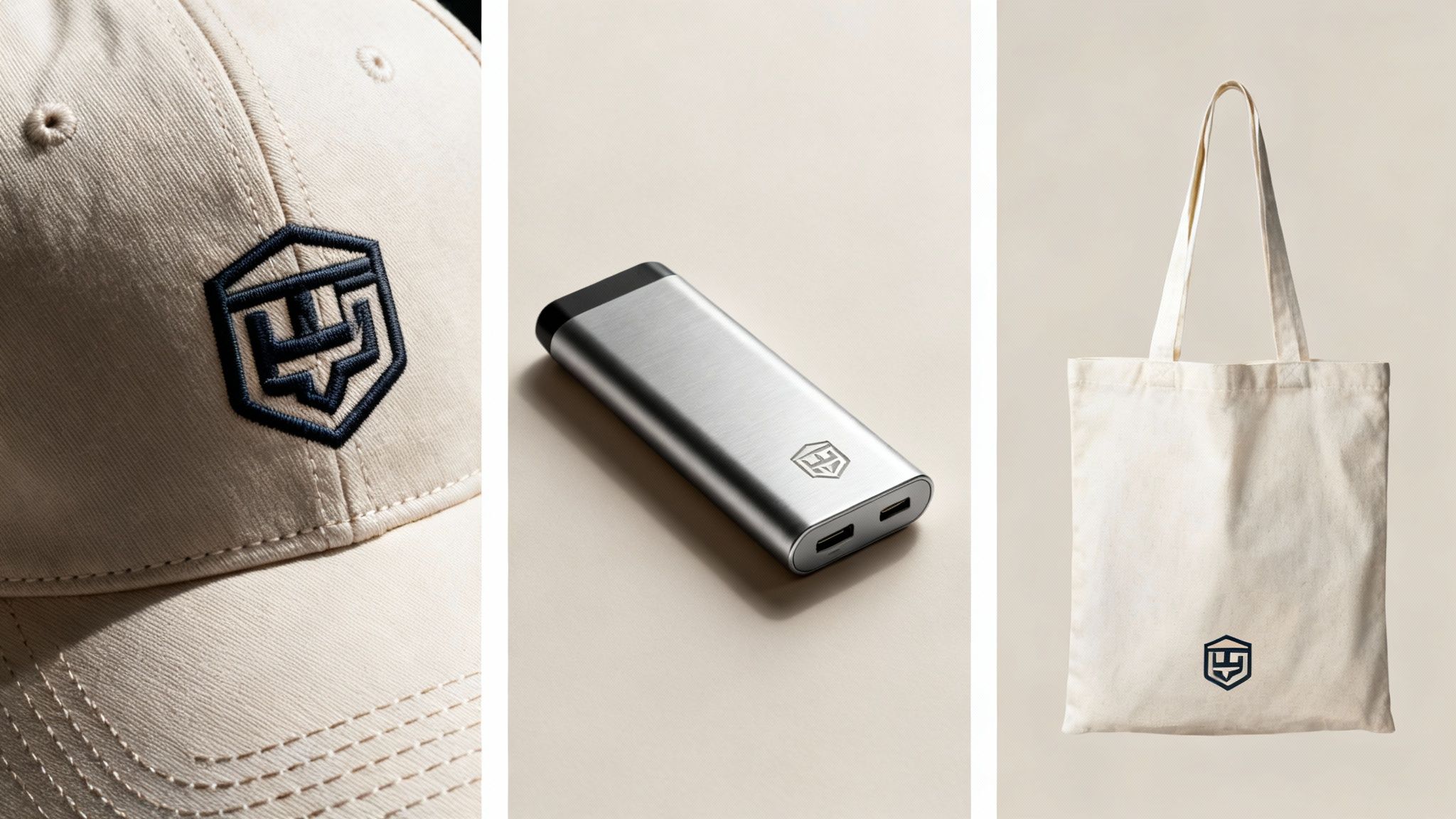
You’ve found the perfect product. That’s a great start, but the real magic happens when your logo and message are applied. This final step—the branding—is what turns a simple item into a memorable piece of marketing.
The right technique makes your design look crisp, professional, and built to last. It’s a bit like cooking; you wouldn't bake something you’re meant to fry. The branding method has to suit the product's material, otherwise, the result just won't work. Getting this right is what makes your promotional items for small business feel premium.
Matching the Method to the Material
Every branding technique has its own strengths and is designed for specific surfaces. Knowing the basics will help you feel confident that you’re making the right call for your merchandise.
Here are the most common methods you’ll come across:
- Screen Printing: This is the absolute classic for fabrics like t-shirts and tote bags. Ink is pushed through a custom screen onto the item, creating a bold, vibrant design that holds up well. It's incredibly cost-effective for large runs, especially for logos with just one or two colours.
- Embroidery: For a high-end, textured finish on things like caps, polo shirts, and jackets, you can’t beat embroidery. Your logo is stitched directly into the fabric, giving it a professional, three-dimensional feel that’s exceptionally durable.
- Laser Engraving: When you need a sharp, permanent mark on hard surfaces—think metal, wood, or glass—laser engraving is the way to go. It etches your design with incredible precision for a subtle, sophisticated look that will never peel or fade. Perfect for premium pens, keyrings, and insulated drink bottles.
- Digital Printing (DTG): Imagine an industrial-strength inkjet printer, but for clothes. Direct-to-Garment (DTG) printing is brilliant for complex, full-colour designs with gradients and photos on items like t-shirts.
Each method gives a totally different look and feel, so your choice should reflect both the item itself and the brand image you want to create.
Preparing Your Artwork for a Perfect Finish
To get that razor-sharp, professional look, the quality of your artwork file is everything. Sending the right file type is like giving a builder a detailed blueprint instead of a napkin sketch—it guarantees a flawless result.
The key thing to understand here is vector vs. raster.
A raster image (like a JPEG or PNG) is built from tiny dots, or pixels. When you try to make it bigger, it gets blurry and jagged. But a vector file (like an AI, EPS, or SVG) is made from mathematical lines and curves. This means it can be scaled to any size, from a tiny logo on a pen to a giant trade show banner, without losing a shred of quality.
For almost every branding job, a vector file of your logo is the gold standard. It’s the only way to guarantee your design stays perfectly crisp, no matter what you put it on.
If all this file talk sounds confusing, don't stress. Many suppliers, including us at Simply Merchandise, have designers who can help sort it out. For a deeper dive, our simple guide is a great place to start. You can learn more by checking out our artwork submission tips for beginners.
Final Checks Before You Hit 'Print'
Once your artwork is sorted and you’ve chosen a branding method, there are a couple of final details to nail down. Colour matching is a big one; the colours on your screen can look quite different in real life. Using Pantone (PMS) colour codes helps ensure your brand colours are spot-on every single time.
Finally, always, always ask for a digital proof or mock-up before production starts. This is your chance to see exactly how your logo will look on the item and make any last-minute tweaks. It’s a simple step that prevents any nasty surprises and ensures you’ll be absolutely thrilled with the finished product.
Budgeting and Measuring Your Campaign's Success
Investing in promotional products is a fantastic move, but like any marketing effort, you need a solid financial plan and a clear way to see if it’s actually working. This is where we turn your campaign from a hopeful expense into a smart, data-backed strategy that delivers a genuine return on investment (ROI).
First things first: you need a realistic budget. This isn't about plucking a number out of thin air. It’s about understanding the moving parts that make up your total spend. Think of it like planning a big road trip—you wouldn’t just start driving without knowing the distance, the fuel cost, and how many people you're bringing along.
Mastering Your Merchandise Budget
When it comes to promo gear, your budget really boils down to two key things: unit cost and total quantity. The unit cost is what you pay for a single item, and the total quantity is simply how many you need. A lower unit cost lets you get your brand in front of more people, while a higher unit cost might be perfect for a premium gift aimed at a smaller, high-value audience.
The good news? These two numbers are directly linked. Ordering in bulk can slash your per-unit cost in a big way. Grabbing 500 pens instead of 100 could bring the price per pen down dramatically, stretching your marketing dollar much further. It always pays to check the price breaks at different quantities to find that perfect sweet spot for your budget.
A well-planned budget isn't a restriction; it's a tool that empowers you to make strategic decisions. By understanding unit costs and order quantities, you can maximise your campaign's reach and impact without overspending.
If you’re not sure where to begin, getting a handle on the costs is easy. You can see exactly how different products and order sizes will fit into your plan by getting a detailed quote. To make your planning a breeze, feel free to request a quote from Simply Merchandise and get a precise picture of your potential investment.
Turning Giveaways into Measurable Channels
Alright, so you’ve handed out all your fantastic merch. How do you know if it did anything? This is the step where so many businesses miss a massive opportunity. With a bit of forward thinking, your promotional products can become a trackable marketing channel, giving you cold, hard data on their effectiveness.
The secret is to give people a specific, measurable action to take. Instead of just slapping your logo on a mug, add a simple call-to-action that you can actually monitor. This simple trick turns a physical object into a digital gateway, letting you see exactly how many people engaged with your brand because of that item.
Here are a few easy but powerful ways to track your ROI:
- Unique QR Codes: Pop a QR code on your item that links to a special landing page on your website. This page could offer an exclusive discount, a free download, or entry into a giveaway. You can then use your website analytics to see precisely how many visits that page got.
- Exclusive Discount Codes: Print a unique code right on your merchandise, something like "TOTE15" for 15% off. When customers punch in that code at checkout, you can count every single sale that came directly from your promotional campaign.
-
Custom URLs: Create a simple, memorable URL (like
yourbusiness.com.au/offer) that you only print on your promotional items. This makes it dead simple to track website traffic coming specifically from people who received your merch.
Beyond just crunching the numbers for your budget, it's vital to track and evaluate your efforts properly. It's well worth learning more about the key strategies for measuring marketing campaign success to ensure your investment is delivering real results.
By using these simple tracking methods, you start gathering invaluable data that proves your campaign’s worth. You’re no longer just hoping it paid off; you have the numbers to back it up. This data-driven approach helps you refine your strategy for the next time around, making each campaign even better and ensuring your promotional items for small business become a reliable part of your growth engine.
Got Questions About Promotional Items? We've Got Answers.
Even with a solid plan, it’s normal to have a few practical questions when you’re getting started with branded merchandise. Here are some straightforward answers to the questions we hear most often from small business owners, designed to give you the confidence to get going.
How Much Should a Small Business Really Budget for This?
There’s no magic number here—it really all comes back to what you want to achieve. The good news is you can launch a really effective, targeted campaign for just a few hundred dollars.
The trick is to stop thinking about the total spend and start thinking about the cost-per-impression. A $3 tote bag that your customer uses every week for a year? That’s delivering incredible value long after you've paid for it. The focus should always be on finding useful, high-impact items that make sense for your budget, whether you’re gearing up for a local fete or putting together some premium gifts for your best clients.
What if My Logo Isn't Professionally Designed?
This is a really common hurdle for new businesses, but it's an easy one to clear. Most good suppliers, including us here at Simply Merchandise, will have in-house designers who can help. They usually offer complimentary artwork services and will tweak the design until you’re completely happy with it.
Just send them the logo file you have, even if it's a basic version. Their team will create a professional digital mock-up for you, which shows you exactly how your logo will look on the actual products before anything goes to print. No surprises.
There Are So Many Products! How on Earth Do I Choose?
It can feel a bit overwhelming, can't it? The best way to cut through the noise is to go back to basics: your audience and your goal. Who are you actually trying to reach, and what do you want them to do or feel? The right promotional item is always one that solves a real problem or fits naturally into your ideal customer's life.
Think about their daily routine. Are they glued to a coffee cup all morning? Do they work outdoors? Are they constantly heading to conferences? Just answering that one question can shrink a list of thousands of options down to a handful of perfect ones.
And if you’re still stuck, just ask your supplier. A good partner will be able to give you suggestions based on what works for other businesses in your industry.
What’s a Minimum Order Quantity and Why Is It a Thing?
A Minimum Order Quantity (MOQ) is simply the smallest number of a specific item you can order. MOQs exist because there are real, fixed costs involved in setting up the branding machinery—whether it’s for screen printing, embroidery, or engraving.
Spreading that initial setup cost across a batch of items is what makes the price for each one affordable. Thankfully, you'll find heaps of products with low minimums these days, making them a great fit for small business budgets.
Ready to find the perfect promotional items for your business? The team at Simply Merchandise is here to walk you through it all, from picking the right product to getting your artwork spot-on. Explore our extensive range and get a free quote today!