



You're coordinating a Sydney trade show, helping a school organise a sports day, and preparing client gifts for a Melbourne office. Lip balm could suit all three, but each campaign has a different audience, setting and level of compliance risk. Before you approve a logo or ask for a quote, decide what kind of balm you need and what claims its packaging can safely make.
Promotional lip balm can earn a place in a conference bag, welcome pack or uniform pocket because it's compact and useful beyond the event itself. This buyer's guide will help you match the product to the occasion, check the labelling and regulatory details, and brief a supplier without treating the job as just another print run.
When Lip Balm Becomes the Perfect Aussie Campaign Giveaway
A marketing manager in Sydney is preparing for a trade show. The team needs a small giveaway that's easy to hand out, fits neatly into a conference bag and keeps the brand visible after visitors leave the stand. Lip balm makes sense here as a practical companion to the event, not just another piece of paper that gets discarded.
Across the country, a Perth school is organising a sports day. A simple balm could fit into a student or volunteer pack, but the organiser should first consider whether the product's ingredients, claims and intended use suit the school community. The answer may be different from the Sydney trade show, even if both teams are ordering branded tubes.
In Melbourne, a business is sending a thank-you gift to clients. A more considered presentation might make the balm feel like a useful addition to a gift pack rather than a low-effort giveaway. The logo, flavour and packaging all need to suit the relationship the business wants to maintain.
These examples show why promotional lip balm is a flexible campaign item. It travels well in a pocket, tote or welcome pack, and it can work across business events, education programs and customer gifting. It's also easy to pair with other items. For a broader event pack, organisers can compare it with sweets and lollies for branded gifting.
If you're coordinating multiple campaigns, looking at Social Cloud's campaign offerings can help you think beyond the giveaway itself and consider how each item fits into the larger experience. The product choice still needs to start with the audience and setting.
The important catch is that not every lip balm is as straightforward to distribute nationwide as it looks. SPF claims and therapeutic wording can change the compliance picture. Treat the order as a procurement decision first, then a branding job.
How Australia Regulates Promotional Lip Balm
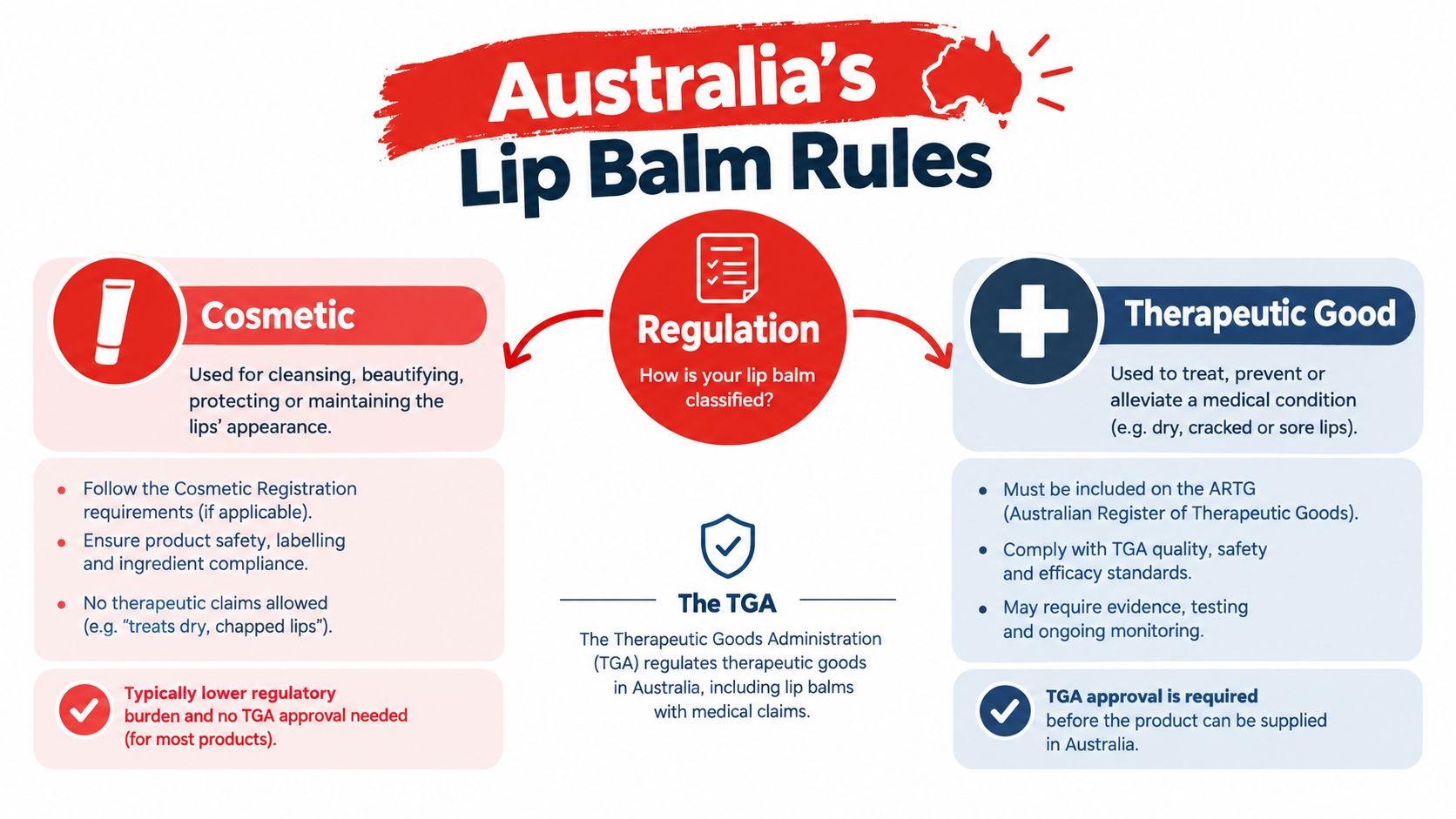
The key question isn't whether the product is called lip balm. In Australia, its regulatory classification depends on its primary use, ingredients and marketing claims. A product presented mainly to moisturise or condition lips may sit within the cosmetics framework. Claims about treating chapped lips, preventing disease or providing therapeutic protection can point towards regulation as a therapeutic good.
The Australian Industrial Chemicals Introduction Scheme's guidance on cosmetics and therapeutics identifies lip balms containing SPF sunscreen as examples of cosmetics when they meet the requirements of the Therapeutic Goods (Excluded Goods) Determination 2018. That doesn't mean every SPF balm is automatically a cosmetic. Products presented primarily for UV protection, or marketed with therapeutic claims, may instead fall under the Therapeutic Goods Administration.
Check the product, then check the claims
Before requesting artwork, ask the supplier to confirm the exact formula, SPF status and likely classification. If the balm is regulated as a therapeutic good, it generally needs to be entered in the Australian Register of Therapeutic Goods (ARTG) before import, supply or advertising, unless an exemption or other authorisation applies. The regulatory framework is grounded in the Therapeutic Goods Act 1989 and Therapeutic Goods Regulations 1990.
Claims matter. “Moisturises lips” describes a cosmetic function. “Prevents sun damage” makes a more consequential claim and should not appear in campaign copy unless the product's regulatory status supports it. The regulator's information on sunscreen cosmetics explains the relevant conditions for lip products containing sunscreen at SPF 4 or higher, while therapeutic sunscreens have additional requirements.
| Balm type | Likely classification | Buyer action |
|---|---|---|
| Plain moisturising or flavoured balm | May sit within the cosmetics framework | Confirm formula and use restrained cosmetic claims |
| SPF lip balm meeting excluded-goods requirements | May be treated as a cosmetic sunscreen product | Obtain Australian compliance documents and verify permitted claims |
| Balm promoted for therapeutic protection or treatment | May be regulated as a therapeutic good | Confirm ARTG status or applicable authorisation before supply |
Practical rule: Don't approve campaign wording based on a product name or supplier catalogue description. Get the compliance details for the exact balm you're ordering.
Lip Balm Formats, Materials and Flavour Profiles
Choose the format around how people will carry and use it. A twist-up tube is familiar and easy to apply without touching the product. A slim stick takes up little space, which suits event packs where every item needs to fit. Pots and tins can offer a different look, but recipients apply the balm with a finger, so they're less convenient when people are on the move.
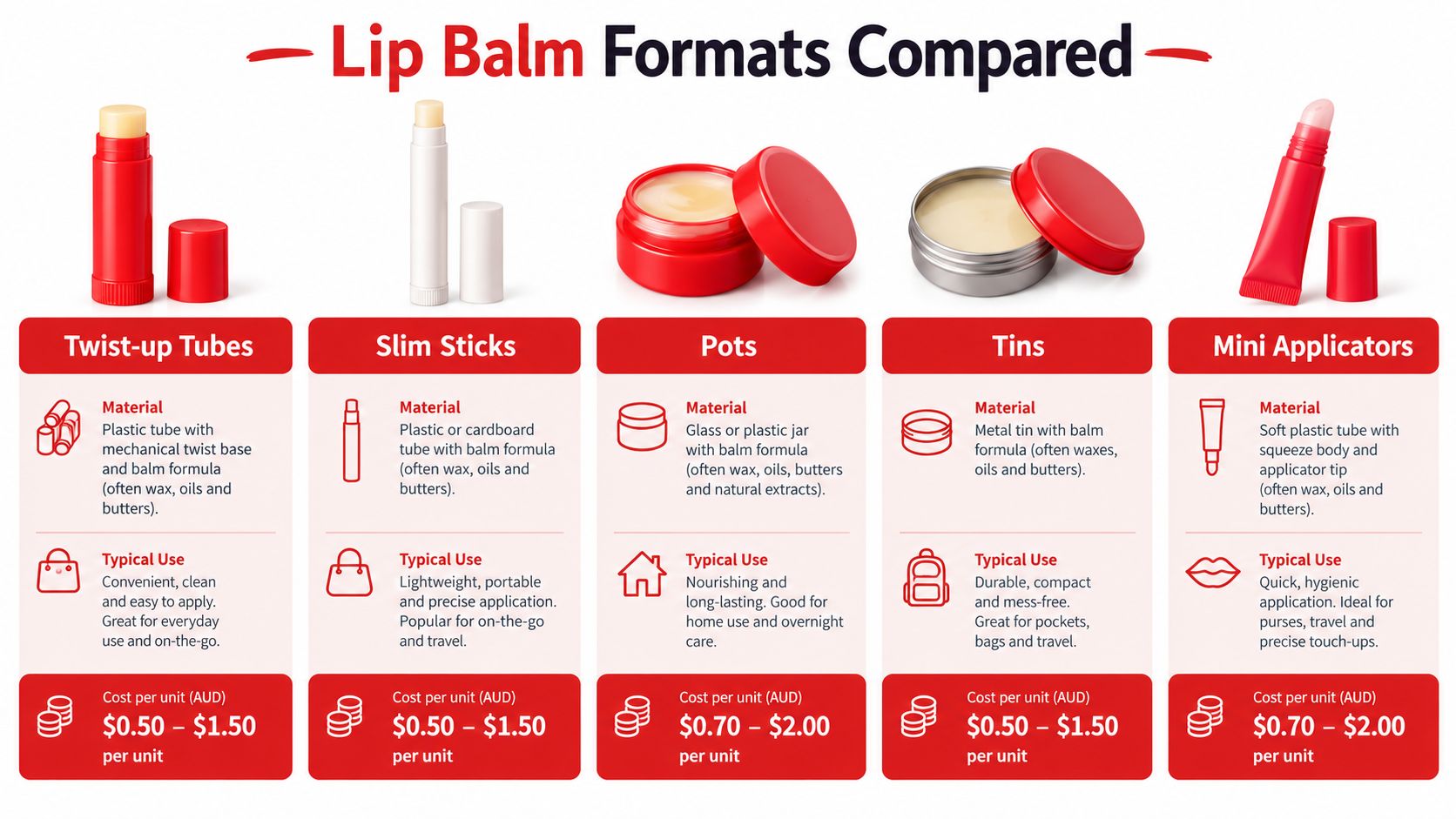
Packaging also shapes what you can do with the branding. A small tube is easy to distribute, but its curved surface and limited label area restrict the amount of information and artwork it can carry. A tin gives you a flat lid to brand, though that doesn't automatically make it feel more premium. Mini applicators can suit a lightweight giveaway, but compact packaging leaves less room for the product label.
Match the formula to the audience
Materials influence the product story as well as the feel. Petroleum-jelly-based formulas are familiar to many recipients. Beeswax offers a different ingredient profile, while plant-based waxes may suit buyers seeking vegan options. Don't rely on a marketing label alone: ask the supplier for the formula and documentation that backs any ingredient or sustainability claim.
Flavour can also affect acceptance. Mint, vanilla and berry may feel inviting, while unflavoured balm is a safer choice if you don't know the audience's preferences. For a school or broad community giveaway, consider whether fragrance and flavour are necessary at all.
| Format | Typical size | Best fit |
|---|---|---|
| Twist-up tube | Compact pocket format | Trade shows, welcome packs and general giveaways |
| Slim stick | Narrow, easy to pack | Uniform pockets and small event kits |
| Pot | Small container with a wider opening | Gift packs where finger application is practical |
| Tin | Flat container with a lid | Gifting where lid branding matters |
| Mini applicator | Small, lightweight format | High-volume handouts with limited pack space |
For most organisers, a tube is the practical starting point. Shortlist a tin if presentation matters more than quick one-handed application, or a slim stick if the item must fit into a tight pack.
Branding Methods and Artwork That Fit a Lip Balm
A lip balm gives you limited curved space, so decoration is a procurement decision as much as a design choice. Start with the exact product format, confirm what can be printed on it, and make required product information part of the layout from the first draft. If you want an SPF claim on the pack, ask the supplier whether the balm is supplied as a cosmetic or a therapeutic good before artwork is approved.
Choose the method for the surface
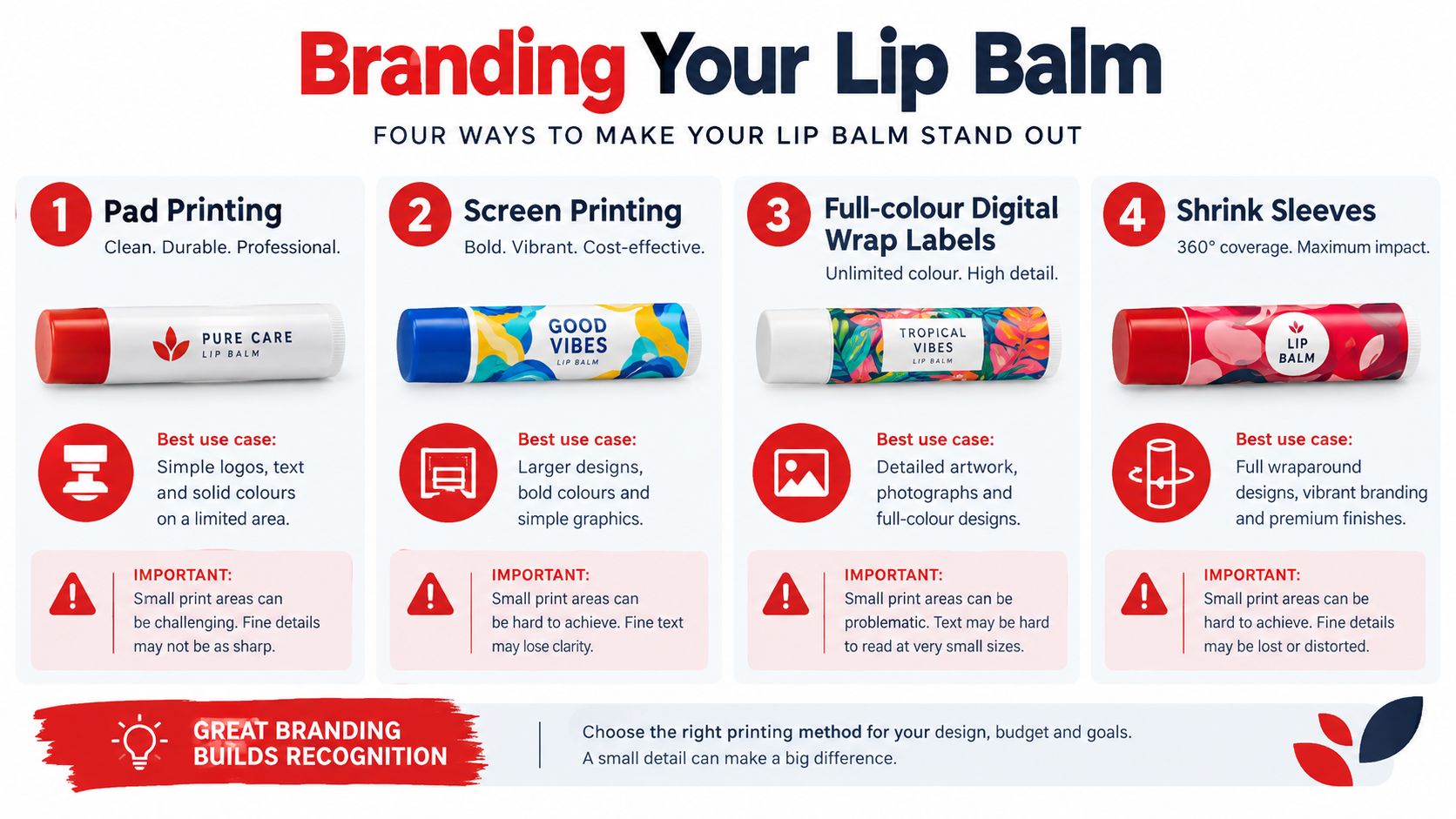
Pad printing suits a simple logo or compact design on a curved tube. Screen printing can produce a strong result on compatible surfaces. Because the available print area and colours depend on the product, confirm which decoration methods the exact format supports before design work begins.
A full-colour digital wrap label gives you more room for colour and detail within the label dimensions. A shrink sleeve can cover more of the package, but the design has to account for how the sleeve sits and how text wraps around the container. Neither option makes a crowded message easy to read.
For tins, lid printing makes a logo easy to spot in a gift pack. Debossing suits a restrained mark, though it cannot carry the detail of a full-colour label. Pick the finish based on how recipients will see and handle the item.
Brief the designer with the dieline in hand
Provide vector artwork where possible and work from the supplier's dieline for the printable area, safe margins, seams, curves and folds. If brand colours matter, supply the colour references the supplier requests and ask how they will reproduce on the chosen material, particularly if a close match is important.
Keep the hierarchy simple: logo first, then one short campaign line if it fits, with required product information left readable. If ingredient or product details need to sit in a small area, resist shrinking them to make room for marketing copy. Review the final proof at packaging scale and read every line before production.
If your message needs more space, move it to a card or outer pack. On the balm itself, clarity wins.
Sustainability and Ingredient Transparency for Australian Buyers
Sustainability claims need evidence, not just appealing words on a product page. If you're considering vegan, cruelty-free, recyclable, refillable or compostable packaging, ask the supplier what the claim means for the exact product and request supporting documentation. A material name alone doesn't tell you whether the whole package can be recycled through the systems available to recipients.
The same discipline applies to ingredients. The Australian Competition and Consumer Commission's cosmetics-labelling consultation paper says cosmetic ingredient information must be available on the container, product or packaging. If the physical size or shape makes that impractical, it may be provided through another readily accessible point-of-sale format.
Ingredients present at 1% or more must generally be listed in descending order by mass or volume, and ingredient names should use English or INCI terminology. Colours can be treated differently, while fragrance or flavour must be disclosed without necessarily listing their full composition. The label still needs to work after your logo is added, so ask to review the final layout rather than assuming the supplier will solve the space problem later.
Ask for proof before you make a claim
For a product described as vegan, check whether the formula and any relevant components meet your organisation's requirements. If the balm uses beeswax, it isn't vegan. Plant-based waxes may be a better fit, but the supplier should confirm the ingredient list rather than relying on a broad product description.
For packaging, ask whether the tube or tin is recyclable, and what recipients need to do with it after use. Don't call packaging compostable or refillable without evidence that supports the claim and clear instructions for the recipient. A sustainability statement that can't be explained is a reputational risk, not a campaign advantage.
A supplier enquiry can ask for the complete INCI list, any relevant vegan or cruelty-free documentation, packaging material details, allergen information, country-of-origin details, and available batch or expiry information. For ideas that extend beyond lip balm, browse eco-conscious promotional products and apply the same evidence-first approach to every claim.
Pricing, Minimum Orders, Lead Times and Samples
Don't compare quotes by unit price alone. Ask for a written breakdown that identifies the product, branding method, setup charges, freight, any sample costs and the assumptions behind the quote. Prices and minimum orders vary by product and supplier, so the useful comparison is the full delivered cost for your actual campaign, not an isolated figure.
Work backwards from the event
Start with the delivery date, then allow time for product selection, artwork preparation, proofing, approval, production and freight. Ask the supplier for the expected schedule for your chosen product and delivery destination. Don't assume a deadline that works for one capital city will work for a regional address, Perth, Darwin or Tasmania.
If you're considering an express service, confirm what it changes and whether it depends on artwork approval, stock availability or freight timing. A rush option can't rescue a campaign if the product classification or final label is still unresolved. Resolve those decisions before paying for production.
Request a physical sample when the product's texture, cap, flavour, label finish or overall presentation will affect acceptance. For an SPF item, also review the compliance documents for the precise variant. A sample can show how the branding looks and feels, but it doesn't replace regulatory checks.
Compare the complete order
Minimum quantities and pricing depend on the product and branding method. Ask whether a larger order changes the unit cost, and check that you can use the extra stock before it becomes unsuitable or irrelevant to the campaign. A low quote may omit freight or setup costs, so clarify what's included and whether any price guarantee applies to the same specification.
Some suppliers offer artwork layouts and revisions, which can make proofing easier. Confirm what support is included, how many approval rounds are practical for your deadline, and who signs off the final file. For multi-site or larger campaigns, ask about bulk merchandise ordering and confirm how delivery will be managed to each destination.
Matching Balm Types to Real Australian Campaign Moments
For an indoor conference, keep it simple. Choose a standard moisturising balm, a familiar tube format and restrained branding. Attendees can carry it away easily, and you avoid adding an SPF claim where sun protection isn't the main reason for the giveaway.
An outdoor festival or sports event calls for a different decision. An SPF balm may be suitable, but only if the product's Australian classification and claims have been verified. Tell recipients plainly that lip balm is only one part of sun protection. Don't present a giveaway as a replacement for hats, shade, protective clothing or broad-spectrum sunscreen.
Let the audience set the specification
For a school excursion or sports day, put suitability before novelty. Ask for the ingredient information and consider whether an unflavoured or simpler formula is the better fit for the group. Confirm with the school how items will be distributed and whether any product restrictions apply.
For onboarding kits and client gifts, focus on presentation and everyday usefulness. A standard balm can sit comfortably beside a notebook, drink bottle or welcome card. If the organisation has a sustainability policy, request evidence for any vegan or packaging claims before using them in the gift note.
Healthcare and wellness promotions need particularly careful wording. Keep claims within the product's approved classification and don't imply that cosmetic balm treats a health condition. For campaign planning beyond the product itself, these memorable product launch ideas can help you build a more coherent experience around the giveaway.
Community programs often need an item that's straightforward to distribute and easy to explain. My recommendation is to choose the simplest balm that suits the setting, then spend your attention on accurate packaging and clear recipient guidance. If you're weighing different giveaway categories, this guide to choosing the right promotional products can help you compare the balm with other campaign items.
Artwork Checklist, Ordering Workflow and FAQs
Before production, check the exact product and label, not just the logo. Buyers catch missing ingredient details, unclear SPF claims and artwork that doesn't fit the package here.
| Check item | Why it matters | Status |
|---|---|---|
| Supplier dieline and final artwork | Confirms the design fits the actual product | ☐ |
| Colour references and proof | Helps you review the intended brand treatment | ☐ |
| Ingredient information and label space | Keeps required product details accessible | ☐ |
| SPF documentation and ARTG status, where applicable | Confirms the product's regulatory position | ☐ |
| Sample approval | Lets you assess the item and branding before sign-off | ☐ |
| Freight quote and delivery destination | Clarifies the delivered cost and timing | ☐ |
| Batch or expiry information, where applicable | Helps you plan distribution and stock handling | ☐ |
A sensible workflow is straightforward. Confirm the audience and use case, shortlist a product, request its formula and compliance documents, then obtain the quote and delivery schedule. Supply artwork using the correct dieline, review the final proof and sample, approve production, and keep the supplier's documents with your campaign records. For artwork preparation, use this guide to submitting promotional product artwork.
Frequently asked questions
Can SPF lip balm be distributed at a school? It may be appropriate, but don't choose it on the SPF number alone. Verify the product's Australian status and permitted claims, and follow the school's requirements for the audience and event.
How should we handle expiry dates? Ask the supplier what batch or expiry information applies to the specific product, check the stock before distribution, and plan quantities around when the campaign will use them. Don't assume every balm has the same shelf-life controls.
If you're ready to brief a supplier, gather your event date, delivery location, quantity, preferred format and any SPF or ingredient requirements before requesting a quote.
Simply Merchandise supplies branded lip balm and a wide range of promotional products for Australian campaigns, with artwork guidance, sampling options and Australia-wide delivery. Share your event details and product requirements with the team to get help choosing a suitable format, branding method and ordering plan.

