



You've got three samples on the desk and a deadline. One is clear PET, one is brushed steel, one is Tritan with a wide mouth and a straw lid. The marketing lead wants a decision by Friday, the trade show is in six weeks, and the artwork needs a home by Monday.
The key question isn't which bottle photographs best. It's which one is still in someone's bag in March, and which state's container rules the recycling message printed on it has to satisfy.
A 500 ml bottle sits in a sweet spot for branded merchandise. Big enough to hold a useful drink, small enough to survive a commute, a school bag and a show bag without becoming a nuisance. The trouble starts when the choice is made on a material label rather than on how the bottle will be used and where it will be handed out. I judge every bottle on real reuse first, deposit rules second, material third. Everything else, recycled content included, follows from those three.
Choosing the Right 500 ml Bottle Material and Use
The short answer comes before the table. Pick Tritan copolyester or stainless steel when the bottle has a realistic chance of daily reuse, standard PET when you need volume at the lowest unit cost for a single-day handout, and glass only where drinks are poured indoors and breakage won't end up in a school bag.
Weight drives your freight bill and the recipient's shoulder. Durability decides whether the bottle survives the first week. Insulation decides whether it earns a permanent spot on a desk or gets left in a hot car.
The material comparison at a glance
| Material | Typical weight | Durability | Insulation | Best fit |
|---|---|---|---|---|
| Tritan copolyester | Light | Shatter-resistant and reusable | None | Daily use, gyms, trade shows |
| Standard PET plastic | Lightest | Moderate, scuffs easily | None | Low-cost single-serve handouts |
| Aluminium | Light | Dent-prone, lined interior | None unless double-walled | Sport and outdoor campaigns |
| Single-wall stainless steel | Heavier | Very durable | None | Team and corporate gifting |
| Double-wall vacuum stainless steel | Heavier | Very durable | Keeps drinks cold for hours | Premium gifts and outdoor events |
| Glass | Heavy | Breaks easily | None | Indoor, premium, low-risk settings |
Lighter materials cost less to post and show wear faster. PET and thin aluminium save money on freight and unit price, then scuff, dent or crack. Double-wall vacuum steel holds temperature for hours and charges you in grams and dollars. Neither is wrong. They serve different campaigns, and a procurement officer who buys steel for a one-day giveaway is paying for durability nobody will use.
For a 500 mL PET bottle intended for Australian distribution, recyclability depends more on material and component design than on volume. Australian government reporting on product stewardship found that plastic packaging recovery was only 20% in 2021–22, against 63% for glass packaging (DCCEEW product stewardship reporting). A promotional PET bottle should therefore use clearly identifiable PET, strip out non-compatible components, and carry disposal guidance aligned with the Australasian Recycling Label. National packaging policy also sets recycled-content and plastic-packaging recovery targets, which makes recycled PET content and end-of-life labelling genuine specifications rather than marketing lines.
Repeated reuse is usually the stronger environmental case, and it isn't automatic. The Australian Packaging Covenant Organisation estimated 7.04 million tonnes of new packaging entered the Australian market in 2022–23, with recovery of all packaging at approximately 56%, and the same evidence suggests maximum local recovery capacity for plastic packaging could reach only 50% by 2027–28 even with projected reprocessing facilities at full utilisation (WWF Australia packaging report). Reuse is moving in the right direction, with returnable cup systems now operating at event scale and keeping measurable volumes of single-use plastic out of landfill. The buyer's real question is how many uses the bottle needs before manufacturing, washing and transport are paid back, and whether this audience will reuse it.
The reusable end of that range looks like this.
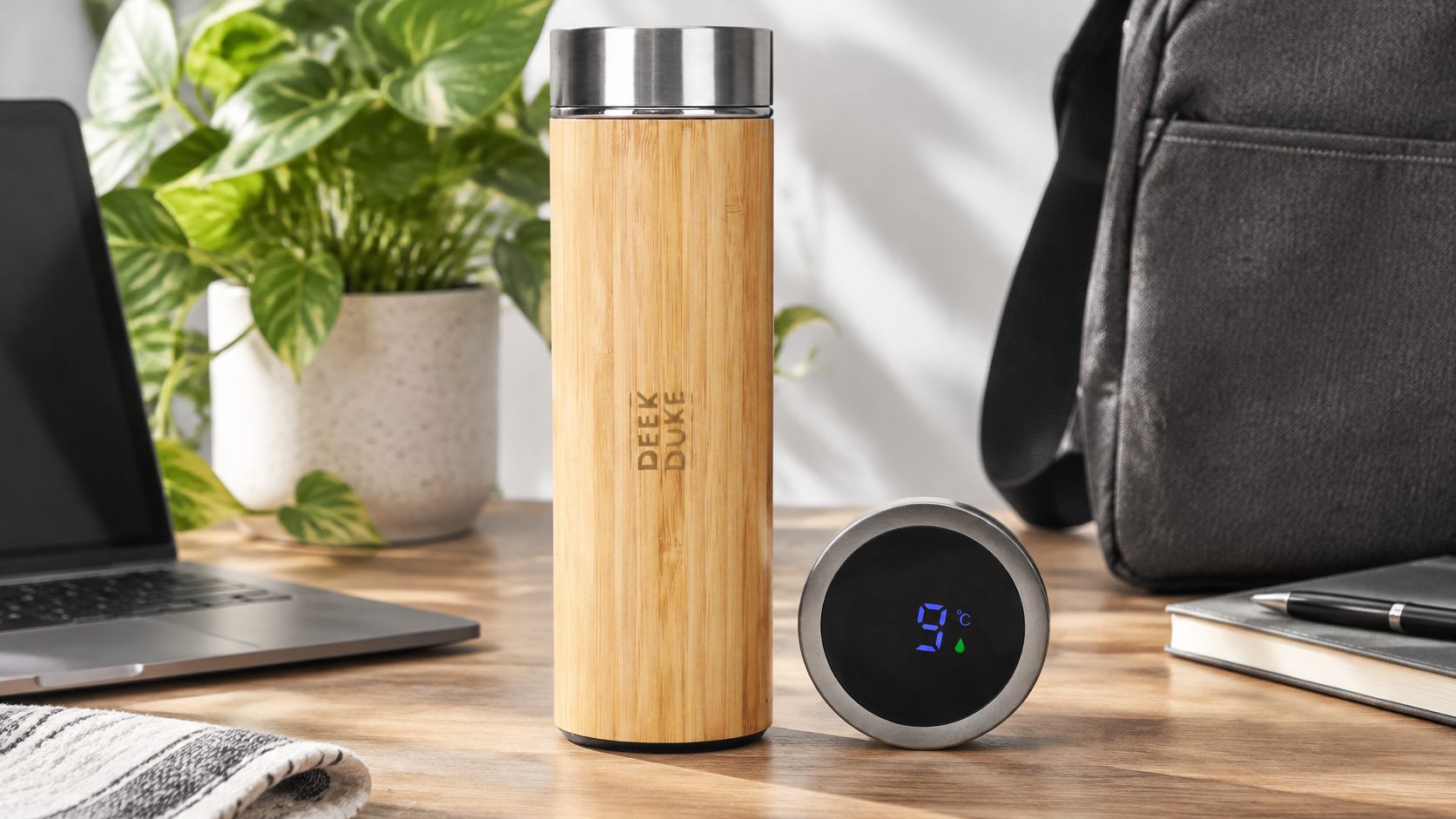
The Duke Smart Bamboo Drink Bottle is a 500 ml stainless steel vacuum double wall bottle with a filter, a sustainably sourced natural bamboo outer wall and a touch LED temperature display lid. It is leak-proof, BPA free and built around a 304 food-grade stainless inner wall, and it needs handwashing rather than a dishwasher cycle. Priced from $29.68 and offered in three variants, it suits campaigns where a premium feel matters more than a low unit cost.
The three questions that settle it
- How often will it be used? A single trade-show visit and a daily desk habit are different products. Buy PET for the first, Tritan or steel for the second.
- Where will it be carried? Handbags, school bags and bike cages punish anything with a weak lid or a wide base.
- Will it be cleaned and refilled? If there's no tap or dishwasher at the other end, a premium bottle becomes clutter.
Shortlist two materials that match the intended use and leave the third in the sample box. If you're still narrowing that shortlist, our steps to choose the right promotional products starts from the campaign objective rather than the product photo.
Features That Make a 500 ml Bottle Worth Carrying
Think about a Tuesday. Someone fills the bottle at the office tap at 8.30, drops it in a tote, carries it into a meeting, leaves it in the car at lunch and refills it at the gym at six. In that story the body barely matters. The lid decides whether the whole thing works.
500 ml fits that day well. The ABS apparent consumption of selected foodstuffs release reported apparent bottled-water consumption of 148.3 grams per person per day in 2024–25, an increase of 7.0 grams, or 5.0%, on the year before. The same release notes its figures exclude tap water and drinks sold through restaurants, cafés and fast-food outlets, so read it as a retail benchmark rather than a count of bottles on desks. A practical test for your bottle is reuse: how many times it gets refilled in a week, and whether it fits the container deposit rules of the state where it's handed out, matters far more than the material printed on the box.
Four features decide whether the bottle gets refilled or forgotten.
- A lid that seals without a fight. Look for a secure screw thread or a proper gasket. A lid that needs two hands and a warning gets left at home.
- A drinking style that matches the habit. Flip valves and straws suit one-handed sipping at a desk. A wide screw cap suits people who gulp.
- A wide mouth for ice and a bottle brush. Narrow necks look elegant and are miserable to clean, and a bottle that's hard to clean becomes a bottle that smells.
- A loop, clip or handle for event days. A spring-loaded carabiner clips to a lanyard, a belt or a tote strap. On a trade stand, that's the difference between carried and abandoned.
Practical rule: check the lid before you check anything else. Leaks and awkward cleaning generate far more complaints than the body ever will.
Trade-offs are real. A straw lid is easy to drink from one-handed and slower to scrub, because the valve and tube hold residue a quick rinse won't reach. A wide mouth cleans faster and splashes more when it's filled on a moving bus. Match the compromise to the audience, not to the spec sheet.
The Mirage Powder Coated Vacuum Bottle - Flip Lid shows how much a lid can carry: the flip-lid format suits one-handed desk sipping, it lists across 100 variants so matching campaign colours is straightforward, and pricing starts from $26.72.
If filtered or purified water is part of the pitch, read Water Filter Advisor on purification bottles before you promise a hydration benefit the bottle can't deliver on its own.
Then run the field test. Hand the sample to a colleague and ask them to fill it, carry it for a day and clean it that night. Note where it struggles. That single day tells you more than any spec table.
Branding Methods That Suit Each 500 ml Bottle
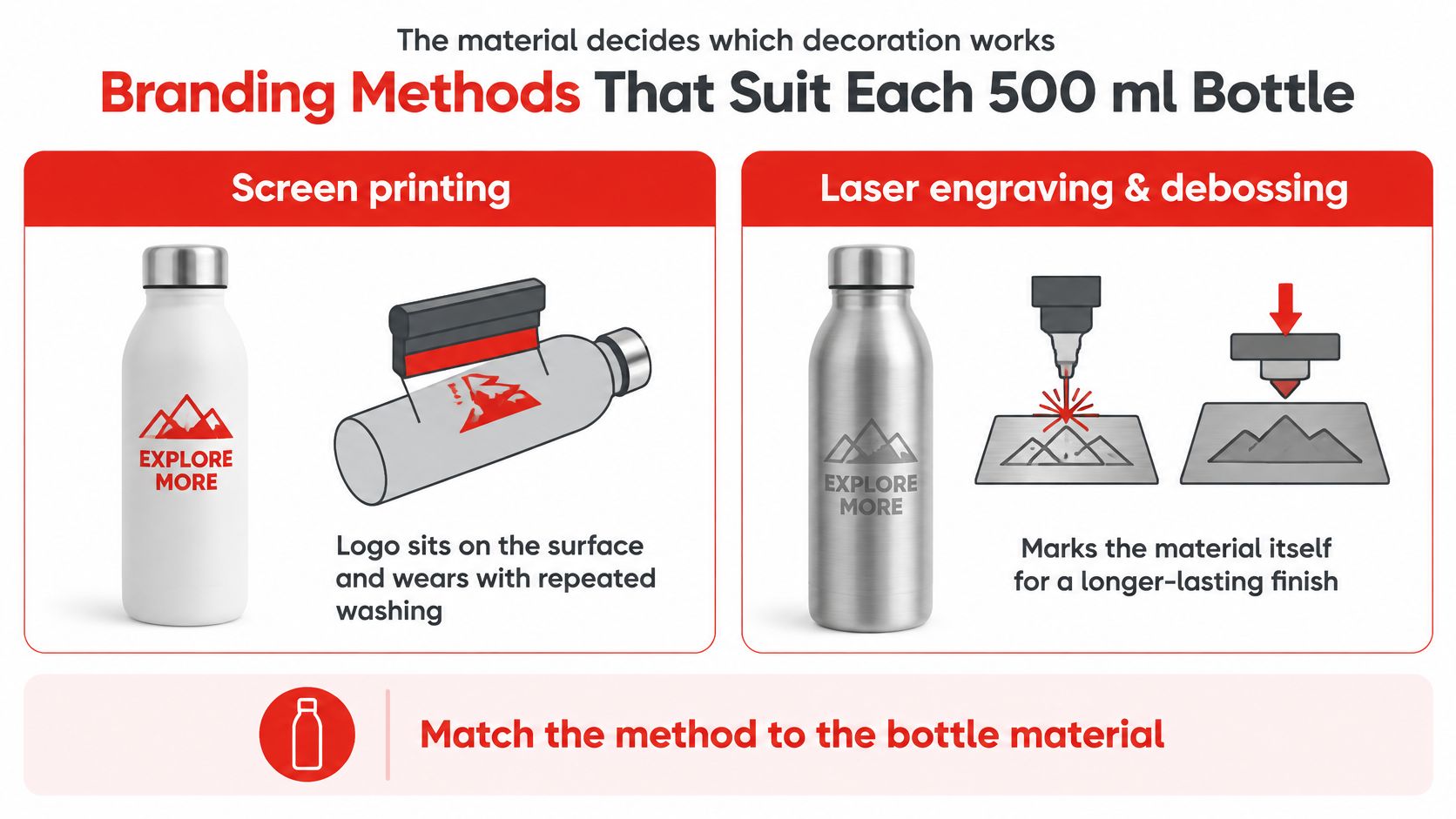
The material decides the decoration. That one sentence saves more reprints than any artwork check, because a method that looks superb on coated steel can look cheap on clear PET, and a logo that sits on a surface wears away while a mark cut into the material stays legible for years.
| Method | Suits | Best for | Main constraint |
|---|---|---|---|
| Screen printing | Plastic and coated metal | Bold single-colour logos in volume | Cost rises with each colour |
| Full-colour digital printing | Smooth coated surfaces | Photographic or gradient artwork | Less durable than engraving |
| Laser engraving | Stainless steel and some plastics | Permanent, premium marks | Engraved mark cannot carry colour |
| Debossing | Stainless steel and some plastics | Subtle tactile logo | Limited detail and depth |
| Sublimation | Polymer-coated surfaces | Full wrap-around designs | Needs a suitably coated bottle |
Screen printing remains the workhorse for a one or two colour logo on a large run of plastic or coated metal bottles. It's fast, it's crisp on flat areas, and every extra colour adds a setup and a pass. If your logo has four colours and fine gradients, this isn't the method.
Laser engraving removes or fuses the surface layer so the mark becomes part of the bottle. On stainless steel it produces a permanent, tonal mark that survives years of washing, which is why it's the default for corporate gifting. You lose colour, and on a powder coated body the engraved area reads as bright steel against the coating.
Debossing presses a logo into the surface for a tactile, understated result. Detail is limited and depth shallow, so it suits a simple mark rather than a detailed crest. Sublimation wraps a full-colour design around a polymer-coated bottle and is the only sensible route for photographic artwork across a large area. Full-colour digital printing covers gradients on smooth coated surfaces, and it sits on top of the coating, so it wears faster than an engraved mark.
Three production habits prevent most problems. Keep the logo inside the printable area and away from the curve where the bottle tapers, because artwork stretched over a radius distorts. Avoid hairline type and thin reversed-out text on a curved surface, since a 1 mm stroke wraps badly. And approve a physical sample, not a screen proof, because colour on coated steel never matches a monitor.
The question to answer is simple: which method gives you the design you want at the quantity and budget you have? If the artwork is elaborate and the run is small, simplify the artwork. Our custom printing options sets out the decoration methods available, so you can match one to the material you've already chosen rather than shopping for a bottle that happens to suit a printing technique.
Recycling Rules and Reuse Impact by State
A branded 500 ml bottle can leave the printer fully recyclable and still miss the refund scheme in the state where it is handed out. Scheme rules, beverage type, material and refund marking each get a vote, which is why a national giveaway needs more thought than a single-state run.
Queensland accepts most eligible beverage containers from 150 ml to 3 L (Queensland container refund scheme container types). The Northern Territory is expanding its scheme to cover more beverage types, including wine, spirits and plain milk containers. Material still shifts recovery once a container qualifies, and return rates differ noticeably by material within the same scheme.
South Australia has had container-deposit legislation since 1977, among the earliest in the country. Its environmental regulator reports approximately 660 million drink containers, around 32,000 tonnes, returned for refund and recycling in 2025–26 at an overall return rate of 72%, with the refund rising from 5 cents to 10 cents in 2008 and the legislation widened in 2003 to cover flavoured milk and pure fruit juice in containers under 1 litre (South Australian EPA container deposit scheme).
| State | Deposit scheme status | Eligible size | Key finding |
|---|---|---|---|
| Queensland | Scheme in place | 150 ml to 3 L | Accepts most eligible beverage containers |
| Northern Territory | Expanded from 1 July 2026 | Up to 3 L | Covers all beverage containers, including wine, spirits and plain milk |
| South Australia | Operating since 1977 | Single-serve drink containers, rules widened in 2003 | PET returned at 63.8% against 78.1% for aluminium in 2025–26 |
| Other states and territories | Separate scheme with its own rules | Set by the destination scheme | Confirm the rules before printing any recycling message |
Four decisions before any artwork is signed off
- Single-use or reusable? A reusable promotional bottle may not qualify for a refund scheme at all, even at 500 ml, so don't print a 10c refund mark on it.
- Which state receives it? A nationwide campaign can send one specification into jurisdictions with different size ranges, beverage coverage and marking rules, so pick the strictest destination as your baseline.
- Lid and label on or off? Confirm the requirement in the destination state rather than assuming the cap goes in the bin.
- Which marking is required? Match the recycling label to the material and the scheme, not to the design template.
Judge the bottle by the deposit rules in the state it lands in and by whether it will be refilled, not by the material label on the spec sheet. A durable bottle used many times beats any recycling route, but only if the person carrying it refills it. If you want eco-focused options that hold up to that scrutiny, our eco-products range is a sensible starting point, and the final check is always the destination state's rules before the printer runs.
Confirming Your Custom Bottle Order Step by Step
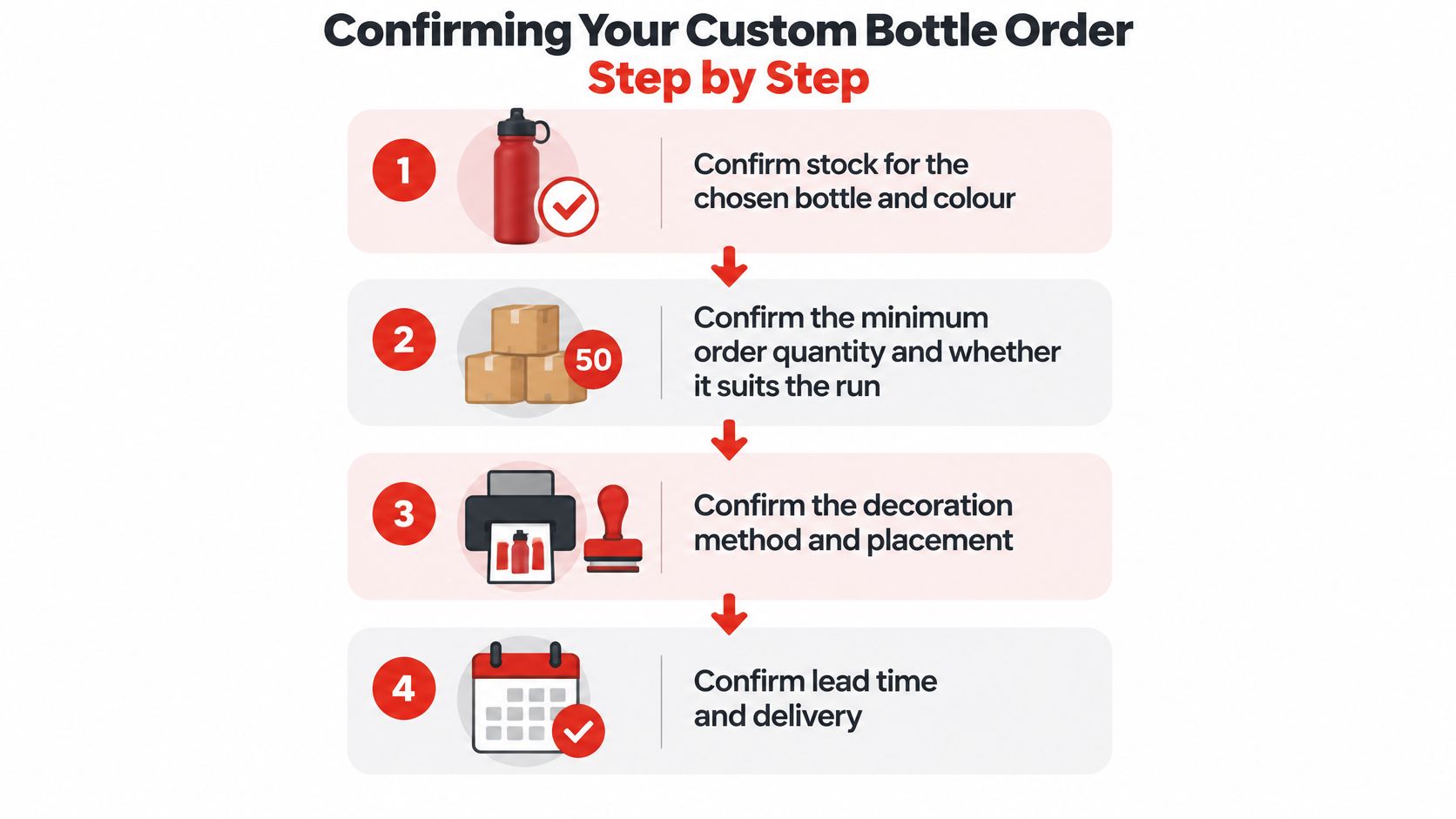
The order path is short if you walk it in sequence and confirm each stage in writing.
- Confirm stock for the chosen bottle and colour. An out-of-stock colour is the most common cause of a missed event date, and it's invisible in a catalogue photo. We confirm stock, minimum order quantity and decoration timing for each option.
- Confirm the minimum order quantity and whether it suits the run. Minimums change the unit cost and sometimes the method. A decoration that's economic at 500 units can be uneconomic at 100.
- Confirm the decoration method and its placement. Method affects both durability and timing. For a selected option, we confirm the available production method, minimum quantity and lead time when asked.
- Ask for a breakdown on mixed colours or several logos. A quote built on one colour understates the total when four logo variants ship in three colours. For mixed colours or several logos, we provide a breakdown so the quote reflects the full order.
- List every component of a gift pack. Bottle, box, card, filler and outer carton each carry a cost and a lead time. Where several items are combined as a participant pack, each item is listed separately and packaging and freight are confirmed so the complete order is ready for distribution.
- Approve a sample or proof before the full run. Sign off on the physical article where possible, and check the logo position, colour and lid function.
What to hold in writing before you pay
Get the confirmed stock, the quantity, the decoration method and the timing into one document. Add freight to the destination state, plus any setup or proof charges, because those are the lines most likely to surprise a first-time buyer. Unit cost moves with quantity, colour count, decoration method and freight, so ask for each to be broken out separately instead of one blended figure.
If your logo file needs rebuilding before it goes onto a curved surface, this guide to preparing artwork for custom shirts covers file setup, vector requirements and proofing habits that transfer directly to bottles. For our own file specifications, the artwork submission tips for beginners sets out what to send and what to avoid.
Plan Your 500 ml Bottle Order Now
Every earlier decision lands here. The material, the features and the branding method only become a bottle once a supplier can price them without a round of clarifying emails, and four details do most of that work.
- The campaign type. Trade show giveaway, staff onboarding, school program or client gift.
- The quantity. It sets the unit cost, the decoration economics and whether bulk discounts apply.
- The destination state. It decides which container deposit rules apply and what the recycling message on the artwork should say.
- The deadline. Work back from the event date through production and freight.
Those four lines are what any supplier needs to quote accurately. A catalogue of more than 10,000 products means a quantity or colour constraint on one bottle can be solved with a genuine alternative rather than a compromise, and bulk discounts apply as quantities rise. Ask for the quote to break down colours, logos and gift-pack components separately, with freight to the destination state shown as its own line.
Once the sample or proof is signed off, the order itself is straightforward: place it through the promotional products order page and file the written confirmation of stock, quantity, decoration method and timing with your campaign records. That document is what makes the reorder easy twelve months from now, when the same bottle needs to land again with the same logo in the same spot.
A branded bottle lives longer than most merchandise, and one that earns daily reuse in the state it was handed out keeps working long after the event ends. Merchandise supplies custom drink bottles to businesses across Australia, with sampling options, artwork guidance and Australia-wide delivery. Send the four details listed above and the team will come back with options and a clear quote.

