



You've chosen the polo, approved the chest logo and almost signed off the uniform order. Then someone asks what's going inside the neck. Suddenly, that tiny label needs to hold your brand name, size, washing instructions and perhaps an origin statement, without scratching the person wearing it.
That's the challenge with customised tags for clothing: each label has to do several jobs in very little space. The best result isn't the biggest logo or the fanciest finish. It's a label that looks considered, gives useful instructions and feels comfortable enough to leave alone.
Why Care Labels Shape Every Tag Design
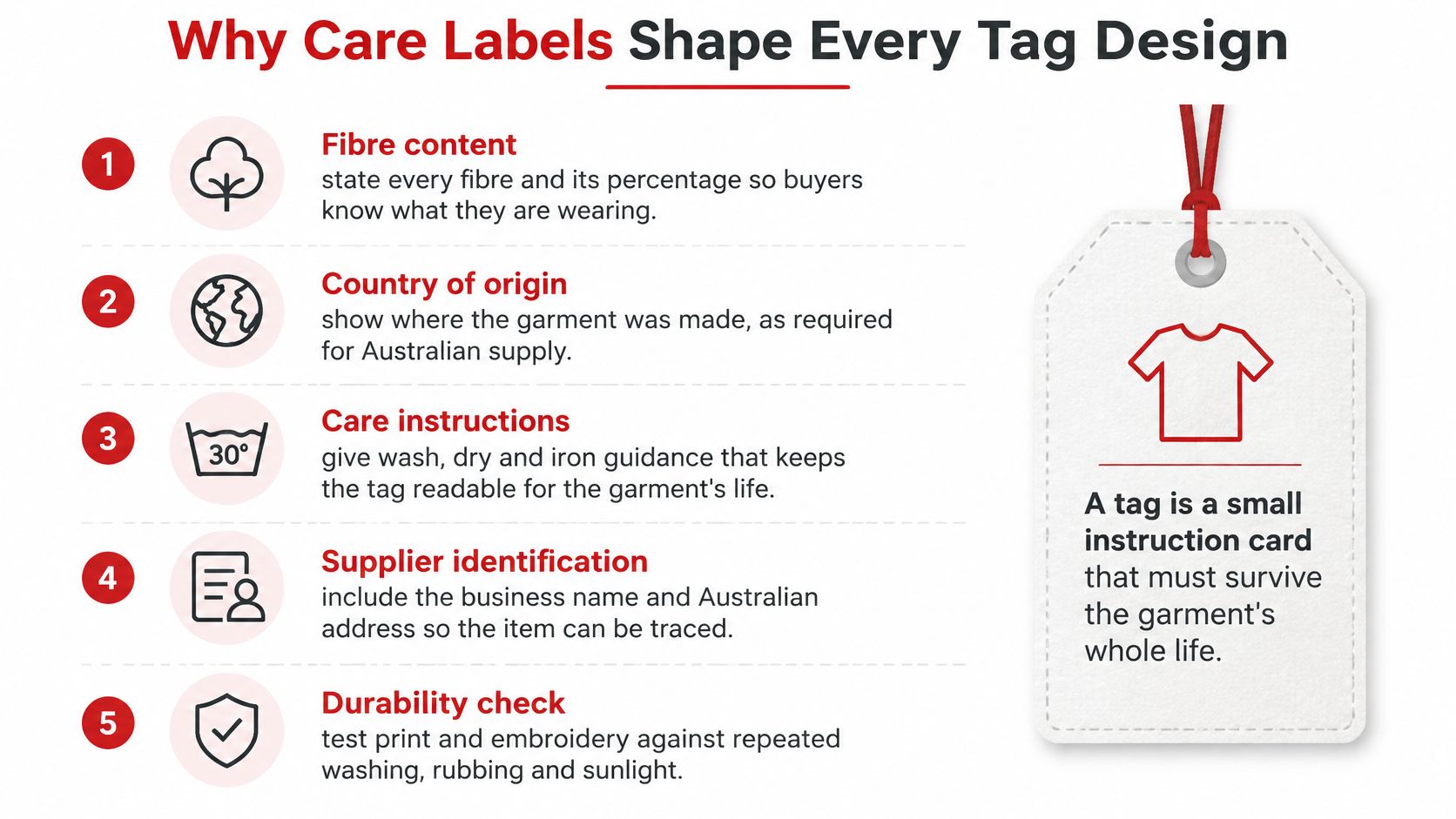
A clothing tag is a small instruction card that should survive the garment's working life. Start with what the wearer needs to know, then build the branding around it. Starting with a beautiful logo layout and squeezing care text into the remaining space usually creates avoidable compromises.
The ACCC's care-labelling supplier guidance establishes the practical requirements of permanent attachment, English wording, legibility and sufficiently accurate instructions to prevent damage when followed, within the Consumer Goods (Care Labelling) Information Standard 2023 framework and its technical foundation, AS/NZS 1957:1998, subject to variations and additions.
Questions to answer before approving the proof
- Is it permanent? A swing tag comes off before wear, so it can't be the only home for required care information. Check the attachment method as well as the label material.
- Can someone read it? Review a physical sample at its actual size. A magnified PDF won't reveal whether tiny lettering disappears into the weave or folds into a seam.
- Is the language right? Keep the required English instructions clear. Additional languages can help your wearers, but shouldn't displace or obscure that information.
- Do the directions suit the finished garment? Consider the fabric, lining, trims, decoration and label together. Washing instructions for an undecorated shirt aren't automatically suitable after a transfer or embroidered badge is added.
The rules distinguish between woven labels themselves, which are excluded from the mandatory standard, and clothing and household textiles that remain within scope. Buying an excluded component doesn't remove the care-information responsibilities attached to the finished garment.
Use this visual as a broader tag-planning checklist, rather than a statement that every field is universally mandatory. Fibre, origin and supplier details need their own assessment; they aren't interchangeable with the care requirements above.
Give instructions room to work
For an example of garment-care communication beyond the physical label, Tattoo Golf's guide to keep your Tattoo Golf gear sharp is a useful reference when planning supporting customer information. A care page can explain the routine more fully, while the garment retains its essential instructions.
Reserve readable space for care wording before scaling the logo. Put the brand and size on the visible face, with care text on a reverse face or separate permanent label where appropriate. Reduce decorative content before reducing legibility.
Choosing the Right Custom Tag for Each Garment
The neck label is the piece of branding a wearer meets whenever they pull the garment on. Choose its construction for that repeated contact, not just for how it looks in a product photograph.
Custom tag types by garment and trade-off
| Tag type | Best garment | Main strength | Main trade-off |
|---|---|---|---|
| Woven label | Premium uniforms and corporate shirts | Crisp edges and fine logo detail | Higher unit cost and minimum run sizes |
| Printed satin or polyester label | Uniforms needing logo plus full care text | Holds lots of text at low cost per unit | Edges can scratch skin if poorly placed |
| Heat transfer label | Soft tees, activewear and quick runs | Flexible, fast to apply | Can crack or peel after repeated washing |
| Tagless heat transfer or print | Wearers with neck or skin sensitivity | No sewn neck label to irritate | Care information needs a suitable permanent location, often a separate sewn label |
| Embroidered patch, iron-on, sew-on or Velcro | Caps, jackets, bags and sports kit | Textured, durable and reusable when removable | Adds bulk and holds little or no care text |
These are selection guides, not guarantees of price or durability. Thread density, label dimensions, print system, order quantity and application method all affect the result. Get quotes against the same artwork and garment so you're comparing like with like.
Match the finish to the job
A woven label suits a restrained brand mark on a structured shirt. Fine logo detail can reproduce well, but tiny care paragraphs are a different challenge. Don't force decorative weaving to perform a printed instruction label's job.
A printed satin or polyester label is often the practical shortlist choice when words matter more than texture. Specify the fold and edge finish, not just the material name. A soft face won't compensate for a stiff cut edge sitting against skin.
For visual inspiration on small sewn-in branding, B-Sew Inn's Tula Pink labels offer a useful reference. Treat decorative label examples as design inspiration, rather than ready-made solutions for your care information.
Compare complete applications
Heat transfers and tagless prints overlap: tagless describes the wearer-facing result, while heat transfer describes an application method. Ask for a sample showing the exact proposed process, rather than approving the word tagless on a specification sheet.
Patches belong where their texture adds something, such as a cap front or jacket sleeve. Velcro supports removal, sew-on construction provides a fixed attachment, and iron-on backing needs compatibility with the fabric and its care routine.
When reviewing branded clothing options, choose the garment first, establish the information it needs, then compare budget and run size. Finish with a shortlist of contrasting samples, such as a folded printed label and a direct transfer, rather than ordering every finish available.
Making Honest Origin Claims on Your Tags
An Australian flag beside your business name can suggest more than local ownership. If the garment was manufactured overseas, adding local embroidery doesn't automatically make that overall impression accurate.
The Australian Fashion Council's labelling guide, which explains ACCC guidance, distinguishes the general position that origin needn't always be stated from imported-textile requirements for a prominent, legible country-of-manufacture description, and explains that the Made in Australia safe harbour requires substantial transformation in Australia.
The practical distinction is between owning the brand, decorating the garment and manufacturing it. Those activities may happen in different places. A well-written label doesn't blur them together.
Origin wording that stays truthful
| Tag wording | Accurate meaning | Condition |
|---|---|---|
| Made in Australia | Garment substantially transformed in Australia | A local logo, label, embroidery or final branding step is not enough |
| Australian business name | Who owns the brand | Does not state where the garment was made |
| Decorated or embroidered locally | Where the logo or decoration was applied | Keep separate from the country of manufacture |
| Made in [country] | Country where the goods were made or produced | Must be prominent and legible on imported textiles |
| Flag, map or the word Australian | Can create an Australian-origin impression | Use only when the production history supports that impression |
Write separate statements, not a blended slogan
Say an Australian-owned business orders overseas-made polos and has its logo embroidered locally. Its label copy should identify those facts separately, using wording supported by the purchasing and production records.
A clear wording pattern is:
- Brand ownership: Brand owned by [Australian business name].
- Decoration location: Embroidered in Australia, if that's where the work occurred.
- Manufacturing origin: Made in [actual country of manufacture].
Keep the manufacturing statement visible. Don't tuck it into a fold while giving a flag and local-brand claim the whole front face.
Artwork check: Read the label as a customer would, without access to your supplier paperwork. The overall impression should match the garment's production history.
Ask whoever approves procurement records to approve the origin wording too. A designer can arrange the text beautifully, but shouldn't have to infer manufacturing history from a logo file or delivery address.
Backing Sustainability Claims on Your Tags
A kraft-coloured label and a leaf icon don't make a garment sustainable. They create an impression, and that impression needs evidence just as much as the words printed beside it.
Australia's information gap makes precision particularly useful: care information is generally required, but fibre-content disclosure isn't mandated nationally. Buyers can't safely treat a green-looking label as proof of what's in the fabric.
The scale matters: Sustainability Matters' discussion of fibre transparency reports that Australia generated an estimated 860,000 tonnes of textile, leather and rubber waste in 2020–21, with clothing representing roughly 300,000 tonnes. Those categories aren't interchangeable, so don't describe the larger total as clothing waste.
Build an evidence file before writing the claim
Keep the care specification and marketing claims as separate approval tasks. A supplier's wash instructions don't establish organic status, and a recycled-content statement doesn't tell you whether a decoration will tolerate ironing.
Use a simple evidence routine:
- Request the composition in writing. Get the fibre names and percentages for the actual garment ordered, not a similar product in the catalogue.
- Identify the claim's scope. Establish whether recycled or organic wording concerns the main fabric, a component, the label or the packaging.
- Retain supporting documents. Save the specification and relevant certification records with the purchase order and approved artwork.
- Print the narrowest defensible wording. State the verified recycled-content percentage rather than substituting a broad environmental promise.
SEYANTE's explanation of GOTS standards for cotton towels provides useful context for questions about organic-textile certification. It isn't evidence that an unrelated garment, supplier or custom label is certified.
Make the information useful after purchase
A clear fibre blend can help a later owner understand the garment and give a reuse or recycling operator better information to assess it. It doesn't guarantee that a local recycler accepts the item, particularly once blends, trims and decoration are considered.
When evaluating eco product options, separate material information from claims about the whole product's environmental impact. A recycled component is a specific attribute, not proof that every stage of production is environmentally preferable.
Print what you can substantiate, not what a green colour palette suggests.
Before approving any environmental wording, procurement should be able to answer: What exactly are we claiming, which part does it describe, and which document supports it? If the answer relies on an assumption, hold the claim rather than stretching the evidence.
Designing Tags People Are Happy to Wear
A scratchy neck label can turn a uniform someone was proud to receive into a daily irritation. That's a branding cost too: the wearer's most persistent contact with your identity shouldn't be an edge they want to cut off.
Choose a smaller, softer or tagless treatment when touch matters more than decorative impact. Keep the physical information useful, then use a digital companion for detail that would otherwise crowd the garment.
Australian-linked inclusive-fashion work in The Sensory Salon proceedings paper discusses NFC-enabled labels that let a smartphone retrieve size, material and care information. That's a useful design direction, provided the digital layer supplements rather than displaces required physical information.
Design from the skin outwards
Lay the garment flat and feel every proposed label edge, fold and stitch line. Then put it on. A label that seems unobtrusive on a table may rub once the collar moves or a backpack presses against it.
- Remove unnecessary contact. Consider a direct print or transfer at the neck instead of adding another sewn component.
- Check pressure points. Don't move an irritating neck label straight beneath the shoulder blade or into underarm friction.
- Examine the reverse. Backing and stitches can matter as much as the front surface, especially beneath close-fitting layers.
- Invite individual feedback. Don't assume a finish described as soft will suit every wearer.
When planning exterior logos through in-house custom embroidery, include the inside of the garment in the sample review. The person wearing it experiences both sides.
Make digital access dependable
A discreet QR code or NFC label can open a garment-specific page containing care directions, fibre details and sizing information. Offer selectable text, useful contrast, large-print viewing and relevant language options rather than uploading a tiny photograph of the label.
Avoid mandatory logins. A donated school shirt or reassigned staff polo shouldn't require the original purchaser's account to reveal its care information.
Assign someone to maintain the destination page when products change or leave the catalogue. Keep essential details available without turning every scan into a sales journey.
Finish the approval process by having intended wearers test the garment for a full shift or normal day of use. Ask where they felt rubbing, not just whether they liked the label.
How Teams Use Custom Tags in Real Programs
A tag is a program's signature, but each setting needs a different pen. The following scenarios show how to choose the construction around the work the garment will do, rather than applying the same premium-looking label everywhere.
A school uniform ready for hand-me-downs
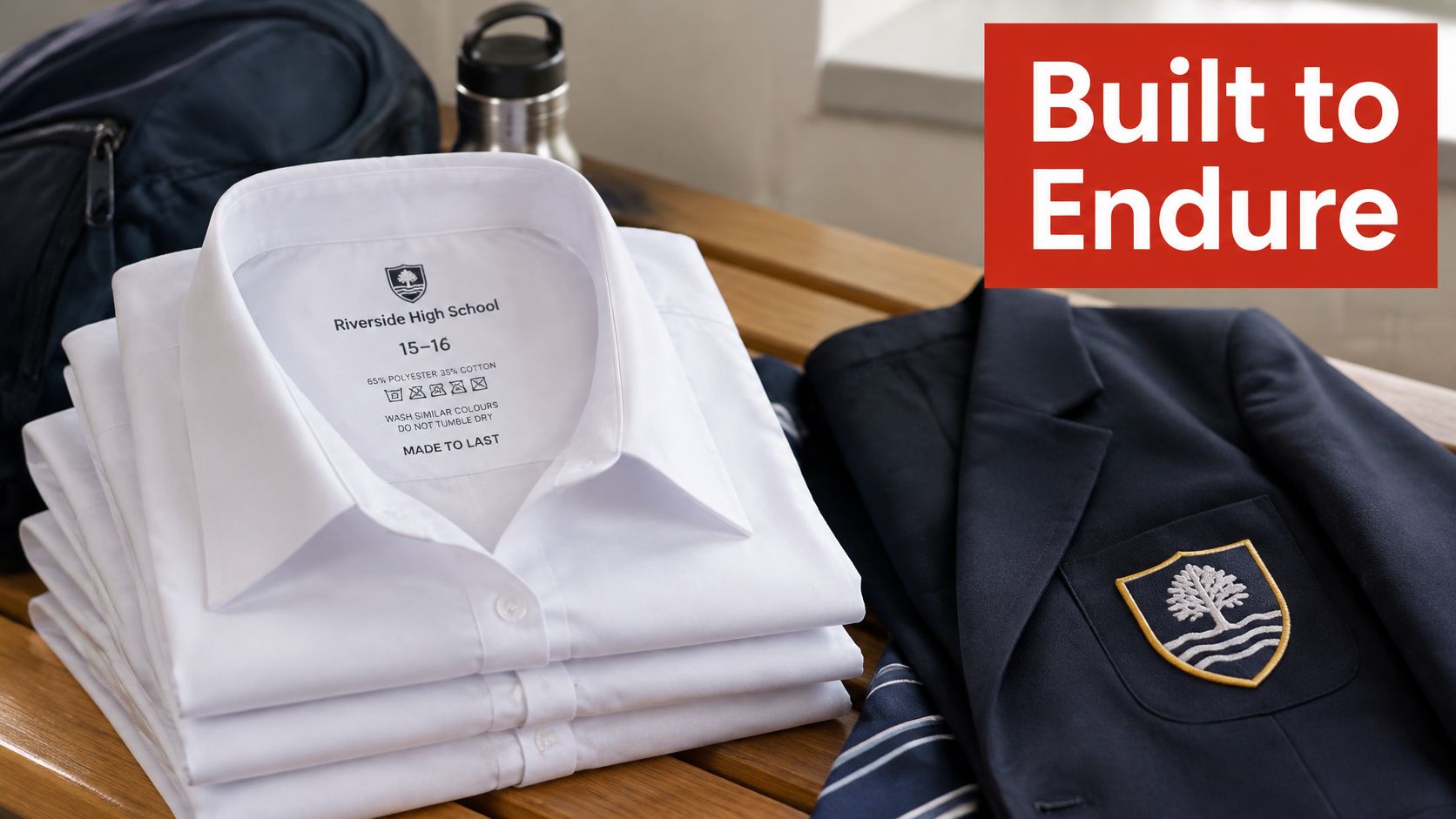
Say a school is refreshing its shirts and blazers. A folded printed label carries the school name, size and care information inside the shirt, while an embroidered crest gives the blazer its visible identity.
The practical check is the finished label after laundering: can a parent still read it, and has the fold stayed flat? Leave a separate space for the pupil's name so personal identification doesn't obscure care text.
Healthcare scrubs built around the laundry routine
A healthcare team chooses a tagless neck print with a soft permanent care label placed where it won't press beneath fitted layers. The aim is to remove neck irritation without leaving staff guessing how to wash the scrubs.
Its approval check is compatibility with the actual laundry process. If the workplace uses hot washing, confirm that the fabric, print and remaining label tolerate that specified routine, rather than assuming every scrub top does.
Club kit that can change with the season
A sports club uses player names and numbers on jerseys, with removable Velcro patches on suitable bags and training gear. Permanent identity belongs on items assigned to a player; changeable branding belongs where sponsors or team roles may change.
The check is the attachment during movement and handling. Test the patch against bag straps and stacked equipment, and inspect whether exposed fastening surfaces catch other fabrics. Iron-on patches suit a fixed application, not the same seasonal interchangeability.
Event clothing that still makes sense afterwards
An event team selects a heat-transfer neck label for tees and an embroidered patch for caps. The event identity stays prominent, while brand ownership and manufacturing wording remain distinct.
The important check is the assembled product, not separate artwork files. Put the tee on, inspect the cap's inner surface and confirm that every element belongs on that particular fabric.
When coordinating corporate wear across roles, keep a garment-by-garment approval record. A successful application on a structured shirt doesn't establish suitability for a stretch tee, knit or cap.
Confirm Your Tag Brief Before You Order
Send a single, organised brief with the garment sample and artwork. Record decisions clearly enough that the person preparing the proof doesn't have to guess.
- Garment and fabric. Identify the exact shirt, scrub top, jersey, tee or cap, including its material specification.
- Care information. Attach the approved wording and identify its permanent location. Confirm the finished layout remains readable and appropriate for the garment.
- Origin wording. Supply separate lines for brand ownership, decoration location and manufacturing country, backed by the relevant records.
- Fibre and environmental claims. Include only approved wording and attach the supplier's written evidence.
- Construction and access. Record the shortlisted label, fold, placement and any QR or NFC destination, including who will maintain it.
- Production approval. Printing and embroidery options vary by garment, so we confirm whether names, numbers or larger designs are available on the selected product before finalising the order. Request a sample on the actual garment and complete the wear test.
Use the artwork submission guide to organise the files accompanying your brief. If the proof needs a colour or size change, request it before approval; we adjust the design until you're completely satisfied.
Merchandise offers custom embroidered apparel across Australia, with in-house design and embroidery to help bring your garment branding together. Visit Simply Merchandise with your garment choice, logo and completed tag brief so we can confirm suitable customisation options before you finalise the order.

