



The usual advice for buying baseball caps in Australia starts with colour, fabric and where to put the logo. That's the wrong order. Start with who'll wear the cap and where they'll wear it, because a great-looking promotional item can still be the wrong choice for someone working or playing outdoors.
Choose for the wearer first, then build the branding around that choice. You'll get merchandise people want to wear without asking a short peak to do the job of a proper sun-protective hat.
Baseball Cap Styles and Which One Fits Your Brief
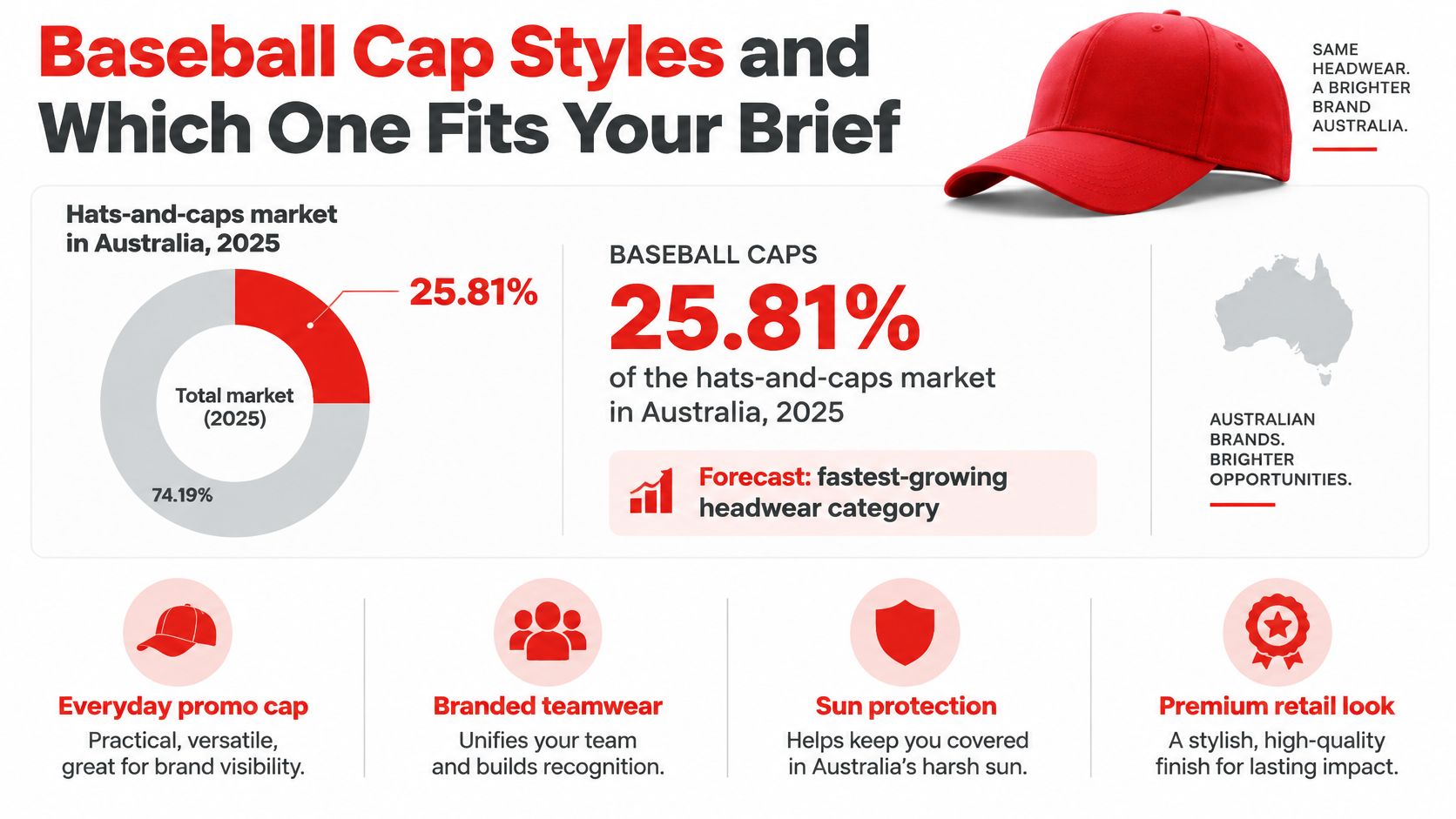
Baseball caps accounted for approximately 25.81% of Australia's hats-and-caps market in 2025, making them the largest individual category, and are projected to be the fastest-growing product type at 5.54% annually through 2034, according to Deep Market Insights' Australian market assessment. That makes them a familiar merchandise choice, not automatically the right one for every brief.
Baseball cap styles compared
| Style | Shape and peak | Sun coverage | Best branded use |
|---|---|---|---|
| Structured six-panel | Stiff front, pre-curved peak | Mainly forehead shading; ears and neck exposed | Corporate giveaways, uniforms, sports teams |
| Unstructured washed | Soft crown, relaxed peak | Mainly forehead shading; ears and neck exposed | Lifestyle merchandise, casual campaigns |
| Mesh-back trucker | Firm front, mesh back panels | Limited facial coverage; open panels aren't equivalent to close-weave fabric | Field-team identity, hot-weather events with additional protection |
| Flat peak | Straight, flat brim | Front-facing shade, not all-round coverage | Contemporary brand looks, youth-style merchandise |
| Bucket hat comparison | Full brim all round | Better surrounding coverage; check brim dimensions and fit | Outdoor events, festival giveaways |
| Legionnaire or wide brim | Neck flap or broad surrounding brim | Greater face, ear and neck coverage when appropriately designed | Outdoor crews, sun-safety programs |
Match the silhouette to the brand's job
For a tidy uniform, start with a structured cap. Its firm front gives the logo a consistent presentation, particularly when different employees adjust the closure differently. Check crown height, though. A tall front that looks strong in a product photograph can sit awkwardly on a smaller head.
Choose an unstructured washed cap when the merchandise should feel like something recipients already wear on weekends. It suits a discreet emblem better than a large, rigid badge. Don't choose it for a campaign that depends on a perfectly upright front panel.
Trucker and flat-peak styles make a more deliberate statement. A trucker prioritises ventilation, while a flat peak puts more emphasis on silhouette. Neither choice should be made solely because the marketing team likes the look.
For coastal lifestyle audiences, Blitz Surf Shop's cap advice for Kiwi surfers offers a useful adjacent perspective on choosing caps for the people wearing them. Keep that lifestyle decision separate from your organisation's sun-safety requirements.
Shortlist rule: Pick a style your audience would wear voluntarily, then reject it if it doesn't suit the setting.
Use our headwear selection to compare silhouettes rather than choosing from a logo mock-up alone. Shortlist contrasting options, such as structured and washed, or baseball and broad brim, then settle the coverage question before confirming the order.
Fabrics That Decide Comfort, Look and UV Protection
Fabric affects how a cap feels in heat, how its front supports decoration and how much ultraviolet radiation passes through the material. Those are separate questions. A soft fabric isn't necessarily cool, and a dark fabric isn't proof of sun protection.
Start with the wearing conditions, then choose the finish. A cap intended for active staff needs a different balance from merchandise designed mainly for a retail-style appearance.
Cap fabrics and what they do well
| Fabric | Feel and heat | Strengths | Watch-outs |
|---|---|---|---|
| Polyester heather | Light; breathability depends on construction | Quick-drying, colour retention, low shrink tendency | Can feel synthetic; request UPF evidence |
| Polyester/cotton twill | Structured, medium weight | Classic appearance, supports crisp embroidery | Can feel warmer than lightweight alternatives |
| Cotton twill | Soft, comparatively substantial | Natural feel, traditional finish | Can fade or shrink; retains moisture |
| Washed cotton | Soft, pre-worn feel | Relaxed appearance, comfortable crown | Less structure; check batch colour consistency |
| Mesh panels | Light, open construction | Airflow during warm conditions | Openings compromise fabric coverage |
| Terry towelling | Thick, absorbent | Sweat absorption, distinctive texture | Can feel heavy during extended summer wear |
Choose the material and construction together
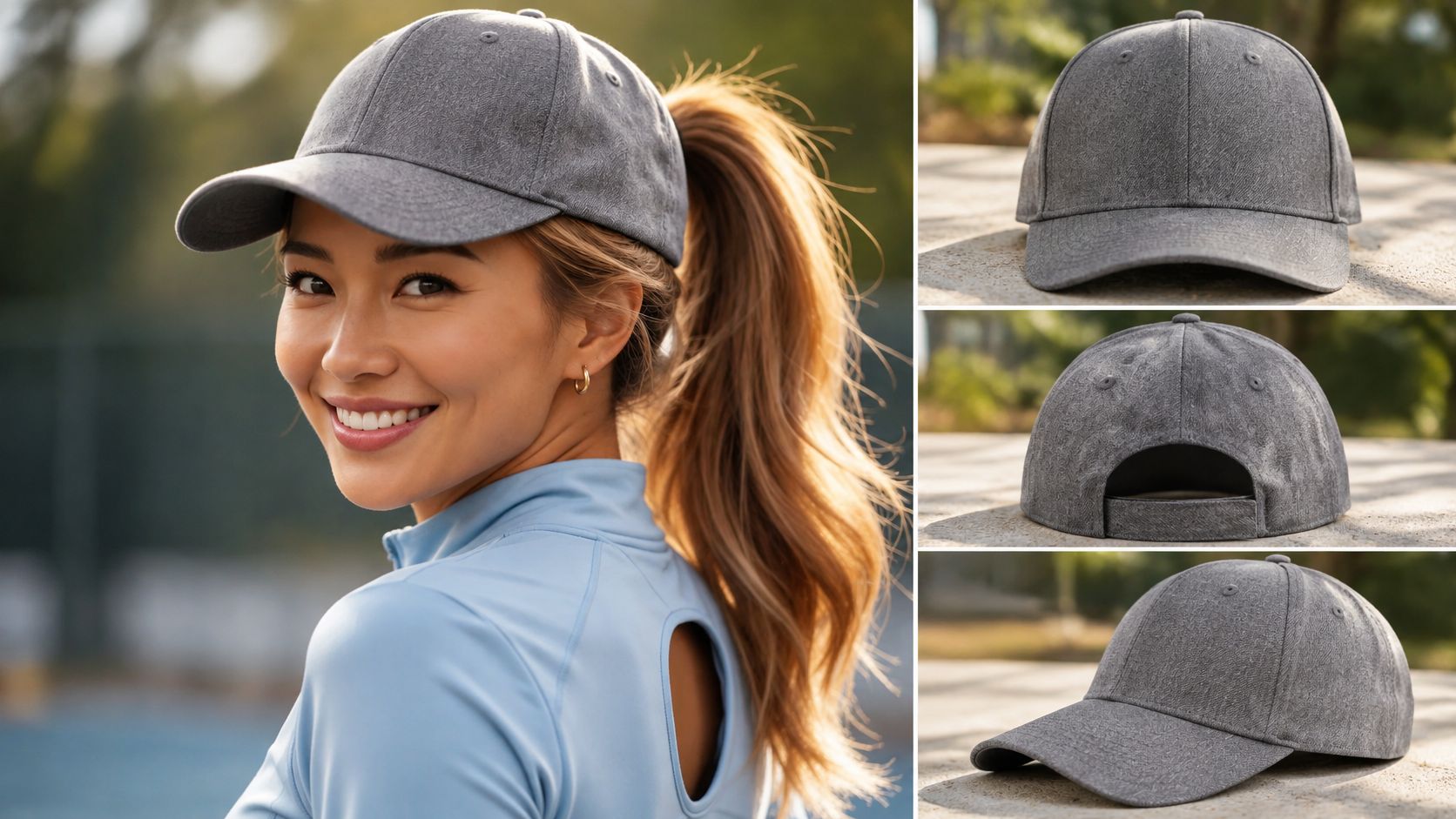
Polyester heather is a sensible starting point when you want a lightweight-looking uniform cap without a washed finish. Our Heather Cap uses polyester with a structured six-panel crown, pre-curved peak and short crossover Velcro closure. It's a construction reference, not evidence that every polyester cap performs identically.
Polycotton twill suits a conventional embroidered uniform. Cotton twill gives a more traditional hand feel, while washed cotton deliberately sacrifices some crispness for a relaxed appearance. Handle a decorated sample before deciding, because backing and dense stitching can change how the front feels against the forehead.
Mesh and terry sit at opposite ends of the comfort trade-off. Mesh promotes airflow through openings; terry absorbs moisture but adds substance. Neither deserves an automatic “best summer fabric” label.
Ask what the UPF claim actually covers
UPF measures fabric performance, not the amount of skin a hat covers, and ratings above 50 are labelled UPF 50+ under the framework explained by ARPANSA's sun-protective clothing guidance.
Request test evidence for the fabric and identify which panels it applies to. Don't assume the front, mesh back and neck attachment share the same performance.
For outdoor wear, prioritise lightweight, breathable, close-weave construction where practical. Then assess the complete hat, because protective fabric can't compensate for an exposed neck.
Branding Methods That Keep Your Logo Sharp
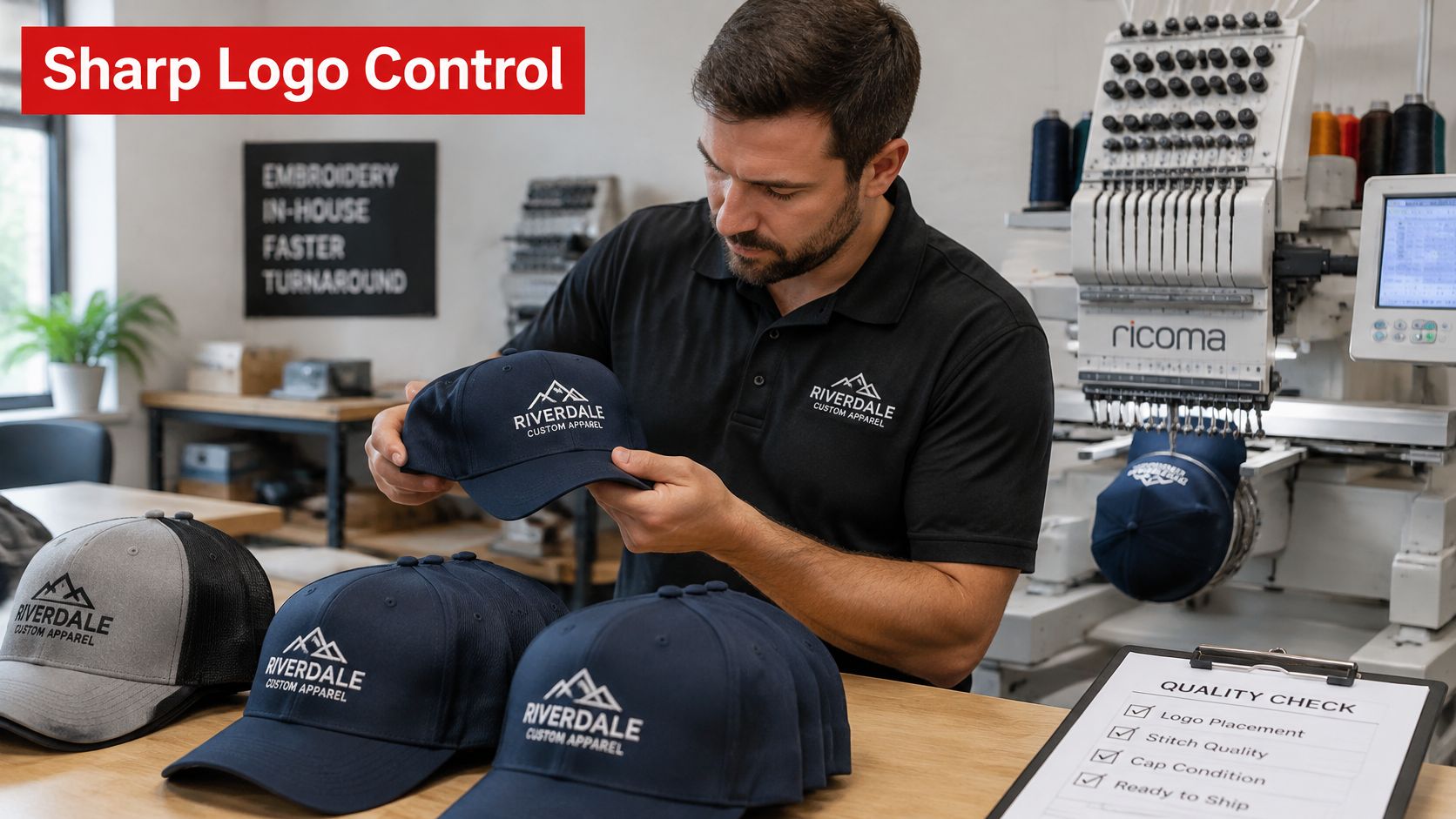
Embroidery is the starting point for most branded caps, not a reason to reproduce every detail of your existing logo. We produce cap embroidery in-house, keeping decoration and quality control under one roof. Turnaround still needs to be confirmed against the artwork, quantity and production requirements.
A cap front is curved, interrupted by seams and smaller than a shirt panel. Artwork that looks clear on a monitor can become crowded when stitched.
Simplify before digitising
Begin with the element people recognise first: the wordmark, symbol or club crest. Remove a secondary tagline if it forces everything else to shrink. Keep meaningful space between letters and avoid forcing thin outlines into stitching.
- Supply clean artwork. Send vector artwork where available, plus a visual reference showing the correct colours and proportions.
- Set the hierarchy. Decide whether the organisation's name or symbol must read first.
- Check the seam position. Ask for placement that accounts for the centre seam and crown shape.
- Approve a stitch-out. Inspect the actual thread, fabric and backing rather than relying only on a digital layout.
For preparing artwork, 2ndShotMVP's file specs for embroidered golf logos are a useful companion to the production discussion. Our in-house custom embroidery service provides the relevant decoration route, but your sample remains the deciding reference.
Use a patch when detail matters
A full-colour printed patch can be a better choice for artwork with fine detail or colour transitions. Specify the patch method clearly, because an embroidered patch still has stitching limitations. Check the border, attachment and flexibility as carefully as the image itself.
Caps can be produced in almost any colour, but Pantone matching needs physical approval. A screen proof won't show the difference between thread sheen, dyed fabric and a printed patch. Review them together under ordinary lighting.
Western Australian Museum collection records document Australian representative and Perth Heat caps carrying player identifiers and team marks, illustrating how a cap can preserve sporting identity rather than function as a disposable print, as shown by the museum's representative cap record.
Use consistent logo proportions across caps, beanies, hats and scarves rather than forcing identical decoration dimensions onto different shapes.
If the logo doesn't read at arm's length on the sample, simplify it before production.
That's a practical readability check, not a promise that tiny lettering will become legible across a crowd.
Sun Coverage Limits You Need to Know
A baseball cap delivers roughly 9 facial-area units of shade at the forehead, 4 at the nose, and less than 1 at the ears, chin and neck, in the comparative data published by ARPANSA's sun-protection hat guidance. The peak does its work at the front and leaves nearly everything else exposed. These are comparative shading measures. They describe where the shadow falls; they carry no information about UPF ratings or percentages of protection.
Cancer Council guidance reaches the same conclusion from the policy side: baseball caps leave the ears, cheeks and back of the neck exposed and aren't recommended for adequate protection. Outdoor workers are exposed to far more UV than indoor workers across a working year, which widens the gap between what a peak shades and what the job demands.
Treat exposed skin as a design problem
Fix the headwear or the conditions of use. Describing the same cap more enthusiastically changes nothing for the wearer.
- Keep the baseball cap for identity-led use. It suits indoor promotions and lifestyle merchandise where it isn't being presented as protective equipment.
- Address incidental outdoor exposure. A suitable neck flap can improve coverage, while sunscreen, sunglasses, protective clothing and shade cover the rest of the wearer's protection.
- Change the design for sustained exposure. Choose an appropriately designed broad-brimmed or legionnaire hat. Sunscreen supports a proper brim; it cannot make a short peak equivalent to one.
Put brim dimensions in the specification
Cancer Council's sun-protection guidance recommends a broad brim of at least 7.5 cm for outdoor protection. Write that measurement into the purchase specification and verify it on the sample. "Wide brim" on a product page gives you a description, so measure it.
Check the shape while it's worn, too. A brim that curls sharply or a neck flap that lifts away during movement may not deliver the coverage a flat product photograph suggests.
Procurement boundary: Don't market a cap as full sun protection on the strength of one panel's fabric rating.
For an outdoor event, weigh headwear against the other items in your outdoor promotional products order. Staff instructions, available shade and the actual duties matter more than whether every item carries the same logo.
State the intended use in writing. A cap for shaded reception staff and a hat for an exposed installation crew are different purchases, even when both teams represent the same business. That written line is what turns the order into duty of care rather than branding alone.
Matching Cap Choice to Exposure and Audience
Separate recipients by activity, then assign a headwear type to each group. A receptionist working under a marquee, a coach on an open oval and a labourer on an exposed site do different work, so they belong on different lines of the same order.
The Cancer Council sporting groups sun-protection policy recommends hats that shade the face, neck and ears, including broad-brimmed, bucket and legionnaire styles, and identifies baseball caps as insufficient protection. A single cap specification is therefore a poor default for an organisation with both indoor and outdoor roles.
Headwear choice by use case and exposure
| Use case | Exposure pattern | Cap alone enough? | Better or added option |
|---|---|---|---|
| Indoor promotional giveaway | Inside, without outdoor exposure | Suitable as merchandise; not a sun-protection claim | Cotton twill or washed cap chosen for audience and fit |
| Shaded trade-show or event | Mainly under cover, with movement between areas | Not a complete outdoor protection strategy | Cap for covered hours; sunscreen and suitable headwear for exposed setup duties |
| Brief outdoor use | Short trips or intermittent time outside | Not as sole sun protection | Add sunscreen, sunglasses and protective clothing |
| Organised sport | Repeated, sustained sun exposure | No | Broad-brimmed, bucket or legionnaire hat plus shade and a sunscreen policy |
| School sun-safety program | Regular outdoor breaks and activities | No | Policy-approved broad-brimmed, bucket or legionnaire hat in children's sizes |
| Full-day outdoor work | Extended exposure during duties | No | Suitable protective hat, UPF-rated clothing, shade and scheduled breaks |
Don't treat shade as a permanent condition
A trade-show employee may spend most of the day beneath a marquee and still work an exposed loading area during setup. Specify for the whole role, including the hours when visitors are absent.
For sport, separate players, volunteers and spectators before you order. Activity rules can restrict what participants wear during play, and that restriction shifts the sun-safety plan to breaks, warm-ups and sidelines rather than removing it.
Schools should choose headwear that meets their sun-protection policy and stays on during play. Sized options make that practical: Long Beach bucket hats come in 540mm, 570mm and 600mm, so children get a working fit rather than a shrunken adult hat.
Write the overlooked details into the brief
Close-weave fabric matters, and so do attachments and compatibility. Where workers need hard hats, use compatible attachable brims and neck flaps rather than substituting ordinary promotional headwear for required safety equipment.
For trades and industrial teams, coordinate the headwear decision with the workwear and hi-vis requirements. We embroider trades, construction and industrial uniforms to comply with Australian workwear quality standards, and the same embroidery can carry your logo onto a legionnaire or bucket hat for the exposed crew. Decoration does not turn an unsuitable cap into protective equipment.
Run the order from the risk down. Protect the exposed groups first, then decide which cap the rest of the audience wants to wear.
Order Branded Caps Step by Step
Before requesting a quote, complete a short written brief. Missing decisions at this stage usually reappear as artwork changes, sample queries or an unsuitable item delivered to the wrong audience.
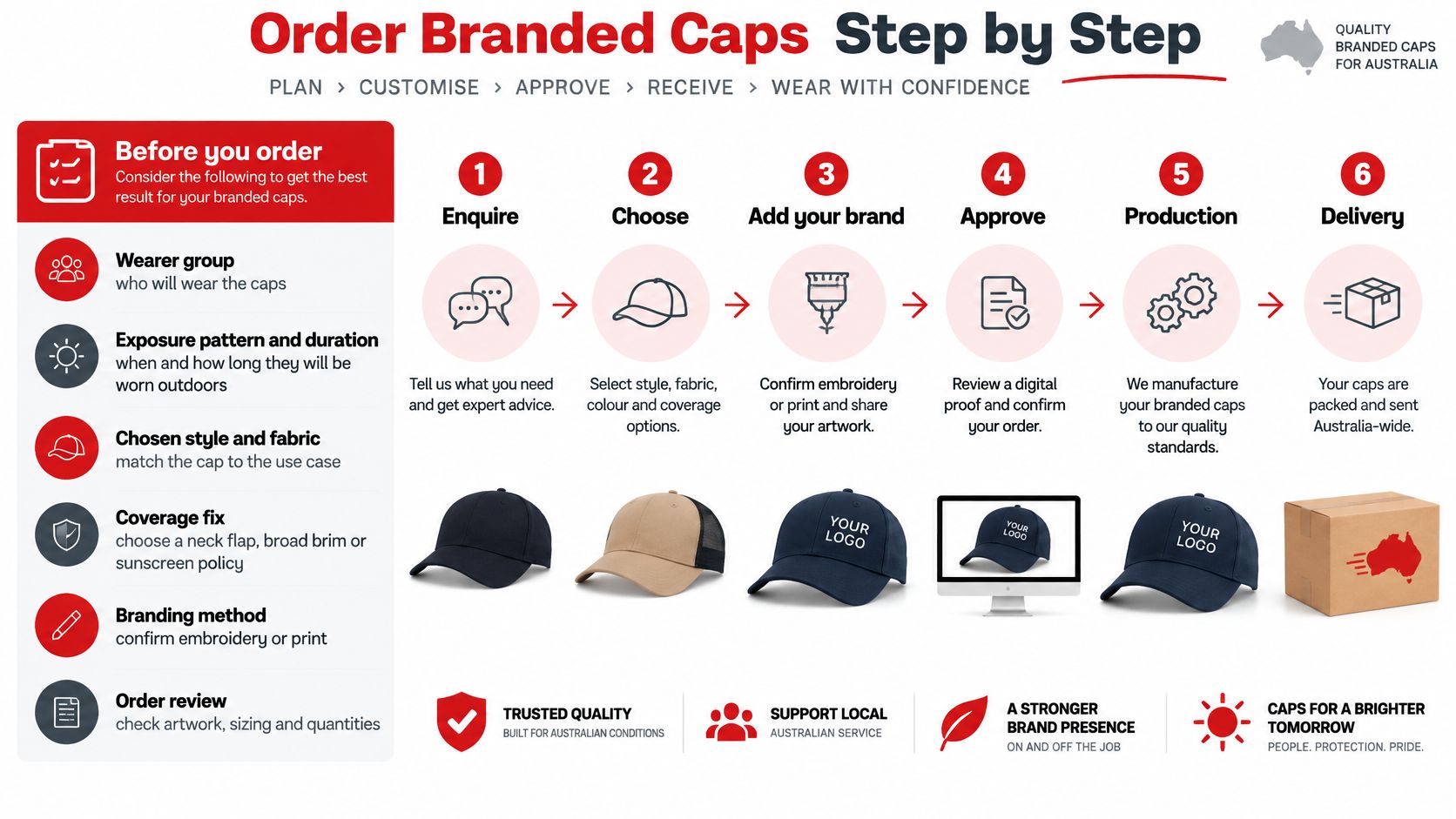
Complete the pre-order checklist
- Wearer group. Identify the people receiving the headwear and their actual duties.
- Exposure pattern. Describe outdoor conditions, duration and movement between locations.
- Style and fabric. Record the preferred construction and an acceptable alternative.
- Coverage response. Specify protective headwear, attachments and supporting measures where needed.
- Decoration. Supply the logo, placement and preferred branding method.
- Order review. Confirm quantities, sizing spread, sample approval and delivery requirements.
Move from brief to written approval
- Define the purpose and wearer. Write a specific description, such as indoor onboarding merchandise or an outdoor volunteer uniform. If the audience has different duties, split the brief instead of forcing everyone into the same item.
- Select the silhouette. Compare the shortlisted styles on real wearers. Look for a comfortable crown, a usable closure and a peak that doesn't interfere with the wearer's normal tasks.
- Confirm the fabric requirements. For outdoor use, request relevant fabric-level UPF evidence and identify any untested components. Keep that documentation with the order so the approved specification doesn't rely on a verbal assurance.
- Resolve the decoration. Decide between direct embroidery and a suitable patch before finalising placement. We produce cap embroidery in-house, so send the artwork for a production assessment rather than assuming a supplied image is stitch-ready.
- Check colours, sizing and quantities. Record the approved physical colour reference and the required fit range. An adjustable closure doesn't guarantee comfortable fit for every recipient, particularly when a campaign includes children and adults.
- Wear-test a decorated sample. Ask intended users to try it during representative duties. Check pressure from the closure, forehead comfort, movement, visibility and whether the decoration pulls the crown out of shape. Wash it according to its care instructions and inspect the result.
- Approve the final specification in writing. Include artwork version, placement, fabric, colour, sizing, quantity and any sun-protection requirements. Confirm what has been approved before production begins.
California Cowboy's guide to how to order custom embroidered hats offers another practical perspective on preparing an embroidery order. Use that preparation to make your own approval clear, not to replace a physical sample.
Our promotional product ordering process is the next step once the brief is settled. Request a sample before bulk production and confirm sun-protection needs in writing. A polished digital proof can't tell you whether someone will comfortably wear the finished cap.
The supplier offers in-house cap embroidery and artwork guidance to help you turn a clear wearer brief into practical branded headwear. Visit Simply Merchandise with your logo, audience, quantities and outdoor-use requirements, and request a sample before approving your bulk order.

