



Junior training ends and a kid walks off with the ball under one arm, club crest facing out, mud across the panels. Nobody at the ground reads it as merchandise. They read it as hers.
A branded ball earns that place only when it's built as equipment first. Get the size, the pressure and the panel layout right, and the crest rides along for a season or three. Get them wrong and you've paid for a display item that splits a seam in week two.
Why a Branded Ball Still Scores
Watch a junior side warm up and the ball is doing three jobs at once. It has to roll true off wet grass, it tells every parent on the sideline which club their kid plays for, and it ends up in a bedroom or a car boot long after the last game.
Organised football runs deep in Australian communities, from metropolitan clubs to small regional associations. That spread matters when you order, because one specification won't serve a five-year-old's first clinic and a first-grade match.
Start with equipment. A ball that's too heavy for its users teaches bad touch and gets dropped. Then identity: a crest across the panels turns a generic training ball into something a player keeps. Then promotion, because of the dozens of things a club or school hands out, the ball is one of the few that gets used weekly, outdoors, in front of other people. It's the same logic behind any brand identity built through promotional merchandise: a useful item carries your name further than a decorative one.
The test: the ball is sized for the people who'll kick it, the branding survives a season of contact, and the order came from a written brief rather than a photo of a logo.
The working order below is the one I'd follow: sizing, brief and build, artwork placement, play settings, lifespan, then product options and lead times.
Pick the Right Size for Every Age Group
Size is a specification, not a preference. The three match sizes break down like this:
| Size | Circumference | Weight | Best for |
|---|---|---|---|
| Size 3 | 58–61 cm | 310–340 g | Younger children and mini-games |
| Size 4 | 63.5–66 cm | 350–390 g | Youth players |
| Size 5 | 68–70 cm | 410–450 g | Older youth, adults and formal fixtures |
The national audience is large enough that no single specification covers it. Football Australia's 2025 participation report recorded approximately 1.93 million participants nationally, which is a lot of different ages and levels of play to serve with one stock ball.
What changes as the ball gets bigger
The reason the numbers move together is physics, not marketing. Reducing circumference and mass lowers the force required to accelerate and control the ball, which is why a Size 3 suits small hands and short legs. The heavier Size 5 gives back the regulation feel that senior players expect when they strike through the ball.
That's why the same logo on the same panel layout can produce a good ball or a bad one. A junior clinic handed Size 5 balls will spend the session chasing heavy rebounds. A first-grade side handed Size 3 balls will spend it laughing.
Match the ball to the brief
For schools, junior clinics and community events, name the intended age group in the artwork brief before production starts. A Size 3 or Size 4 branded ball improves usability in youth programs, while a Size 5 is the safer choice for clubs, corporate tournaments and adult participation. If you want a second reference point alongside the figures above, the 2026 soccer ball sizing guide from Villarreal Houston Academy walks through age bands with the matching circumference and weight ranges.
One caution that saves arguments later: when the ball will be used in formal fixtures, confirm the relevant state or competition rules in advance. Promotional suitability and match compliance are not the same requirement, and a perfectly branded ball can still be ineligible on match day.
Practical rule: size follows the player, and the logo follows the size.
Brief, Build and Approve Your Ball
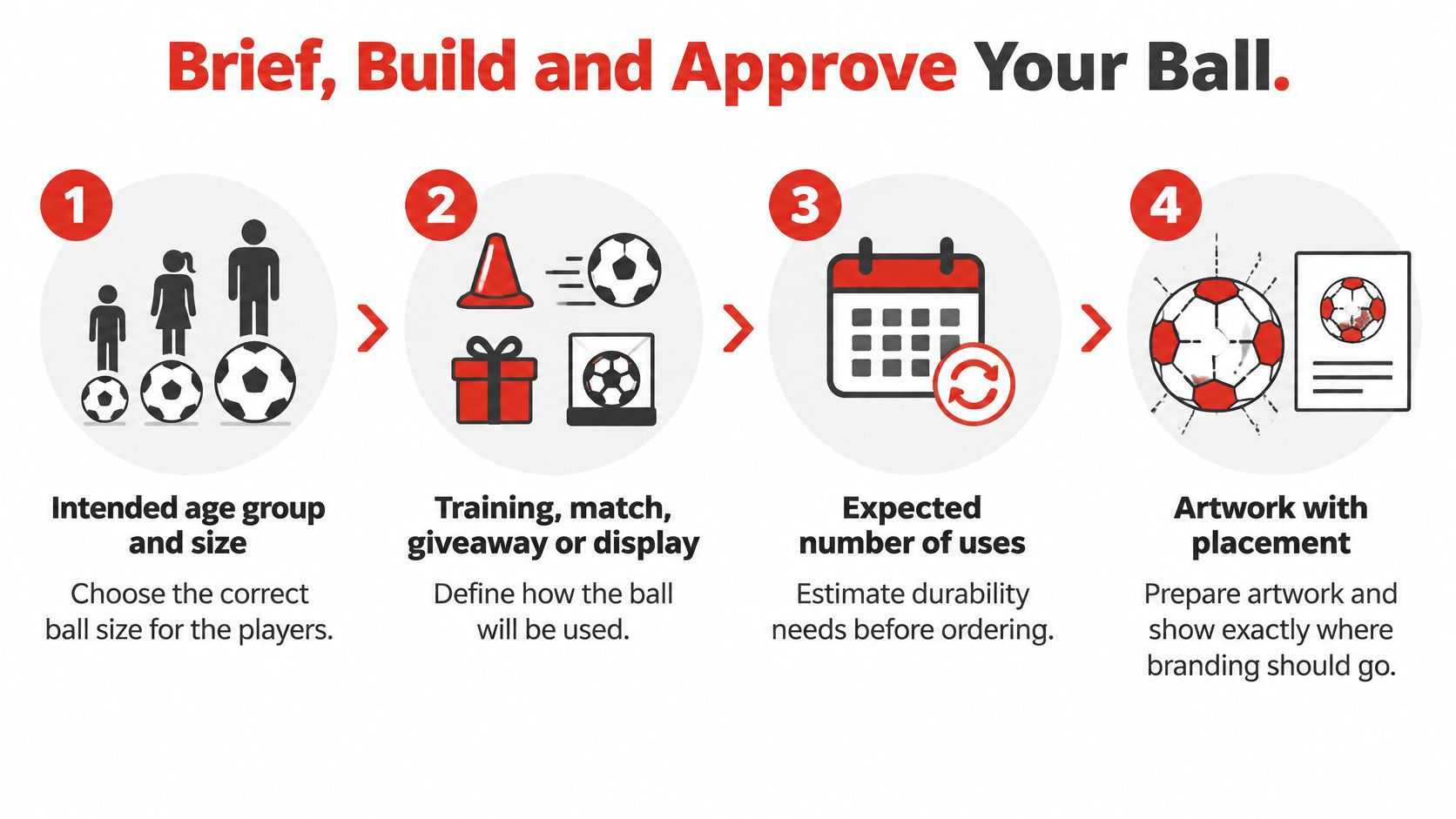
A supplier can only build what your brief tells them. Before you ask for a quote, have these seven answers written down:
- Age group and size: the size the players use at their age, settled before any artwork begins.
- Setting: training, match, giveaway or display. These are different products.
- Expected number of uses: weekly training through a season, or one afternoon at a tournament.
- Artwork with placement marked: the file plus a note on which panels carry which mark.
- Colour requirements: including any club-specific shade that must be matched.
- Quantity: the number you need, plus the number you might add later.
- In-hand date: the day the balls must be at the ground. Everything else in the order works backwards from it.
Brief a training ball and a giveaway ball as separate products, even if they share a design. Their durability expectations are nowhere near each other.
The build, step by step
1. Choose construction. Match machine-stitched or thermally bonded panels to the wear you expect. Repeated training needs stronger panel and seam durability than a short promotional display. The common slip is choosing the cheapest build for a training order and replacing it mid-season.
2. Plan the panel layout. Map the logo, crest, sponsor marks and base colours onto each panel before artwork is finalised. Keep key marks away from high-flex seams. The slip is placing a crest straight across a seam because it looked centred on a flat template.
3. Choose the print method and colour system. Confirm spot or full-colour options and check minimums for matched colours before you lock the artwork. We hold black Special PMS colours from a minimum of 500 pieces, so a specific shade ask can shift your quantity planning. The slip is confirming colours after the artwork is approved.
4. Approve a physical sample. Get the ball in your hands before full production and put it through the inflation and abrasion checks set out in the artwork section below. Approving artwork on a flat screen without inflating the ball first is how distortion gets signed off.
5. Confirm timing and freight. Ask for production lead time, air or sea freight, and the delivery date to your venue. Then schedule the order backwards from the event date so the balls arrive with room to spare.
Design Artwork That Survives Play
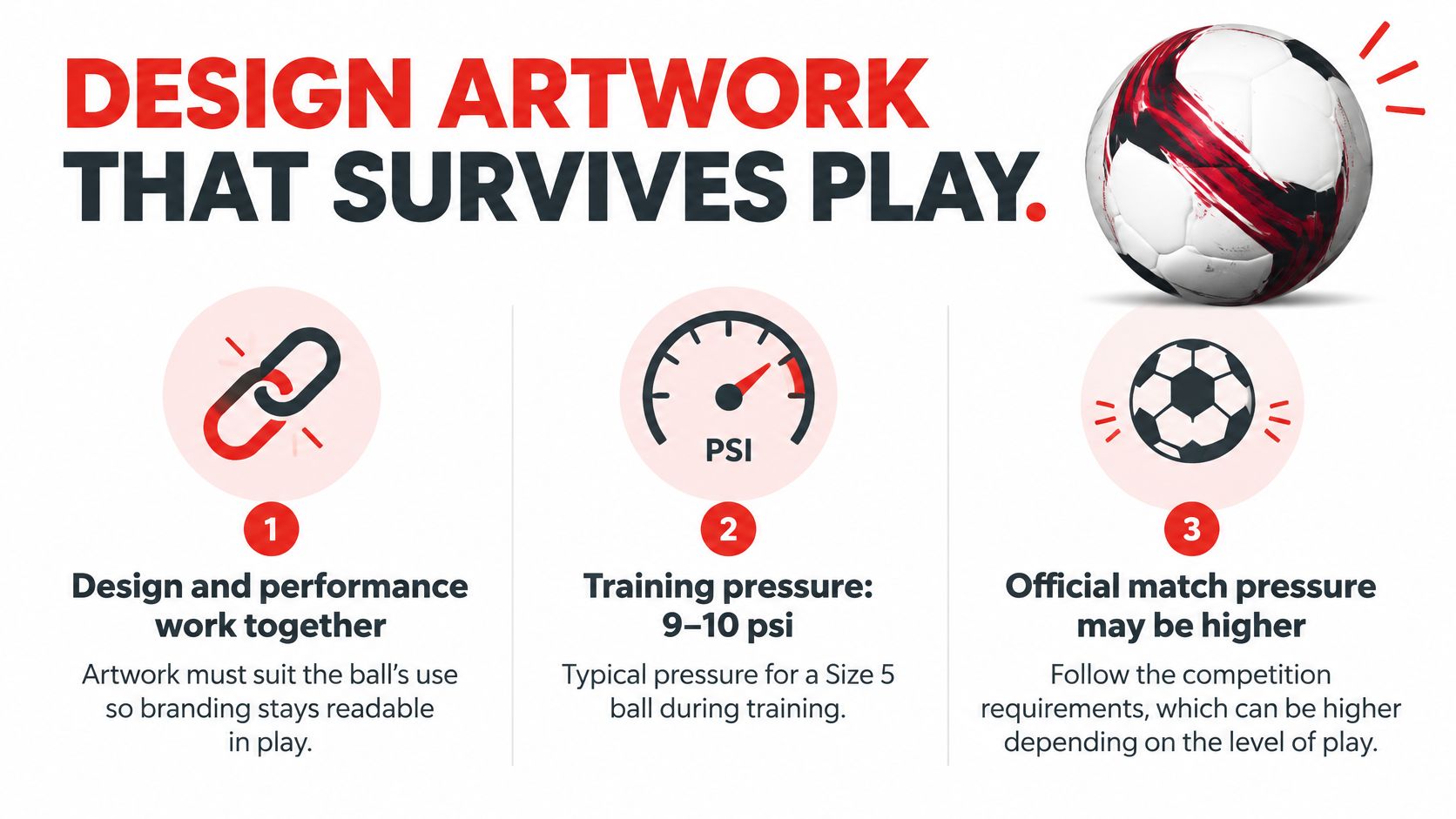
Artwork is approved on a ball that will spend its life being compressed, kicked and scuffed, so print and pressure belong in the same conversation. For a Size 5 ball, typical training inflation is about 9 to 10 psi, and official match pressure may be higher depending on the governing specification, as set out in Elite Champions Coaching's ball size guide. Under-inflation increases deformation at impact, absorbs more energy and reduces rebound consistency. Excessive pressure produces a harder feel and changes flight and kicking response, which is why a logo that looked crisp on a soft ball can look stretched once the ball reaches match pressure.
Placement decisions that pay off
Print behaves differently depending on where it sits. Ink laid across a seam flexes every time the ball compresses underfoot, so a crest straddling a join cracks and flakes sooner than the same mark centred on one panel. A sponsor badge placed across two panels because it looked balanced on the flat template reads as two half-marks once the ball inflates; shifting it onto a single panel puts the whole mark on a surface that curves in one direction. Keep critical marks off the panels that take the most abrasion too, because repeated scuffing strips visual clarity long before the ball itself wears out.
Size and contrast do the rest. A small, intricate crest reads beautifully on a proof and disappears in motion, so favour large, high-contrast marks that stay identifiable as the ball rotates.
Run this check with a sample in hand:
- Inflate first: take it to playing pressure and re-check every mark, since panel stretch changes how edges and letterforms sit.
- Spin it: if you can't identify the club from three metres while it turns, enlarge the mark.
- Check the seams: confirm no letterform or key element crosses a high-flex join.
- Roll it: a lap of concrete shows which panels lose ink first, and those panels carry no critical marks next time.
- Compare against the file: colour shift on a curved panel is normal, but it should still match the brief.
When you prepare files, follow the same discipline our artwork submission guide for beginners sets out: clean vector logo, correct colour references, and placement marked clearly on the panel template.
The clubs that get this right treat the print as part of the equipment, sized for the panel it sits on and proven on an inflated ball before a single unit ships.
Where Custom Balls Earn Their Keep
Organised football reaches children in every regional classification, from the big cities to remote communities. The Australian Sports Commission's 2024 AusPlay data counts about 516,000 children playing organised football outside school hours in major cities, 105,000 in inner-regional areas, 52,000 in outer-regional areas and 7,000 in remote or very remote communities, so the two regional bands together account for about 157,000 of the roughly 680,000 children counted across all regions, or about 23% (AusPlay results).
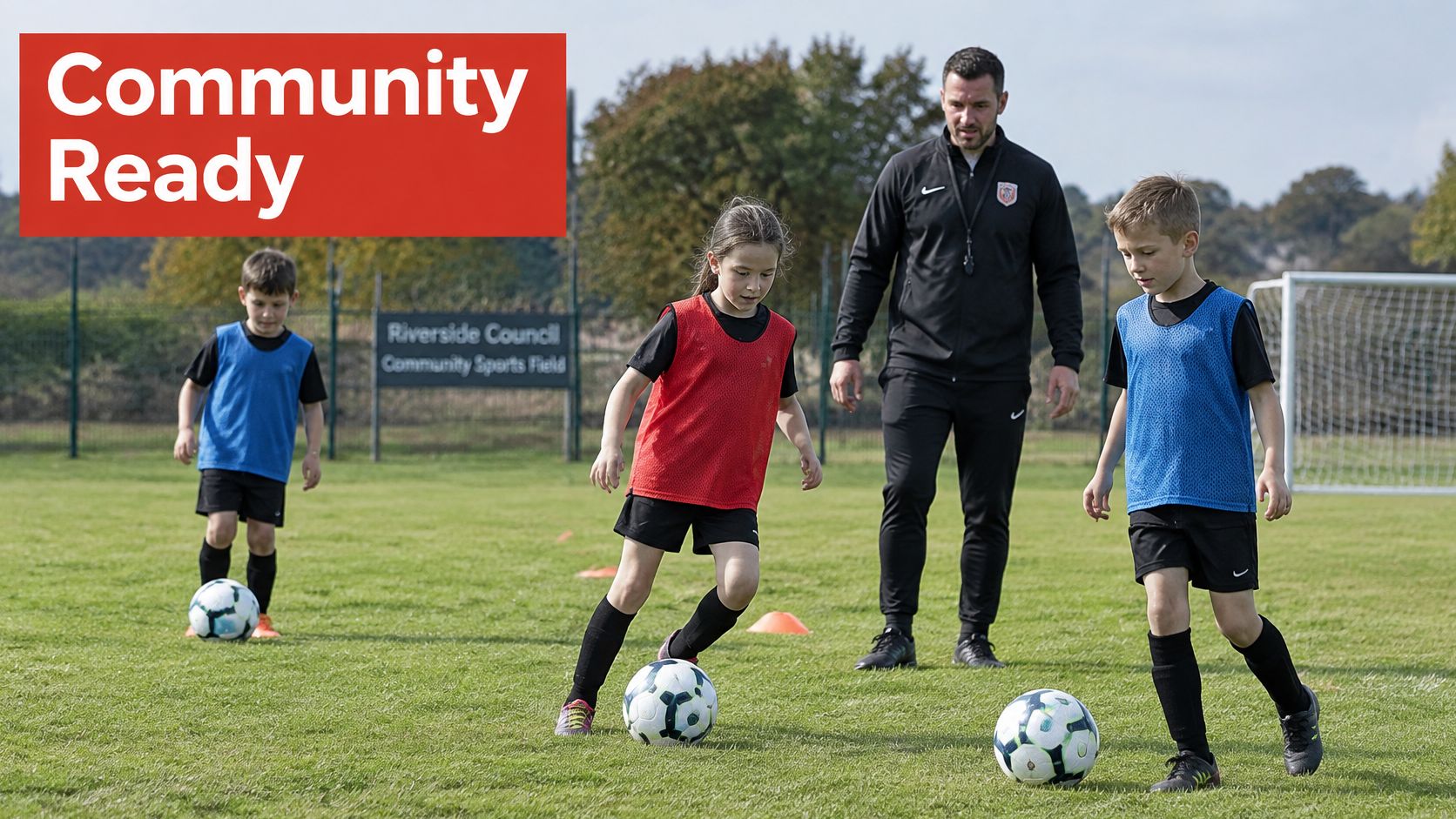
That spread is why balls work as outdoor promotional products: they get used where the audience already is. The setting decides the spec, and the spec decides what the artwork has to survive. Sizes below follow the table above.
- Junior clubs: Size 4 or 5 with a crest and squad identity. Weekly training means hundreds of strikes a month, so a hard-wearing casing and scuff-resistant print matter more than fine detail.
- School clinics: Size 3 or 4 in bold school colours. Daily sessions on mixed surfaces scuff prints faster than weekend matches, so choose thicker coatings over intricate marks.
- Councils and community events: Size 4 or 5 carrying the event name and sponsor marks. These balls are seen far more than they are struck, so large, high-contrast artwork earns more than match-grade construction.
- Corporate tournaments: Size 5 in brand colours that stay sharp through a full day of matches, where the print has to survive real play rather than a shelf.
- Giveaways: One simple mark that reads at a glance, on a ball sized for the recipient. A size 3 a child kicks beats a size 5 left in the garage.
- Formal fixtures: Size 5 with the competition's equipment rules confirmed before production. A mark that breaches those rules turns a match ball into a training ball.
Spec for the hardest use the ball will see, then fit the artwork to that life.
A ball handed out at a family fun day earns more when the day is planned around it. These activity ideas for family celebrations come from a Singapore events provider, so treat them as a general prompt for structuring games and challenges rather than an Australian supplier list. Plan the activity first, then put the branded ball in the middle of it.
Lifespan and Sustainability Matter Too
A size 5 ball that holds its shape and pressure for three seasons is a greener purchase than one built from recycled material that loses its shape in a term. The word recycled on a quote is not proof of lower environmental impact. Service life comes first, material claims second.
That order changes how you buy. A ball for occasional brand activation and one for weekly training carry different lifecycle expectations, and pricing them as the same product usually means overpaying for one and under-specifying the other. The audience for that decision is large: the Australian Sports Commission's evidence on children and youth in sport recorded football/soccer participation among 313,000 young people aged 15–24 in 2025, and the schools, universities and councils buying for that group need criteria they can defend.
Print durability sits inside the sustainability conversation too. Branding that flakes or fades makes a structurally usable ball unsuitable for continued promotion, and a ball nobody will put back on the field ends up in a storeroom either way.
Put these questions to any supplier, in writing:
- What percentage of the ball is recycled content, and from what source?
- Which certifications apply, and can you provide the reference?
- What durability testing has been done on the panels, seams and print?
- What packaging does it ship in, and can that be reduced?
- What are the warranty terms?
- How should the ball be disposed of at end of life?
When a purchase runs through a formal tender or a school procurement policy, written answers carry more weight than general green language because the decision has to be documented and defensible. Our eco products range is a practical place to compare material claims side by side.
Prioritise service life and fit for purpose, then compare material claims and packaging reduction. That order keeps both the budget and the waste line honest.
Choose Your Option and Lead Time
Two options cover most orders: Soccer Ball Pro, a PVC size 5 ball supplied deflated, and Soccer Ball Mini, a gloss PVC promotional ball supplied deflated for giveaways.
| Product | Construction | Supplied | Best for | Lead time |
|---|---|---|---|---|
| Soccer Ball Pro | PVC size 5 | Deflated | Training and matches | Confirmed per order |
| Soccer Ball Mini | Gloss PVC promotional ball | Deflated | Giveaways | Confirmed per order |
Because both arrive flat, the first job after delivery is inflation to playing pressure, and the first job before ordering is the quote. Sizes, construction, number of colours, matched-colour minimums, quantity and freight all move the price, so the quote is prepared per order rather than read off a list. Ask for the current lead time when you request it, then work backward from your event date with room for artwork approval and delivery.
That sequencing matters more than the ball choice itself. A size 5 for a pre-season training block needs the artwork signed off before the run starts, while Mini giveaways for a tournament day can be briefed against the same palette so the two arrive as one kit. If your colours use Black Special PMS matching, that carries a 500-piece minimum, so check the palette before the quote comes back rather than after.
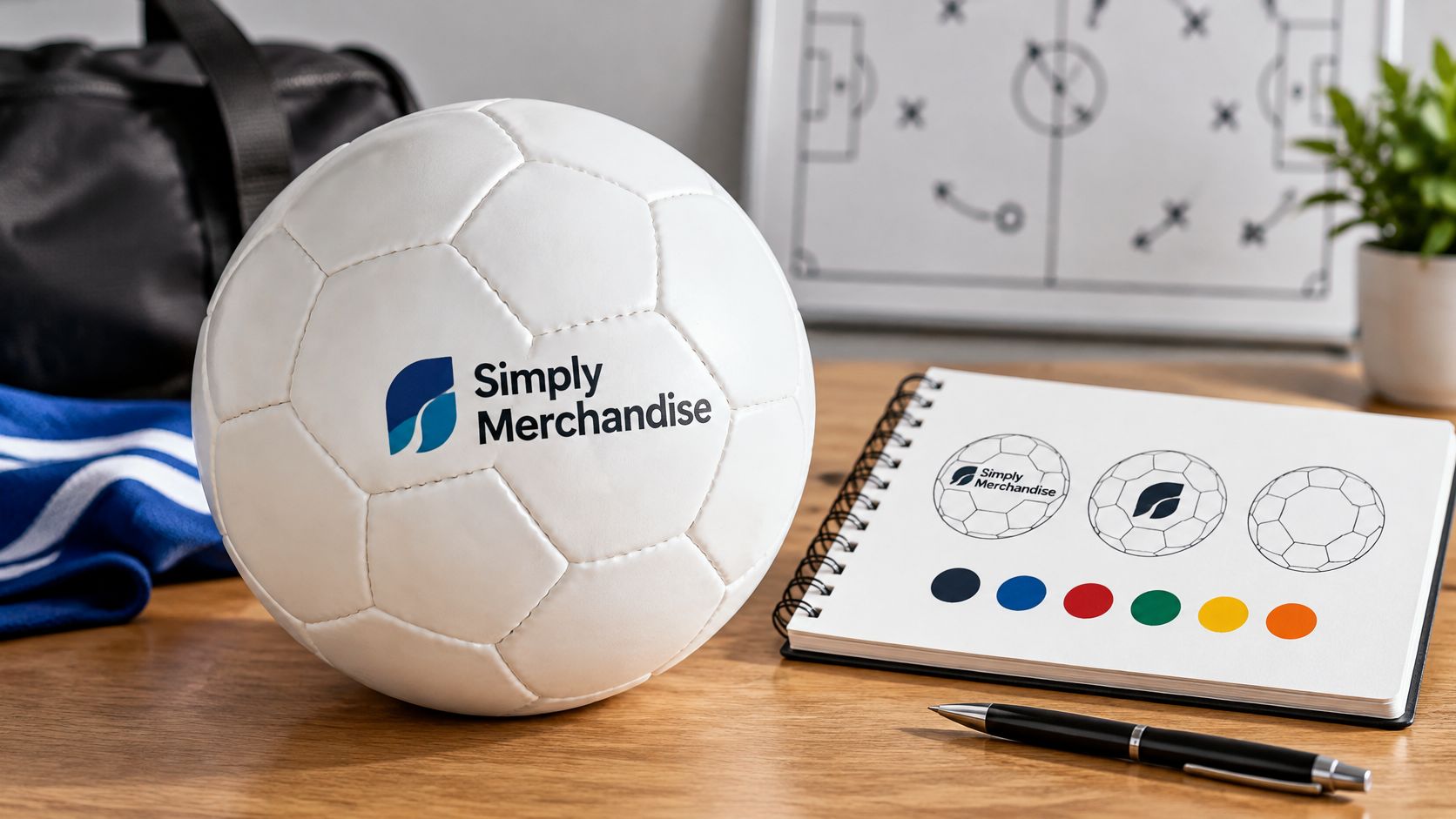
If your date moves closer, review the express promotional products range early rather than halfway through a production run.
Once the artwork checklist from the design section is ticked off, the final approval is quick: the sample tells you whether the seam placement, colour and mark size hold up on the finished ball.
Merchandise supplies custom branded teamwear for training, events and everyday group activities. Send us your artwork and the age group you're ordering for, and we'll lay out the panels, check the colours against your club or school palette and quote the run. Start your order at Simply Merchandise and we'll get the ball into pre-season training rather than next season's wish list.

