



The usual advice about cheap plastic water bottles is to buy more and pay less per unit. That only works if you're buying the right bottle. A low starting price can lose its appeal once you add artwork, freight, cartons at the venue and staff collecting discarded bottles after the event.
Buy against the job, not just the price list. A filled bottle for a short community event and a refillable gift for employees solve different problems. The better purchase is the one that delivers useful brand exposure without creating avoidable handling, cleaning or disposal costs.
Cheap Plastic Water Bottle Prices at a Glance
The lowest unit price can produce the most expensive giveaway. Treat the catalogue figure as the first line in a total-cost check that also covers branding, freight, event clean-up and any applicable state deposit or recycling rules.
Australia consumed 4.2 million tonnes of plastic products and packaging in 2024–25, according to the Department of Climate Change, Energy, the Environment and Water, so every cheap bottle is a disposal decision as well as a purchase. Low pricing here comes from efficient operations and bulk buying power while maintaining material quality.
Start with a shortlist that separates ready-to-drink handouts from bottles recipients will fill themselves. The two formats have different handling and repeat-use value, even when their starting prices look close.
Starting prices and best fits for cheap plastic bottles
| Bottle | Capacity | Starting Price | Best Fit |
|---|---|---|---|
| Spring Water with Custom Printed Label | 250ml, 350ml or 600ml | From $3.55 | High-volume sampling and event handouts |
| Arca MM Transparent | Confirm capacity before ordering | From $3.24 | Budget-led giveaways, subject to material and care checks |
| Action Sipper Bottle | Confirm capacity before ordering | From $6.62 | Sport and gym handouts where a sipping lid matters |
| Komo Plastic Drink Bottle | Confirm capacity before ordering | From $10.77 | Repeat-use gifts that recipients keep and refill |
| Accent Water Bottle - Frosted | Confirm capacity before ordering | From $10.76 | Students and office workers who carry bottles daily |
Starting prices leave out the finished-order total. Branding is shown as a separate cost in most cases, with additional branding and packaging options available. Check what the base configuration includes even when the product name refers to a custom label.
Use the products by price page to establish a budget, then request a complete quote for your chosen specification. Include the quantity, delivery destination, artwork and required date so each comparison reflects the order you will place.
Buying rule: Compare the unit price, branding add-on, freight and likely uses per bottle before shortlisting on price alone.
A refillable bottle can justify a higher purchase cost when recipients want to carry it. An unwanted premium giveaway can waste budget as quickly as an unsuitable cheap one.
Matching Bottle Capacity to Your Event
How long will recipients hold the bottle, and how hot will the day be? Answer those questions before choosing capacity. A compact bottle is convenient at a seated seminar, but frustrating if attendees must leave an outdoor activity to find more water.
Don't use a promotional bottle order as your entire hydration plan. Confirm drinking-water access, refill queues and who replenishes supplies before deciding how much water each handout needs to hold.
Capacity bands and their trade-offs
| Capacity | Best Use | Trade-off |
|---|---|---|
| 250ml | Kids' events, sampling booths and short sessions | Empties quickly, potentially requiring more refills or replacement bottles |
| 350ml | Conferences and seminars with regular breaks | Convenient to handle, but offers less water between outdoor breaks |
| 400ml to 600ml | Trade shows, everyday carry, offices and schools | Useful middle ground, but check bag fit and refill access |
| 700ml and above | Gyms, outdoor work and longer activities | Heavier when filled and requires more transport and storage space |
These are shortlisting categories, not drinking-water allowances. Weather, activity and individual needs affect consumption, so don't promise that a particular bottle size will last an entire session.
Capacity also changes how your team handles the order. Filled bottles need storage and movement to distribution points; empty refillable bottles need a practical place to fill them. A larger bottle can reduce trips to a refill point, but it also adds weight to a recipient's bag.
Check the shape as well as the volume
The notebook-shaped option in the shortlist illustrates why dimensions matter. Its bevelled body slides alongside books, laptops and folders, while its screw-on lid and finger grip support carrying. That's a different proposition from a round sports bottle intended for a gym bag.
For a commuter campaign, test the sample in the kind of bag recipients use. For a school event, check whether children can comfortably grip the body and operate the lid.
Use our steps to choose the right promotional products to connect the bottle to the audience rather than choosing by appearance. Before approving capacity, write down the event duration, confirm tap-water access and check the filled bottle's handling weight. Where deposit returns are part of the plan, container eligibility needs its own check.
Plastic Types That Survive Repeat Use
Material choice decides whether a cheap bottle stays cheap. A bottle that fails after a few washes costs more per use than a pricier one that lasts a season, so read the material and care details before comparing unit prices. A clear body says nothing about dishwasher suitability.
Single-use beverage packaging and refillable bottles belong in different categories. Describe a one-event handout rather than relabelling it as a long-term gift.
Plastic types, care limits and reuse suitability
| Material | Shortlist example | Care limits to confirm | Suits |
|---|---|---|---|
| PET | Custom-labelled spring water bottles in 250ml, 350ml and 600ml | Cold fill only; treat as single use unless the listing states otherwise | One-event giveaways with a collection plan |
| Reusable clear plastic (copolyester type) | The transparent style in the shortlist; the Arca MM Transparent is the catalogue's clear-body option | The written cleaning method and temperature limit, before assuming dishwasher or hot-fill use | Gifts intended for repeated cold-water use |
| Rigid frosted plastic | The notebook-shaped flat bottle in the shortlist | Whether it is dishwasher safe and the temperature range it tolerates | Daily carry where recipients can follow the stated care routine |
Care limits vary between products that look alike.
A metal-look base or lid does not make a plastic body suitable for boiling water or hot drinks. Whatever the listing states for the body material governs the bottle's real limits.
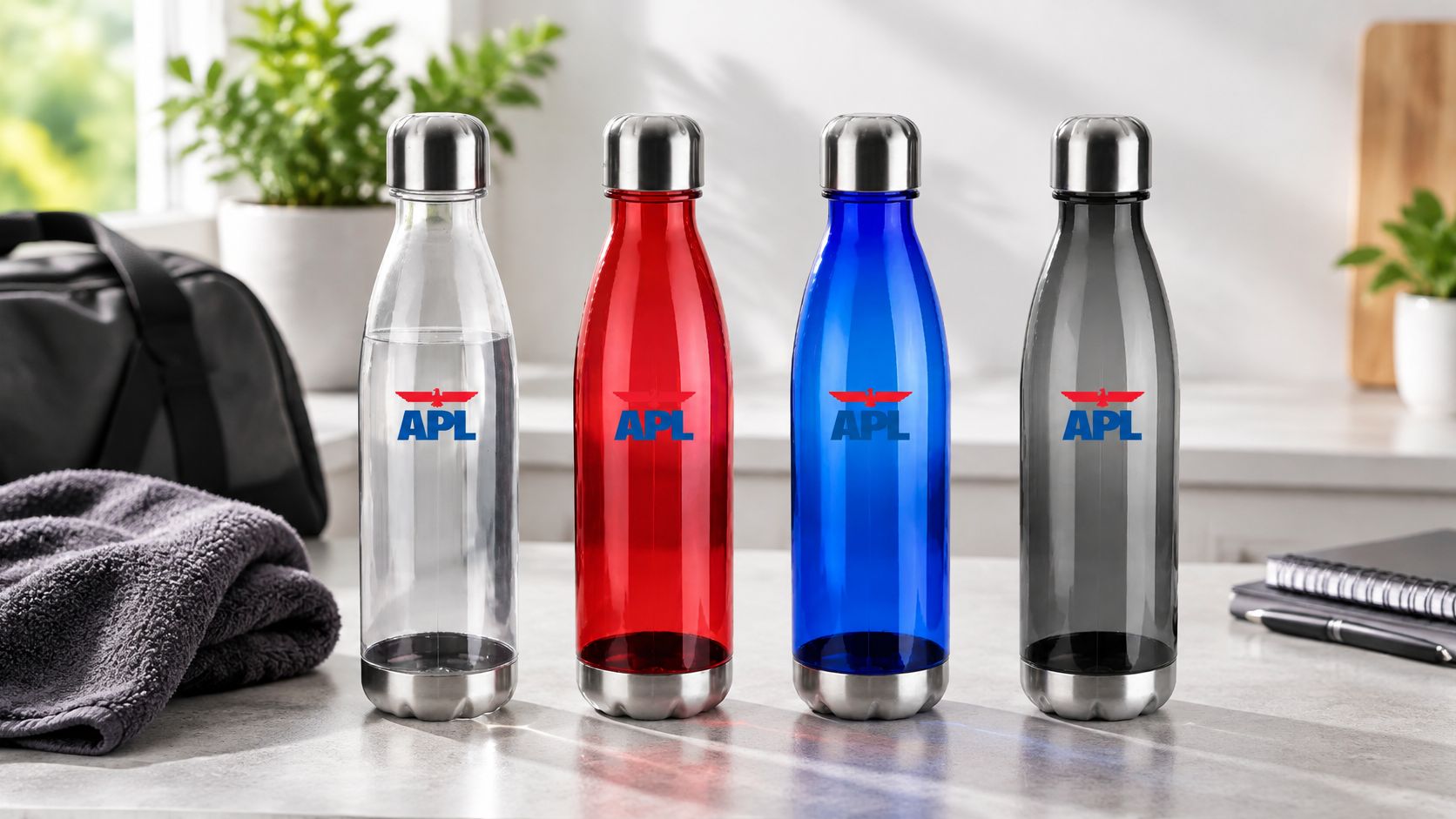
The Komo Plastic Drink Bottle shown here is a separate style from the table rows above, so take its care instructions from its own listing rather than from a similar-looking bottle.
Ask for evidence beyond BPA-free wording
The NSW Government's announcement on single-use plastics and harmful chemicals includes action on harmful chemical additives in plastic food and beverage packaging. Treat that as a reason to request meaningful material information while judging each product on its own documentation.
Ask for the plastic type, food-contact suitability, additive information and cleaning instructions in writing. BPA-free wording alone leaves dishwasher suitability, temperature resistance and expected service life unanswered.
Our low prices come from efficient operations and bulk buying power, never from lower-quality materials or cutting corners. Even so, the stated limits still have to fit the intended use, and confirming them costs nothing compared with replacing a failed order.
Only promise reuse when the product's documented care instructions support the way recipients will use it.
A handwash-only bottle can suit an office gift, provided recipients know how to care for it. An organisation planning to run shared bottles through a commercial dishwasher needs documentation that allows it, and staff time spent handwashing counts against the unit price you saved. Put care information into the event handover, not just the purchasing file, and avoid promising unlimited reuse or a lifespan the paperwork does not support.
Branding Choices That Keep Costs Down
Choose the printing method that fits the bottle and artwork, then refine the design. Starting with a complicated image and forcing it onto the cheapest bottle can create extra production work without improving recognition.
Our custom printing options help distinguish the available methods. The useful comparison is the finished result on your selected surface, not the method name alone.
| Method | Where it fits | What to check in the quote |
|---|---|---|
| Pad print | Smaller print areas, including small bottles; also commonly used on pens and note pads | Printable area, colour count, position and setup |
| Screen print | Larger print areas; also used on clothing, rulers and notebooks | Bottle suitability, artwork separation and additional-colour charges |
| Full-colour digital printing | Detailed or multicolour artwork on a compatible surface | Print coverage, production quantity and how colour is charged |
A small print area doesn't automatically mean the lowest setup charge. Ask for the actual comparison, especially if the design requires several colours or printing positions.
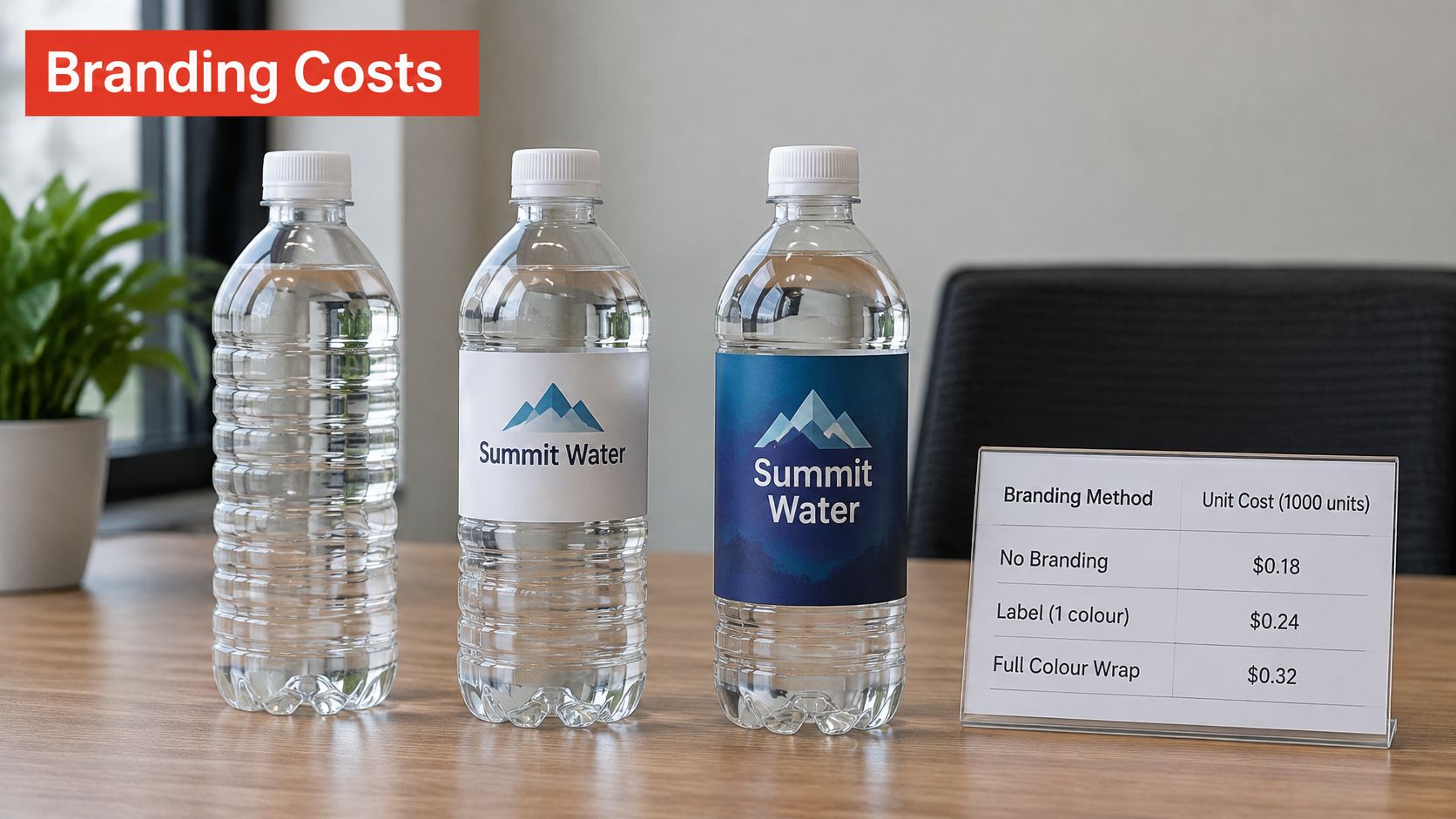
Simplify what recipients need to recognise
- Reduce colours deliberately. Request a simple logo treatment alongside the full-colour version. Compare the saving against any loss of brand recognition.
- Use the visible body area. Keep the main mark readable while someone holds the bottle, rather than squeezing the whole campaign message into a narrow space.
- Protect required information. Don't place decorative labels over product details, barcodes or deposit-scheme markings.
- Remove unnecessary copy. A bottle needs to identify your organisation. It doesn't need to reproduce the brochure.
Check the artwork at its actual printed size. Fine lines and small text that look clear on a large monitor can become difficult to read on a curved surface.
I'd favour a clean single-colour logo over a crowded design for a busy trade show. Request both versions if colour is central to the campaign, but approve the more expensive treatment only when it adds something recipients can see.
How to Compare Quotes Without Surprises
Compare quotes against a shared specification. Otherwise, you may be comparing an unbranded bottle delivered to a warehouse with a decorated, individually packed order delivered to an event venue.
The total matters, but so does what the quote commits each supplier to deliver.
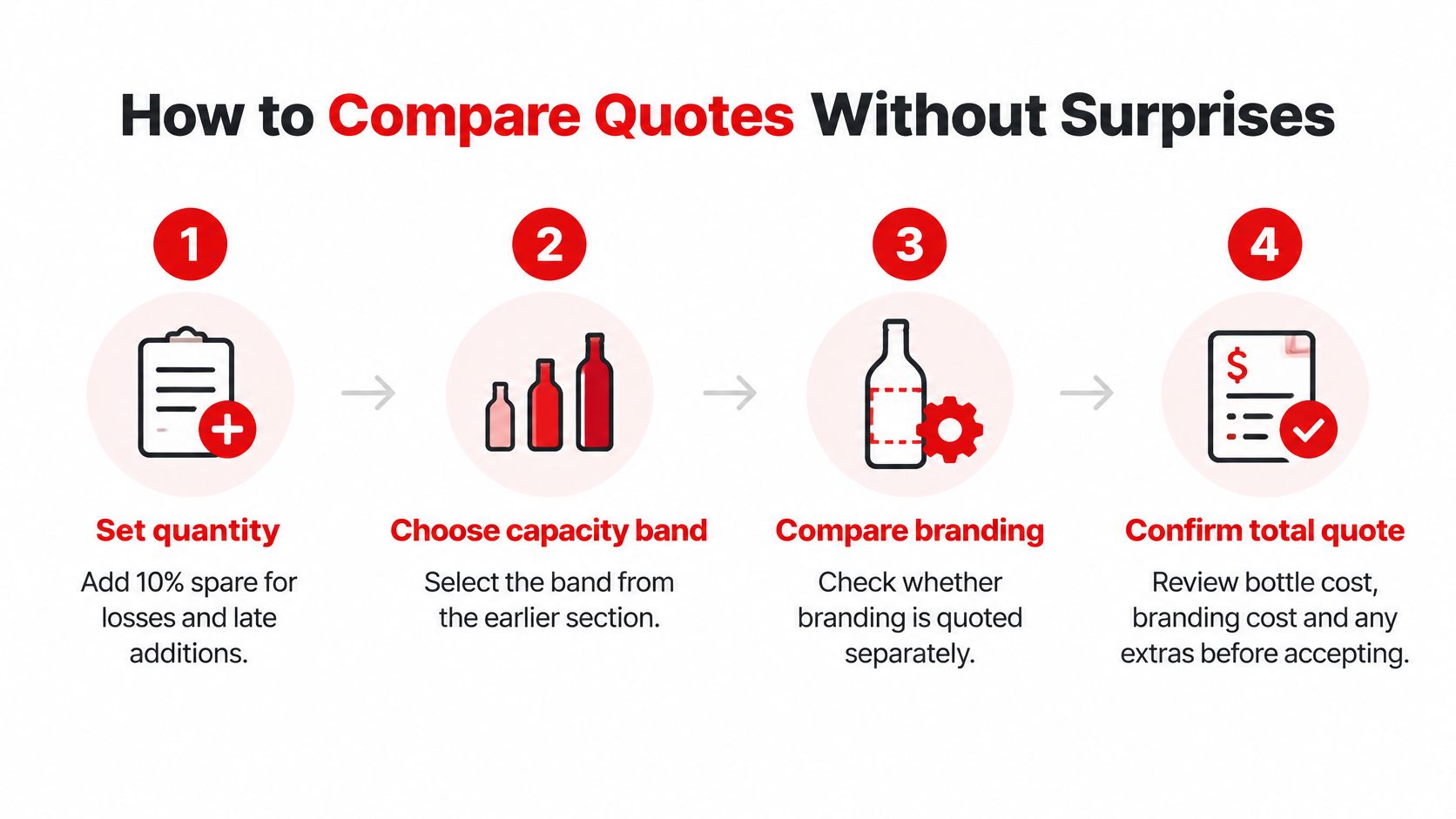
Build a like-for-like purchasing brief
- Set quantity against distribution. Separate confirmed recipients, staff needs and a clearly identified spare allowance rather than adding an arbitrary surplus. This prevents a cheaper volume tier from turning into paid storage for unwanted stock.
- Fix capacity and construction. Specify the size, material, lid style and whether bottles arrive filled or empty. That prevents an apparently cheaper substitute from changing the event's water-supply or handling requirements.
- Inspect a sample. Our sample items are generally unbranded or may carry other companies' logos, and branded samples may be available at cost. Check lid operation, grip, bag fit and cleaning access before committing the whole budget.
- Request the landed total. Include the bottle, decoration, setup, packaging, freight and any venue-delivery requirements, with GST treatment clearly shown. Get each inclusion or exclusion written down so your accounts team isn't comparing incomplete totals.
- Compare meaningful quantity tiers. We offer bulk discounts and a Lowest Price Guarantee; confirm whether the exact competing specification qualifies before relying on it. Buy the larger quantity only when you have a credible use for the additional bottles.
- Attach the product documentation. Include material, care and recycled-content details with the approved quote, rather than leaving them in a separate sales conversation. This protects the specification if another team member takes over the order.
- Calculate cost per useful use. Divide total landed cost by the realistic number of recipient uses, not an optimistic lifetime estimate. Add separately identifiable event handling and clean-up costs so an inexpensive disposable format doesn't receive an artificial advantage.
For a useful explanation of allocating order costs, Dirt Cheap Headwear's guide to calculate your custom hat unit costs provides a transferable approach. Apply the costing logic to bottles, but use the charges and inclusions from your actual bottle quote.
Count the work after delivery
A carton arriving at reception isn't the end of the purchasing job. Someone must store it, move it, distribute its contents and deal with leftovers.
Budget check: A bulk discount is a saving only when the extra stock has a planned destination.
Use our request-for-quote form with the artwork, delivery address, event date and preferred specification attached. Ask for alternatives against that same brief so you can see whether the saving comes from quantity, decoration or a different product.
Recycling and Deposit Rules to Check First
Check the destination jurisdiction, not just the supplier's location. Container-deposit systems operate separately, and a promotional drink bottle isn't automatically an eligible beverage container. The distinction between packaged water and an empty reusable giveaway matters.
The Enviro Essentials jurisdiction overview describes jurisdiction-specific schemes and proposed NSW changes to beverage-container design, including tethered lids. Treat proposed changes as a procurement watchpoint, not an already-operative blanket requirement.
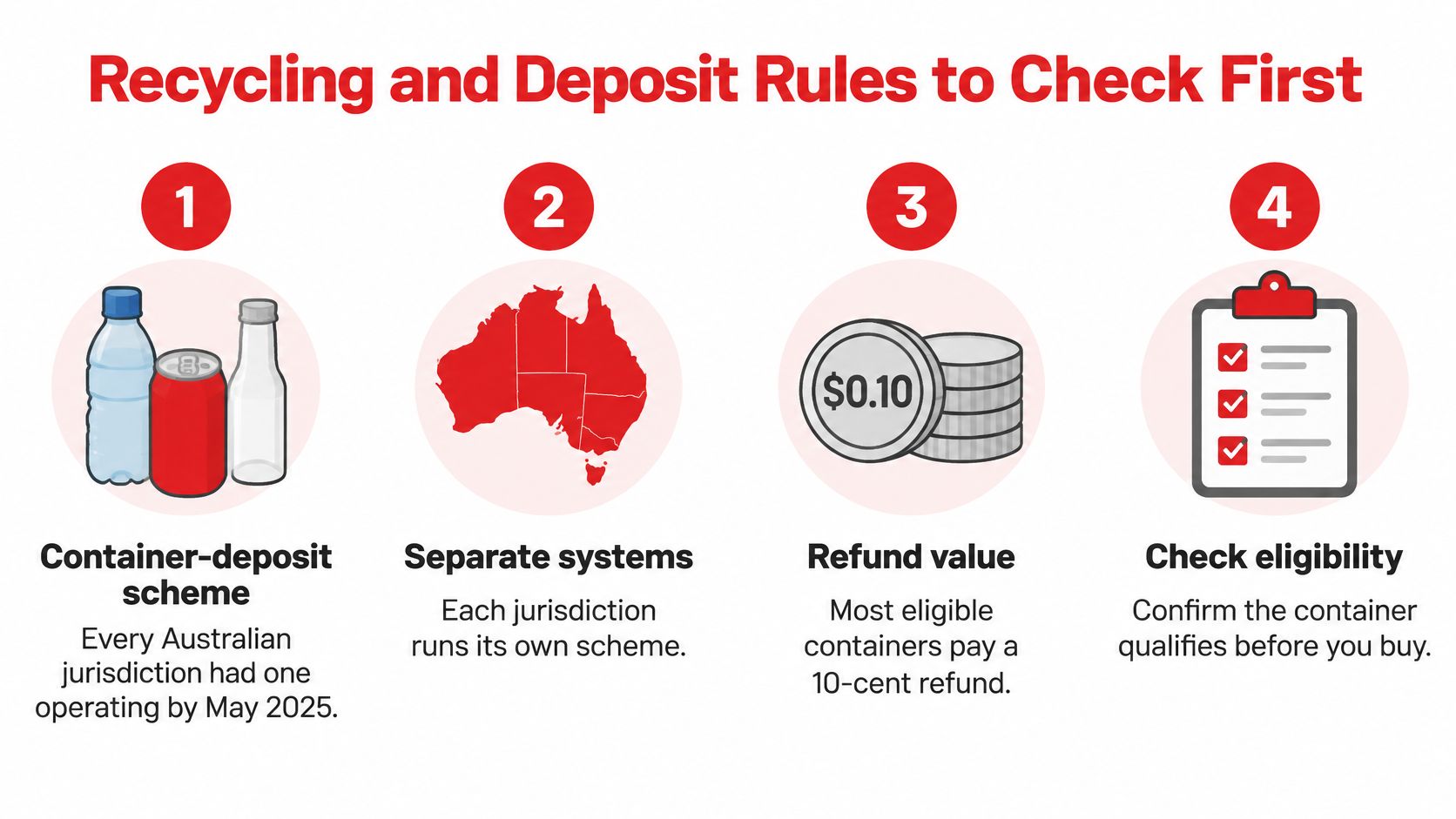
Eligibility requires more than the right size
For a worked example, the Australian Government recycling guidance identifies eligible Western Australian PET beverage containers from 150mL to less than 3L. Being inside that size band isn't sufficient on its own: the container must satisfy the scheme's other eligibility requirements.
Recyclability also doesn't guarantee recovery. Australia's plastic packaging recovery rate was 20% in 2021–22, with 1.28 million tonnes consumed and 0.26 million tonnes recovered, according to the Department of Climate Change, Energy, the Environment and Water.
Turn those distinctions into purchase conditions rather than leaving disposal to attendees.
- Confirm scheme eligibility. Check the beverage category, container size and product registration requirements for the jurisdiction where distribution occurs.
- Preserve identification. Keep required product information and scheme markings visible, and have the finished label checked before printing.
- Document recycled content. Request evidence and identify whether the claim covers the bottle body, other packaging or the complete product.
- Review lid requirements. For NSW orders, confirm the current position on proposed tethered-lid rules at the time of procurement.
- Assign collection responsibility. Name the organiser, venue contractor or collection partner responsible for empty containers, including removal after pack-down.
Make disposal practical at the venue
Place collection points where people finish drinks, not only where they receive them. Agree with the venue which stream accepts the selected container, and make signs specific enough that attendees don't have to interpret a general sustainability message.
For reusable giveaways, don't assume the beverage-container return stream accepts them. Check the material and local disposal pathway separately.
Our eco products range can support alternative shortlists, but assess each option against its documented composition and intended use. A broad environmental description isn't a substitute for a collection route that works at your event.
Confirm Your Bottle Choice Before You Order
Use cheap plastic water bottles for a defined one-off event with a workable collection plan, and choose a documented reusable format when recipients are expected to keep refilling it. The right specification is more valuable than the lowest headline price.
Your final choice should have a clear purpose:
- One-off distribution: Beverage-style PET with an agreed collection and recovery route.
- Everyday carry: A manageable body shape, suitable lid and written care instructions.
- Longer-term gifting: A durable reusable construction that matches recipients' cleaning habits and drink preferences.
The disposal decision deserves attention. New South Wales generated 936,000 tonnes of plastic waste in 2023–24, of which 16% was recycled, according to the NSW State of the Environment report.
Approve the physical product before the production run
Order a sample, test the lid and carrying experience, then request a total quote covering branding, packaging and freight. Make sure the person approving artwork also sees the product's care limitations and intended disposal route.
If the deadline is urgent, ask our team about express water bottles rather than assuming every style can meet a rush order. Confirm the available product, decoration and delivery arrangements before approving production.
A well-chosen bottle gives recipients a reason to keep your brand close. Make it useful enough to earn that place in their daily routine.
Merchandise offers branded drink bottles, sampling options, artwork guidance and bulk discounts to help you match the product to the campaign. Visit Simply Merchandise with your quantity, artwork, delivery destination and event date, and request a complete quote before committing your budget.

