



The sample arrives with a sticker on the cover: made from stone, no trees, waterproof. You have a quote for 500 branded notebooks sitting in your inbox, a conference running across three outdoor sites in the middle of winter, and a colleague asking whether the recycling bin at head office will take them in March.
Both questions have real answers, and neither one is printed on the sticker. Stone paper is a useful material with a short list of things it does better than wood pulp, and a longer list of claims worth checking before you put your logo on 500 of them.
What a Stone Paper Notebook Is Made Of
A stone paper notebook holds pages made mainly from calcium carbonate, usually quarried as limestone or marble, bound with a small amount of high-density polyethylene (HDPE). No wood pulp goes into the sheet. The mineral carries the bulk and the polymer holds the particles together, roughly the way a concrete path works: stone for substance, binder for cohesion.
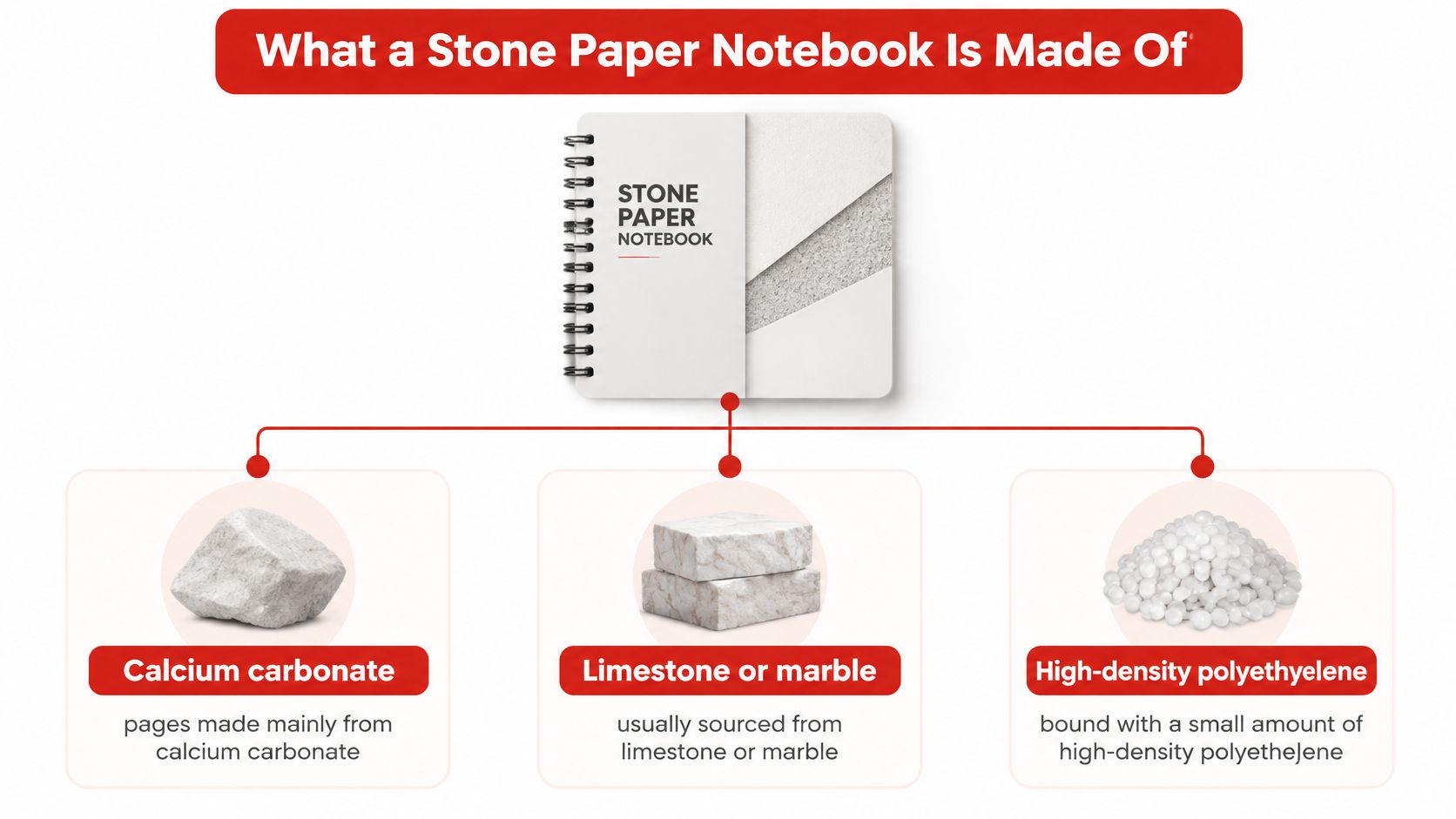
That structure explains the feel in your hand. A non-fibrous sheet has no grain to fight and no absorbent fibre to drink ink, so pages stay flat and the surface stays smooth under a fine-tipped pen.
What the numbers on a listing mean
Australian specs for these notebooks commonly report a sheet around 120 microns thick, an equivalent paper weight of about 144 gsm, A5 formats near 148 × 210 mm and roughly 144 pages (Look Brilliant product page). Microns measure thickness, not mass, so read the gsm figure as a bridge to the 70 gsm or 100 gsm sheets you already buy rather than as the same measurement.
One name, several recipes
Listings use "recycled stone", calcium-carbonate-based material and polymer-heavy blends under the same words, and the ratio rarely appears. Ask any supplier for thickness, gsm, page count, format and binder type in writing before you compare two quotes side by side.
The category also landed in Australia against a huge paper habit. The country used approximately 1.72 million tonnes of printing and writing paper annually, a figure reported in 2019 in coverage of Australian stone paper notebook maker Karst, whose sheets are manufactured primarily from calcium carbonate combined with a relatively small quantity of HDPE binder (Inside FMCG).
The sentence worth repeating to a colleague is simple. A stone paper notebook is a notebook whose pages are mineral powder and a polymer binder instead of wood fibre.
Stone Paper Versus Standard Paper Side by Side
Put the two notebooks on the same desk and eight differences decide which one belongs in the campaign. The table is the scorecard; the notes after it explain how to read the rows buyers most often misjudge.
| Feature | Stone paper notebook | Standard paper notebook |
|---|---|---|
| Base material | Calcium carbonate from limestone or marble with a small HDPE binder | Wood-pulp cellulose fibres |
| Typical sheet weight | About 120 microns, roughly 144 gsm equivalent | 70 gsm to 100 gsm in everyday notebooks |
| Water resistance | High, pages survive spills and light rain | Low, pages cockle and ink can bleed |
| Tear resistance | High, dense non-fibrous sheet | Moderate, tears easily along folds |
| Ink absorption | Low, ink sits on the surface and needs drying time | High, ink soaks in quickly |
| Sunlight sensitivity | Degrades under prolonged sun exposure | Yellows and weakens over time, faster in acidic conditions |
| Recyclability | Depends on local council and facility acceptance | Widely accepted in standard paper recycling streams |
| Price reference | Budget through premium, with small formats at the low end of the range | Entry-level to premium, priced by brand, format and page count |
The short version: stone paper wins on water and tear resistance, standard paper wins on ink behaviour and on the odds that your council will take it.
How to read the rows
The first row explains most of the others. A sheet of mineral powder held together by polymer has no fibres for liquid to travel through, so water cannot soak in and neither can ink. One material decision produces opposite consequences in two different rows.
It helps to split the table into two groups. Water, tear and ink rows describe behaviour in the hand, on the day the notebook gets used. Sunlight and recyclability describe behaviour over months and at disposal, and those rows matter more to the product's environmental claims than the headline suggests.
The recyclability row is where "no trees" meets Australian reality. A page made of calcium carbonate and HDPE has no automatic path through a paper recycling stream, so the honest test is what your local council accepts at the kerb, not what the front cover promises. A notebook can be tree-free and still end up in landfill if the facility will not take it.
The row about sunlight
A University of Melbourne study of stone papers describes the material as calcium carbonate plus a small amount of HDPE instead of cellulose fibres, designed to degrade under sunlight, and examines how it deteriorates and how it stores. A notebook left on a sunny windowsill for months is not the same object as one that lives in a bag.
The table compares typical products, not every brand. Rank the rows that match your use case with a structured way to choose promotional products before you shortlist anything.
How Stone Paper Performs in Wet, Outdoor and Daily Use
A site inspection in drizzle, a festival gate where notes are taken one-handed, a backpack dropped on wet grass: fieldwork is where this notebook stops being a novelty and becomes kit. The question shifts from what the sheet can do to whether the whole setup, page, pen and routine, works at the pace the field demands.
Wet weather also changes what counts as a good pen. Indoors, a slow-drying gel pen is a minor annoyance. On site, where the book is closed seconds after the last word, it is the difference between a legible log and a smeared one.
Pick the pen for the field, not the desk
Ballpoints and quick-dry rollerballs suit clipboards and cold mornings better than the gel pen favoured at a desk. Choose pens made for coated or non-porous surfaces rather than the cheapest bulk option, and test before you place a large order. For outdoor activations and wet-weather campaign kits, outdoor promotional products pair naturally with this material because every item in the kit faces the same weather.
The three-step test on a sample
- Write a line with the pen you plan to give away, using normal pressure.
- Wait thirty seconds before you touch the page.
- Rub it with your thumb, then check the reverse side for smudging and bleed-through.
If the line survives step three and the back of the page stays clean, the pen and the page are compatible. If it does not, change the pen rather than the notebook.
A site log written during a shower still reads clearly at the next inspection, provided each entry gets its drying time before the book snaps shut. Build that short pause into the routine and the material does its job.
Sustainability Claims Worth Testing Before You Believe Them
The brochure makes its argument in four words: no trees, less water. Both parts are true as far as they go, and neither answers the question a procurement team asks, which is whether this specific notebook, made in this factory and shipped to Australia, beats the alternative.
What the water and carbon numbers compare
One widely cited comparison reports 27 gallons of water per metric tonne for stone paper against 15,500 gallons for conventional paper, and an Australian industry account claims a 60% smaller carbon footprint (CPA Australia's In the Black). Those figures compare raw material manufacture. They're producer-linked comparisons rather than an independent national life-cycle assessment, and they don't cover quarry transport, resin production, the cover, the spiral, the freight to Australia or what happens to the notebook in five years.
The whole product is the product
Run the comparison on the object in the box. Resin content and where the polymer comes from, a laminated cover, a metal spiral, an elastic closure, ocean freight, the notebook's working life and the odds a user can recycle it all shift the total. A heavy cover can outweigh a saving in the pages.
Every claim about the sheet is a claim about part of a product. Judge the part, then judge the rest.
Stone is not a synonym for plastic-free
HDPE is a plastic. The binder is a small share of the sheet, but it's the reason the pages resist water and the reason some facilities have no idea what to do with them. "Stone" describes the filler, not the absence of polymer.
What still deserves credit
Waterproof pages and tear resistance keep a notebook in service longer, which avoids reprints, replacement orders and the freight that comes with them. For a like-for-like comparison on the recycled-paper side, the B6 Bamboo Notebook pairs a bamboo cover with 80 leaves (160 pages) of 70gsm recycled lined paper, a different material story you can sit beside the mineral one. Our eco products range covers that comparison in more depth before you commit to a claim on the cover.
How to Dispose of a Stone Paper Notebook in Australia
The mistake is assuming the bin outside the office takes it. A stone paper notebook is not automatically recyclable in Australia: whether it can be recycled depends on your council and the facility that handles your kerbside collection, and plenty of municipalities accept the pages as neither paper nor plastic. Product guidance says stone paper belongs in the No. 2 HDPE stream only where the local service accepts it (Karst Australia FAQ).
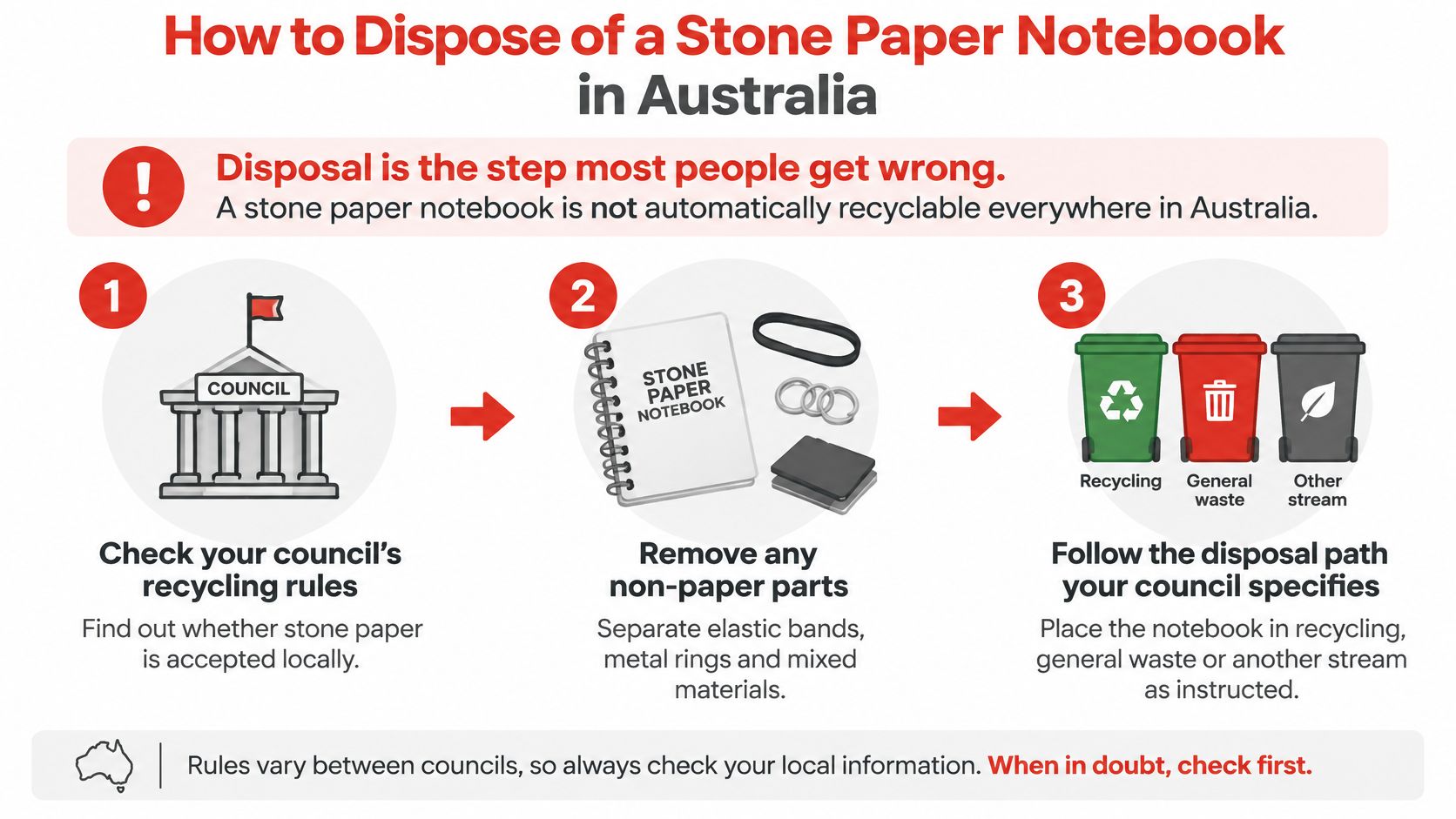
1. Check your council's rules. Look for whether No. 2 HDPE plastics are accepted in kerbside recycling. One page on the council website or one phone call settles it.
2. Strip the non-paper parts. Elastic closures, metal spirals, adhesive labels and laminated covers go in separate streams. A notebook made of pages plus hardware isn't one material.
3. Use the plastic stream only if it's accepted. Clean, dry pages go in with No. 2 HDPE where your council takes them.
4. Otherwise, general waste. If the notebook isn't accepted, the rubbish bin is the honest destination, because a wrong bin contaminates a whole load.
5. Never use the organics bin. Stone paper is described as non-biodegradable under normal composting conditions, so food and garden organics collections are the wrong place for it.
6. Print the instructions for the recipient. For business orders, put disposal guidance on the packaging or an insert card. A line on the inside cover travels further than a paragraph on a website nobody visits.
Before the bin: read your council's page, not the sticker on the cover.
Independent reporting also notes that some sorting facilities mistake stone paper for ordinary paper, or reject it from both the paper and plastic processes. That's why step one comes first.
Where Stone Paper Notebooks Fit in Promotional Campaigns
A trade show delegate drops a tote bag of giveaways in a wet car park and finds it again a week later. That soggy bag is the best test of a promotional notebook.
Stone paper earns its place where the notebook will meet weather, grit or a long stretch of handling: field teams and site crews, outdoor event giveaways, onboarding kits for staff who move between offices and sites, and gifting programs where a waterproof cover reads as practical rather than preachy. The "no trees" headline works as a talking point rather than a selection criterion. Judge the notebook on what the recipient will put it through, and on where the pages can go once they are full.
What the 2026 Australian listings show
Pricing sits far apart depending on format and seller, and two current listings make the gap concrete.
| Listing | Size | Pages or leaves | Starting price |
|---|---|---|---|
| Printibly stone paper notebook | 130 × 183 × 9 mm | 68 leaves | From A$5.00 |
| BirdLife Australia Lyfer Field Stone Paper Notepad | A6, 105 × 148 mm | 64 pages | A$16.00 |
Printibly lists an Australian stone paper notebook at a starting price of A$5.00 per unit in 2026 (Printibly). BirdLife Australia lists the Lyfer Field Stone Paper Notepad at A$16.00 (BirdLife Australia). A small field pad sold to support a conservation organisation serves a different buyer than a bulk promotional run, so compare cost per usable page and confirm current pricing with each seller.
Matching the branding method to the artwork
Pad print is a smaller print, usually used on smaller items like pens or note pads. Screen print is the larger print, applied to products like clothing, rulers and notebook covers.
The choice follows the artwork more than the budget. Fine lettering, detailed artwork and large solid designs may each need a different treatment, and the size, placement and colours are approved on the artwork proof. A cover design full of small text belongs in a conversation with the printer before the order, not after it.
The fit test
Choose the mineral sheet when pages will face moisture, long handling or outdoor use, and the message you want to send is durability. Choose a standard paper notebook when the audience expects heavy annotation, fountain-pen writing or a page that takes a highlighter.
The Moleskine Classic Hard Cover Notebook - Large offers 120 leaves (240 pages) of 70 gsm ivory-coloured lined paper in a hard cover A5 format with a ribbon and elastic closure, and the artwork proof is where the size, placement and colours of your branding are confirmed before production. The branded merchandise for business range covers notebooks, pens, note pads and other staples, so a matched campaign kit can be assembled from one supplier.
Confirm These Specs Before You Order Branded Notebooks
A failed notebook order rarely announces itself on the proof. It shows up later: a "recyclable" cover bound with a metal spiral nobody can separate, or a fine serif logo that filled in on the coated mineral sheet. Work through this checklist with the supplier before you approve artwork, because each item is cheap to confirm now and expensive to discover on a pallet.
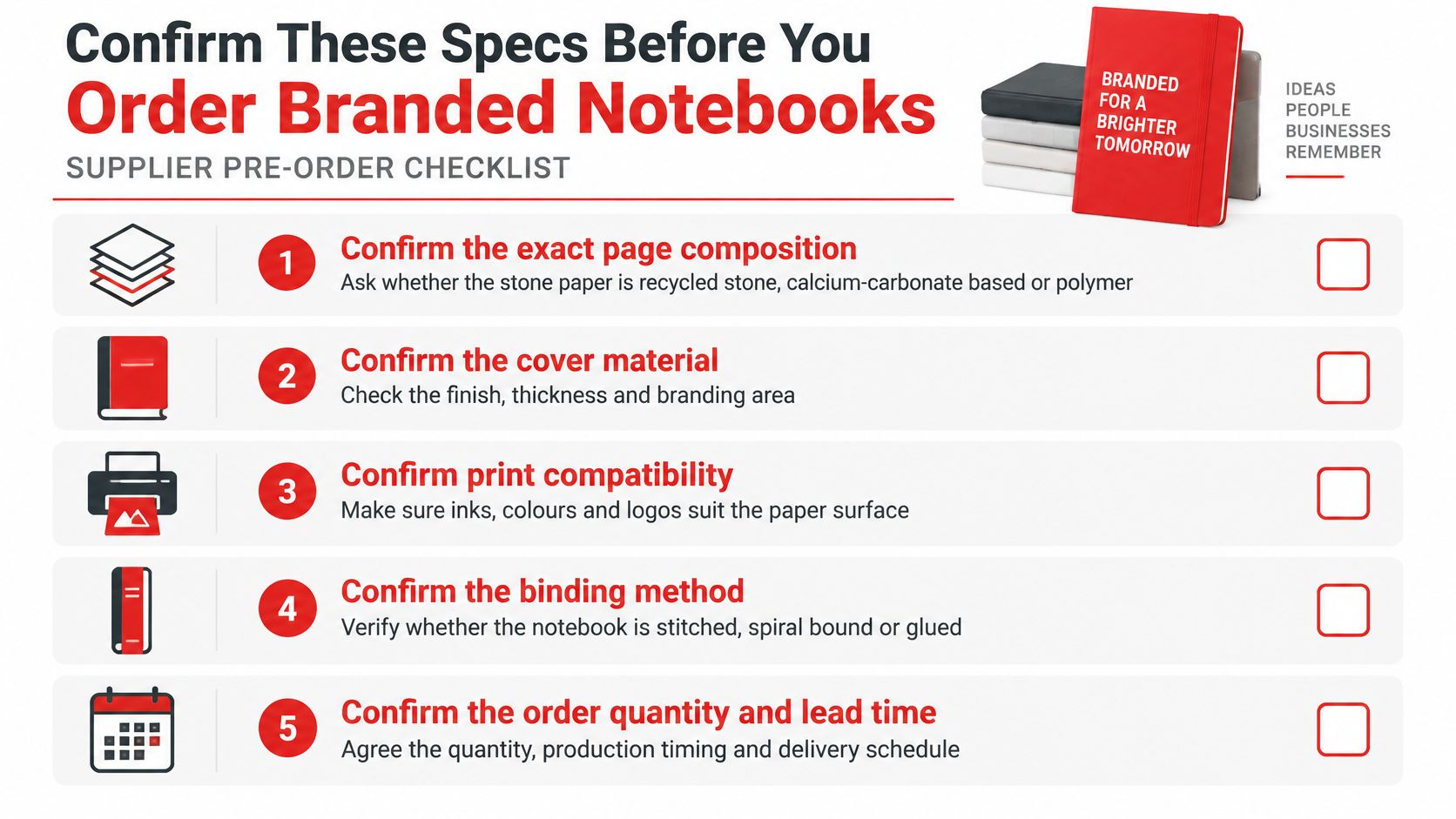
Page composition. Ask whether the stone paper is recycled stone, calcium-carbonate based or polymer bound, and get the answer in writing. Supplier listings themselves swing between "recycled stone", calcium-carbonate material and blends containing polymer binders (Brand Connect stone paper notebook listing), so brochure wording rarely matches the spec sheet.
Recycled content and evidence. Request the recycled-content percentage, product-specific life-cycle evidence, the scope of any certification and the Australian disposal instructions. A certification covering the mill doesn't automatically cover a notebook bound with a metal spiral.
Disposal instructions on the product. Ask for the guidance to be printed on the packaging or an insert card. The person who receives the notebook is the one who decides which bin it goes in.
Branding method against the design. Fine lettering, detailed artwork and large solid designs may need different treatments, and the size, placement and colours are approved on the artwork proof. Ask how detailed line work behaves on a coated mineral surface before it lands on a thousand covers.
Proof approval. Sign off in writing, with colour references, before production. A screen proof won't show how a metallic ink sits on a non-porous sheet, so request a physical pre-production sample on the actual material for large runs. If your artwork needs to be supplied print ready, the KLM Design & Prints leaflet guide sets out bleed, resolution and file setup plainly.
A sample and the three-step test. Write, wait, rub. Write on the page, let the ink dry, then rub it to check for smudging. Confirm the pen you're supplying works with the page you're buying.
Timing and express options. Allow room for proof approval, then ask what happens if the deadline moves. Express services exist for rush orders, but they cover specific products, so confirm your notebook format qualifies. The custom printing options page explains which methods suit which surfaces.
Specified properly, a notebook stops being a giveaway and becomes the thing your contact reaches for on a wet Tuesday six months later.
Merchandise supplies branded notebooks across Australia, with free artwork layouts and unlimited revisions before anything goes to print, plus sampling options and express services for urgent deadlines. Share the campaign, the conditions it runs in and your budget per unit, and the team will match the format and branding method to fit. Start your notebook order with this checklist in hand.

