



You're choosing jerseys for a Saturday training squad in Brisbane, and the artwork is almost ready. Then the questions arrive: will the fabric feel sticky in the heat, will everyone fit the same cut, and can a late joiner get a matching top? Getting custom jerseys in Australia right means looking beyond the mock-up and the price per garment.
A good order gives people something they're comfortable wearing, makes replacements manageable and leaves you with a plan for unwanted stock. Start with the job the jersey needs to do, then approve the fabric, decoration and fit together.
Custom Jersey Options at a Glance
Fabric, decoration and tested sun protection shape the starting specification. A breathable training jersey doesn't need the same construction as a hospitality uniform, and an embroidered crest doesn't behave like an all-over printed design.
Use the table as a shortlist, not a purchase order. The use case tells you which direction to take; the other columns identify what needs confirming on a physical sample.
Starting jersey specification by use case
| Use case | Fabric to specify | Decoration that suits | Sun protection target |
|---|---|---|---|
| Summer training and club games | Lightweight knitted polyester | Screen print or sublimation for numbers | Tested good protection or better outdoors |
| Outdoor events in Queensland and northern Australia | Polyester mesh with ventilated side panels | Sublimation for full-colour designs | Tested excellent protection on the complete garment |
| School sport and carnivals | Lightweight polyester with reinforced seams | Embroidered names and numbers, subject to sample approval | Tested good protection or better on the garment |
| Corporate or hospitality uniforms | Breathable knit blend | Embroidered logos | Confirm a tested classification for outdoor duties |
| Supporter or fan merchandise | Polyester knit | Screen print or heat-applied graphics | Not usually a purchasing requirement for indoor wear; specify protection for outdoor use |
An important distinction: a starting specification isn't proof of performance. A lightweight polyester can still have a dense construction, while a generous mesh panel may change the garment's sun-protection result. Request evidence for the actual style you're ordering.
Decoration also changes how a jersey feels. Large embroidered numbers can be stiff on a light school top, so compare a stitched sample with a printed alternative before committing. For outdoor activities, consider compatible headwear alongside the jersey rather than expecting a short-sleeved garment to cover every exposed area.
Before choosing colours, settle these questions:
- Wear location: Is the jersey for a shaded indoor venue, an exposed oval or staff moving between both?
- Heat and duration: Will people wear it briefly for photographs or through extended activity in humid conditions?
- Wearer requirements: How many people need fitting, and which cuts or coverage options will they need?
Those answers give you a useful brief. A logo file on its own doesn't.
Why Australian Teams Are Ordering Their Own Jerseys
Say a community club wants to replace its collection of mismatched training tops. The coach needs readable numbers, the committee wants sponsor recognition, and new players want to feel part of the group. A shared jersey can serve all those purposes, provided the club decides which ones matter most.
The same applies to a school choosing house colours or a business entering a community sports event. The jersey gives people a visible connection, but the practical requirements remain different: a playing top needs freedom of movement, while an event uniform may need clear identification above everything else.
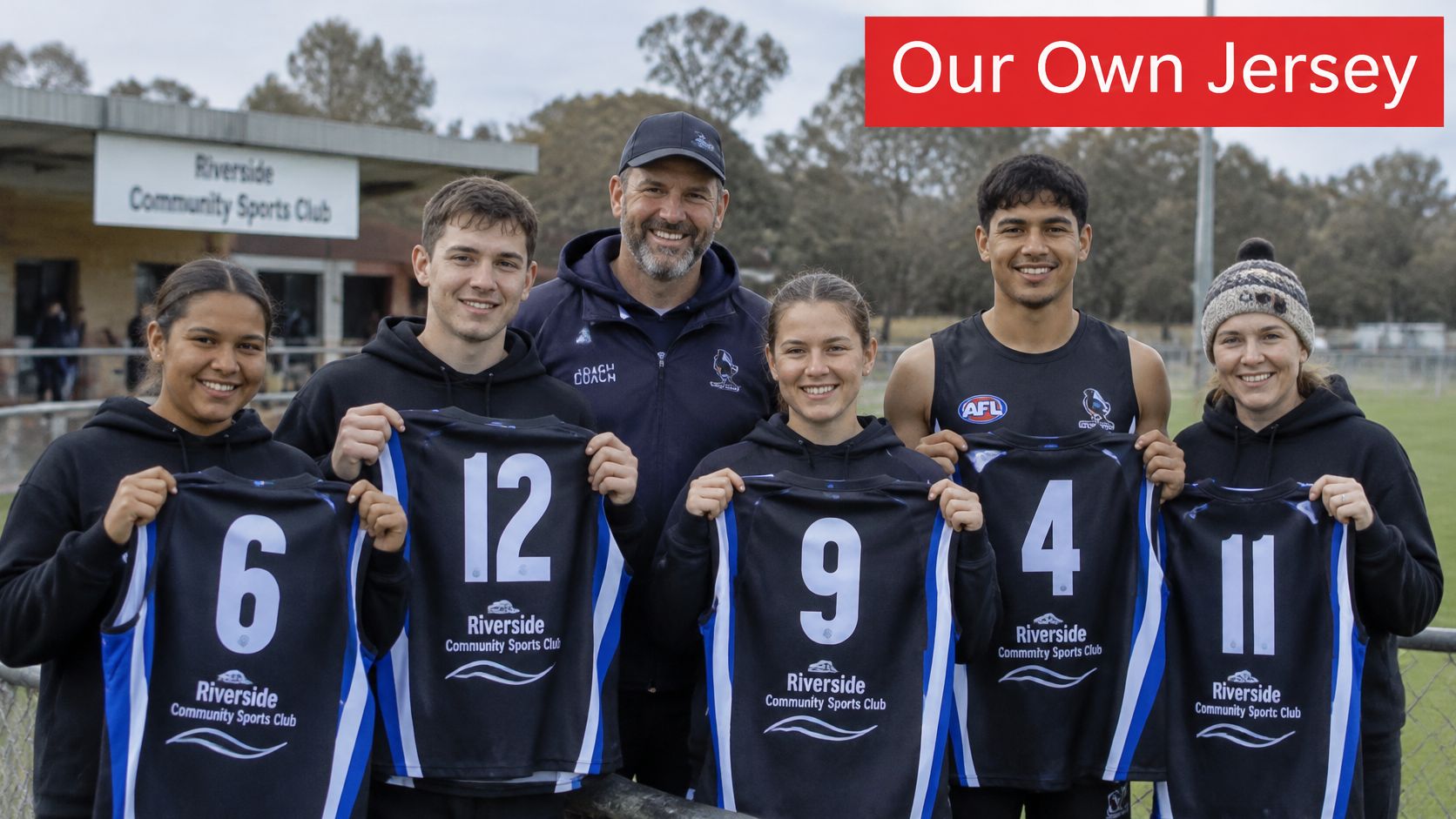
A Research and Markets sportswear report reported that approximately 1.93 million Australians played football in 2025, illustrating the scale of a participation base with recurring team-apparel needs. Separately, the Australian Sports Commission reported that 17% of Australians bought or wore a uniform or other supporter merchandise for an Australian professional sports team in 2024/25, up from 14% in 2023/24.
Supporter merchandise isn't the same as playing kit, but both make group identity visible. For buyers, the useful question is whether the garment is primarily for participation, identification or support.
Match the order to the organisation
- Clubs: Prioritise playing requirements, sponsor placement and dependable replacement options.
- Schools and universities: Allow for growing wearers, shared equipment and different coverage preferences.
- Corporate and hospitality teams: Choose a presentation standard that suits staff duties and laundering.
- Councils and nonprofits: Make garments easy to identify, distribute and reuse across community programs.
If fundraising will help pay for kit, the fundraising guidance from Vanta Sports is a useful planning resource before the committee commits to a purchase. Set out who pays, who owns the garments and what sponsors receive.
Keep playing jerseys distinct from other branded clothing. Coaches, volunteers and supporters may share the colours without needing identical garments.
Fabric Choices That Hold Up in Australian Heat
Choose the fabric construction before the artwork. Fibre content alone won't tell you how easily air passes through a jersey, how it feels against wet skin or whether it suits sustained activity.
Fabric options for Australian conditions
| Fabric | Breathability and drying | UV protection | Best use |
|---|---|---|---|
| Lightweight knitted polyester | Seek an open construction and verified drying performance | Must be tested on the finished garment | Training, club games and school sport |
| Polyester mesh panels | Open zones encourage airflow at the sides and back | Include mesh zones in the garment test | Hot, humid venues and outdoor events |
| Cotton or cotton blend | Absorbs moisture and can remain wet against the skin | Don't assume protection without testing | Casual supporter wear rather than demanding match play |
| Heavy double-knit polyester | Dense constructions can retain heat and humid air | Density alone doesn't establish a classification | Cooler conditions where the sample remains comfortable |
A peer-reviewed review in Sports Medicine – Open, citing Sports Medicine Australia guidance, explains that lightweight, breathable clothing supports sweat evaporation and heat dissipation, while higher air permeability reduces the insulating barrier around the skin. It also notes that loose-fitting synthetic sports clothing can improve thermal comfort compared with tight-fitting designs.
That makes ease through the torso and underarm a performance consideration, not just a styling choice. Have the wearer reach, turn and raise their arms in the sample. A top that looks neat while standing still may cling or restrict movement during play.
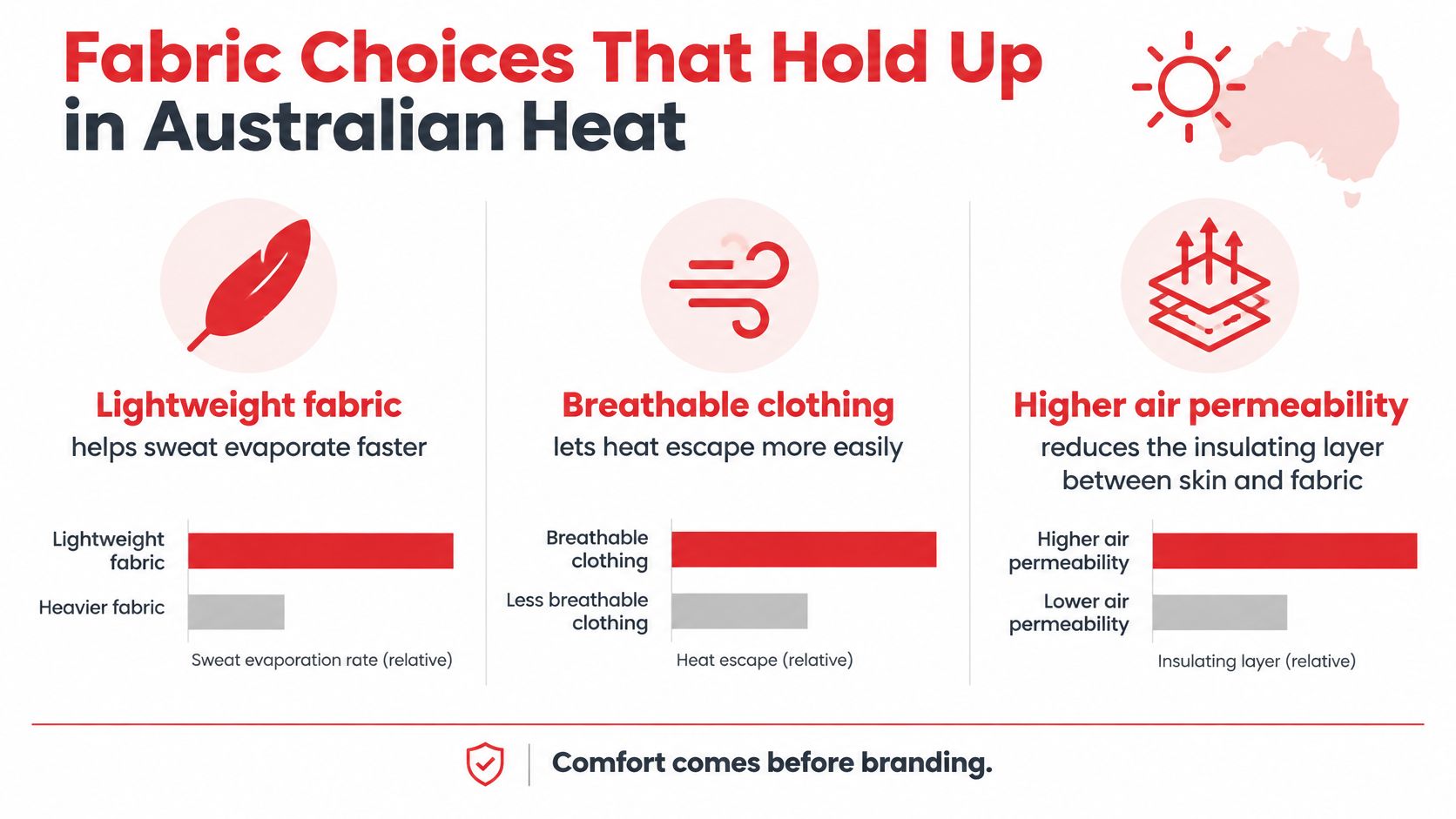
For Queensland and northern Australian conditions, request air-permeability, water-vapour-resistance and drying-performance results. Compare results obtained using matching test methods and conditions; marketing descriptions such as breathable aren't a substitute.
Rain brings another trade-off. A jersey selected for ventilation isn't a rain barrier, so plan separate sideline protection rather than making the playing top heavier. Check how a damp sample clings and whether pale sections become more revealing.
Sun protection needs garment evidence
The published discussion of Australian sun-protective clothing testing describes ARPANSA's classifications of UPF 15 as minimum protection, UPF 30 as good protection and UPF 50/50+ as excellent protection, with testing under AS 4399 available for fabrics and complete garments.
For exposed outdoor use, I'd target the excellent-protection classification and request documentation covering the finished garment configuration. Don't accept a body-fabric report as proof for a jersey that introduces different mesh, contrasting panels or other construction details.
Practical rule: Approve ventilation and sun protection together. Don't assume that improving airflow preserves the original protection classification.
Stretching, wetting and construction details can affect protection. Check what the report covers, retain the classification in the specification and reject unsupported claims based only on polyester content, dark colour or printed graphics.
Decoration Methods Compared for Team Jerseys
Match the decoration to the job. A match jersey needs readable identification without unnecessary weight, while a corporate training top may favour a stitched crest. An event garment might need detailed artwork in a small run.
The cheapest application isn't automatically the cheapest finished order. Artwork complexity, placement, fabric compatibility and the possibility of later changes all influence the decision.
Decoration methods for team jerseys
| Method | Best for | Durability | Limits |
|---|---|---|---|
| Screen printing | Bulk runs with few colours and clean numbers | Strong when properly cured | Extra colours and detailed artwork complicate production |
| Embroidery | Names, numbers and logos on training and corporate wear | Durable when suitable thread, backing and construction are used | Tiny text and gradients don't translate well; large designs can stiffen light fabric |
| Sublimation | Full-colour and all-over designs on suitable polyester | Colour is incorporated into the fabric rather than applied as a surface film | Not suitable for ordinary cotton jerseys |
| Velcro or iron-on patches | Changeable identification and sponsor marks | Fastener or adhesive quality determines performance | Adds bulk; iron-on patches aren't automatically reusable |
| Digital or full-colour transfer | Small runs and detailed images | Good when the application and care process suit the fabric | Can crack, lift or fade with unsuitable application or laundering |
Sublimation suits integrated designs, particularly where stripes, gradients and sponsor marks need to sit within an overall pattern. Its limitation is reversibility: a name incorporated into the print isn't something you can peel off for the next player.
Embroidery offers a different finish. Keep crests compact on light jerseys, simplify fine lettering and inspect the reverse side for uncomfortable backing. Large stitched numbers deserve particular scrutiny because they can change the drape across the back.
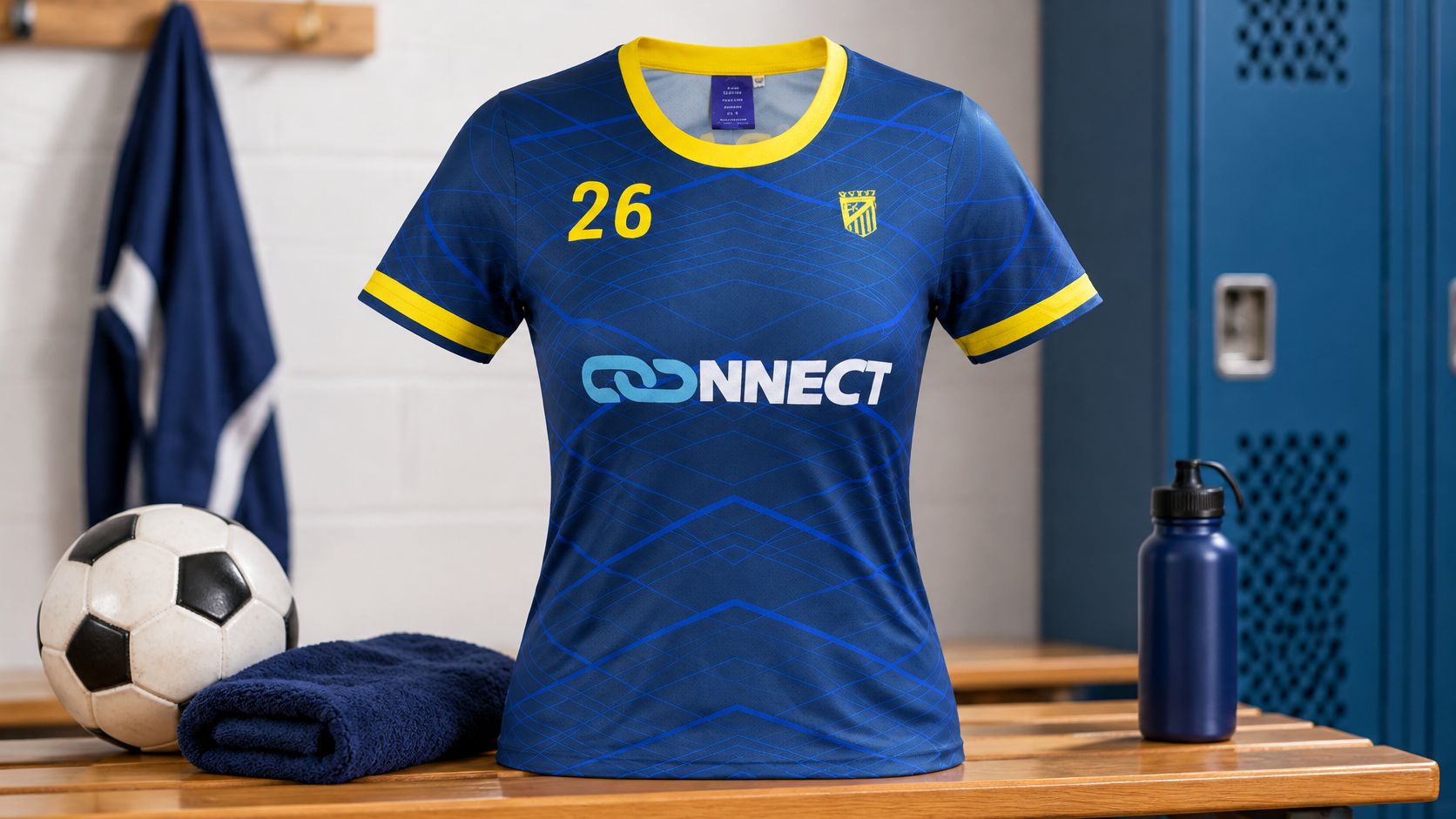
For a concrete construction reference, the Custom Womens Soccer Top uses 150gsm, 100% ultra-mesh polyester, with PMS-matched artwork and personalisation included; its stated production lead time is 35 working days. Those specifications don't establish a UPF rating or tell you whether its cut will suit every wearer.
We provide in-house design and embroidery. Sports teams can have embroidered names, numbers and logos, or Velcro or iron-on patches attached to jerseys and bags; the right choice still needs to suit the garment and intended use.
Approve an application, not just an image
A digital mock-up establishes layout, not texture, adhesion or comfort. Use custom printing options to frame the application discussion, and consider the Mystershirt guide to custom tees when deciding whether casual football-themed merchandise should be separate from technical playing kit.
Before authorising the run:
- Inspect a decorated sample: Look at edge definition, placement, backing and the garment's drape.
- Check laundering behaviour: Agree on care instructions and inspect a washed sample for lifting, puckering or colour change.
- Test replacement assumptions: Establish whether removing a number leaves adhesive, stitch holes or a visible outline.
A hook-and-loop patch is designed to detach. A heat-applied patch may be removable only with work that damages the garment. Don't treat them as interchangeable solutions.
Designing Jerseys That Last Beyond One Season
The better sustainability question isn't whether a jersey contains recycled polyester. It's what the supplier can document about its use, repair and destination after you're finished with it.
Australia sent an estimated 200,000 tonnes of clothing to landfill in 2023, according to the explanatory statement supporting national clothing product stewardship. A recycled-content claim doesn't resolve the practical problem of keeping your own unwanted kit out of that stream.
Mixed fibres, elastane, trims and applied graphics can complicate recovery. Even a clearly labelled polyester jersey needs a collection and processing pathway that accepts the finished item.
A jersey isn't circular because its label describes where the fibre came from. You also need a credible destination for the garment.
Specify useful life before recycled content
Build longevity into the purchase brief:
- Identify the materials: Record the main fabric, panels, trims and decoration rather than accepting an incomplete fibre description.
- Choose maintainable construction: Request accessible seam repairs and embellishments that can be removed where appropriate.
- Keep identity flexible: Consider squad numbers rather than permanent personal names on club-owned kit.
- Protect continuity: Retain approved artwork and colour references so replacement garments don't require a redesign.
- Provide usable care instructions: Give the kit manager guidance for washing, drying, stain treatment and minor repairs.
- Name the next destination: Arrange internal reuse, an accepting community organisation or a documented collection pathway.
Stitched decoration can be appropriate when you want a durable finish, but it isn't automatically removable without damage. Use the in-house custom embroidery service information to frame questions about backing, placement and repair access rather than assuming every embroidered design supports reuse.
Make ownership clear
A school-owned pool of jerseys needs a return process. A player-owned top needs care information and a realistic route for passing it on. Decide which model you're purchasing for before adding individual names.
Donation also needs a receiving organisation, not just a hopeful note in the procurement file. Confirm that the recipient wants the sizes, condition and branding you'll offer; otherwise you're transferring a disposal problem.
A jersey built for repeated use can be a more useful purchase than one promoted only through recycled content. Put the decisive question in writing: what happens to these jerseys when we're finished with them?
Size, Order and Send Your Spec Sheet
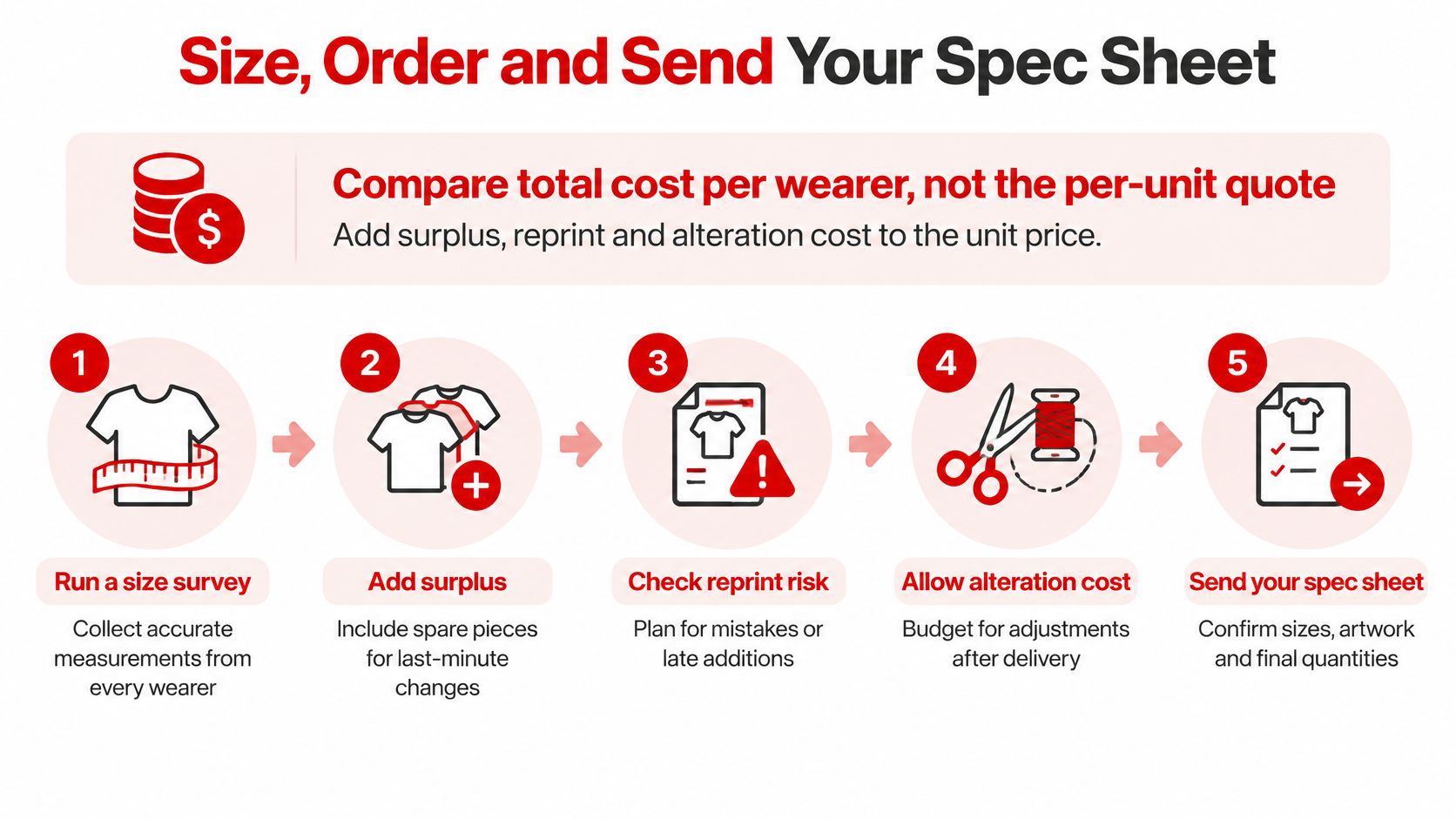
Compare total cost per wearer, not just the per-unit quote. Add sampling, decoration, freight where applicable, alterations, replacement orders and unusable surplus to the order cost, then divide by the people you can outfit. Don't spread the cost across garments nobody can wear.
The Australian Government's textile waste roundtable material reports that Australians bought about 56 clothing items per person in 2018–19. For a kit buyer, avoiding preventable misorders is a practical way to control both spending and waste.
Fit the people who will wear the kit
-
Run a wearer survey.
Use a spreadsheet with a separate row for each wearer. Record their approved name spelling, squad number, preferred cut and measurements, keeping personal information accessible only to those who need it. Offer adult, youth and women's cuts where available, and provide a private way to request longer sleeves, a modest fit or other coverage needs. -
Request a measured sample garment.
Ask for the actual style, not a substitute shirt with a similar size label. Measure the sample flat across the chest, from the shoulder to the hem and along the sleeve, following the supplier's measurement diagram. Have representative wearers sit, reach and move in it, including over any base layer they expect to use. -
Confirm the ordering constraints.
Get the minimum order quantity, available size range, sample arrangements and replacement lead time in writing. Establish whether mixed cuts count towards the same minimum and whether a later order can use the original artwork. A size chart is only useful if the required sizes can be ordered. -
Resolve reassignment and repair.
Decide which garments need permanent personalisation and which should remain transferable. Record the agreed process for correcting an error or replacing damaged identification. Keep the approved names-and-numbers file separate from working drafts so an old spreadsheet doesn't reach production. -
Approve the sample in writing.
Sign off the garment style, cut, colour, decoration position and final wearer list together. Ask the supplier to confirm the production schedule from that approval, rather than from the date you first requested a quote. Keep the approval email and sample photographs with the purchase order.
Leave room for real-world changes
Skipping the fitting sample, buying the same size for everyone and forgetting late joiners are avoidable mistakes. Assign a kit coordinator to collect responses, chase missing information and lock the final list. Don't let separate coaches send conflicting amendments directly to production.
Set aside unpersonalised spares in sizes supported by your wearer profile, rather than adding an arbitrary quantity across every size. Label and store them so the next coordinator can find them. If stock remains after the season, assess it promptly for replacement use or an agreed community destination.
Budget check: A lower unit price isn't a saving if the order leaves people without wearable kit.
Keep turnaround promises specific to the process. Our Express 72-hour embroidery service has items ready within 72 hours after sample approval, with urgent orders prioritised from logo digitising through final stitching. That isn't a universal production or delivery promise for custom-manufactured jerseys.
We deliver promotional merchandise to Sydney, Melbourne, Brisbane, Adelaide, Perth, Darwin and Tasmania, and Australia-wide. Put the full receiving address, contact person and event deadline on the order, and distinguish the required arrival date from the dispatch date.
Send a specification someone can quote accurately
Prepare artwork using the artwork submission tips, then attach a specification containing:
- Use and location: Playing, training, staff or supporter use, including outdoor exposure.
- Fabric and protection: Construction, panel requirements and the requested garment-test documentation.
- Decoration: Application method, artwork files, placement and the final personalisation file.
- Fit: The approved wearer spreadsheet, cut requirements and sample reference.
- Order conditions: Quantity, minimum order, spare-stock plan and replacement arrangements.
- Approval and delivery: Written sample approval, agreed schedule, receiving address and required arrival date.
Send the pack this week and request a measured sample before authorising production. Call 1800 833 006 or email save@simplymerchandise.com.au to confirm product options and request a quote.
Merchandise provides in-house design and embroidery to help turn a practical jersey brief into an approved garment specification. Visit Simply Merchandise with your artwork, wearer list and delivery deadline, and ask about suitable options and sampling before production starts.

