



You're finalising numbers for a club day, a wedding, a trade show or a community fundraiser, and someone asks the deceptively simple question. Should we order stubby holders, and will they keep drinks cold?
It's a fair question, and you deserve a straight answer. A neoprene stubby holder is brilliant at comfort, grip, branding and bulk distribution. It's not a substitute for a vacuum-insulated cooler when a drink must stay cold for hours. Choose it for the right job, size it properly, look after it well, and plan what happens after the event, and it'll earn its place in drawers, eskies and car consoles long after the banners come down.
What a Neoprene Stubby Holder Is and How to Size It
A neoprene stubby holder is a snug sleeve that slips over a stubby bottle or can, keeping your hand off the cold, wet surface so the drink stays comfortable to hold for longer. Neoprene is the flexible synthetic rubber also used in wetsuits, and that stretch is why it replaced earlier rigid foam versions, which handled fewer bottle and can sizes. Set the expectation while you plan: the sleeve insulates, grips and slows warming for the length of a drink, and sizing it well is what decides whether guests keep it or bin it.
The Australian Food Timeline stubby holder history credits the stubby holder as an Australian invention while noting the precise inventor remains disputed. It identifies the earliest printed reference in December 1970 and traces the shift from polystyrene foam to neoprene through the 1970s and 1980s. That dispute is worth remembering before you print a confident origin story on event signage.
Two styles worth comparing
Start with the Neoprene Stubby Holder in its classic open form for most cans and stubbies. The Wedding Neoprene Stubby Holders with a base sew a base into the sleeve, so the holder stands upright on a table for photos and place settings.
| Feature | Classic Neoprene Stubby Holder | Wedding Neoprene Stubby Holders with a base |
|---|---|---|
| Material | Neoprene | Neoprene |
| Construction | Open sleeve | Sleeve with base |
| Table stability | Stands once a drink is inside | Base helps it stand upright |
| Listed dimensions | Check the product page and confirm with a sample | Diameter listed |
| Fits | Most stubby bottles and cans | Most stubby bottles and cans |
Thickness and fit are what you feel in the hand. A snug, slightly stretchy sleeve hugs the vessel, catches condensation and stays put when palms are wet. Because listings don't always publish material thickness, ask the supplier before a bulk order and judge a physical sample rather than a product photo.
A three-point sizing check
- Measure the widest point: Check the bottle or can you'll serve, not a similar one from the fridge. Glass stubbies vary more than cans.
- Match the listing: Compare that measurement and the vessel height against the dimensions on the product page. The wedding style lists a diameter; the classic doesn't, so measure a sample directly.
- Test one sample: Slide the drink in and out several times before approving a bulk order. Pick it up with wet hands and set it down on the table you'll use.
Neoprene stretches slightly, so a snug fit is normal. A holder that strains at the seam, slides off, or sits loosely isn't the right size.
If you're comparing sleeves with rigid coolers while you work out how to keep your beer cold, keep the fit test identical for each option. Same can, same bottle, same wet-hand pickup. The comparison shows quickly which format suits a quick drink and which suits a longer hold.
Sort the vessel first, then browse matching promotional bar accessories for coasters, openers or bar items to round out the order. A holder that fits gets kept, washed and pulled out at the next barbecue; one that doesn't is landfill before the season ends. Get the size right and you can move on to branding with confidence.
What Neoprene Does Well and Where It Falls Short
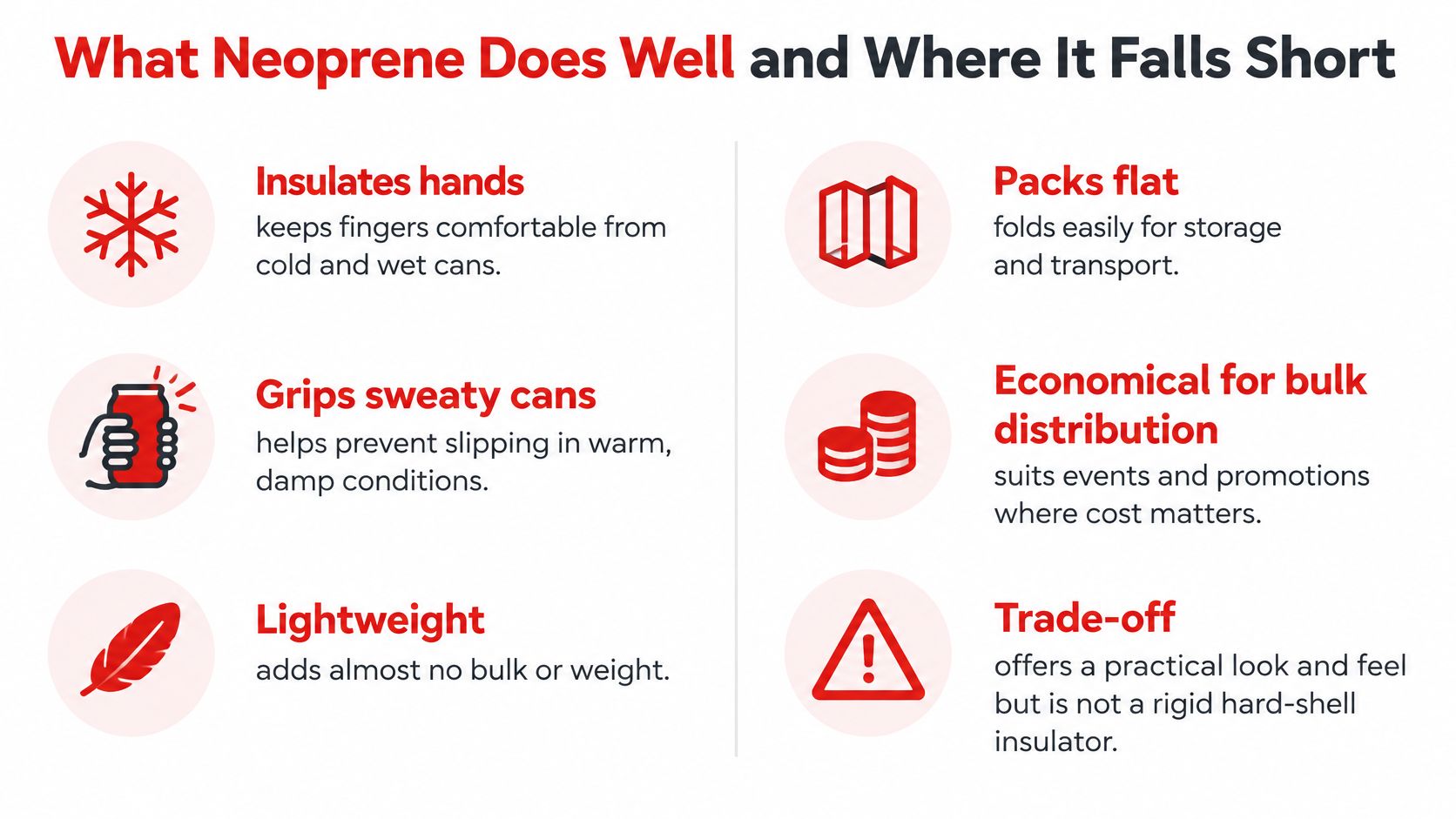
What a neoprene sleeve does well shows up in the first minute. It insulates your hand from cold and condensation, grips a sweaty can, weighs very little and packs flat by the boxful. For an event manager, those traits translate into lower freight bulk, easy storage, fast handouts and a printable surface guests carry through the venue.
Its limit is just as concrete. Sustained chilling belongs to sealed, vacuum-insulated gear, and a sleeve that slows warming is still a different product from one that holds temperature for hours.
Set a realistic cooling expectation
Don't accept a bare claim that a sleeve keeps drinks cold. Ask what was tested, including drink size, ambient temperature and duration. The Nestpath Australian stubby holder comparison notes that no standard measurement is commonly published for stubby-holder insulation and that a soft sleeve cannot match a vacuum-insulated cooler because the open top and base allow heat transfer.
That openness is also the product's convenience. You slide a drink in, drink from it normally and slide it out again. The open top and base let heat in, so the sleeve slows warming rather than sealing the drink, while warm air moves around it outdoors and the drinking surface stays exposed the whole time.
Fit changes the result too. A snug holder limits the warm-air gap around the vessel and stays in contact with it. A loose holder lets air circulate and can slip when condensation builds. Direct sun, a hot table, frequent handling and a drink that starts only mildly chilled will all shorten the comfortable window.
Write the same honesty into your campaign copy. A holder sold as an all-day cooler invites disappointed guests. Described accurately as a comfortable, reusable sleeve, it earns a spot in the esky drawer at home and keeps working for your brand long after the event.
Match the holder to the setting
| Setting | Neoprene holder suits it? | Better choice when |
|---|---|---|
| Short outdoor events | Yes, light, grips well, keeps hands comfortable | Service runs all afternoon away from refrigeration |
| Sports clubs and festivals | Yes, packable and cost-effective in bulk | Spectators hold a single drink for hours in the sun |
| Trade-show giveaways | Yes, low weight and easy to hand out | Recipients expect active chilling rather than hand comfort |
| Long-duration chilling | No, open top and base let heat transfer | Always, use a vacuum-insulated cooler |
| Hot-weather hospitality | Partly, comfortable grip, limited cooling | Drinks sit on hot tables in direct sun between serves |
The same fit-for-purpose thinking applies across insulated products. If you're reviewing choosing the right lunch bag size for staff or hospitality use, capacity and carry time matter more than a generic insulation claim. With a stubby holder, vessel fit and expected drinking time matter more than a slogan.
Practical rule: Choose neoprene when comfort, grip, packability and cost per unit matter most. Choose a cooler when temperature retention over hours is the primary goal.
I'd still pick neoprene for most short events. Guests can fold it into a pocket, take it home and use it again, while your team can transport a large quantity without dedicating a vehicle to rigid coolers. Pair it with well-chilled drinks and a sensible service pace, and look through the broader drinkware range when some guests need a sealed or vacuum-insulated option.
Branding Options for Events and Promotions
A holder earns attention because it travels. It wraps around the drink, sits at hand height, appears in photos and stays visible across a crowd. A sponsor name, team colours, a club crest or a wedding message gets repeated exposure without asking guests to carry a sign.
That visibility only helps when the artwork survives handling, condensation and washing. Choose the branding method for the design you have, not the design you wish would compress neatly onto a curved sleeve. Then proof it wrapped around a real can.
Match the method to the artwork
| Method | Best fit | Check before ordering |
|---|---|---|
| Screen printing | Bold logos in one or two colours | Ink adhesion and wash durability on neoprene |
| Full-colour digital printing | Photos, gradients and detailed artwork | Colour match and fade after repeated washing |
| Laser engraving | Simple marks and text | Whether the neoprene surface suits engraving |
| Debossing | Subtle, texture-based marks | Whether the foam compresses cleanly and keeps the mark |
| Sublimation | Full-coverage designs | Dye uptake on neoprene, confirm before committing |
We offer screen printing, digital and full-colour printing, laser engraving, debossing and sublimation across our range, but availability on a catalogue page doesn't prove every method suits every material. Ask for the recommended method for this exact neoprene construction and finish. For comparison, reviewing how businesses design custom cocktail glasses shows the same principle at work. Curved surfaces, viewing distance and washing all shape what looks good in use.
Pad printing needs a specific conversation too. Pad Print is a smaller print usually used on smaller items like pens or note pads, so ask whether it suits a holder's larger, flexible surface before committing. A method that's perfect on a hard, compact item may not give you the coverage or registration you want on foam-backed fabric.
Three design checks before approval
- Keep the logo bold: Use a clear mark, generous letter spacing and few colours. Fine lines and tiny sponsor stacks get lost when the sleeve stretches.
- Protect the reading zone: Leave clear space around the main message and keep critical text away from seams, top edges and the base curve.
- Proof it in the round: Wrap the artwork around the actual drink. Check where the design starts, where it ends and whether a name gets split across the back.
Colour contrast deserves the same attention as the logo file. Team colours that look strong on a white screen can sink into a dark sleeve or clash with a can showing above it. Print a physical proof under event lighting if colour matching matters to a sponsor. Screens brighten artwork and hide texture.
Put the design to work
Say a junior sports club runs a presentation day. A bold club name and season year turns the holder into a keepsake parents reuse at training. At a trade show, a short service promise and a readable web address work harder than a full product list because people see the holder for only a few seconds.
For weddings and celebrations, the based style stands upright for table displays and photographs. Names, a date and one restrained graphic usually look better than a crowded photo collage. Sporting sponsors may prefer one dominant logo on the front and a smaller club mark on the reverse, rather than squeezing every partner around the circumference.
Review the available custom printing options, then order a branded sample, not just a blank sizing sample. Wash it according to the care instructions, flex it, slide a wet can in and out, and check the edges of the print. That small test protects the full run and gives your sponsor a design that still looks sharp after several events.
Using Holders Safely at Events
Treat the holder as an external carrier around a sealed can or bottle. The beverage package remains the food-contact barrier, and the neoprene shouldn't touch the liquid, rim or drinking opening. That one rule guides purchasing, guest instructions and cleaning.
Material data can be misread here. An Australian neoprene rubber technical data sheet lists neoprene rubber as commonly serviceable across approximately -20°C to 100°C. That range describes material performance. It doesn't prove a particular printed, laminated, dyed or adhesive-containing holder is suitable for direct food contact or repeated hot washing.
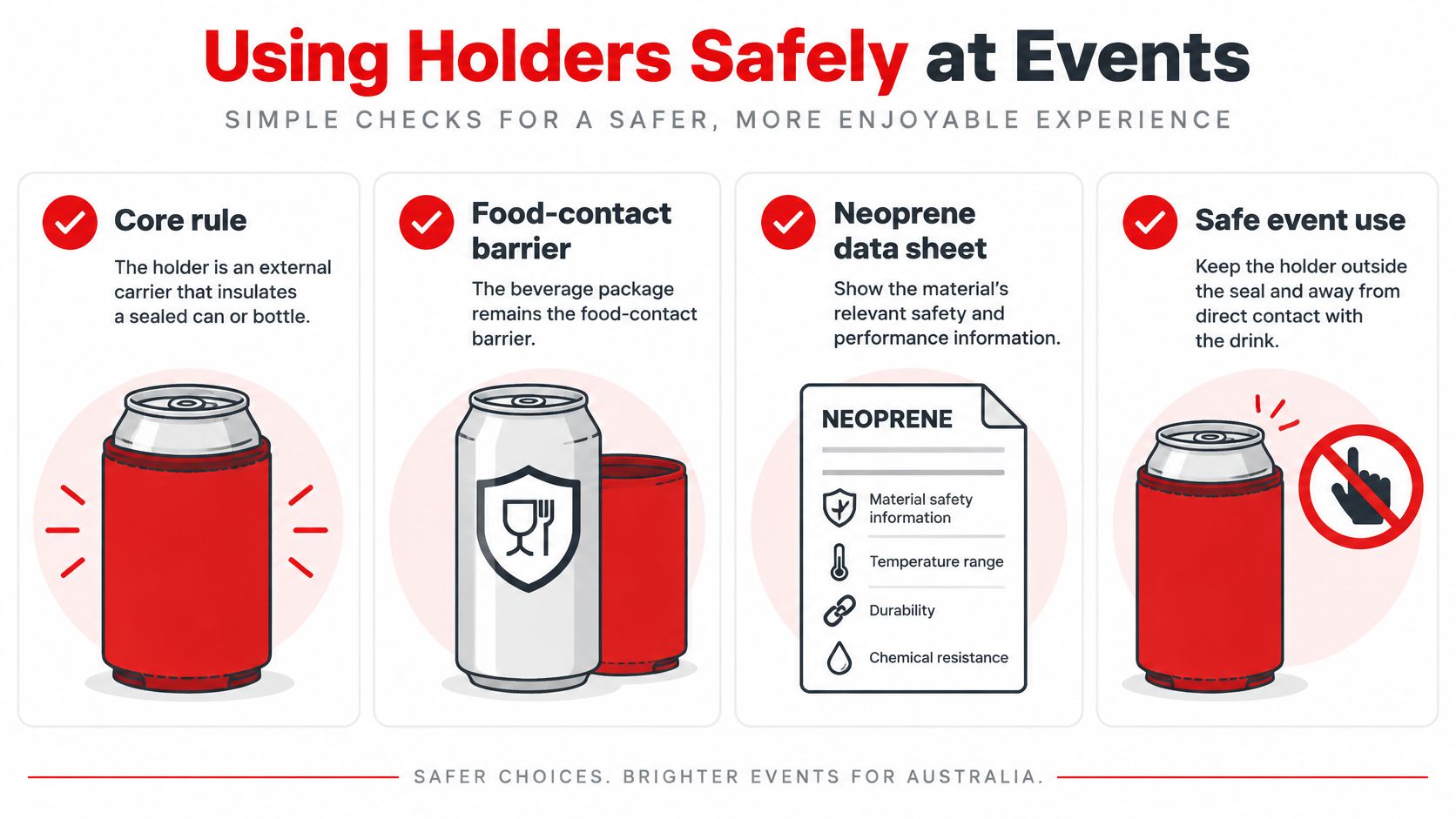
Write the distinction into your procurement brief. State the compatible vessel diameter, intended use around chilled sealed drinks, whether the item is hand-wash only, and that the neoprene surface isn't intended to contact beverage contents. Ask for material composition and care instructions before anyone claims dishwasher or sanitising suitability.
Hygiene matters more than thickness
Neoprene is textured and typically more porous than hard food-contact plastics. It can hold moisture and debris if it's stored damp or used after food spills. The NSW Food Authority food packaging guidance says reusable food-contact surfaces should be smooth, easy to clean, and resistant to absorbing grease, food particles and water, and warns that 'food grade' alone does not establish suitability for every use or repeated washing.
Keep holders removable and fully dryable. Before reuse, check inside and out for tears, compression damage, embedded debris and persistent odour. Retire a holder that stays smelly after proper washing and drying, because guests shouldn't have to wonder whether it's clean.
Use simple care-card wording guests can follow:
- Hand-wash: Use mild detergent and warm, not hot, water.
- Rinse thoroughly: Remove detergent from the textured surface and inside the sleeve.
- Squeeze gently: Press out water rather than wringing or twisting the printed surface.
- Air-dry completely: Stand or lay the holder where air can circulate before storage.
Don't claim sanitisation or dishwasher compatibility unless that performance has been validated for the exact construction, including print, laminate and adhesive. Hot water, detergents and sanitising chemicals can contribute to shrinkage, delamination, odour retention or print failure on an unsuitable product. A cautious care instruction is better than a convenient claim you can't support.
Controls event staff can apply
Issue holders with sealed beverages and show staff how far the sleeve should sit below the rim. Don't move one holder from guest to guest during service without cleaning it. If a drink spills over the top, remove and wash the holder rather than wiping only the outside.
Collect returned holders in a ventilated tub, not a sealed bag while they're damp. Wash, rinse and dry them before packing them away. Replace visibly torn, flattened or deteriorated units instead of sending them back out because the logo still looks acceptable.
Clean, dry and intact beats thick every time.
These habits suit workplaces, schools, clubs and public events because they don't depend on specialised equipment. Brief whoever serves drinks, put the care wording where guests receive the holder, and name one person to inspect returns. You'll protect the drink, the print and your organisation's reputation in one routine.
Ending a Holder's Life Responsibly
Don't assume a used neoprene holder belongs in kerbside recycling. That assumption is easy to make at the end of a cheerful event, especially when the can inside it has a clear recycling or container-deposit pathway. The holder and the container are different materials with different outcomes.
Chilled drinks move through Australian events in serious volume, and a printed sleeve rides along with many of them: club days, festivals, weddings, trade shows, backyard barbecues. Scale is the reason disposal wording deserves care. A vague green claim repeated across a full print run reaches every guest who takes a holder home.
Separate the holder from the drink container
Remove the aluminium can or PET bottle and send it through the applicable container-deposit or recycling pathway. Keep the neoprene holder for another drink. Its mixed-material construction and printed surface make ordinary kerbside recycling unsuitable, and neoprene itself is a synthetic rubber foam rather than a fibre that breaks down readily. Once it reaches landfill, it persists.
That persistence is the end-of-life challenge. The honest answer is practical rather than cosmetic: a holder people keep using, a print that survives washing, and order quantities matched to genuine demand.
The most responsible promotional holder is usually the one that's still being used next season.
Where a container-deposit or refund scheme applies, the split is easy for guests to act on. Signage can say it in one line: return the container here, take the holder home and reuse it.
Build reuse into the campaign
- Design beyond one date: Use club, sponsor or community artwork that stays welcome after the event. A prominent one-day headline can shorten useful life.
- Order to the audience: Base quantities on registrations and expected attendance, then allow a modest buffer rather than doubling the run for comfort.
- Offer a return point: At closed events, collect unwanted holders, wash and dry them, and keep sound units for the next club or workplace function.
- Explain disposal: Tell recipients not to place the holder in kerbside recycling unless local guidance for that exact item says otherwise. I'd put this line on the same card or sticker that carries the care instructions.
National packaging ambition makes unsupported claims even riskier. A 2025 parliamentary review of packaging reform found Australia's packaging targets, including 100% reusable, recyclable or compostable packaging and 70% recycled or composted plastic packaging, were not on track. A promotional sleeve shouldn't borrow credibility from those targets unless the exact product and recovery pathway support the claim.
Avoid words such as eco, recyclable or compostable on artwork and order pages unless you can verify them for the finished, printed holder. A take-back promise also needs an owner, a collection method and a destination. If your campaign calls for lower-impact merchandise, compare the eco product alternatives rather than relabelling neoprene.
At home, wash and dry the holder, store it with the esky or picnic gear, and keep using it while it's intact. Pass spare sound holders to a club barbecue box. When one finally tears or keeps an odour, check local council guidance or an available take-back option before disposal. Longevity first, honest disposal second.
Choose the Right Holder for Your Next Event
Three questions decide the order, so write the answers on the brief. What drink will you serve, and how long does it need to stay cold? Where will people use it, whether that's a short outdoor day, festival, trade show, wedding or club function? What must the design achieve once guests take it home?
If the honest answer is several hours in the heat, buy a vacuum-insulated cooler for that role. If drinks arrive well chilled and disappear inside a normal event window, neoprene earns its place through comfort, grip, portability and branding in one lightweight item. It does a specific job well, and overselling it only creates disappointed recipients.
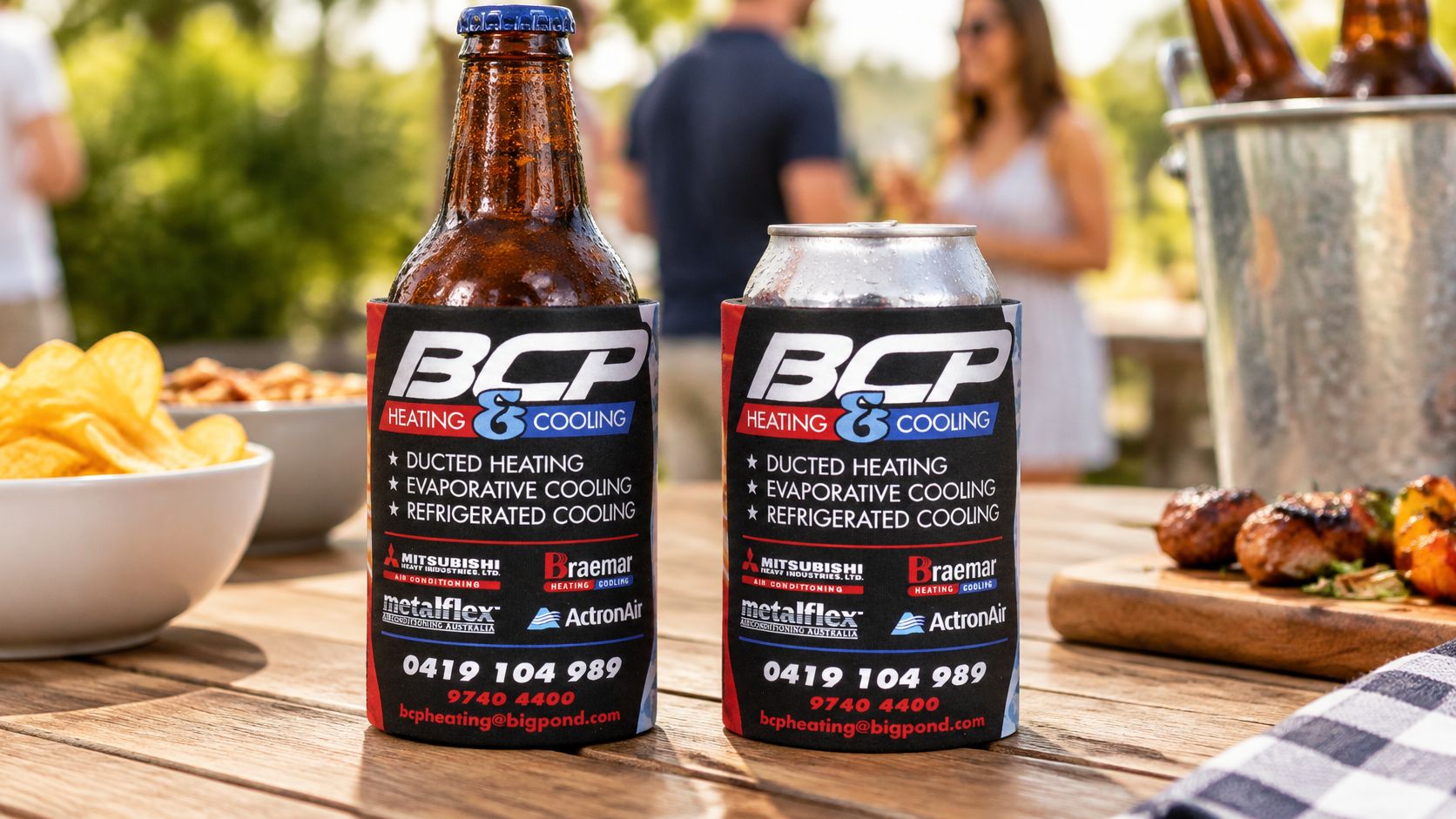
For most stubbies and cans, I'd default to the Neoprene Stubby Holder, a classic holder sized for standard stubby bottles and cans. Choose a wedding style with a firm base when the holder needs to stand neatly on tables for a display, photograph or keepsake setting.
Use a benchmark, then quote the actual job
Retail listings for licensed designs can sanity-check a budget, though they are not a bulk branded quote. In 2025, the WhatsCheap North Queensland Cowboys stubby holder listing recorded an Australian lowest price of AUD 8.99 compared across 13 retailers. Your unit cost will turn on quantity, branding method, artwork, finish and delivery requirements.
Ask for the quote to separate product, branding, artwork, freight and any sampling cost. That separation makes comparisons fair and exposes a lower unit price hiding an unsuitable print method. A licensed retail holder and a custom bulk holder price different jobs, so treat the numbers accordingly.
Your four-step order checklist
- Order a sample: Test the actual can and bottle, including wet-hand grip, removal and table stability.
- Test the branding: Wash and flex the printed sample according to the care plan before approving colour and placement.
- Agree the reuse plan: Decide whether guests keep holders, staff collect returns, or the club stores sound units for later use.
- Confirm the quantity: Count registered guests, staff, sponsors and a modest contingency rather than ordering from an optimistic crowd estimate.
Stubby coolers already sit among familiar merchandise choices. The most popular merchandise items in the top 5 and top 10 are coffee mugs, pens, caps, golf balls, printed t-shirts, lanyards, stubby coolers, note pads, drink bottles and travel mugs. Familiarity helps because recipients already know how to use the item, while fit and artwork still decide whether yours gets kept.
Use our guide to the steps to choose the right promotional products if holders are part of a larger event pack. Match each item to a job rather than adding products to fill a bag. We offer sampling options and artwork guidance, so you can test the fit on the finished drink, review the wrapped proof and settle the care wording before the full run.
A well-chosen holder will not turn a warm drink cold, and it never claimed to. It keeps a chilled drink comfortable to hold, carries your colours through the crowd and recalls a good day each time it comes out of the esky. That is a proud Australian tradition worth doing properly.
Ready to choose a holder that fits your drinks, suits your event and carries your artwork beautifully? Simply Merchandise can help you compare styles, arrange samples and prepare artwork for a polished branded result. Visit the main store to start your order with clear sizing, honest performance expectations and a reuse plan you are proud to share.

