



The most common advice about embroidered tote bags is to fixate on two things, the logo and the price break. Choose 12 oz cotton canvas, simplify the artwork, order the full quantity in one hit so the unit rate drops. None of that is wrong. It's just the easy half.
An embroidered tote bag is a textile product before it becomes a marketing item. It has a fibre, a fabric weight, a stitch plan, a wash life and an end-of-life. Buyers who specify only appearance meet the rest of it later: a logo puckering across a dense stitch block, a handle tearing out at the join, dye transferring onto a pale shirt on a humid day, and a storeroom of bags carrying a logo the business retired last year.
One question settles most of these decisions. How many trips will this bag make before someone stops using it, and where does it go when they do. Material, stitch density, test method and order quantity all fall out of that. A bag is only as good as its service life, and its service life is decided at the specification stage, months before anyone sees a stitch.
Choosing a Tote Material That Holds Embroidery
Reusable bags stopped being a niche alternative once single-use plastic bags were banned in every Australian state and territory, a milestone recorded in the National Waste Report 2022. That policy shift raised the stakes for specification. A bag that goes to the shops fifty times carries the logo fifty times. One that splits at a handle seam on the second trip carries it once.
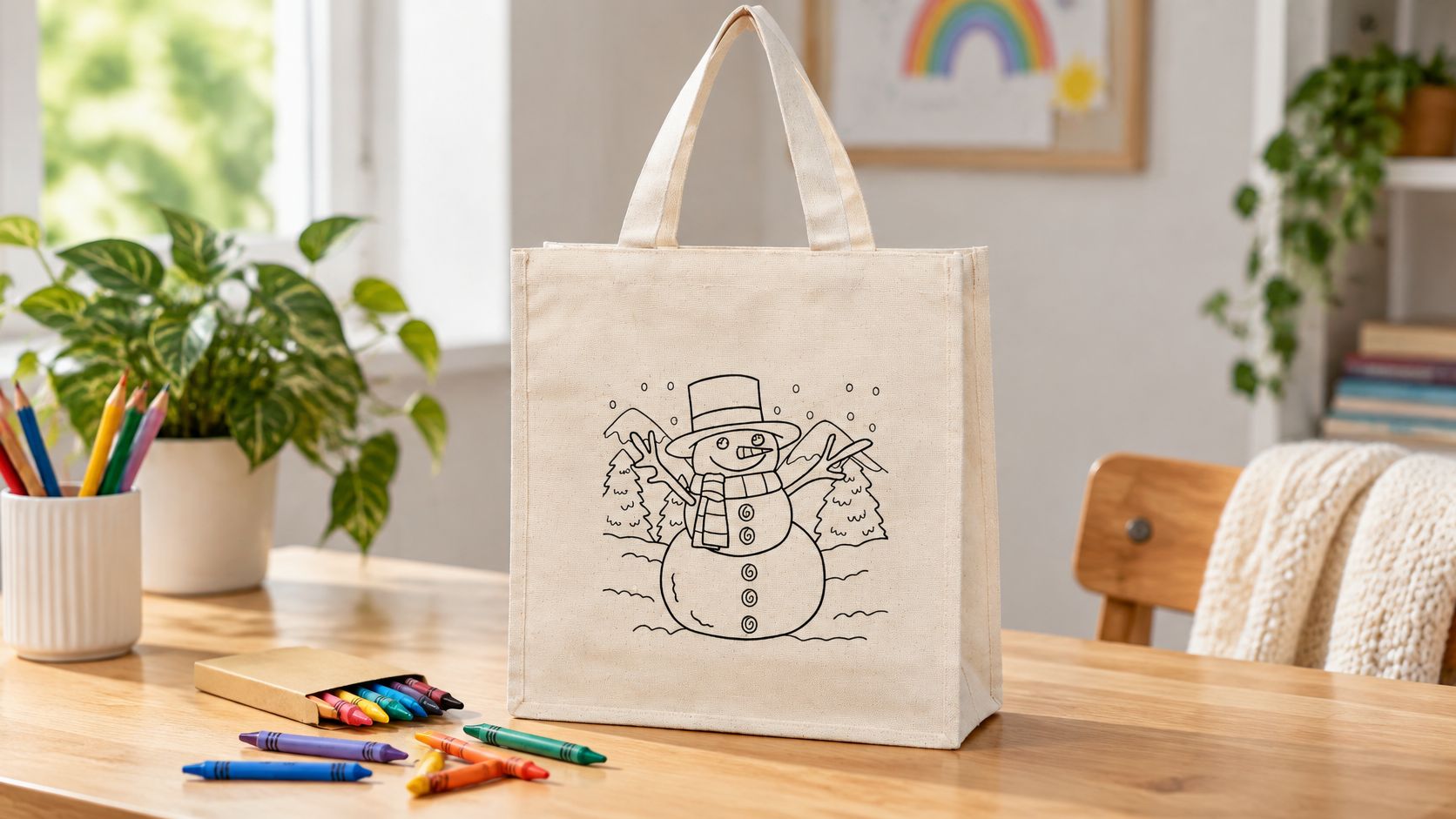
The standard embroidered tote looks like this: a firm canvas body, a gusseted base, and a logo sitting proud of the cloth.
The five materials worth shortlisting
| Material | Typical weight | Embroidery suitability | Best use |
|---|---|---|---|
| Cotton canvas | 10 to 12 oz (roughly 340 to 400 gsm) | Excellent for dense logos and lettering | Events, retail and premium corporate gifts |
| Cotton twill | Around 8 to 10 oz | Good for medium-density logos | Everyday carry and staff use |
| Non-woven polypropylene | Light and thin | Fair; thin fabric can pucker under dense stitching | High-volume trade show giveaways |
| Recycled polyester | Specified in denier, commonly 210D to 600D | Good; check colourfastness and stitch backing | Campaigns built around recycled content |
| Jute or hessian | Heavy, coarse weave | Poor for fine detail; suits bold, simple marks | Rustic and sustainability-led branding |
Weight is the column to read first. It drives how the bag feels on a shoulder, how it holds a box shape on a shelf, and how many washes it survives before the base goes limp. The embroidery column is the one buyers skip, and it's where cheap bags get caught. Dense stitching needs fabric thickness underneath it. A full-colour stitch block on thin non-woven polypropylene pulls the weave into ripples that no amount of pressing flattens.
The coarse end of the table has the opposite problem. Jute and hessian swallow small lettering, so a bold single-colour mark reads well while a detailed crest turns to mush. Cotton twill sits between the extremes, softer than canvas and easy for staff to fold into a work bag, though less able to carry a heavy weekly shop. Whichever fabric wins the shortlist, get the design stitched on a swatch of it before the order is finalised; puckering and coverage problems show on real cloth, never in a digital mock-up.
The shortlist rule: buy the heaviest material the budget allows for any bag that must survive daily use, and keep one lighter option for giveaways where the bag is really a leaflet with handles.
Material is also where the service-life question gets answered. A heavier fabric costs more per unit and earns it back each time the bag gets picked up again, while a flimsy giveaway leaves the campaign early and takes the logo with it.
Our promotional bags range is grouped by use rather than by material, which is often the faster way to narrow a shortlist. For family-facing campaigns, one catalogue example worth knowing is the Colouring Executive Canvas Tote Bag, a cotton canvas tote built around a colouring activity for kids. The activity matters more than any corporate logo there, which makes it a different brief from the workhorse shopping totes above.
How Embroidery Changes How a Tote Performs
Embroidery is decoration, not structure. The thread adds mass only where the needle has been, and every stitch is a puncture through the weave. The load sits somewhere else entirely: at the handles and at the seams holding them to the bag body.
Until you understand that separation, a sample can look perfect on a table and still fail on the first Saturday shop. Stitching changes the local behaviour of the cloth, and local changes are where bags fail.
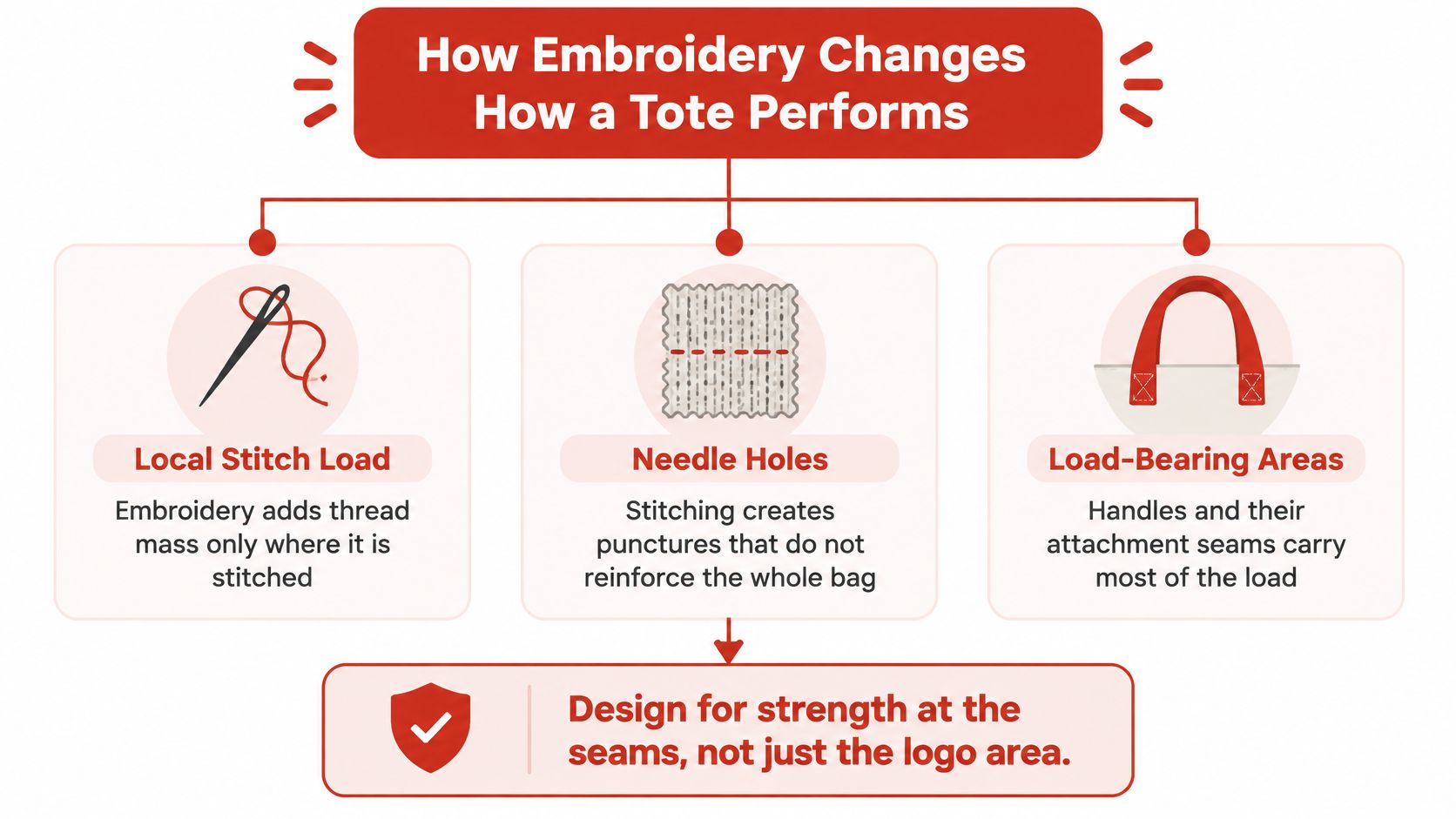
Three ways a decorated tote fails
- Shoulder load and friction. A full tote hangs from two points and rubs against a hip or a bike frame for the whole walk home. Base corners and handle edges abrade first.
- Laundering. Cotton canvas shrinks in a warm wash and the embroidered panel doesn't shrink at the same rate, so lettering distorts and the stitched block ends up standing proud of a puckered surface.
- Wet and sweaty handling. Damp hands, a spilled drink, a bag left on a wet market table. Dyed canvas and dyed thread can both bleed, and a pale handle shows every mark.
Western Australian textile training guidance treats abrasion resistance, dimensional change after washing, tensile strength, seam opening and colourfastness to washing, perspiration, rubbing and light as routine performance tests (WA Department of Training and Workforce Development). Those categories map almost one to one onto the three failures above, which is why the decorated panel is the thing to examine.
Say a heavy canvas tote carries a dense full-colour logo across the front. The stitched area stiffens like a patch of thin card. Fold the bag and the crease forms along the edge of the stitching rather than through it, concentrating stress at the needle line. On the same bag, the handle join usually fails before the body does, at the rivet or the stitched box where the webbing meets the panel.
Three checks you can run on a sample
- Fold the decorated panel and press it flat. Look for a crease that follows the logo edge, and for fabric that stays rippled after you let go.
- Pull each handle hard, at the join, in both directions. A sound join holds without the webbing shifting, the topstitching opening or the rivet tearing the cloth.
- Wash the sample to its care instructions, dry it flat, then measure the logo against the original. Width and height should still match, with no broken thread.
A good sample comes back with a flat logo, handles that don't shift in the join, and no thread breakage. If two of the three go wrong, the fabric isn't heavy enough for the design or the stitch plan is too dense for the fabric.
Test Specifications Worth Asking Your Supplier For
A brief that asks for "heavy duty" or "premium canvas" gives you nothing to compare between suppliers. A NATA-listed Australian textile laboratory lists the methods that make durability claims technically comparable, and they transfer straight into a tote specification.
The tests to put in your brief
| Test | Standard | What it reveals |
|---|---|---|
| Abrasion resistance (Martindale) | AS 2001.2.25 series; ISO 12947 | Base and handle wear from repeated friction |
| Tear resistance | AS 2001.2.10; ISO 13937-2 | Tearing around stitched logos and pockets |
| Wide-strip tensile strength | AS 2001.2.3.1; ISO 13934-1 | Handle and seam load capacity |
| Spray water resistance | AS 2001.2.16; ISO 4920 | Performance in wet weather and spills |
| Colourfastness to light | AS 2001.4 series colourfastness methods; ask for the rating | Fading from outdoor sun exposure |
| Colourfastness to wet rubbing | AS 2001.4 series colourfastness methods; ask for the rating | Colour transfer from damp hands |
Each line answers a question you'd otherwise be guessing at. Tear resistance matters most around a stitched logo or a pocket, because needle perforations create a line of weakness that a plain fabric test never sees. Wide-strip tensile strength is the honest measure of whether a handle and its seam will carry a loaded bag or open up on a cold morning.
Colourfastness needs two lines rather than one. Light exposure fades a logo on a bag that lives in a car window or sits on a market table all summer. Wet rubbing lifts colour onto a damp hand or a pale shirt. Different causes, different failures, so specify each and ask for the rating, not just the method name.
Ask for the method, the specimen condition and the result on every line. A supplier who can name both knows what they're selling; one who answers with adjectives doesn't. That discipline is the same one behind good manufacturing specification in any category, and Genpire's DFM guide for consumer brands is a useful primer on writing a brief a factory can be held to.
The final step is the one most buyers skip. Test an embroidered sample against an undecorated control after abrasion, washing and load testing, then compare: puckering, thread breakage, seam opening, handle separation and colour transfer. Approve the run on that comparison, not on a photograph. Our in-house custom embroidery services cover digitising through to the finished decorated panel, which is exactly where these checks belong.
Design Choices That Stay Sharp on Fabric
The logo has to fit what the cloth can hold. A design that reads beautifully on a business card can collapse at 200 mm on canvas, because the digitiser has to turn hairline strokes into satin columns and small text into a thicket of thread.
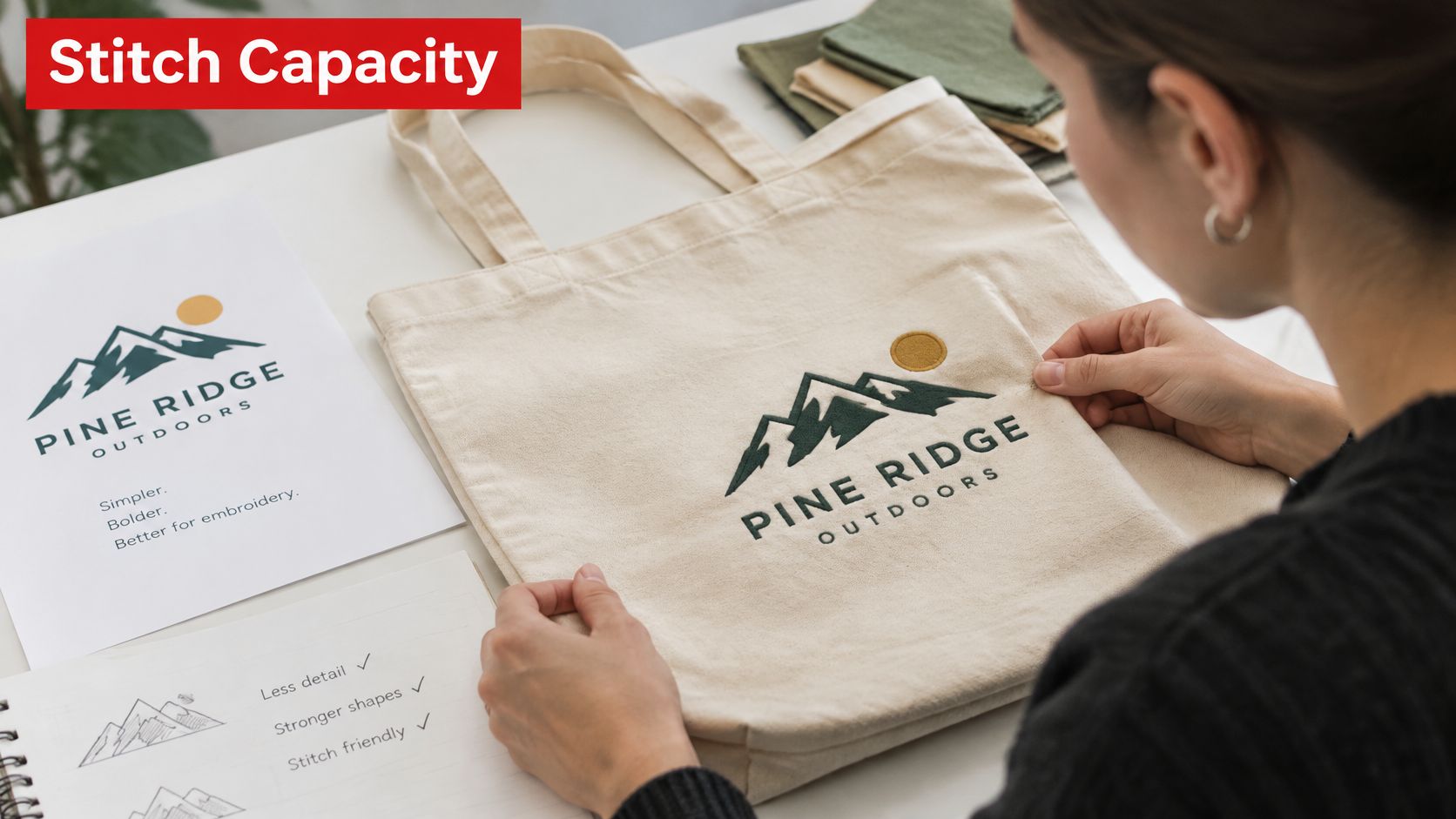
Limits that hold up in production
- Lettering height. Keep text above roughly 6 mm high. Below that, counters fill in and thin strokes disappear under thread.
- Colour count. Three or four colours give a crisp, legible mark on canvas. Each extra colour adds thread changes and a heavier stitch block over the same area.
- Placement. Keep the design inside the front panel imprint area, clear of side seams, handle joins and the top hem. Stitching that crosses a seam fights the structure underneath it.
- Contrast. Light thread on dark canvas reads at a distance. Mid-tone on mid-tone doesn't, and stitch density won't fix it.
A three-colour logo around 200 mm wide reads clearly on a 380 mm wide tote with room either side. A detailed crest with a motto underneath needs a bigger bag or a simplified version, because the motto, not the crest, is what fails first.
Names, numbers and larger designs aren't available on every product, so confirm the option on your chosen bag before the artwork is finalised. Teams often want an embroidered name on a bag that only takes a logo, and the fix is usually a patch rather than a redesign.
The step that prevents an expensive reprint happens before production starts. We stitch the design onto a fabric swatch and send a photo of the real embroidery before the run begins.
Check that photo for edge definition, colour blocks and text against the artwork. A stitch-out on a swatch is the closest look you'll get at 500 identical bags, and it's far cheaper to change a letterform there than after the run. If you're preparing files, the artwork submission guide covers the formats and details that speed up digitising.
Branded Uses That Put the Bag to Work
Sort the uses by how long the bag stays in circulation, because that's what you're buying. Unit price tells you what a bag costs once. Service life tells you what each brand impression costs.
Trade shows and conferences. A mid-weight canvas tote, around 10 to 12 oz, with the logo on the front and a clean back for a booth message or a QR panel. Realistic life is the walk home, then the weekly shop, then the cupboard. A bag that survives the first wash stays in the rotation.
Corporate onboarding kits. A sturdy cotton tote with the company name embroidered goes home with a new starter and turns up at the supermarket for years. This is the strongest case for paying for stitching over printing, because the bag keeps doing quiet brand work long after the program that funded it has ended.
For onboarding kits, choose a campaign-neutral mark. A bag tied to a dated slogan is dead stock the month the campaign ends.
Schools and universities. Durable totes for student and community programs, where a bag that survives daily use matters more than the lowest unit price. Back-to-school timing is unforgiving, so confirm lead time against term dates rather than assuming.
Sports and community teams. Team name and colours on the bag, with a patch where the design has to change between seasons. Embroidered names, numbers and logos can sit alongside Velcro or iron-on patches, which lets a club refresh a season without replacing every bag.
Retail and market stalls. Heavy canvas, because these bags take repeated loading and washing by people who didn't pay for them.
A regional market stall that hands out thin non-woven totes loses the bag within a month: the handle splits, the customer stops carrying it, and the brand stops travelling. The same stall on heavy canvas with a two-colour mark gets its bags brought back week after week, sometimes with a competitor's tote inside. The bag stops being a flyer and becomes a piece of equipment people chose to keep.
If you're weighing up formats across a whole program, the branded merchandise for business pages show how totes sit alongside other items in the same campaign.
Planning Surplus Totes Out of Landfill
Australia generated about 860 kilotonnes of textile, leather and rubber waste in 2022-23, equivalent to 33 kilograms per person, up from about 780 kilotonnes in 2016-17, according to the Department of Climate Change, Energy, the Environment and Water. Around 70% came from commercial and industrial sources, and the estimated recycling rate for the category was 5%, most of it carpet rather than ordinary textile products.
The consumption side is worse. Australians consume about 39 kg of textiles per person a year, 2.5 times the global average, and the Productivity Commission's circular economy interim report identifies high costs and limited practical information as barriers to change. On the clothing side, an estimated 1.4 billion items were sold nationally in 2023 with about 200,000 tonnes sent to landfill, which sits behind the 2025 government-supported voluntary product-stewardship program for clothing textiles set out in the product stewardship instrument for clothing textiles.
None of that makes a reusable bag a bad purchase. It makes the reusable label a weak proof of anything on its own.
The contrarian case: a larger eco-labelled order can create more waste than a smaller conventional one if demand is uncertain and the logo ages out of use within a year.
The routine that keeps surplus out of the bin is unglamorous and effective.
- Define the bag's job and expected lifespan. A conference giveaway and a staff onboarding tote need different fabric, and admitting that early prevents over-ordering.
- Pick from the material comparison, not from the cheapest cell. Weight and weave decide whether the bag survives long enough to justify being made.
- Send the supplier brief with test methods and ask for results. Method, specimen condition and result, on every line.
- Forecast quantity against campaign dates and recipients. Count the people who will carry the bag, then add a small buffer rather than a large one.
- Approve a stitched swatch photo before production. One look at the embroidery is cheaper than a reprint.
- Ask for minimum order quantity, lead time and unit price in writing. Those three numbers decide whether staging the order is affordable.
- Document a reuse destination before you buy. Staff, schools, community programs or internal onboarding, named in advance, and separate genuine recovery from donation, because donated textiles can still be exported or landfilled.
Embroidered orders ship Australia-wide with fast, tracked shipping, so splitting a campaign into two staged runs is practical rather than painful. If you're weighing up where surplus could go, our eco products section is a reasonable starting point for lower-impact options across a whole campaign.
Tell us the bag's use, the size you have in mind and the quantity you're considering, and we'll turn it into a brief: material options, stitch limits for your artwork and the tests worth asking for on that specific bag.
A well-specified embroidered tote is one of the few promotional items people keep using long after they've forgotten where it came from, and we'd rather help you get that right than sell you a bigger order than you need. Merchandise runs in-house embroidery, from digitising through to a photo of the stitch-out on a swatch, so you can see the logo on fabric before the run begins. Send your artwork, the bag's intended use and your quantity to Simply Merchandise and we'll come back with material options and a specification you can compare like for like.

