



Logo polo shirts are a whole lot more than just comfortable workwear. Think of them as a wearable business card—a simple, effective tool that gets your company name out there, brings your team together, and maintains a sharp, professional look no matter where your staff are.
Why Logo Polos Are a Branding Powerhouse
When you get your logo onto a well-designed polo shirt, you instantly turn your team into brand ambassadors. Every time they step out—whether it's for a client meeting, a trade show, or even just their daily commute—they're creating a low-key marketing moment. This consistent visual presence is gold for building brand recognition and creating a sense of trust with your audience.
To really get why this works, it helps to understand the difference between branding vs logo. Your logo is the symbol, but your brand is the entire feeling and perception people have of your company. Logo polos are where those two ideas click together perfectly, making a simple graphic a real-world symbol of your brand's commitment to quality.
Fostering Unity and Professionalism
Getting the whole team into matching logo polo shirts does something brilliant for morale—it creates an instant sense of belonging and unity. That shared identity helps build team spirit by making everyone feel like they’re part of one cohesive group. It's a cornerstone strategy when building a solid collection of branded merchandise for business that genuinely strengthens your company culture.
This infographic breaks down how a unified look can directly influence the way people see your brand.
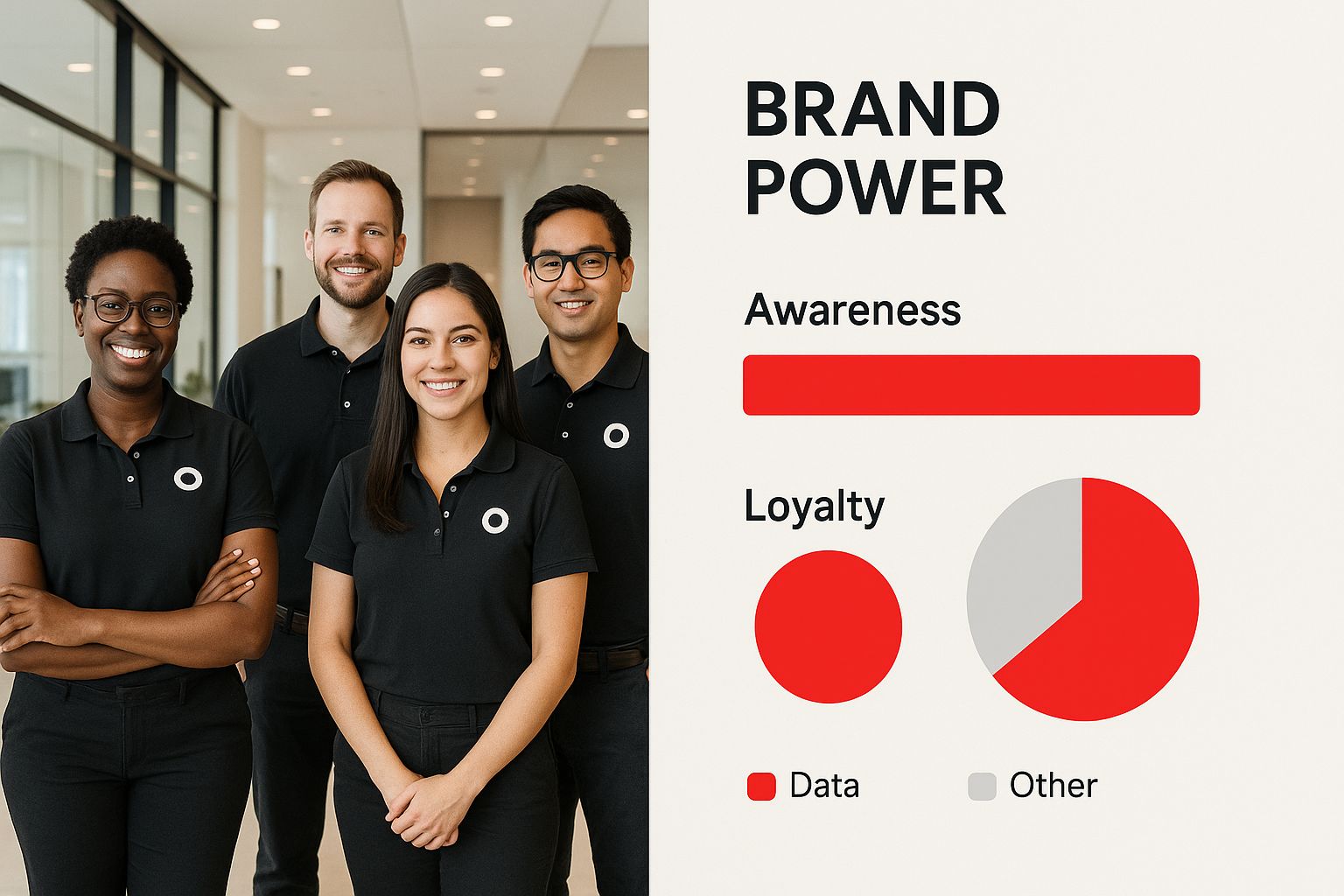
As you can see, a polished and consistent appearance is a fundamental piece of the puzzle when it comes to establishing credibility and brand power in any professional environment.
Meeting Modern Workplace Demands
Here in Australia, we're seeing a real surge in the popularity of logo polo shirts, and it makes perfect sense. With so many workplaces embracing a smart casual dress code and more flexible arrangements, polos hit that sweet spot between comfort and professionalism.
The numbers back this up, too. The Australian polo shirt market is part of a much larger Asia Pacific industry that’s tipped to grow from USD 881.8 million to over USD 1.1 billion by 2025. This tells us that more and more businesses are realising these shirts are the perfect uniform for today's teams. You can read more research on the polo shirt market trends to learn more.
Choosing the Right Fabric for Your Polos
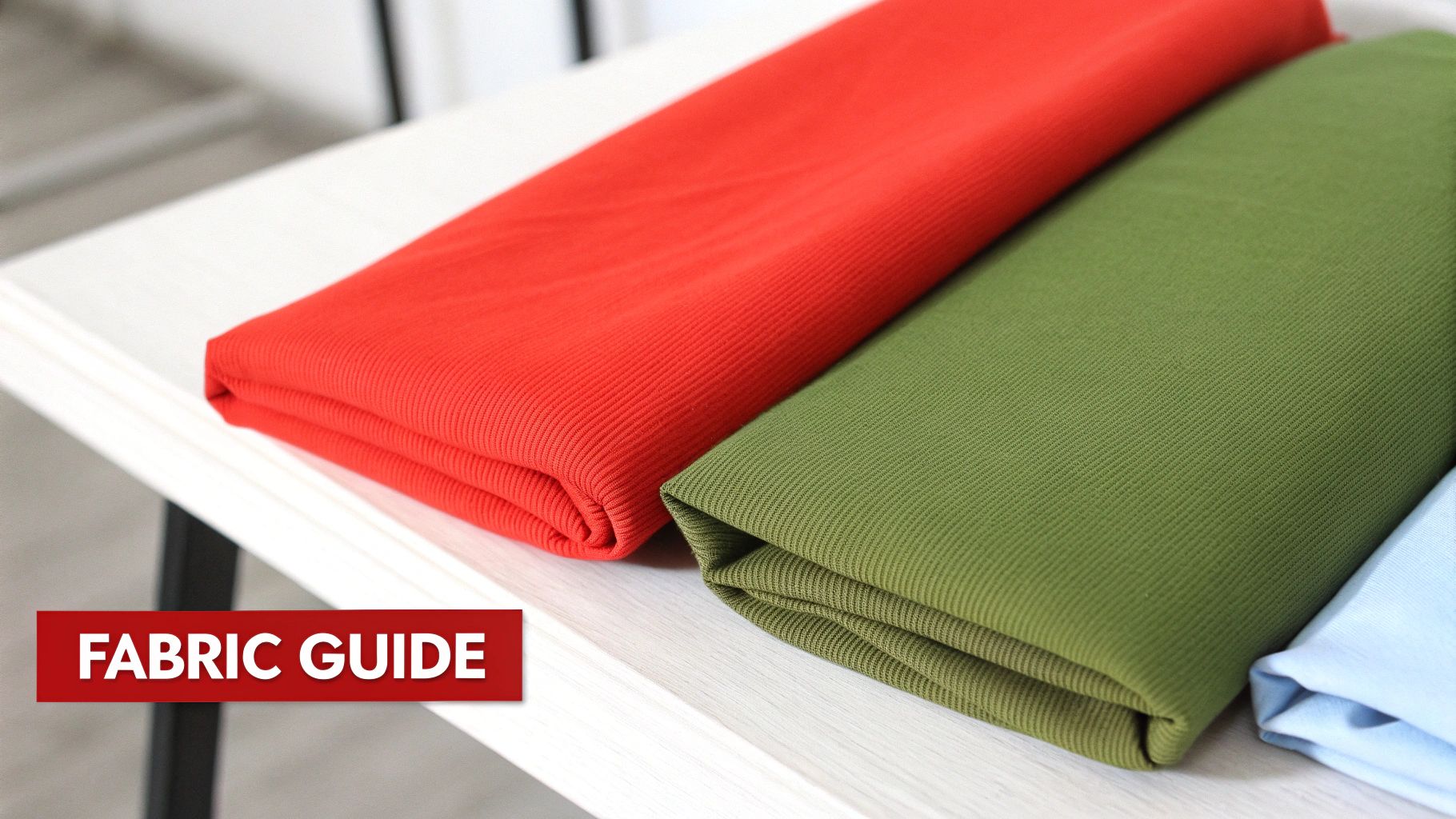
The look, feel, and performance of your logo polo shirts really come down to one thing: the fabric. Picking the right material is a bit like choosing the right tyres for a car; it has to be a perfect match for the conditions and the job you need it to do. A quality fabric doesn't just feel better to wear—it also makes your branding look sharper.
Your choice has a direct impact on comfort, durability, and the professional image your team puts forward. Think about where your team spends their day. Are they out in the Aussie heat, or are they presenting in an air-conditioned boardroom? The answer will point you straight to the ideal material for your branded gear.
Classic Comfort With 100% Cotton
If you're after timeless comfort and a classic, professional look, 100% cotton is the traditional favourite. It’s famous for its softness and breathability, which makes it perfect for office settings, executive teams, and more relaxed corporate events. There's a premium feel to cotton that says a lot about your brand's commitment to quality.
Just remember, cotton tends to absorb moisture instead of wicking it away. That makes it less ideal for physically active roles or humid climates where staying dry is the main game.
Durability and Performance With Polyester
When your team is always on the go, polyester is the undisputed champion. This synthetic fabric is built for performance, with excellent moisture-wicking properties that draw sweat away from the skin, keeping the wearer cool and comfortable. It’s the perfect choice for trade shows, outdoor events, or any job that involves a bit of hard yakka.
Polyester is also incredibly tough, resists shrinking, and holds its colour brilliantly, wash after wash. For a logo polo that needs to look vibrant and last through tough workdays, polyester is a smart investment.
Key Takeaway: The choice between cotton and polyester often boils down to a simple trade-off: classic, breathable comfort (cotton) versus modern, moisture-wicking durability (polyester).
For a really detailed breakdown of how these two stack up, this complete fabric guide on cotton vs polyester has some great insights to help you make the call.
The Best of Both Worlds: Poly-Cotton Blends
Can't quite choose between the softness of cotton and the sheer resilience of polyester? You don't have to. A poly-cotton blend gives you a fantastic, balanced solution. These hybrid fabrics bring together the natural comfort of cotton with the durability, wrinkle-resistance, and moisture-wicking power of polyester.
This "best of both worlds" approach makes blends an incredibly popular and practical option for all sorts of uniforms. They feel great to wear and are a breeze to look after, ensuring your team always looks polished with minimal effort. Finding the right blend is a huge part of exploring different https://simplymerchandise.com.au/pages/clothing-categories.
To make it even easier to weigh up your options, here’s a quick comparison of the three main fabric choices for your logo polos.
Polo Shirt Fabric Comparison
This table breaks down the most common polo shirt fabrics, helping you choose the best fit based on comfort, durability, and how you plan to use them.
Ultimately, whether you lean towards the natural feel of cotton, the hardworking nature of polyester, or the balanced performance of a blend, the right fabric will ensure your team looks and feels fantastic.
Embroidery vs Printing: Which Is Best for Your Logo?
Choosing how to get your logo onto a polo shirt is a bigger decision than you might think. It’s the final step that really defines the garment’s entire look, feel, and even its perceived value. The two main players in this game are embroidery and printing, and each brings something different to the table. The best choice for you really just boils down to what you’re trying to achieve.
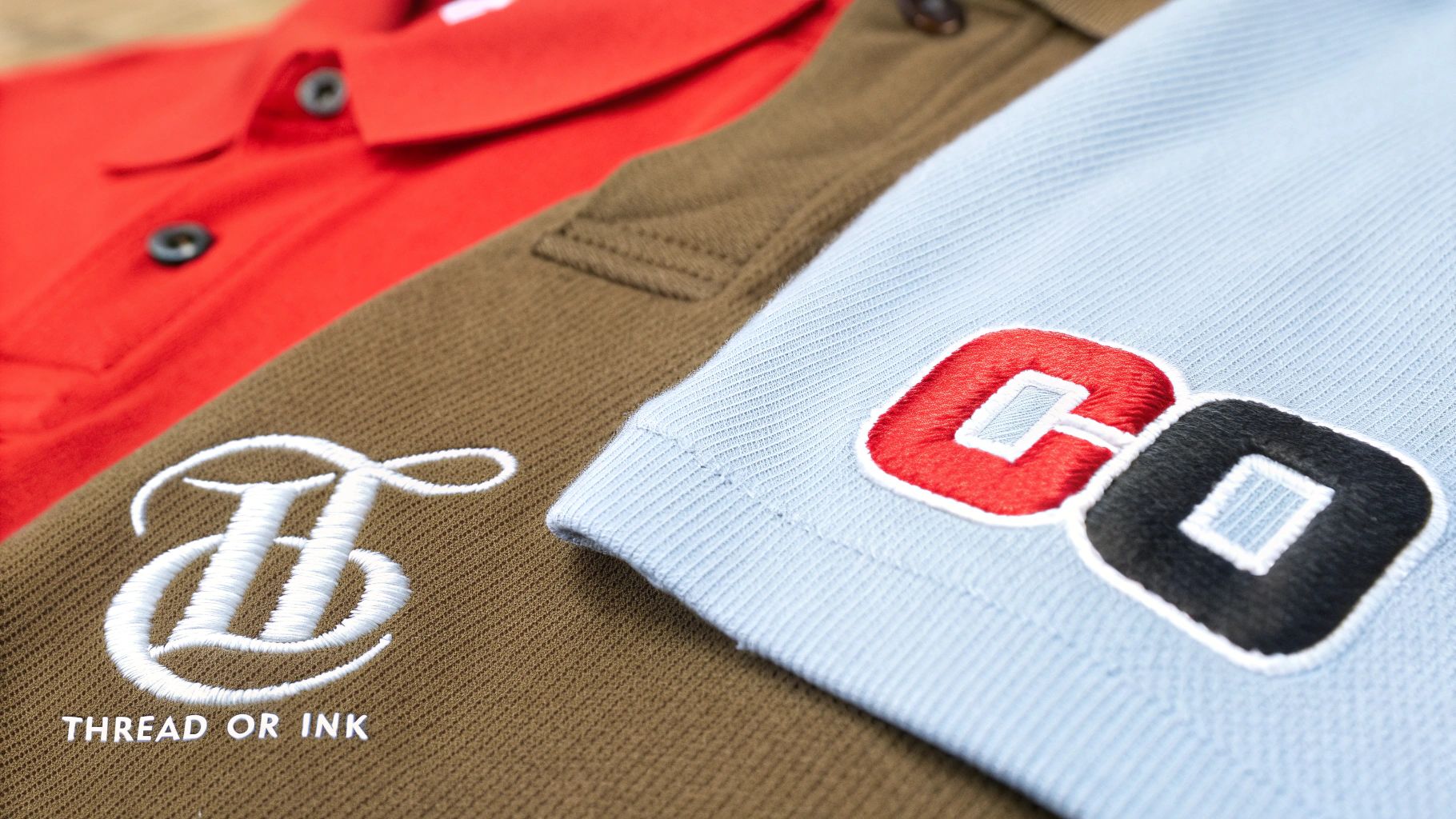
Let’s break it down with an analogy. Think of embroidery as painting with thread. A needle and thread stitch your design directly into the fabric, creating a textured, almost three-dimensional finish. This process gives your logo a real sense of weight and quality, lending a premium, professional feel to your polo shirts that’s designed to last.
Then you have printing, which is more like stencilling with ink. Methods like screen printing or modern digital printing apply ink right onto the surface of the fabric. This is your go-to when you need to create bold, colourful graphics, capture fine details, or splash a large design across the shirt that needs to make an impact.
When to Choose Embroidery
Embroidery is the clear winner when you’re aiming for an image of quality, durability, and professionalism. The classic, high-end look of a stitched design is something people instinctively associate with established, trustworthy brands.
You’ll want to lean towards embroidery for:
- Corporate Uniforms: It delivers a sophisticated and long-lasting finish that can handle the rigours of daily wear.
- Executive Apparel: That premium feel of a stitched logo is perfectly suited for high-level branding.
- Thicker Fabrics: Embroidery works brilliantly on materials like pique knit or heavier cottons that can support the dense stitching without puckering.
- Simple, Bold Logos: Designs with solid colours and clean, distinct lines translate beautifully into thread.
But it’s not perfect for everything. Embroidery can struggle with designs that have subtle colour gradients or photorealistic elements. Thread just can’t replicate those fine tonal shifts with the same precision as ink.
When Printing Is the Better Option
Printing, on the other hand, offers incredible versatility, especially when you’re working with complex or highly colourful artwork. It’s the superior choice when your design needs to be sharp, detailed, or cover a large part of the shirt.
Printing is your best bet when:
- Your Logo is Complex: If your design features gradients, tiny text, or intricate details, printing will capture every nuance with crisp precision.
- You Need Vibrant Colours: Ink can hit a level of brightness and colour accuracy that thread often can't quite match.
- You're Using Lightweight Fabrics: Printing sits on top of the material, so it won’t pull or weigh down thinner fabrics like polyester, ensuring the garment hangs properly.
- You Have a Large Design: For a huge logo on the back of a shirt or any large graphic, printing is a much more practical and cost-effective solution.
Pro Tip: Your choice isn't just about the look—it's also about longevity. A high-quality embroidered logo can easily outlast the polo shirt itself. The lifespan of a print, however, really depends on the specific printing technique used and how the garment is cared for over time.
Making the Final Decision
So, how do you make the call? It really comes down to a balance of four things: your logo’s complexity, the polo’s fabric, your budget, and the specific image you want your brand to project. A simple, classic crest for a law firm just screams embroidery. A vibrant, multi-coloured design for a new tech startup? That's a perfect job for printing.
Getting your head around these differences is the key to making sure your finished polo shirts look exactly how you imagined them. If you want to get into the nitty-gritty, you can explore the various custom printing options to see the technical side of each method. Arming yourself with that knowledge will help you make a confident choice that aligns perfectly with your brand and guarantees a flawless result.
How to Prepare Your Artwork for Flawless Results
A brilliant logo polo shirt starts long before a needle or a drop of ink ever touches the fabric. The real secret to a flawless, professional finish is getting the artwork right from the very beginning. Nail this step, and you'll save yourself from costly mistakes and time-consuming revisions, ensuring the final product is exactly what you envisioned.
Think of your artwork file like a recipe for a baker. Give them a blurry, low-resolution photo of a cake, and you’ll get a mess. But give them a precise, detailed recipe, and they can create a perfect replica every single time, no matter how big or small.
Vector vs. Raster: The Recipe and the Photo
This brings us to the most crucial element: your file type. For any kind of branding, your logo should ideally be in a vector format. The most common types are .AI (Adobe Illustrator), .EPS, or .SVG files.
A vector file is the "recipe" in our analogy. It's built from mathematical equations, not pixels. This means it can be scaled to any size—from a tiny logo on a chest pocket to a giant print on a banner—without losing a single shred of quality or sharpness.
On the other hand, you have raster files like .JPG, .PNG, or .GIF. These are the "photos." They're made up of a fixed grid of pixels. While they might look perfectly fine on your screen, they become blurry and jagged when you try to make them bigger. Submitting a raster file for your polo shirts is one of the most common pitfalls, and it almost always leads to a fuzzy, unprofessional-looking result.
Key Takeaway: Always, always provide your logo in a vector format (.AI, .EPS, .SVG). This gives the production team the scalable "recipe" they need to create a perfectly crisp and clean logo, whether it's embroidered or printed.
Ensuring Brand Consistency
Beyond just the file type, a few other details are vital for getting your branding spot-on. Consistency is everything, so paying close attention to your colours and logo placement is a must.
Here's what to lock down:
- Provide Pantone Colours: Don't just say "our brand blue." Use the Pantone Matching System (PMS) to specify the exact colour codes. Every computer screen shows colours differently, but a PMS code is a universal standard that guarantees your signature blue or red looks identical on every single polo we produce.
- Define Logo Placement: Be specific about where you want the logo. The left chest is the classic choice, but the sleeves or the back yoke (just below the collar) are also great options. Letting us know your preference removes any guesswork.
- Confirm Logo Size: Tell us how big you want the final logo to be. A standard left chest logo is usually between 8 and 10 centimetres wide, but it’s always best to provide precise dimensions so the scale feels right on the garment.
Provide Pantone Colours: Don't just say "our brand blue." Use the Pantone Matching System (PMS) to specify the exact colour codes. Every computer screen shows colours differently, but a PMS code is a universal standard that guarantees your signature blue or red looks identical on every single polo we produce.
Define Logo Placement: Be specific about where you want the logo. The left chest is the classic choice, but the sleeves or the back yoke (just below the collar) are also great options. Letting us know your preference removes any guesswork.
Confirm Logo Size: Tell us how big you want the final logo to be. A standard left chest logo is usually between 8 and 10 centimetres wide, but it’s always best to provide precise dimensions so the scale feels right on the garment.
Getting these details sorted from the start makes the whole process run like a dream. For a bit more help, take a look at our simple guide with artwork submission tips for beginners. Following these steps is the best way to turn a great design into an even better logo polo shirt.
A Step-by-Step Guide to Ordering Your Custom Polos
Ordering custom logo polos for the first time can feel a bit daunting, but it's actually a pretty simple process once you know the steps. Breaking it down makes the whole thing manageable and stress-free. Think of it as a clear path from your initial idea to getting that perfect box of branded apparel delivered.
It all starts with getting your ideas together. The first thing you'll do is figure out your vision—what are these polos for? Who's wearing them? What kind of vibe are you going for? Nailing this down sets the stage for everything else.
The Quoting and Approval Process
With a solid idea in mind, the first real step is getting a quote. This isn't just a price tag; it's a complete summary of your project. A good supplier will give you a detailed breakdown covering the cost of the shirts themselves, the branding method (like embroidery or printing), and any setup fees involved.
This is also the best time to ask about bulk pricing. As a rule of thumb, the more polo shirts you order, the cheaper each one becomes. This is a huge help for staying on budget, especially if you're outfitting a big team or prepping for a major event.
Crucial Checkpoint: Never, ever let production start without approving a digital mock-up first. This is your visual proof, showing exactly how your logo will look on the polo—its size, colours, and placement. Look it over with a fine-tooth comb, because this is your final chance to request changes before it's too late.
Once you give the green light on that mock-up, the magic happens. Your order gets slotted into the production schedule, and your logo is skilfully applied to each and every shirt.
From Production to Your Doorstep
Getting a handle on the timeline is key for your own planning. Production times can vary based on how complex your design is and the branding technique used, but your supplier should be able to give you a clear estimate once you've signed off on the mock-up. Always build this timeframe into your schedule, especially if you're working towards a firm event deadline.
After the production run is finished, your order is carefully packed up and readied for dispatch. Any reputable supplier will offer reliable shipping across Australia, making sure your brand-new team uniforms get to you safely and on schedule.
To get the ball rolling, you can easily request a quote online to get a clear idea of the investment.
Here are a few final tips to make sure it all goes off without a hitch:
- Be Specific: The more detail you can provide upfront about what you need, the better.
- Ask Anything: If you're unsure about timelines, costs, or anything else, don't be afraid to ask.
- Plan Ahead: Give yourself plenty of time. Starting the process well before you need the polos will save you a world of last-minute stress.
Follow these steps, and you’ll be able to manage your order with confidence, knowing the final product will be a perfect reflection of your brand.
Care Tips to Maximise the Life of Your Polos
Think of your new logo polo shirts as a smart investment in your brand's image. Just like any good investment, a little bit of care goes a long way in protecting its value. Following a few simple rules will keep your polos looking sharp and professional, ensuring they represent your business well for years to come.
The single most important habit to get into? Always turn your polo shirts inside out before they go into the wash. This one simple step creates a protective barrier for your logo, drastically reducing the friction that causes embroidery to fray or prints to crack and fade.
Washing and Drying Best Practices
When it comes to the actual wash cycle, a gentle approach is always best. You don't need harsh chemicals or high heat to get a great clean, and being gentle will make a huge difference to the lifespan of your apparel.
- Stick to Cold Water: Always opt for a cold wash. Hot water is the enemy of vibrant colours and can cause unwanted shrinking, both in the fabric and sometimes in the logo's backing material.
- Use a Mild Detergent: Harsh detergents are tough on fabric fibres and can be particularly damaging to printed logos, causing them to break down over time. A quality, mild detergent is all you need.
- Say No to High Heat: High heat from a dryer is one of the fastest ways to ruin a good polo. It can shrink the garment, melt delicate embroidery threads, and make printed designs peel right off.
The gold standard for drying is to hang them up to air-dry. If you're short on time and must use a machine, be sure to select the lowest heat setting available or a "tumble-dry low" cycle.
By making these small adjustments to your laundry routine, you'll ensure your team's polos stay looking as crisp and impressive as the day they arrived.
Got Questions About Logo Polo Shirts? We've Got Answers
Ordering custom apparel for the first time can bring up a few last-minute questions. Getting those sorted out is the key to planning your budget, timeline, and inventory without any guesswork. Let's walk through some of the things people ask us most often about ordering logo polo shirts.
What's the Minimum Number of Polos I Can Order?
This is usually the first question on everyone's mind: what's the minimum order quantity, or MOQ? The MOQ is simply the smallest number of items you can order in one go. For most custom logo polo shirts, you're typically looking at a minimum of around 10 to 20 units.
Why is there a minimum? Well, a lot of work goes into setting up the embroidery machines or screen-printing equipment for a custom job. Spreading that initial setup cost over a decent number of shirts is what makes it affordable for everyone—it keeps the price per shirt reasonable for you and makes the production process viable for the supplier.
Can I Get a Mix of Different Sizes and Colours?
Absolutely! We know that outfitting a whole team means catering to different people. You can almost always mix and match various sizes, styles, and even colours within the same order, provided the logo design stays consistent across every item.
This is a massive plus for any business. It means you can get exactly what everyone needs and prefers without the headache of placing several different orders. Just double-check the details with your supplier when you're finalising your quote.
How Long Will It Take to Get My Order?
Once you've given the final thumbs-up on your digital proof, the clock starts ticking. You can generally expect your finished logo polo shirts to be ready for dispatch within about 10 to 14 business days. This standard timeframe gives us enough room to handle the branding process with precision and run all the necessary quality checks.
Ready to create logo polo shirts that make your brand look its best? The expert team at Simply Merchandise is here to guide you through every step, from artwork preparation to final delivery. Explore our custom polo options and get a free quote today

