



An estimated 2.4 million Australian women aged 15 and over took part in a sport-related activity at least once a week in 2025, and roughly 853,000 girls aged 0 to 14, or 37%, played organised sport outside school hours every week, per Australian Sports Commission figures published by the Australian Bureau of Statistics.
Every one of those people has a bust measurement, a shoulder breadth and an arm length, and no size label printed on a poly bag knows any of them.
That gap is the whole problem. The varsity jacket women keep for a decade is the most personal thing a team buys together, and it fails in predictable ways: sleeves past the knuckles, a front that won't close over a hoodie, a shaped waist that flatters three players and traps the fourth.
Fit first. Decoration second. Cost third.
What a Women's Varsity Jacket Says About Your Team
A women's varsity jacket is a wool-body or shell jacket with contrasting sleeves, ribbed cuffs and hem, and a chest letter or crest. Simple object. Complicated message.
The message becomes clear when the order goes wrong. A captain hands out last season's jackets and the tallest defender gets one that stops above her wrist bones. The goalkeeper can't close hers over a hoodie. Two teammates swap, and one wears a jacket two sizes large all season because she'd rather be cold than make a fuss.
The test of a team jacket: hand it to the smallest and the tallest player on the roster. If both wear it home, the order worked.
A jacket that sits on the shoulders properly does this to a wearer:
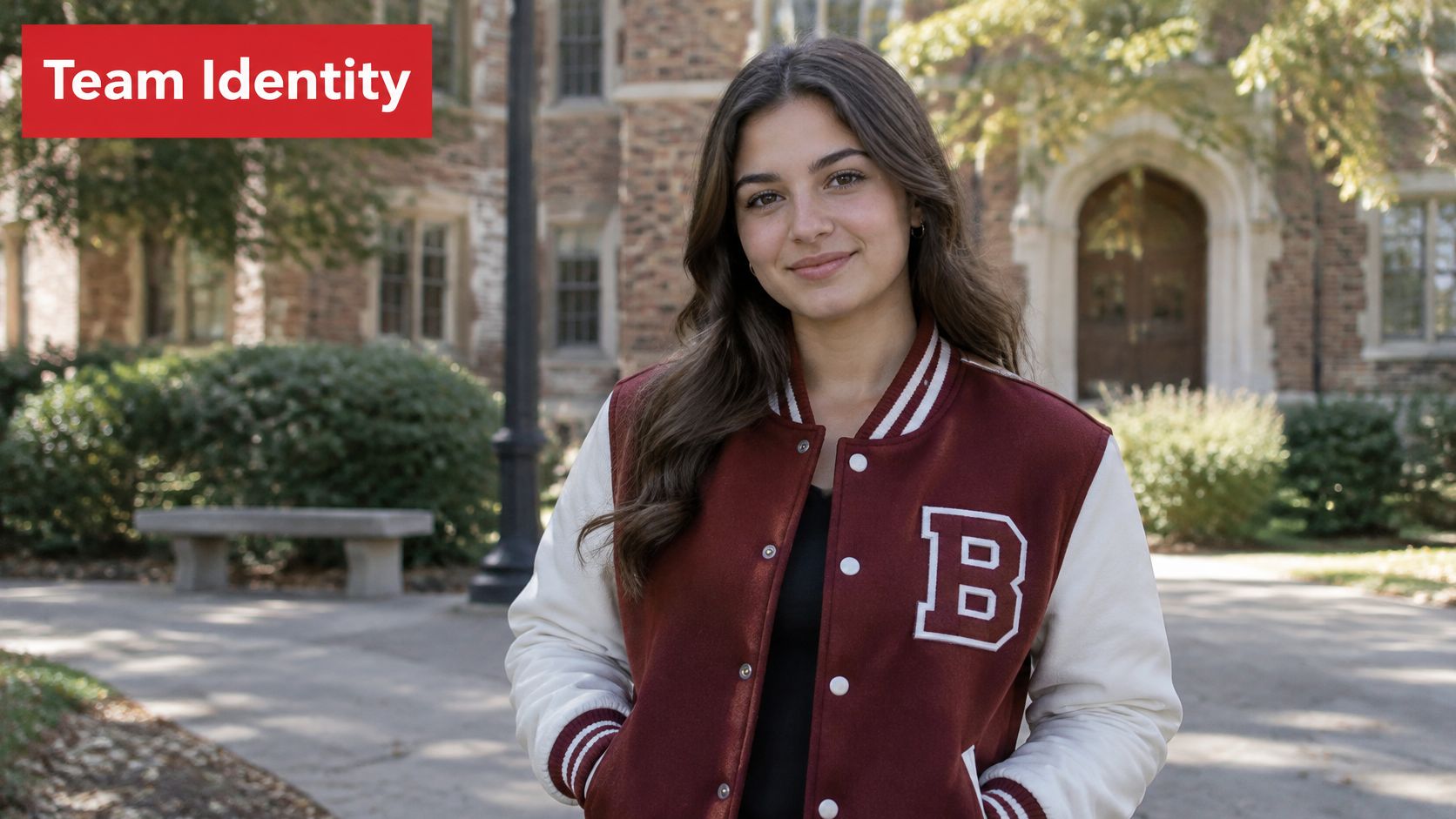
Schools, clubs, universities and community teams don't buy these garments because a catalogue photo looked sharp. They buy them because a player wears hers to the shops on Sunday and gets asked about the grand final. That's belonging with a logo stitched onto it.
Six decisions decide whether the order lands, and they run in sequence: measurement, cut, fabric, decoration, reuse plan, purchase order. Get the first two wrong and no amount of chenille lettering rescues the result. If you're ordering through a school merchandise program, the same sequence applies with crest approval bolted on the front.
Size the whole roster before anyone sketches a sleeve stripe. A jacket that fits every member of the team says the team belongs to all of them, and that's a message worth getting right the first time.
Measure Every Wearer Before You Choose a Size
You need seven numbers per wearer before anyone opens a size chart. Six describe the body. The seventh describes what she'll wear underneath it, which on a jacket with a fixed rib hem changes everything.
Put every teammate on one sheet, one row per person. Keep that sheet with the purchase order so next season's reorder starts from data instead of memory.
| Measurement | How to take it | What it decides |
|---|---|---|
| Bust | Around the fullest point, bra on, arms relaxed | Whether the chest closes comfortably |
| Shoulder breadth | Edge to edge across the back | Whether the shoulders sit flat or pull |
| Upper arm | Around the fullest point, arm bent | Room for a shirt or knit underneath |
| Sleeve length | Shoulder point to wrist, elbow slightly bent | Where the rib cuff sits |
| Waist | Narrowest point of the natural waist | Whether a shaped cut suits or gaps |
| Hip | Fullest point, feet together | Whether the hem sits without riding up |
| Layer allowance | Measure the base layer worn most often | Extra ease over bust and shoulders |
Why the label comes last
Australian apparel sizing isn't governed by a single active body-measurement chart, and recognised garment-training guidance treats women's sizing as its own system keyed to bust, waist, hip, shoulder breadth, arm length and posture, as the MSTFD4018 garment training unit sets out. That's the industry's own description of how a woman's garment gets fitted, and it doesn't begin with XS.
Nominal categories also drift between suppliers. The same M on two charts can describe materially different bust, waist and hip dimensions, so you compare each wearer's figures against the supplier's finished-garment chart and never against the label she wore in a different brand. For a cross-check on how dress sizing conventions shift between systems, Robosize's dress sizing breakdown maps measurements against chart logic and shows where the gaps open.
What rib knit takes away
Rib-knit cuffs and hems don't adjust. A jacket with a tight upper arm can't be let out later, and a fitted women's block with too little bust allowance limits how high a player can raise her arms. That's a change-room annoyance in September and the reason the jacket lives in the bottom of a bag by March.
Practical rule: measure a jacket that already fits its wearer, add ease over the bust and shoulders for the thickest base layer she'll wear, then compare that target against the supplier's chart.
Record each wearer's figures, her usual base layer and the size you approved. Sign it off before the order goes in.
Pick the Cut That Fits Every Team Member
Match the cut to the wearer before you discuss the size label. That single shift solves most of the fit complaints a coach hears in week one.
| Wearer | Check first | Choose |
|---|---|---|
| Petite | Shorter body and sleeve length | Shorter-body cut with the cuff checked at the wrist |
| Plus-size | Bust and upper-arm allowance | Cut sized by chest and arm measurements before the label |
| Tall | Sleeve length | Extended sleeve option |
| Bustier | Bust fit against waist | Bust-first sizing, waist can be looser |
| Gender-diverse or relaxed-fit | Preferred silhouette | Unisex cut in the same colourway |
A women's cut isn't automatically the inclusive one
This assumption deserves a challenge. A shaped waist improves the line for some wearers, restricts movement for others, and excludes anyone who prefers a relaxed, gender-neutral silhouette. Offering a unisex cut in the same colourway isn't a compromise, it's a second option that keeps everyone in team colours and team photographs.
The sizing-up trade-off
Sizing up allows room for a hoodie under a wool-blend body, and it costs you line. Shoulders sit past their natural point, the cuff swallows the hand, and the team photo shows a row of uneven silhouettes. If the roster holds both preferences, order two cuts rather than forcing one on everyone.
The cost of getting this wrong isn't only comfort. Australians consume about 39 kg of textiles per person annually, around 2.5 times the global average, according to the Productivity Commission's circular economy interim report. A jacket nobody wears because the shoulders were wrong is waste you paid for twice.
For the relaxed option, a unisex snap-front style such as the Custom Varsity Jacket pairs with a fitted women's cut without a colour clash: 280gsm polyester jersey body, brushed fleece lining, knitted hem, cuffs and collar in a choice of 19 colours, seven sizes. If the group also needs polos or hoodies in the same palette, work through the full clothing categories before you lock colours.
Request a physical sample in the cut you plan to order. Hand it to two or three wearers over their usual base layer and watch how it behaves when they reach, sit and carry a bag.
Materials That Balance Warmth, Comfort and Durability
Comfort wins, and the evidence is blunt. In a 2025 Victorian survey of 312 girls aged 12 to 18, 91% were active and 90% preferred shorts for school sport, while Victorian research on uniforms that encourage girls to play sport reports that more than 80% of adolescent girls prefer T-shirts and shorts over alternative tops and skirts.
None of that tested a varsity jacket. All of it tells you what the jacket has to do: move with the wearer, layer over a shirt without bunching, and hold its colour and shape through repeated washing.
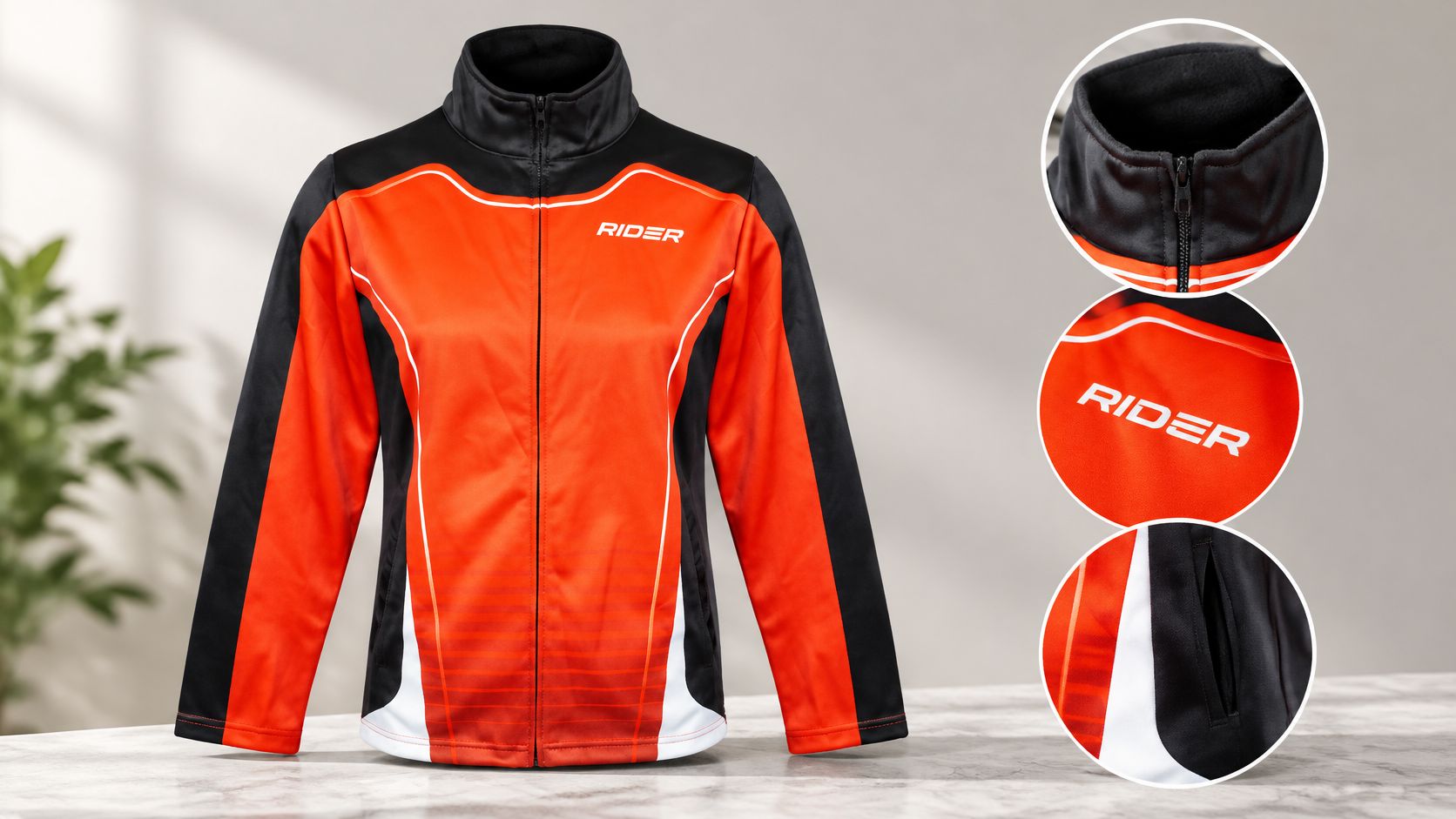
Here's the range you'll be choosing between:
| Material | Warmth | Comfort and stretch | Durability | Best for |
|---|---|---|---|---|
| Wool-blend body | Warm | Moderate stretch | High | Cold climates and the classic look |
| Polyester fleece lining | Warm | Soft and flexible | High | Layering in winter training |
| Poly-cotton twill | Light | Breathable | Moderate | Warm-weather schools and clubs |
| Polyester shell with brushed lining | Medium | Flexible and light | High | Mixed training and everyday wear |
| Padded or quilted panel | Very warm | Less flexible | Moderate | Outdoor and courtside teams |
The weight question
Heavier fabric reads as premium on a hanger and feels restrictive at training. Ask for the fabric weight in grams per square metre before you judge a swatch, because "heavyweight" on a spec sheet means nothing until there's a number beside it.
Three questions for any supplier
- Fibre content and weight: what percentage wool, polyester or cotton, and how many gsm in the body, the sleeves and the lining.
- Where the lining sits: whether it covers the body or only the sleeves, since a sleeve-only lining leaves the torso cold on a July morning.
- Wash and colour-fastness: the care instructions and colour-fastness results, because a jacket that fades in ten washes is a one-season purchase.
The Custom Womens Sports Jacket is a regular-fit 280gsm polyester style with a brushed fleece lining, two side pockets and a vertical zippered chest pocket across seven sizes, which suits a club training through winter that wants pockets deep enough for a phone.
Make dark colourways the default and let a team choose a pale one deliberately. Pale jackets show mud, sunscreen and bus-seat grime within a month, and no buyer enjoys explaining that at the end of term.
Ask for the care label before you approve the sample. A jacket the team can wash normally gets worn; one that needs dry cleaning gets left at home.
Customisation Choices That Make the Jacket Yours
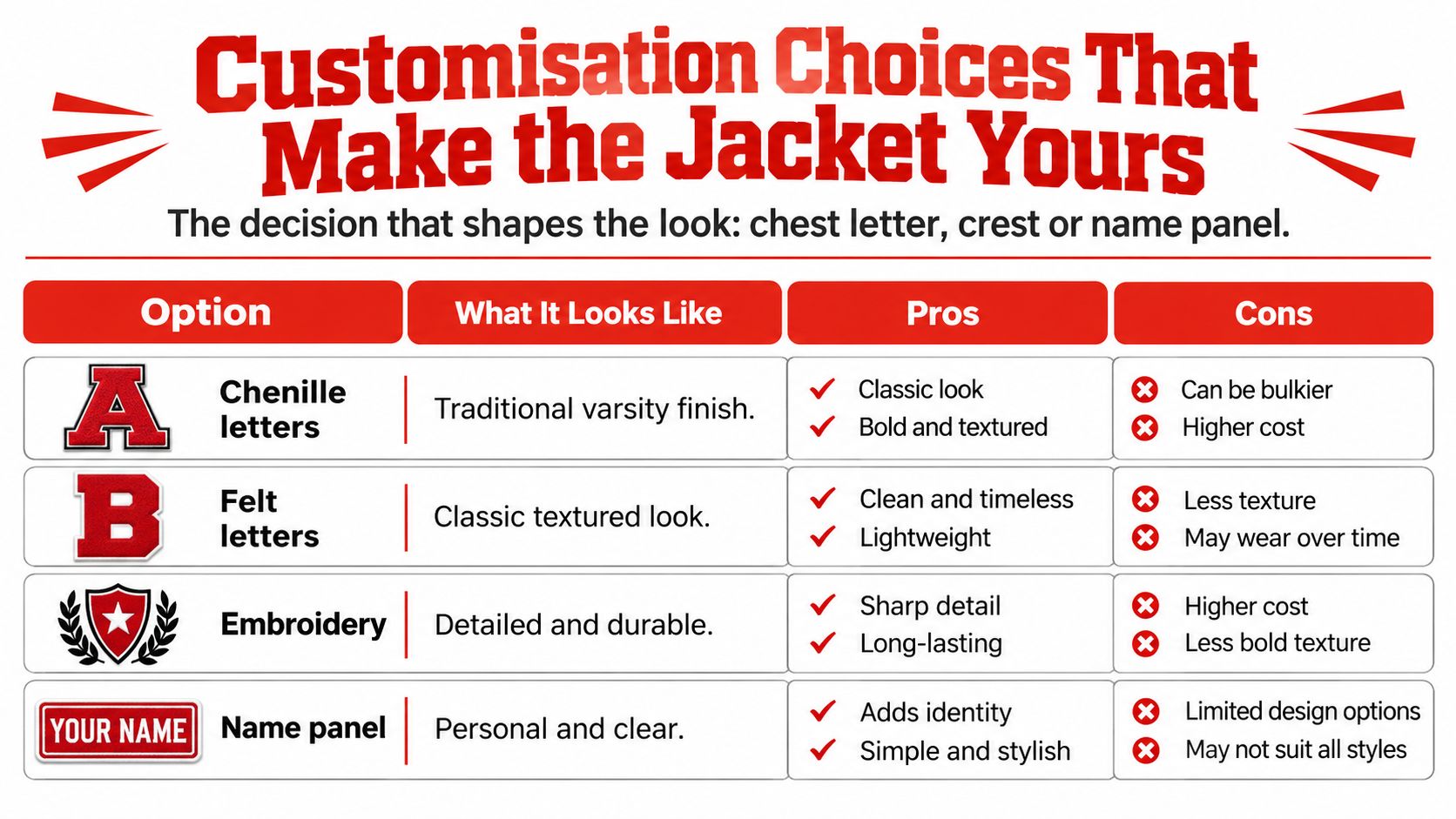
The first decision isn't colour. It's where the identity sits and how removable it needs to be.
The decision that shapes the look: chest letter, crest or name panel.
| Method | Best for | Durability | Detail level |
|---|---|---|---|
| Embroidery | Crests, logos and names on wool and knit | High | Fine stitched detail |
| Chenille or felt letters | Traditional chest letter | High | Bold and raised |
| Iron-on patch | Quick name or number changes | Moderate | Flat and sharp |
| Sew-on patch | Long-wear crests and badges | High | Flat and fixed |
| Velcro patch | Swapping badges between seasons | Moderate | Flat and removable |
| Screen or digital print | Full-colour art on polyester | Moderate | Large graphics |
| Personalised names and numbers | Team identity on the back | Depends on method | Per wearer |
Permanent or removable
Embroidery is the honest choice for a crest that won't change: it survives wash after wash, sits flush on wool and knit, and looks like it was always there. The trade-off is that you live with it, so a sponsor change or a merged club means a new jacket order.
Patches do the opposite. An iron-on number can be updated in a week, a sew-on crest can move to a new jacket, and a Velcro badge swaps between seasons or between wearers. The risk sits with the application: a badly heat-pressed iron-on lifts at one corner after a season and never lies flat again.
Where branding should and shouldn't sit
Keep permanent logos off the lower sleeve. That's the highest-wear zone on any jacket, the part that drags across desks, bags and benches, and the first place a stitch fails. Crest on the left chest, letter or number on the back, removable patch on the sleeve if the sleeve must carry something.
Sign off a one-page layout
Front, back, sleeve, placement measurements, thread colours, and every name spelled out in writing. "Maddie" and "Maddy" come from the same family, and neither wants the wrong one stitched on for three years. Approve that sheet before production starts.
If the crest work is intricate, an in-house custom embroidery service keeps digitising and stitching under one roof, which shortens the loop between the mock-up and the finished jacket. When you brief any supplier, ask which method suits the fabric you've chosen rather than picking a decoration first.
Designing for Reuse Beyond a Single Season
A jacket built around one logo has one season in it. Australian reporting estimates that roughly 2,000 tonnes of school uniforms go to landfill each year, and Green Industries SA reports that about 85% of apparel purchased in Australia goes directly to landfill at end of life, per analysis published in Sustainability.
The cause is rarely carelessness. It's a jacket specified for a campaign, then discarded when the branding, the staff or the sizes change.
Specify the build accordingly. Reinforced seams at the underarm and cuffs. Replaceable or removable badges. Embroidery positioned so the garment can be reused after a campaign rather than sitting on the panel that wears through first. Ask for fibre-content disclosure and a documented take-back, donation or reuse pathway, and treat polyester-heavy and poly-cotton constructions as material streams that need a plan rather than a bin.
Compare expected service life, repairability and reuse options alongside the unit price, not after it. For teams working a circular brief, the eco products range is the starting point rather than an afterthought.
Reuse plan: label each jacket inside the collar with the wearer's size and season, so the next player gets a jacket that fits instead of one that fits nobody.
Order a size mix built from measurements and you cut surplus stock at the same time. Fewer spares, fewer leftovers, less waste.
Run the Bulk Order and Confirm Fit Before You Pay
Good orders are built on one page before they're built in a factory. One row per wearer, with measurements, cut, fabric and decoration recorded against their name, grouped so the supplier can see at a glance who gets what.
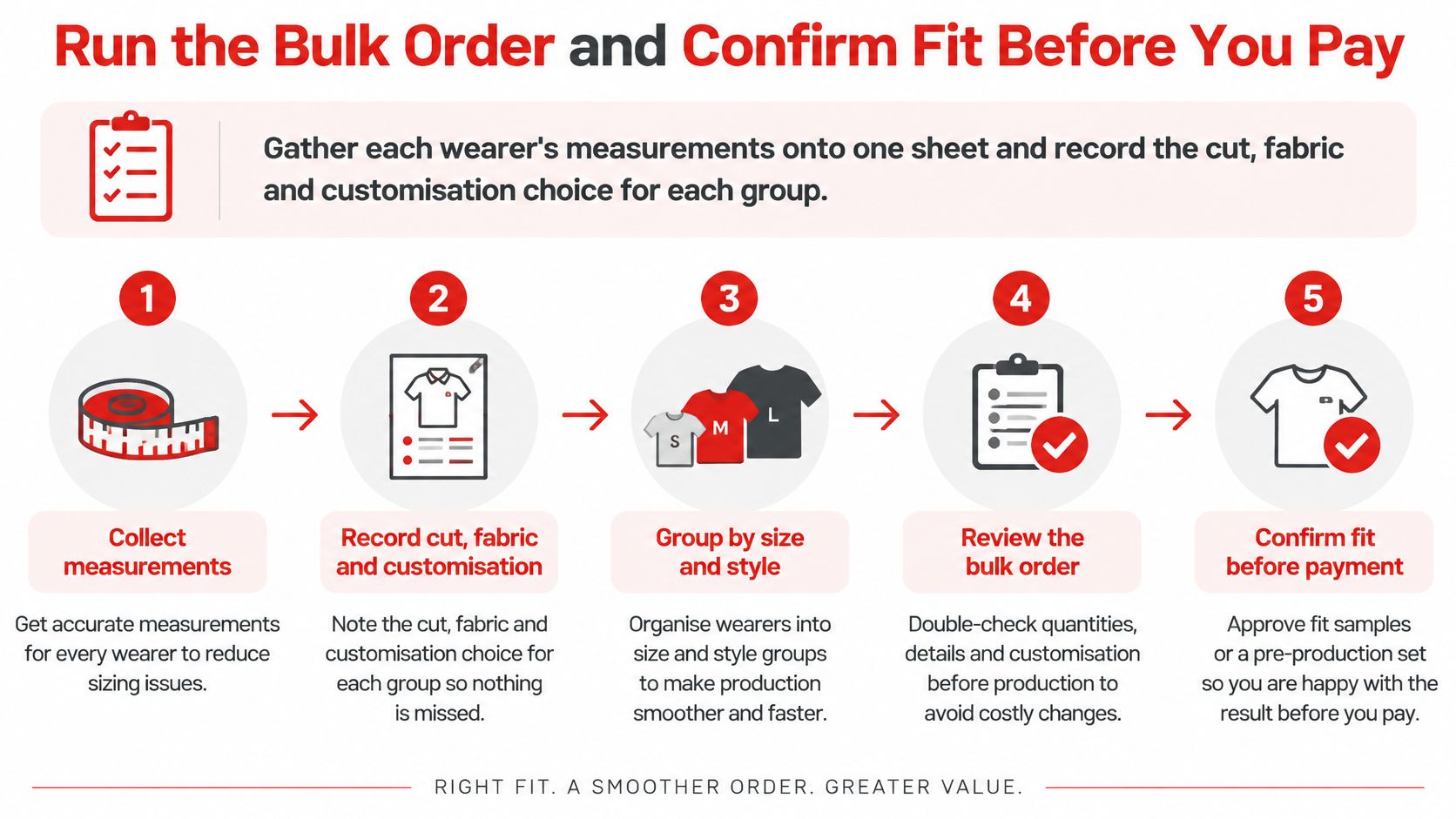
- Set quantity and size mix from the measurement sheet. The usual slip is ordering from one guess about an "average" size, which produces three sizes and a queue of swaps.
- Choose the cut for each group. The slip is one cut for everyone, when two lines on the order form would have fixed it.
- Select fabric and lining for the climate and the training load. The slip is heavy wool for a squad training through a Queensland summer.
- Pick the decoration method and the placement. The slip is permanent branding on the lower sleeve, the spot that wears first.
- Approve a physical sample in the wearer's base layer. The slip is approving a photo, which tells you nothing about bust allowance or cuff position.
- Confirm production lead time and freight before you commit. Air freight is quicker and sea freight can lower the cost on larger runs, and both are decisions with dates attached. See how the bulk order process handles freight so the delivery date is settled before production starts.
- Run a fit check on delivery against the measurement sheet and log any size swaps straight away while the supplier still has your numbers.
What to put on the supplier's list
Ask for the finished-garment chart, the fibre content, the fabric weight in grams per square metre, whether a sample can be sent, the take-back pathway, and the unit price with minimum order quantity. Anyone who hesitates on the first three is telling you something.
We embroider logos on shirts, polos, jackets and vests, and our sports teams get embroidered names, numbers and logos, or Velcro and iron-on patches on jerseys and bags. Custom embroidered patches come as iron-on, sew-on or Velcro, which lets a school hold a permanent crest and a swap-in badge on the same order.
Work backwards from the first match
Start at the date the team needs the jackets and walk backwards: production, freight, sample approval, artwork sign-off, measurement collection. Allow real time for sampling and production rather than hoping the freight lands the week before the season opener, because it won't.
Open the measurement sheet today. Six numbers per player, one base layer noted, one sample requested. That's the whole start.
Merchandise supplies custom team jackets, in-house embroidery and iron-on, sew-on or Velcro patches to schools, clubs and businesses across Australia, with free artwork layouts and free personalisation on names and numbers. Send your measurement sheet through and we'll match each group to the right cut, fabric and decoration method before anything reaches production. Visit Simply Merchandise to start the order.

